
Specs are compiled from manufacturer listings and verified buyer reviews and can change over time — please confirm the key details on the product page before buying.
You see black spots on the leaves of your rose bushes, or a dusty white powder coats the blooms. The difference between a rose that fights off disease and one that loses every leaf often depends on picking the right fungicide at the right time — and matching it to how you want to garden. Best fungicide for roses choices start with knowing which diseases you face and if you want a ready-to-use spray or a concentrate that stretches further.
I’m Rikta — the founder behind Lawn Gear Lab. This guide compares manufacturers’ published specs and patterns in verified customer reviews, so you get each pick’s real strengths and trade-offs.
A ready-to-use spray works for quick rescue on a few pots. A concentrated formula, like one that makes 10 gallons from a single 32-ounce bottle, treats a whole garden on a budget. The right one depends on the disease type, the growth stage, and how much mixing you want to do.
Quick Picks
- Earth’s Ally Disease Control (32 oz) — Best Value Concentrate
- Bonide Rose Rx 3-in-1 Concentrate (16 oz) — Best Overall
- Garden Safe Fungicide3 (1 Gallon / 128 oz) — Big Garden Pick
- Neudorff Copper Soap Fungicide (16 oz RTU) — Gentle Organic Option
- Fertilome Triple Action (32 oz) — Budget-Friendly Classic
How To Choose The Best Fungicide For Roses
A rose fungicide needs to hit the right disease, fit how you apply it, and not burn your plants. Here are the key things to weigh before picking a bottle.
Disease Match: Black Spot, Powdery Mildew, or Rust
Not every fungicide covers every rose disease. Black spot, powdery mildew, and rust are the most common, and you want a product that lists all three on the label. Copper soap and neem oil both work on black spot and powdery mildew, but their effectiveness on rust varies — so check the listed diseases on the product label first.
Ready-to-Use vs Concentrate
Ready-to-use sprays are the grab-and-go option for a few pots or a small bed — you spray directly from the bottle and you are done. Concentrates require you to measure and mix with water (for example, 6 tablespoons per gallon of water), but a single bottle makes many gallons. If you have more than a handful of roses, the concentrate is more economical per treatment.
3-in-1 vs Dedicated Fungicide
A 3-in-1 product combines a fungicide, an insecticide, and a miticide (a spray that kills mites) in one bottle. If you also battle aphids or spider mites, this saves a separate treatment pass. A dedicated fungicide, like a copper soap spray, works only on fungal disease and cuts out chemicals you might not need — better if your insect problem is under control.
Organic Certification and Harvest Use
If you grow vegetables or herbs near your roses, or if you want to spray right up to the day of harvest, look for an OMRI-listed formula (certified for organic use by the Organic Materials Review Institute) or a USDA-approved ingredient like neem oil. Copper soap formulas are also accepted in organic gardening, but they can burn leaves if you over-apply or spray in direct sun.
Quick Comparison
On smaller screens, swipe sideways to see the full table.
| Model | Best For | Active Ingredient | Liquid Volume | Item Form | Amazon |
|---|---|---|---|---|---|
| Neudorff Copper Soap | Gentle organic control | Copper Octanoate | 16 oz | Ready-to-Use Spray | Amazon |
| Earth’s Ally Disease Control | Economical concentrate | Citric Acid | 32 oz (makes 10 gal) | Concentrate | Amazon |
| Garden Safe Fungicide3 | All-in-one + insect control | Neem Oil | 128 oz | Ready-to-Use | Amazon |
| Bonide Rose Rx | Pro-grade neem concentrate | Neem Oil | 16 oz (concentrate) | Concentrate | Amazon |
| Ferti-lome Triple Action | Long-time user favorite | Neem Oil | 32 oz | Concentrate | Amazon |
In‑Depth Reviews
1. Earth’s Ally Disease Control (32 oz)
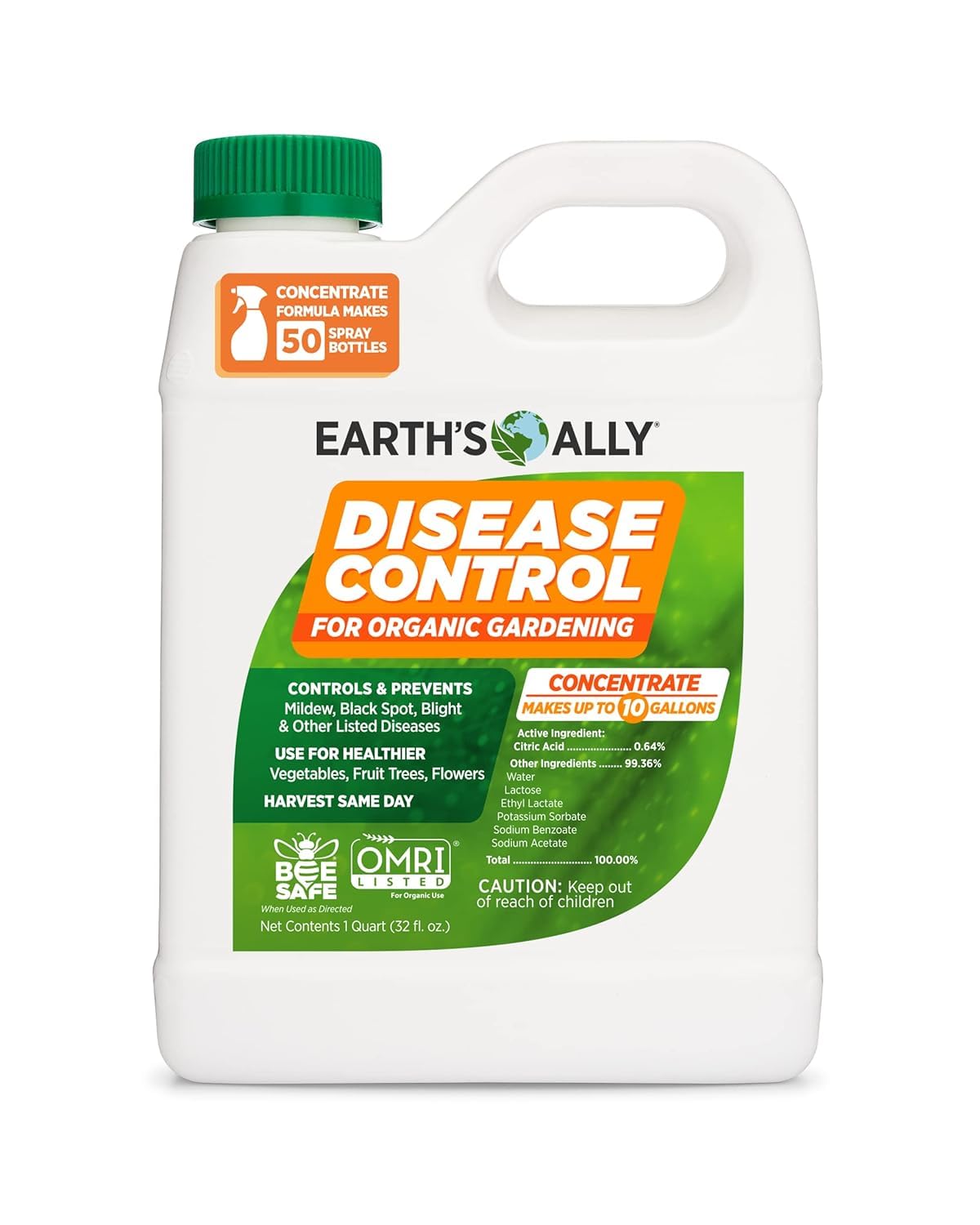
Makes 10 gallons of spray from one 32-ounce bottle — serious coverage from a concentrate.
You get a full 10 gallons of ready-to-use product from one 32-ounce bottle of Earth’s Ally Disease Control when you mix 6 tablespoons per gallon of water. The active ingredient is citric acid, which breaks down without harsh residues. The formula is OMRI-listed (certified for organic use) and safe to use on fruits and vegetables up until the day of harvest. This gives you more coverage per dollar than the ready-to-use bottles like the Garden Safe Fungicide3 below.
The bottle weighs 2.26 pounds, versus the 1.12-pound Bonide Rose Rx concentrate below — a clear weight difference from the lighter neem-oil sprays. Reviewers report it “stopped root fungus in 2 applications,” which for a rose-grower with stubborn disease is a strong sign of fast action. It treats powdery mildew, downy mildew, blight, canker, black spot, and leaf spot — covering the most common rose diseases in one bottle.
One catch: because it is a concentrate, you need a separate sprayer and a measuring tool. The up-front effort pays off if you are spraying a large bed or a whole garden, but for a single potted rose a ready-to-use spray is simpler.
Why it works for big gardens
- Makes 10 gallons of treatment from one bottle
- OMRI-listed for organic gardening
- Treats black spot, powdery mildew, blight, canker, and leaf spot
What you give up
- Needs a separate sprayer — not ready to use
- No insect or mite control
Reach for this if: you have multiple rose bushes or a mixed flower and vegetable garden and want a safe, concentrated fungicide that goes far per dollar.
Look elsewhere if: you also need to kill aphids or spider mites with the same spray — this is fungicide-only.
2. Bonide Rose Rx 3-in-1 Concentrate (16 oz)

A concentrated dose of neem oil that kills fungus, aphids, and mites with one mix.
You get fungus, insect, and mite control from one bottle with Bonide Rose Rx. Buyers report “it smells awful, but it does really work — better than all the many products I’ve used.” The smell disappears within moments after spraying. The payoff is a 3-in-1 treatment that prevents and controls black spot on roses, powdery mildew, downy mildew, anthracnose, rust, and leaf spot while also killing aphids, spider mites, whiteflies, caterpillars, and scales. The active ingredient is clarified hydrophobic extract of neem oil, which is USDA-approved for organic gardening.
Compared to the Garden Safe Fungicide3 below, this is a concentrate — you mix it with water in a sprayer. The 16-ounce bottle weighs 1.12 pounds, while the Earth’s Ally bottle is 2.26 pounds, but you get multiple full-spray cycles from it. It is designed specifically for roses, flowers, houseplants, ornamental trees, fruits, nuts, and vegetables, so it works across the whole garden without needing a separate insecticide pass.
The trade-off: the strong neem smell during mixing can be off-putting, and the concentrate form means handling a measuring step and a sprayer.
The specialist’s take: This is the broadest-spectrum rose treatment in a single bottle, covering fungus, insects, and mites in one mixing routine. The neem oil is USDA-approved organic, and the concentrate is cost-effective compared to ready-to-use bottles.
One buyer’s reality: The scent is strong — hold your nose during mixing and it fades fast.
Best for: the rose gardener who also fights aphids and spider mites and wants one concentrated solution instead of three separate bottles.
skip it if: you are sensitive to strong-smelling sprays or prefer a grab-and-spray bottle.
3. Garden Safe Fungicide3 (1 Gallon / 128 oz)
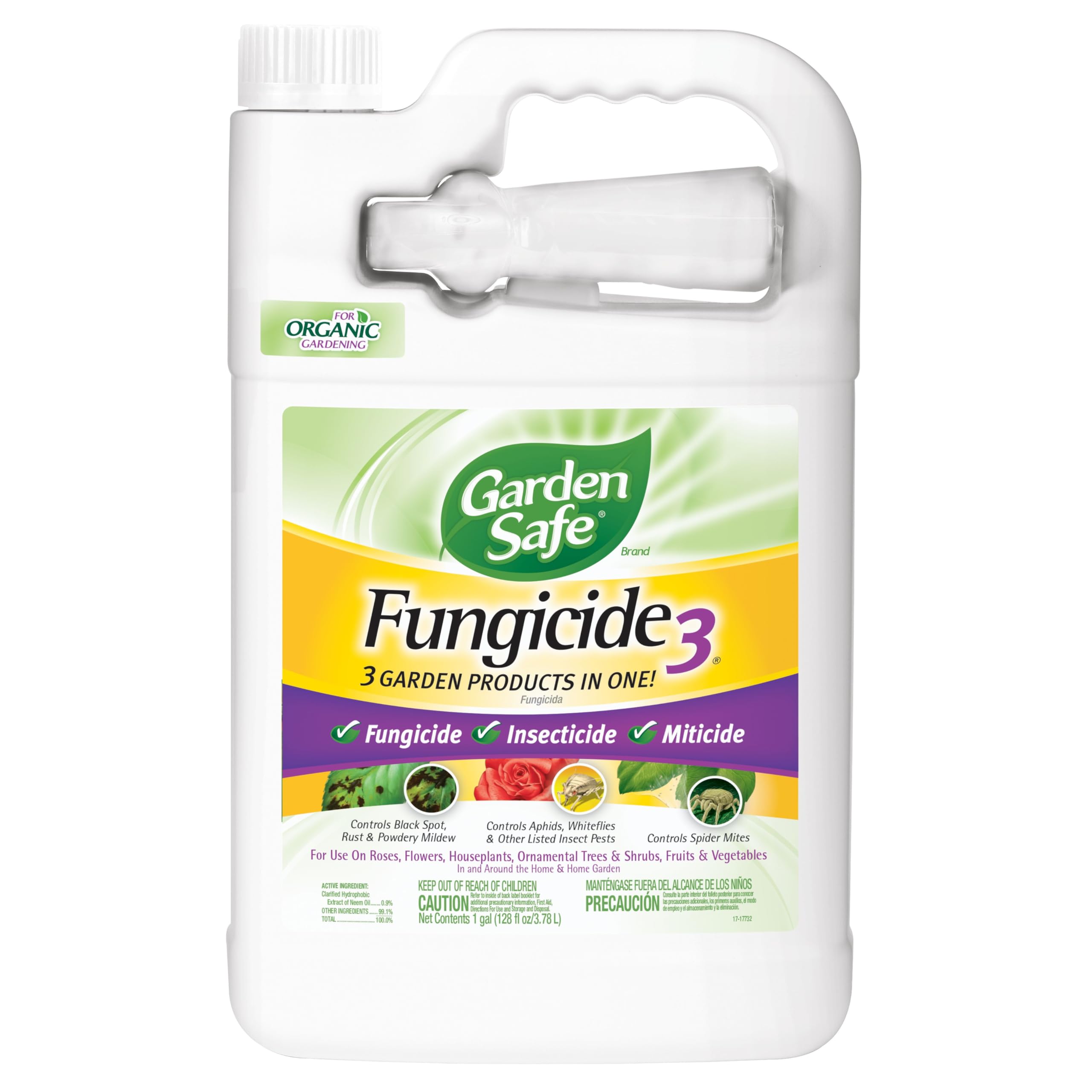
A full gallon of ready-to-use neem oil that kills fungus, insects, and mites on contact.
You get a 128-fluid-ounce jug with a sprayer attached, compared to the 16-ounce bottles of Neudorff or Bonide Rose Rx. For a large rose bed with dozens of bushes, this gallon jug cuts down re-fill trips dramatically. It is a 3-in-1 product: a fungicide that controls black spot, rust, and powdery mildew, plus an insecticide that kills aphids, whiteflies, and other listed pests, and a miticide (a spray that kills mites) that targets spider mites.
The active ingredient is clarified hydrophobic extract of neem oil, and it is approved for organic gardening on roses, flowers, houseplants, ornamental trees, fruits, and vegetables. Reviewers report it is “effective against mildew on hibiscus, roses, tomatoes, blueberries” and that weekly use stopped mildew and improved foliage and fruit yield. It kills eggs, larvae, and adult stages of listed insects, so it works as a preventive and a clean-up treatment.
Two honest downsides: some buyers found the built-in sprayer clumsy, with a short coiled hose that makes reaching the back of a rose bed awkward. Also, neem oil can burn leaves if sprayed in direct midday sun, so morning or evening application is best.
The volume advantage
- 128 fluid ounces ready-to-use — no mixing required
- 3-in-1 fungicide, insecticide, and miticide
- Organic, neem-based with EPA certification
The setup catch
- Built-in sprayer can be awkward to maneuver
- Neem oil may burn foliage if applied in the heat of the day
Reach for this if: you need to treat a large rose garden fast, without mixing, and want insect and mite control in the same pass.
Look elsewhere if: you want a small, portable sprayer or prefer a cleaner-smelling formula.
4. Neudorff Copper Soap Fungicide (16 oz RTU)

A copper-based spray that uses a gentle fatty-acid soap to stop rose diseases.
You get a copper-based treatment that works differently from the neem-oil products above. Instead of neem, it uses copper octanoate (a copper soap that decomposes into soluble copper and fatty acid, both usable by plants and microbes). This makes it a good choice for organic gardening — it can be sprayed up to the day of harvest on roses, vegetables, fruits, and ornamentals. It controls powdery mildew, rusts, black spot, leaf and fruit spot, downy mildew, fruit rot, late blight, and peach leaf curl.
Reviewers report it “worked great to eliminate a fungus that almost killed our decades old gardenia” and that it “works immediately on black spot, powdery mildew, red blotch.” The spray is a 16-fluid-ounce ready-to-use bottle that weighs 16 ounces, while the Garden Safe jug is 128 ounces, making it ideal for a small rose collection or for treating a single precious plant. It has a mild scent and a blue dye to track where you have sprayed.
The flip side: one reviewer noted it “stopped fungus on hostas but burned the plants,” meaning copper soap can burn foliage if applied too heavily or in strong sunlight. Unlike the neem-oil concentrates, this one does not control insects or mites — it is a dedicated fungicide only.
The practical take: For a small rose bed or potted roses where you want a gentle, organic, ready-to-spray option, this is a straightforward pick. The copper soap breaks down cleanly and works immediately.
The honest limit: No insect or mite control, and the burn risk means you need to follow label rates carefully.
Pick this over the Bonide Rose Rx if: you want a milder, ready-to-use spray for a few special roses and do not need insect control — the Bonide is better for broad-spectrum pest coverage.
5. Fertilome Triple Action (32 oz)
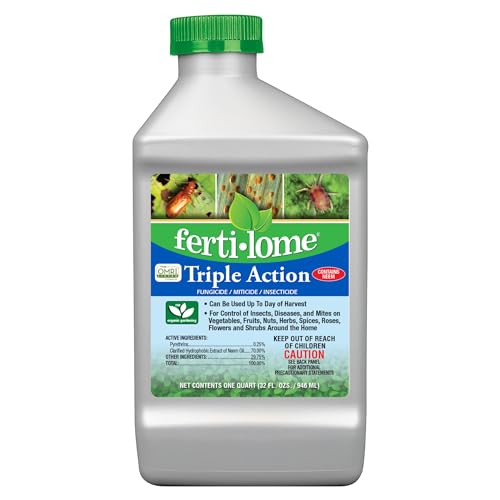
A neem-based concentrate that has been a go-to for apple trees and roses for years.
You get a 3-in-1 concentrate that works as an insecticide, miticide (kills mites), and fungicide in one bottle with Fertilome Triple Action. The active ingredient is neem oil, and it covers an impressive list of targets: aphids, spider mites, leafminers, leafrollers, armyworms, plus powdery mildew, rust, and leaf spot on roses, fruits, herbs, nuts, spices, vegetables, and shrubs. It is the same 3-in-1 concept as the Bonide Rose Rx, but in a 32-ounce bottle versus Bonide’s 16-ounce concentrate.
Owners mention they “have used this produce for years works well on our apple trees,” pointing to its reputation as a steady performer across fruit trees and ornamentals. The manufacturer recommends reapplying every 7 to 14 days for best results. Because it is a concentrate, you mix it with water using a hand sprayer or sprinkler can — same routine as the Earth’s Ally and Bonide concentrates.
The main trade-off: some long-time users say the price has climbed noticeably, making it less of a budget-saver than it used to be compared to the Earth’s Ally concentrate. Also, like any neem-based treatment, it can burn leaves if applied during hot, direct sun, so timing matters.
What it covers
- 32-ounce concentrate stretches for many spray sessions
- Fungicide, insecticide, and miticide in one bottle
- Works on roses, fruit trees, vegetables, and herbs
The honest catch
- Neem can burn leaves if applied in direct sunlight
- Price has increased over time, according to long-time users
Choose this for the volume: 32 ounces of concentrate at a familiar brand name, versus the 16-ounce Bonide Rose Rx bottle, though both are 3-in-1 neem formulas.
Understanding the Specs
Active Ingredient: Neem Oil vs Copper Soap vs Citric Acid
Neem oil (clarified hydrophobic extract of neem oil — a concentrated oil from the neem tree) is the most common active ingredient in 3-in-1 rose fungicides. It works as a fungicide, insecticide, and miticide (kills mites) in one treatment. Copper soap (copper octanoate) is milder and breaks down into nutrients, but it only treats fungus — no insect control. Citric acid (used in Earth’s Ally) is a natural acid that disrupts fungal cell membranes; it is OMRI-listed (certified for organic use) and breaks down without residues. Each is organic-certifiable, but neem oil is the only one that also kills insects and mites.
Ready-to-Use vs Concentrate: How It Affects Coverage
A ready-to-use spray comes pre-mixed in the bottle — you spray straight out of the container (like the 128-ounce Garden Safe and the 16-ounce Neudorff). A concentrate requires you to measure a specific amount and mix it with water in a separate sprayer. The big advantage of a concentrate is that a single bottle can make many gallons of finished spray (Earth’s Ally makes 10 gallons from one 32-ounce bottle). Ready-to-use is simpler but covers fewer plants per bottle, so for a large rose garden a concentrate is the more practical value.
FAQ
Can I use the same fungicide on roses and vegetables in the same garden?
How often should I spray fungicide on my roses?
Will a fungicide burn my rose leaves?
What is the difference between black spot and powdery mildew treatment?
Can I mix fungicide with insecticide in one spray?
How many gallons of spray does a concentrate make?
Is organic fungicide as effective as synthetic?
Will these products kill aphids and spider mites too?
Can I use these on indoor houseplants?
Do I need to wear gloves and a mask when spraying?
Final Thoughts: The Verdict
Across the board, the fungicide for roses winner is the Bonide Rose Rx because its concentrated neem oil delivers fungus, insect, and mite control in one mixing routine, and buyers consistently say it works better than anything else they have tried. If you want a safe, OMRI-listed concentrate that goes the distance on a large garden, grab the Earth’s Ally Disease Control. And for a simple grab-and-spray gallon that treats a huge rose bed without mixing, the standout is the Garden Safe Fungicide3.
How We Picked
We do not accept paid placement, and we did not hands-on test every unit. Instead, we match each pick to a real buyer and use-case by comparing the manufacturers’ published specifications against the patterns in verified customer reviews — so you get each pick’s real strengths and trade-offs instead of marketing copy.
Sources & Methodology
Specifications: manufacturer listings and product documentation. Review insights: verified customer reviews, as of July 2026. Pricing: not shown on this page (it changes often); check the current price via the retailer link.
As an Amazon Associate, Lawn Gear Lab earns from qualifying purchases. This does not affect which products we feature.