
Specs are compiled from manufacturer listings and verified buyer reviews and can change over time — please confirm the key details on the product page before buying.
You own a sloped yard, and you are tired of wheel spin and missing the steepest strips. A standard two-wheel-drive mower slides sideways on damp grass and leaves the hills untouched. That is why a 4 wheel drive lawn mower sends power to every corner — so you can mow the ditches, the bumps, and the uneven patches you have been avoiding all season.
I am Rikta — the founder behind Lawn Gear Lab. This guide compares manufacturer specs and patterns from verified customer reviews, so you get each pick’s real strengths and trade-offs instead of marketing spin.
The best 4 wheel drive lawn mower for most people is the MOVA LiDAX Ultra 3000 AWD because its wire-free LiDAR navigation and 15.8-inch cutting width cover hilly mid-size lawns with the fewest compromises. For a larger property with extreme slopes, the Segway Navimow X450 cuts a 17-inch swath and climbs 84% grades. For overgrown, rocky land where robots fail, the Mowrator S1 remote-control mower chews through anything with its 21-inch deck and 147.7-pound build.
Quick Picks
- MOVA LiDAX Ultra 3000 AWD Robot Lawn Mower — Best Overall
- Segway Navimow X450 Robot Lawn Mower — Largest Cut
- DREAME A3 AWD 2000 Robot Lawn Mower — Wire-Free Pick
- DREAME LiDAR 2500 A3 AWD Pro Robot Lawn Mower — Edge Master
- Worx Landroid Vision Cloud 4WD Robot Lawn Mower — Cloud Navigator
- Mammotion LUBA 3 AWD 3000H Robot Lawn Mower with Garage — Sensor Fusion
- Mowrator S1 4WD 18Ah Remote Control Lawn Mower — Tough Terrain
How To Choose The Best 4 Wheel Drive Lawn Mower
Not every 4WD mower suits your property. The first question is if you want a robot that mows on a schedule or a remote-control machine you drive yourself. Robots are quieter and maintain the lawn daily; remote-control mowers cut faster and tackle rough overgrowth. From there, match the machine to your yard’s slope, size, and obstacles.
Slope Rating — The Real Number That Matters
The slope percentage or degree angle tells you the steepest hill the mower can climb. An 80% slope equals roughly 38.6 degrees — that is a very steep bank, the kind where you brace your feet. If a mower handles 75% (37 degrees), it will climb a sharp incline but may struggle on a vertical edge. Always match the rating to the steepest part of your yard, not the average.
Cutting Width and Battery Life
A wider cutting deck (17 inches or more) finishes a half-acre faster, but it also means a bigger, heavier machine. Robots with narrow decks around 8 inches take longer but navigate tight paths between flower beds. Battery life tells you how long the mower runs on a single charge before it needs to dock; consider that time alongside the coverage rating given for a typical lawn.
Wire-Free Setup vs. RTK and LiDAR
Older robot mowers require you to bury a boundary wire around the entire yard. Modern 4WD robots use LiDAR (a spinning laser that builds a 3D map), AI vision cameras, or RTK (a satellite correction system that pinpoints location to within an inch) to navigate without wires. Some use a combination of all three. A wire-free setup saves hours of installation and lets you adjust the mowing zone from your phone.
Quick Comparison
On smaller screens, swipe sideways to see the full table.
| Model | Best For | Cutting Width | Max Slope | Weight | Amazon |
|---|---|---|---|---|---|
| MOVA LiDAX Ultra 3000 AWD | Hilly, bumpy lawns up to 0.75 acre | 15.8 Inches | 80% | 52 Pounds | Amazon |
| Segway Navimow X450 | 17 Inches | 84% | 63.71 Pounds | Amazon | |
| DREAME A3 AWD 2000 | Quick setup, no wires or RTK needed | 7.87 Inches | 80% | 26.4 Pounds | Amazon |
| DREAME LiDAR 2500 A3 AWD Pro | 15.75 Inches | 80% | 40 Pounds | Amazon | |
| Worx Landroid Vision Cloud 4WD | RTK cloud navigation without a local antenna | 8.7 Inches | 84% | — | Amazon |
| Mammotion LUBA 3 AWD 3000H | — | 80% | — | Amazon | |
| Mowrator S1 4WD 18Ah | Tough terrain and overgrowth up to 1.12 acres | 21 Inches | 75% | 147.7 Pounds | Amazon |
In‑Depth Reviews
1. MOVA LiDAX Ultra 3000 AWD Robot Lawn Mower
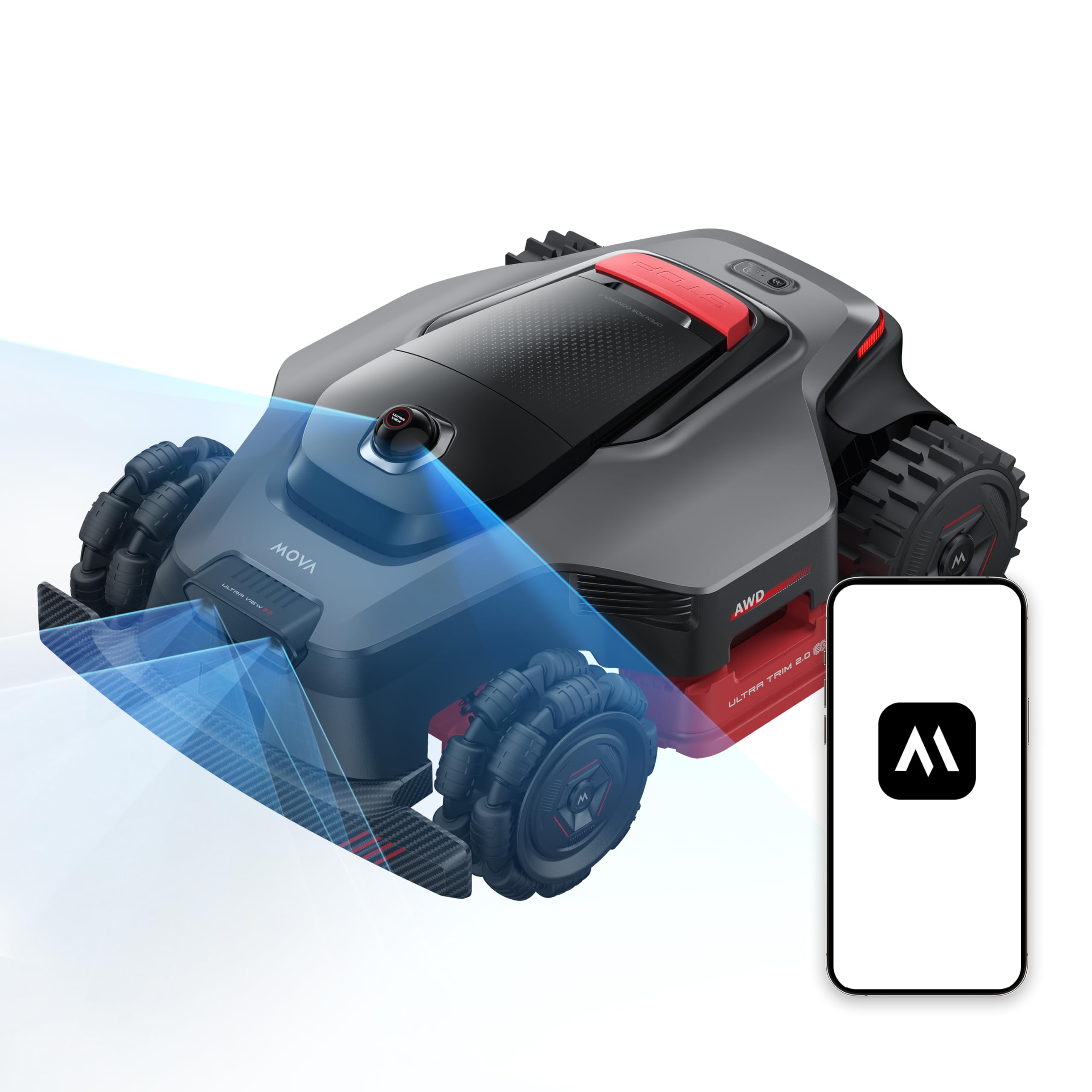
A wire-free robot that tames bumpy three-quarter-acre hills without boundary wires.
The MOVA LiDAX Ultra 3000 AWD uses 360° 3D LiDAR (a spinning laser that builds a 3D map) and AI dual vision to map your yard the moment you turn it on — no RTK (Real-Time Kinematic satellite correction) base station, no boundary wire to bury. That 15.8-inch cutting width is twice as wide as the DREAME A3 AWD 2000’s 7.87-inch cut, so you cover more ground per pass. Buyers report it works well on hilly, bumpy 3/4 acre lawns, and the four 116W hub motors handle slopes up to 80% without slipping.
Cutting height adjusts from 1.2 inches at the lowest up to 3.9 inches, and the UltraTrim 2.0 edge technology leaves just 1.2 inches of uncut grass along borders — close enough that you rarely grab a string trimmer afterward. The 243Wh battery drives the dual-disc system for up to 165 minutes per charge, enough to handle a quarter-acre per run before it returns to dock automatically.
One catch some owners note: the front wheels do not turn, which can dig into soft dirt or grass during tight pivots. And at 52 pounds, it is a full 25.6 pounds heavier than the lightweight DREAME A3 AWD 2000, so carrying it between zones is a two-hand job. Pick this over the Segway Navimow X450 if your lawn is under an acre — the MOVA’s 15.8-inch cut and 52-pound weight strike a better balance for medium-size hills than the heavier, wider X450.
What Shines
- Wire-free setup with 360° LiDAR and AI vision
- 15.8-inch cutting deck covers ground quickly
- 165-minute battery life on one charge
- 1.2-inch minimum cutting height for close trimming
Watch For
- Front wheels lack turning ability, can scuff turf
- At 52 pounds, noticeably heavier than the DREAME A3 AWD 2000
Reach for this if: you have a bumpy, sloped lawn up to three-quarters of an acre and want a robot that maps and mows without any buried wire or RTK station.
Consider another if: your lawn has many tight turns or very soft soil where a fixed-front-wheel design could leave tracks.
2. Segway Navimow X450 Robot Lawn Mower
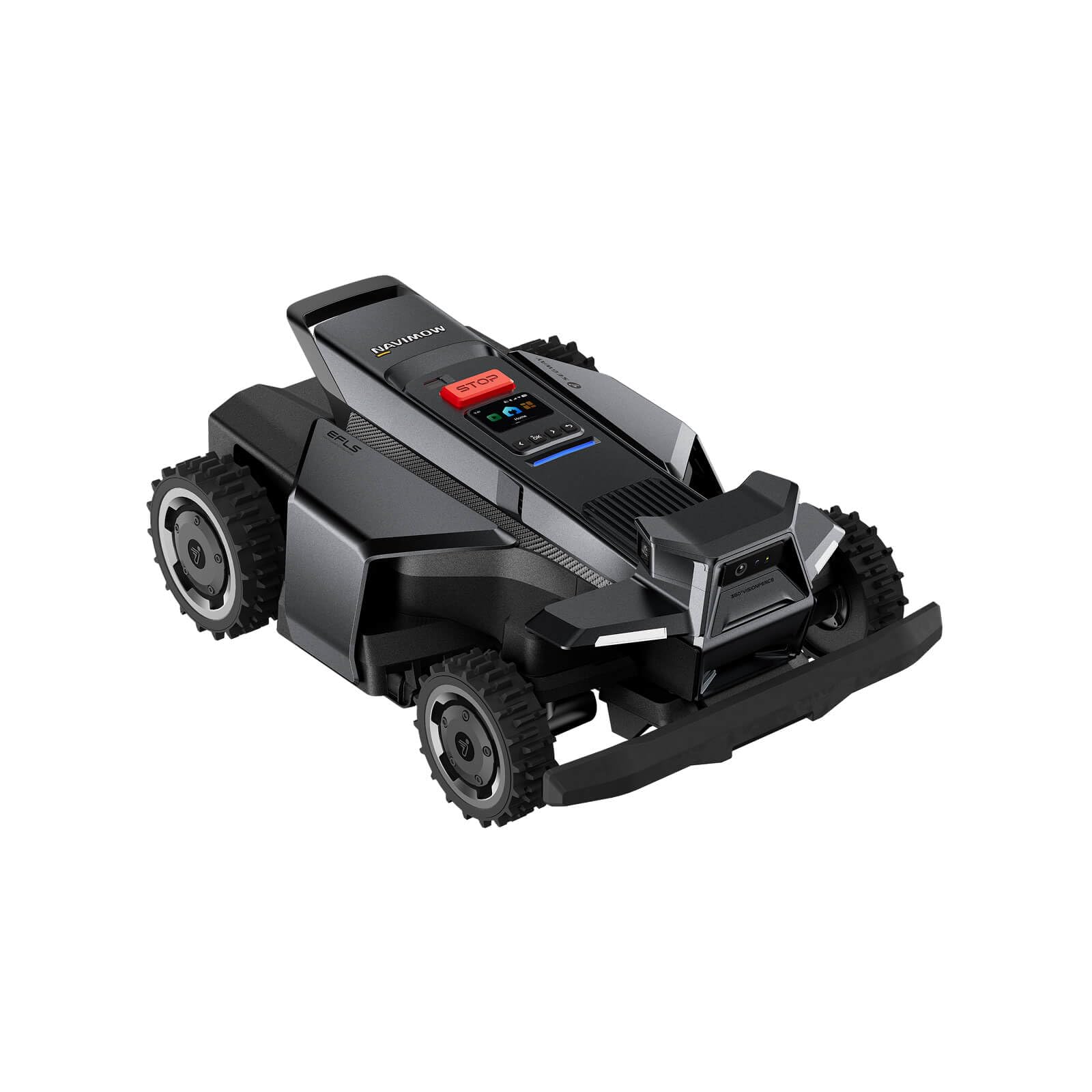
The widest deck on our list, with zero-turn steering that spares your turf.
With a 17-inch cutting width, the Segway Navimow X450 cuts a swath a full inch wider than the MOVA LiDAX Ultra 3000 and more than double that of narrow robots. Its dual 180W motors drive two cutting discs with 12 blades total, and the 2.6 ft/s mowing speed means you can cover a larger property faster. The Xero-Turn AWD steering rotates the mower in place without dragging the wheels sideways — no ripped-up patches of grass when it spins around a tree or flower bed.
It climbs slopes up to 84% — that is roughly 40 degrees, the steepest rating you will find here alongside the Worx. EFLS tri-frequency Network RTK combined with 360° Vision and VIO (visual inertial odometry — a camera system that tracks movement by comparing images) keeps centimeter-level accuracy even under trees or along fence lines. Cutting height ranges from 0.75 inches at the lowest setting up to 4 inches, and EdgeSense trims within 2 inches of borders to reduce string-trimmer follow-up.
One owner who switched from a Mammotion Luba 2 reported the X450 has a wider cut, protected blades that do not clog with wet grass, and cleaner cutting lines. At 63.71 pounds, it is the heaviest robot here — you will not be carrying it between lawns. Battery drain is modest: one reviewer noted 60% remaining after one hour of mowing. The premium price and heavy weight mean this is only for buyers with a landscape large enough to justify both.
Strong Points
- 17-inch cutting width covers up to 1.5 acres
- Zero-turn steering prevents turf damage
- 84% slope rating for very steep inclines
- No perimeter wire or RTK antenna needed
Trade-offs
- At nearly 64 pounds, difficult to move manually
- Premium tier price
Grab this for: a larger lawn up to 1.5 acres with steep sections, where you want the widest cut and zero-turn agility that does not tear the grass.
Pass if: you need a mower you can lift or carry between separate fenced areas — this one stays put.
3. DREAME A3 AWD 2000 Robot Lawn Mower
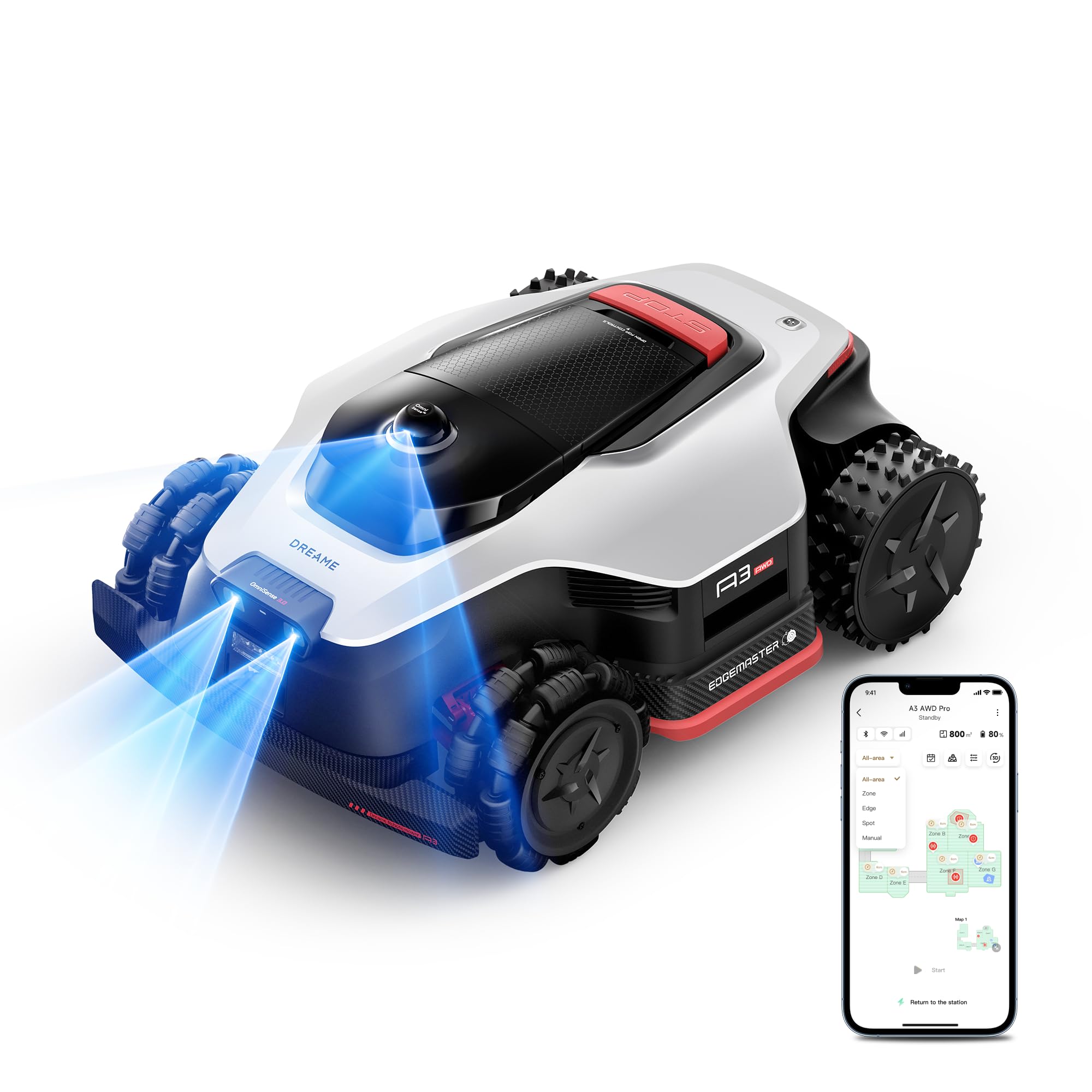
Lightest robot on the list with 360° LiDAR and no wires to bury.
The DREAME A3 AWD 2000 weighs just 26.4 pounds — roughly half the MOVA LiDAX Ultra 3000 — so you can pick it up and move it between front and back yards without straining. Its 7.87-inch cutting width is narrow, which means more passes to finish a lawn, but the trade-off is a machine that navigates tight paths and multi-zone layouts without getting wedged. It climbs slopes up to 80% (38.7 degrees) and steps over obstacles up to 2.17 inches high.
The OmniSense 3.0 navigation uses 360° LiDAR and Binocular AI vision, and owners mention that no RTK or boundary wires are needed; it solves signal loss under trees and on hills. That is a real advantage over RTK-only robots that drop positioning under heavy tree cover. EdgeMaster 2.0 precision trims within 1.97 inches of borders, and an optional trimmer module (sold separately) shrinks that to under 1.18 inches. Dreame claims the 5A adapter recharges the battery in 45 minutes — 22% faster than the industry norm.
Not every owner had a smooth start. Several reviews mention bumper errors or wheel issues on arrival, though DREAME offers a 3-year warranty and 1-year free 4G service. The 4G subscription cost after the first year is unclear — one buyer criticized the lack of transparent pricing. Leave this on the shelf if your lawn is larger than half an acre; the narrow deck will take too long to finish compared to the MOVA’s 15.8-inch cut.
What Works
- 26.4 pounds — easy to lift between zones
- Wire-free with 360° LiDAR and AI vision
- 45-minute fast charge
- 3-year warranty included
Watch Out For
- Narrow 7.87-inch deck takes more passes
- 4G service cost after year one is not disclosed
- Some units arrived with bumper or wheel defects
Best for: a small, multi-zone lawn under half an acre where you need a lightweight robot you can shuttle between areas and do not want to mess with boundary wires.
skip it if: you have a large, open lawn — the narrow deck will take too long to finish.
4. DREAME LiDAR 2500 A3 AWD Pro Robot Lawn Mower
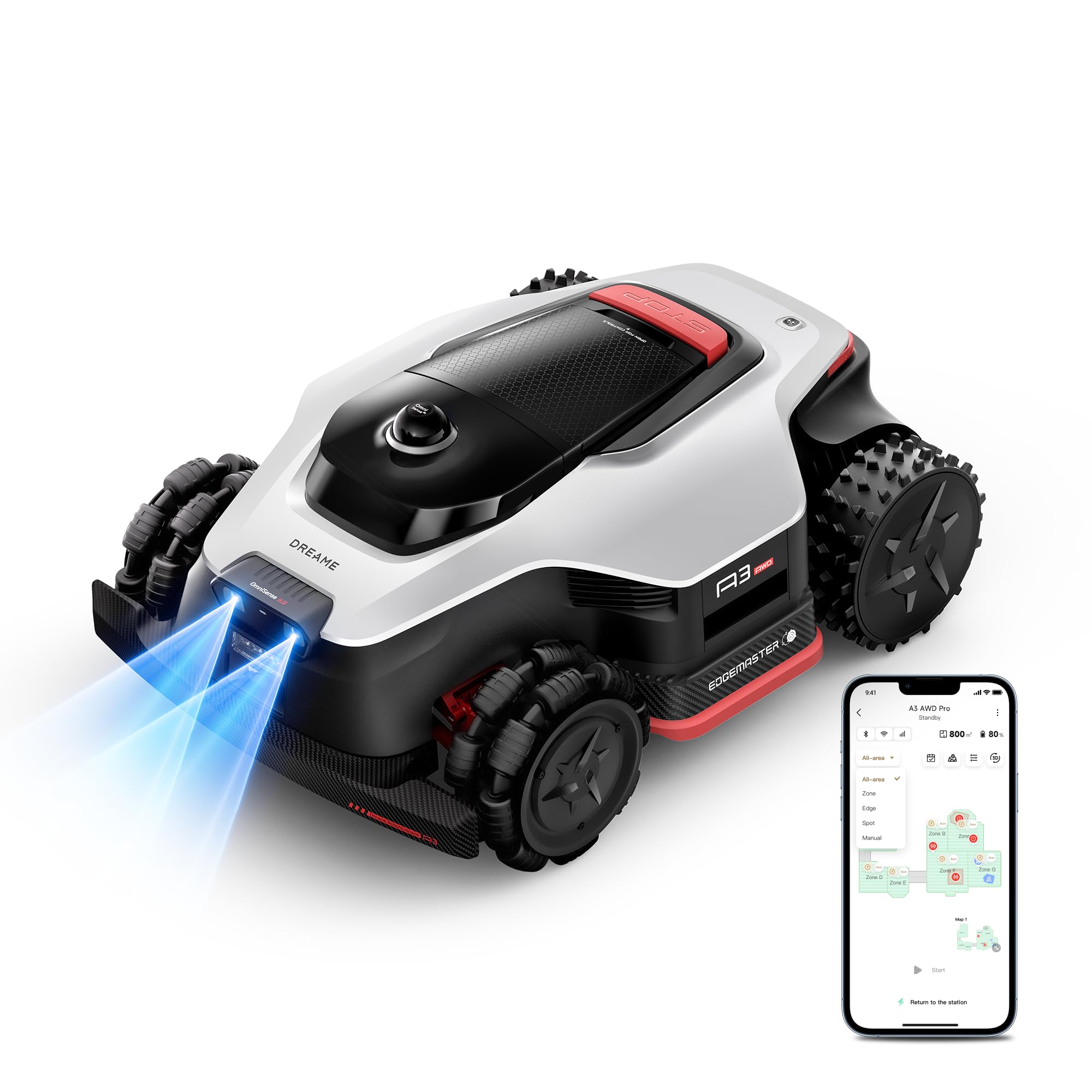
A 4WD robot with a 15.75-inch deck that cuts tight against borders.
The DREAME LiDAR 2500 A3 AWD Pro splits the difference between the compact A3 AWD 2000 and the heavy MOVA — it weighs 40 pounds and carries a 15.75-inch cutting width, nearly matching the MOVA’s 15.8 inches. Dual floating cutting discs give you consistent mulching across the full width, and EdgeMaster 2.0 leaves almost no uncut strips along fences and garden beds. One owner noted the mowing performance and AWD are genuinely great, with strong mulching and systematic straight-line coverage.
OmniSense 3.0 combines 360° LiDAR with binocular AI vision for obstacle avoidance — it spots pets, toys, and hoses among 300+ object types. The 240-foot long-range detection means it sees obstacles well before it reaches them. Cutting height adjusts between 1 and 4 inches via the Dreamehome App, and the mower handles grass up to 8 inches tall by trimming it down in stages. Rush Mode mows at up to 8,611 square feet per hour when you need fast coverage.
A few buyers found the setup nightmarish on imperfect lawns with trees, bumps, and weeds, and noted the app does not let you edit a map — you must restart mapping from scratch. The AWD climbs slopes up to 80%, and the suspension system steps over roots and curbs up to 2.2 inches without getting stuck. For a medium lawn where edge precision matters, this is a strong middleweight contender. It outshines the MOVA for edge trimming if your lawn has lots of borders.
Pros
- 15.75-inch dual-disc cutting width
- EdgeMaster 2.0 for minimal border leftovers
- Handles grass up to 8 inches tall
- 40 pounds — lighter than the MOVA but same deck size
Cons
- App lacks map editing — must remap from scratch
- Setup fussy on uneven or weedy lawns
Choose this for: a medium-size lawn where you want a wide cut and close edge trimming without the 52-pound heft of the MOVA.
Think twice if: your lawn has many obstacles and you want to be able to edit zones on the map without re-mapping the entire yard.
5. Worx Landroid Vision Cloud 4WD Robot Lawn Mower
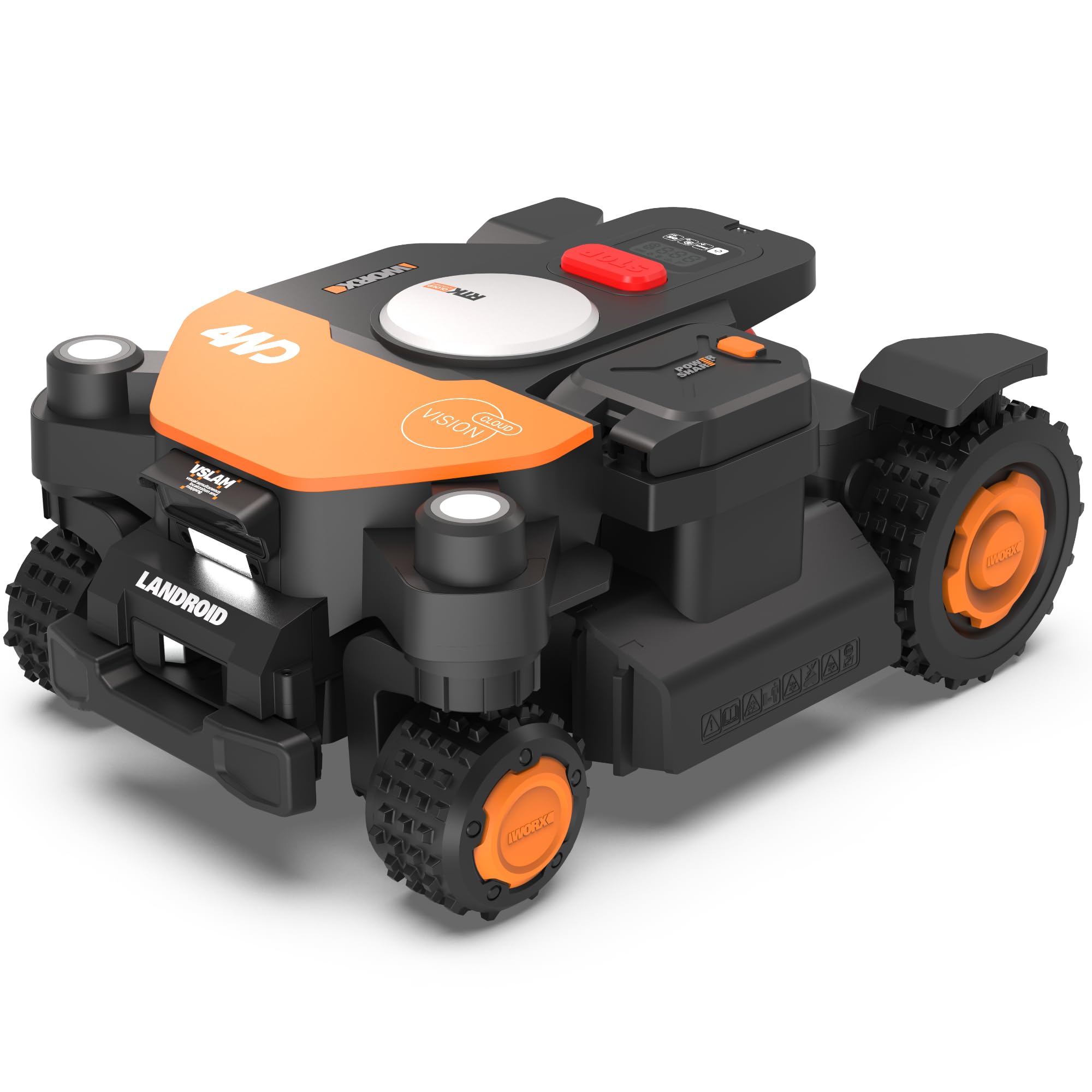
Uses cloud-based RTK so you skip the local antenna and still get centimeter accuracy.
Most RTK robot mowers need a base station you mount on a roof or pole. The Worx Landroid Vision Cloud 4WD delivers the same correction accuracy from the cloud — no local antenna, no extra subscription cost. It still climbs a formidable 84% slope, matching the Segway Navimow X450 for the steepest rating here. The 4WD terrain-adaptive chassis keeps all four wheels planted on uneven ground, and true front-wheel steering turns without tearing the turf.
The cutting width is 8.7 inches — narrower than the MOVA and Segway but comparable to the DREAME A3 AWD 2000. Cutting height adjusts in 7 positions from 1.57 inches to a maximum of 3.54 inches. Vision AI processes up to 10 trillion operations per second to recognize obstacles, and the Cut-to-Zero offset blade trims very close to the edge, reducing the need for manual string trimming. The FiatLux light lets it mow safely after dark.
Setup is hit-or-miss. One buyer on a 0.7-acre lawn said the mapping and scheduling worked well after initial connection errors that were fixed by moving the base for a clear sky view. Another buyer on 2 acres reported persistent connection loss, error codes, and a non-functional unit. The mower relies on a 2.4GHz Wi-Fi connection. If you have good Wi-Fi coverage across your yard, the cloud RTK system is a clever upgrade; if your signal is weak, the base model Worx might be more reliable. It is not the mower for a large, open lawn either — the 8.7-inch cutting width is slow on bigger properties compared to the Segway’s 17-inch deck.
Highlights
- Cloud RTK eliminates the need for a local antenna
- 84% slope rating for extreme hills
- Cut-to-Zero blade reduces edging work
- Night mowing with FiatLux light
Downsides
- Setup glitches reported on larger or signal-poor properties
- Only 8.7-inch cutting width is slow on bigger lawns
- Plastic chassis feels less rugged than metal-bodied competitors
Pick this if: you want RTK-grade accuracy without installing an antenna on your roof, and your lawn has a strong 2.4GHz Wi-Fi signal.
pass on it if: your property is larger than an acre or has poor Wi-Fi coverage in the yard.
6. Mammotion LUBA 3 AWD 3000H Robot Lawn Mower with Garage
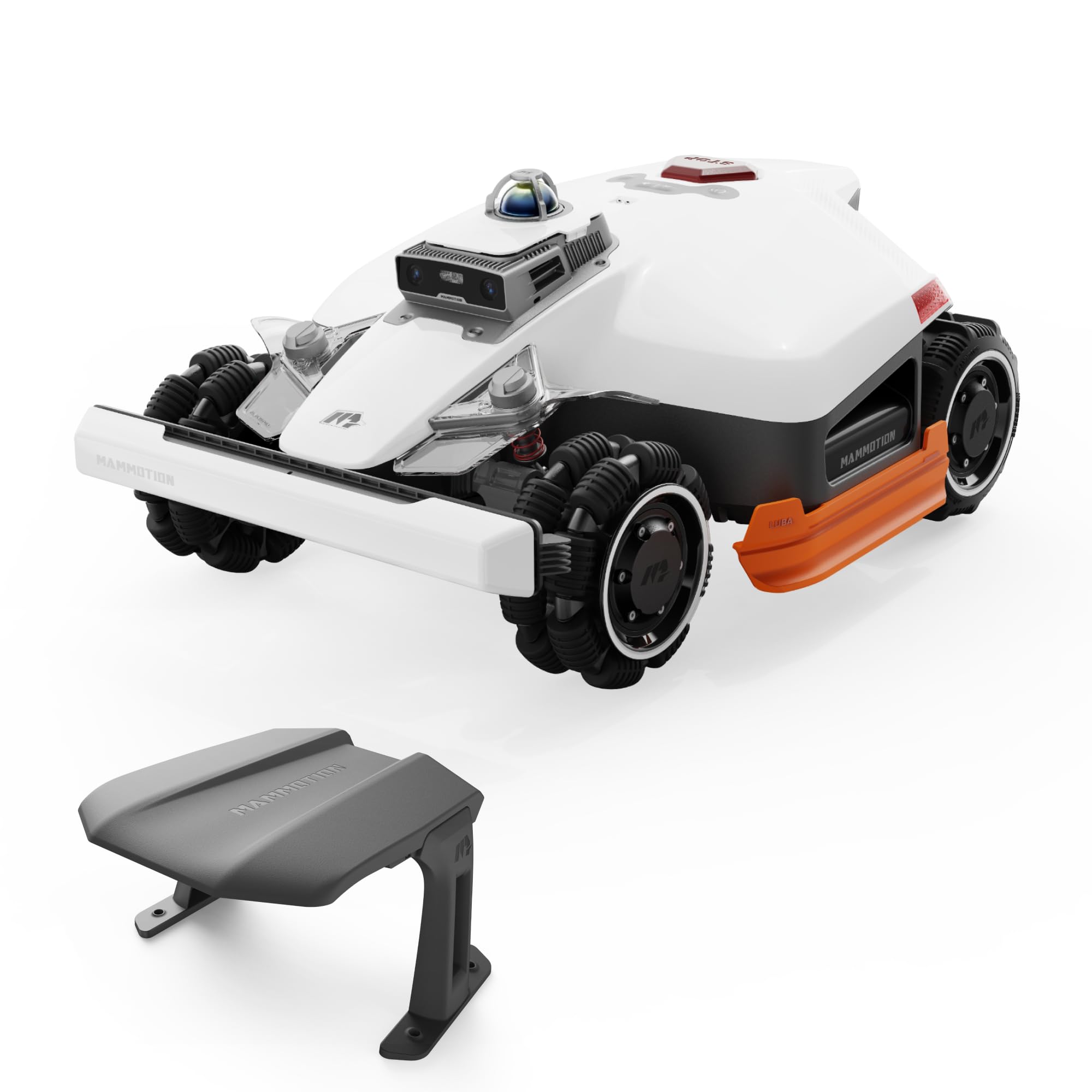
Triple-navigation robot that switches between LiDAR, NetRTK, and AI vision for smooth coverage.
Most robots rely on one or two navigation methods — the Mammotion LUBA 3 AWD 3000H uses three: 360° LiDAR with a 230-foot range, NetRTK for satellite corrections, and dual-camera AI vision. The system selects the best sensor for the moment, so if you move from an open area to a tree-covered corner, the robot does not lose its position. The 360° LiDAR sweeps a full horizontal circle plus 59 degrees vertical, mapping from ground level up into tree canopies.
Four independent motors deliver 80% (38.6°) slope climbing, and the omni wheel allows smooth pivots without scuffing turf. The adaptive suspension steps over curbs and roots up to 50 mm high. Two high-torque 165W motors with 6-blade discs cut at up to 500 m² per hour, and the 12Ah battery runs up to 175 minutes per charge. The included garage ships separately — a nice perk for keeping the mower sheltered from rain and sun.
One owner who switched from a Worx Landroid called the LUBA 3 excellent and noted the smaller size, Lidar navigation, and better cut compared to a Segway. Cutting height adjusts only from 2.2 inches to a maximum of 4 inches — that 2.2-inch minimum is higher than the 1-inch minimum on the DREAME A3 AWD 2000, so if you prefer a very low cut, this is not your mower. The 30-zone management and multiple mowing patterns (zigzag, checkerboard, adaptive) give you fine control over complex properties. It beats the Worx for reliability under tree cover thanks to triple navigation, but the higher minimum cut limits its appeal for low-lawn keepers.
Strengths
- Triple navigation (LiDAR + NetRTK + AI vision) for reliable positioning
- 175-minute runtime with 12Ah battery
- 30-zone management for complex yards
- Garage included for weather protection
Limitations
- Minimum cutting height of 2.2 inches is not for low-cut lawns
- App controls require some learning for non-gamers
- Real-world battery coverage reported at ~60% of advertised rate
Reach for this if: you have a complex, multi-zone lawn with a mix of open areas and heavy tree cover, and you want a robot that never loses its position.
Consider another if: you keep your grass very short (below 2 inches) — the 2.2-inch minimum may leave it longer than you like.
7. Mowrator S1 4WD 18Ah Remote Control Lawn Mower
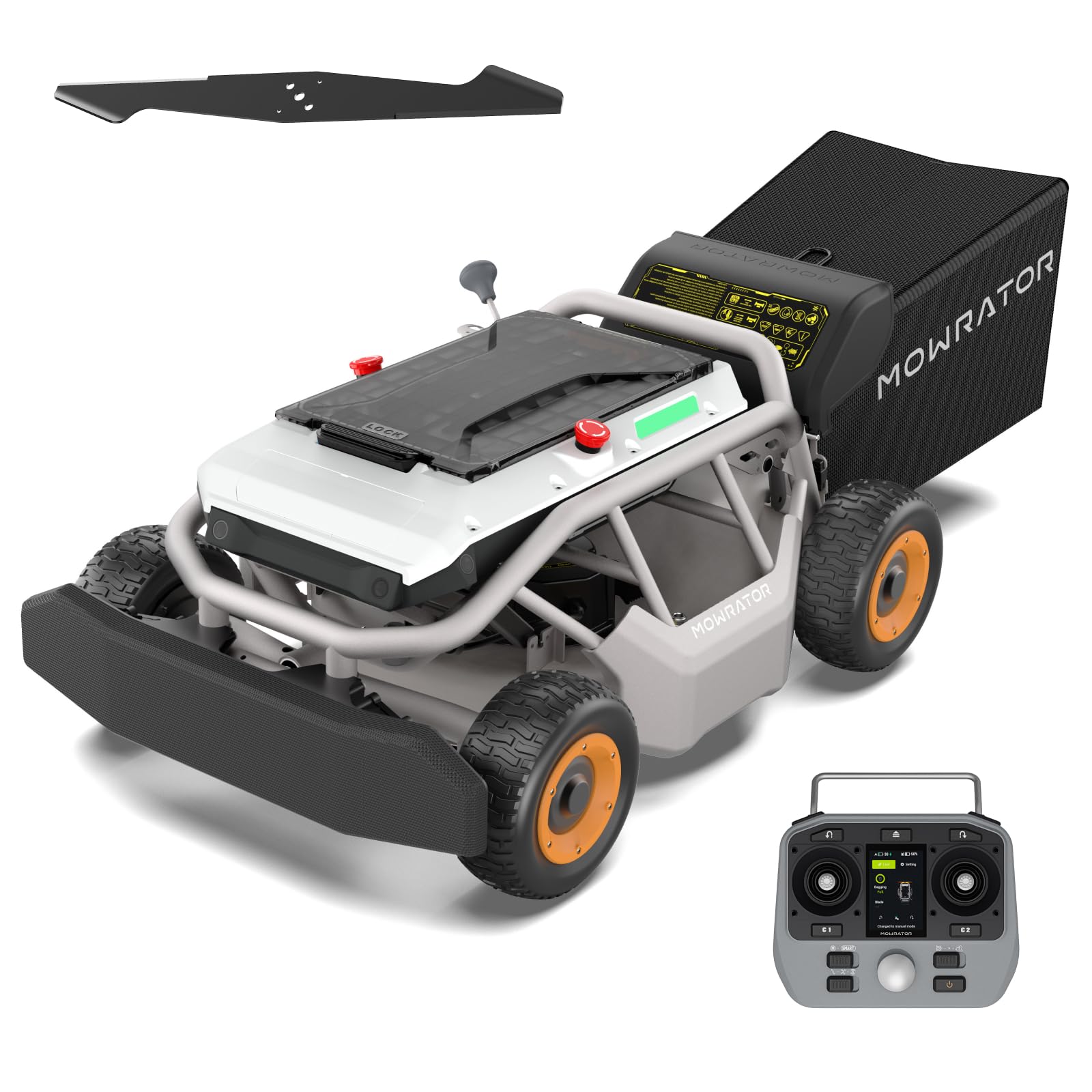
A remote-control beast with a 21-inch deck that chews through overgrown terrain.
The Mowrator S1 is not a robot — you drive it with a remote control — and it is built for yards where no autonomous mower can survive. It cuts a 21-inch swath, the widest on our list, and weighs 147.7 pounds, giving it the mass to push through thick, wet grass and over rocks. The 18Ah battery runs for 2.25 hours per charge, and the mower climbs slopes up to 75% (37 degrees). It is a full season machine: in spring you can add the optional tow hitch for hauling, in fall the mulching blade for leaves, and in winter the snow plow with snow chains.
Buyers call it a beast and a quality tool. One owner with 38 acres of steep, rocky terrain said the 4WD climbs like a mountain goat and cuts 10 times faster than a string trimmer. The low-latency remote control responds instantly, and the mower handles thick, wet grass without bogging down. The AWD can tear turf when turning sharply on soft ground, so you want to steer wide on delicate grass.
This is the machine for the worst-case lawn — steep, overgrown, rocky, and large. The trade-off is that you have to stand there and drive it, unlike the robots that mow on a schedule. At the highest price tier here, it is a serious investment, but buyers with truly challenging terrain say it earns every dollar. Mowrator offers a 2-year manufacturer warranty, and warranty support is reported as excellent. If you can live without a robot scheduler, the 21-inch deck and 147.7-pound mass mow over anything the Segway or MOVA would stall on.
What It Does Best
- 21-inch cutting width — fastest coverage here
- 147.7 pounds with metal, steel, and aluminum build
- Handles 75% slopes and overgrown grass
- Year-round use with optional attachments
What To Know
- You drive it manually — no schedule mowing
- Can tear turf during sharp turns
- Premium price
Buy this for: a steep, rocky, overgrown property larger than an acre where a robot would get stuck or damaged — this mower powers through what stops everything else.
Do not buy if: you want a low-maintenance robot that mows while you are away from home.
Understanding the Specs
Slope Rating
This is the angle of incline the mower can climb, usually expressed as a percentage — an 80% slope equals about 38.6 degrees, a very steep hill. The number matters because a standard 2WD mower loses traction on anything over 30% unless the grass is bone dry. A 4WD mower with a high slope rating (75% or higher) can handle the hills near your house without slipping or sliding backward. Always check the steepest part of your yard and buy a mower rated at least a few points higher.
Cutting Width and Deck Design
Cutting width tells you the size of the swath the mower cuts in one pass, measured in inches. A wider width (17 to 21 inches) finishes a lawn in fewer passes but creates a bigger, heavier machine that may struggle in tight gardens. A narrow width (around 8 inches) takes more passes but fits through gates and between flower beds easily. Robot mowers often use dual-disc designs with multiple floating blades, which handle uneven ground better than a single solid blade.
Battery Life and Coverage
Battery life is measured in minutes or hours per charge, but the real number to watch is the coverage area — how many square feet or acres the mower can handle on a single run. A 165-minute battery sounds impressive, but if the mower cuts slowly, it may only cover a quarter-acre before returning to dock. Pay attention to advertised coverage per charge and compare it to your yard size. Most robot mowers automatically return to charge and resume later, so a single charge does not have to finish the whole lawn.
Navigation System: LiDAR, RTK, and AI Vision
Modern wire-free robot mowers use one or more of these technologies. LiDAR (a spinning laser that measures distance) builds a 3D map of your yard in real time. RTK (Real-Time Kinematic) uses satellite corrections for centimeter-level GPS positioning, but often requires a local antenna. AI vision cameras look at objects and identify them — a dog, a hose, a tree root. The best systems combine all three, so when one sensor struggles (LiDAR in heavy dust, RTK under tree cover), another takes over without losing position.
FAQ
How steep of a slope can a 4 wheel drive lawn mower handle?
Do these mowers need boundary wires?
Can a robot mower handle wet grass?
What does RTK mean and do I need it?
How long does the battery last on these mowers?
Will a 4WD robot mower tear up my lawn when turning?
What is the difference between a robot mower and a remote control mower?
Can these mowers go over tree roots and curbs?
Do I need Wi-Fi in my yard for a robot mower to work?
What kind of warranty do these mowers come with?
Final Thoughts: The Verdict
For the majority of shoppers, the 4 wheel drive lawn mower winner is the MOVA LiDAX Ultra 3000 AWD because its 15.8-inch cutting width, wire-free LiDAR navigation, and 80% slope rating cover the widest range of hilly, medium-size lawns with the fewest compromises. If you want the absolute widest cut and zero-turn steering that protects your turf, grab the Segway Navimow X450. And for the toughest, rockiest terrain where no robot can survive, the standout is the Mowrator S1 and its 21-inch remote-controlled deck.
How We Picked
We do not accept paid placement, and we did not hands-on test every unit. Instead, we match each pick to a real buyer and use-case by comparing the manufacturers’ published specifications against the patterns in verified customer reviews — so you get each pick’s real strengths and trade-offs instead of marketing copy.
Sources & Methodology
Specifications: manufacturer listings and product documentation. Review insights: verified customer reviews, as of July 2026. Pricing: not shown on this page (it changes often); check the current price via the retailer link.
As an Amazon Associate, Lawn Gear Lab earns from qualifying purchases. This does not affect which products we feature.