
You water, you weed, and your plants still look sad. The problem is often not your effort — it is what you are feeding the soil. You need a balanced meal for your whole garden that won’t burn tender roots and actually delivers the right nutrients for everything from tomatoes and roses to shrubs and houseplants.
I’m Rikta — the co-founder and writer behind Lawn Gear Lab. This guide is built by comparing the manufacturers’ published specifications and the patterns across verified customer reviews, so you get each pick’s real strengths and trade-offs instead of marketing spin.
The best all purpose fertilizer for most gardeners is the FoxFarm Happy Frog, because its 6-4-5 ratio (6% nitrogen, 4% phosphorus, 5% potassium) delivers 50% more nitrogen than a balanced 4-4-4 formula and includes live soil microbes. For tomatoes and flowering vegetables, the Down To Earth 4-6-2 mix gives you a phosphorus boost that the FoxFarm cannot match. If you have a big garden on a budget, Jobe’s Organics 16 lb bag of 4-4-4 gives you the most coverage per dollar while staying organic.
How To Choose The Best All Purpose Fertilizer
Three numbers on a bag — they look like a secret code, but they are simply the percentage of Nitrogen (N), Phosphorus (P), and Potassium (K) inside. Nitrogen pushes leafy green growth, phosphorus helps roots and flowers bloom, and potassium builds overall plant health and disease resistance. Your choice between organic and synthetic, and between granules and water-soluble powder, depends on how fast you want results and how much effort you want to put into mixing.
N-P-K Ratio: The Numbers Matter More Than the Brand
A balanced formula like 4-4-4 or 5-3-3 is safe for almost all plants and unlikely to burn roots if you apply too much. A high-number formula like 20-20-20 is a strong, fast-acting blend that needs careful measuring — great for a quick green-up on lawns or hungry vegetables, but risky for delicate seedlings or container plants where salts can build up.
Organic vs. Synthetic: It Is About Speed and Soil Health
Organic fertilizers are made from natural ingredients like bone meal, feather meal, and kelp. They release nutrients slowly as soil microbes break them down, which feeds the living biology in your dirt. Synthetic fertilizers deliver nutrients instantly to the plant roots, giving you a faster visual result, but they do very little for long-term soil structure. Homeowners often prefer organic for flower beds and vegetables, while a synthetic water-soluble option is handy for a quick pick-me-up on lawns or potted plants that are clearly starving.
Granules vs. Water-Soluble: One is “Set and Forget”, the Other Is “Mix and Pour”
Granular fertilizers, like the FoxFarm Happy Frog or Jobe’s Organics, are sprinkled onto the soil and break down with watering over weeks. You apply them once and do not think about it again for a month. Water-soluble types, like the GS Plant Foods 20-20-20, must be mixed with water and applied every one to two weeks. They work faster, but they also demand a recurring chore. If you travel or tend to forget, stick with granules. If you enjoy a weekly garden ritual and want rapid results, go soluble.
Quick Comparison
On smaller screens, swipe sideways to see the full table.
| Model | Category | Best For | Key Spec | Amazon |
|---|---|---|---|---|
| FoxFarm Happy Frog | Organic Granules | Reviving weak vegetables | 6-4-5 + soil microbes | Amazon |
| Down To Earth Tomato & Veg | Organic Granules | Tomatoes & flowers | 4-6-2 formula | Amazon |
| Espoma Plant-Tone | Organic Granules | Low-maintenance feeding | 5-3-3 + Bio-tone | Amazon |
| GS Plant Foods 20-20-20 | Water-Soluble | Quick green-up | 1:1:1 ratio + kelp | Amazon |
| Jobe’s Organics 4-4-4 | Organic Granules | Large gardens & lawns | 16 lbs, 4-4-4 | Amazon |
| Espoma Garden Food 10-10-10 | Synthetic Granules | Heavy feeders & trees | 10-10-10, pack of 2 | Amazon |
In‑Depth Reviews
1. FoxFarm Happy Frog All Purpose Fertilizer

You get one bag that works on everything — from a fussy Monstera in your living room to a row of tomatoes in the back yard. The FoxFarm Happy Frog is the most versatile pick here because its 6-4-5 ratio delivers 50% more nitrogen than the balanced 4-4-4 formula of Jobe’s Organics, so your leafy greens and ornamentals get a noticeable growth boost right away. Buyers report it revived yellow tomato and zucchini plants to green within a week — a rare speed for a granular organic. The secret is that it contains live soil microbes and mycorrhizal fungi, which are tiny organisms that help roots absorb water and nutrients more efficiently. This gives you results that look almost like a synthetic fertilizer without the chemical salts. The honest drawback is the smell: reviewers consistently note it has a strong, manure-like odor that is pungent indoors, and a few warn that if you sprinkle it too thick you can get a bit of white mold on the soil surface after watering. If you have a sensitive nose or grow indoors, the Down To Earth 4-6-2 has a milder scent. For the sheer breadth of plants it handles and the speed of visible recovery, this is the bag to start with.
Why it’s great
- Live soil microbes and mycorrhizal fungi improve root health naturally
- OMRI listed so you can use it in organic vegetable gardens
- Fast visible results — buyers saw green-up within a week on yellowing plants
Good to know
- Strong barnyard smell that is noticeable indoors
- Must be sprinkled thinly to avoid white mold after watering
- 4 lb bag covers less ground than larger options
2. Down To Earth All Natural Fertilizers Organic All Purpose Tomato & Vegetable Mix

If you grow tomatoes, peppers, or other fruiting vegetables, this Down To Earth mix beats the FoxFarm Happy Frog on phosphorus — 6% vs. 4% — which directly supports bigger, more abundant flowers and fruit. The 4-6-2 ratio is a classic “bloom booster” for edible gardens, and it is a full 4.0x more phosphorus-rich than a balanced 1:1:1 synthetic like the GS Plant Foods 20-20-20. Owners mention it revived pale, flimsy tomato plants within two weeks after application, making it a reliable rescue option for a struggling veggie patch. The ingredients list reads like an organic farmer’s pantry: fish bone meal, blood meal, feather meal, rock phosphate, langbeinite, greensand, humates, and kelp meal — all slow-release sources that feed the soil food web rather than just the plant. Choose this over the FoxFarm if your priority is flowering and fruiting rather than general leafy growth, or if you grow in containers where the gentle 4-6-2 formula is very hard to overdo. The 5 lb box is compact enough for a small garden, but if you have a huge plot you may find yourself reordering sooner than you would with the 16 lb Jobe’s bag. It smells unpleasant for a few days after application, but customers note it dissipates.
Where it shines
- High phosphorus (6%) is ideal for tomatoes, peppers, and flowering vegetables
- OMRI listed and made from 100% organic ingredients with no synthetic chemicals
- Gentle, non-burning formula safe for seedlings and container plants
Worth noting
- Unpleasant smell that dissipates after a few days in the soil
- 5 lb box is a modest size for larger gardens
- Slower release than water-soluble options; plan ahead
3. Espoma Organic Plant-Tone 5-3-3

Imagine a fertilizer that you apply in the spring, forget about until the fall, and your plants still look fantastic. That is the Espoma Plant-Tone experience. Reviewers point out they use this twice a year, and the 5-3-3 ratio with 5% calcium is ideal for everything from roses and annuals to trees and shrubs. It is a true “set it and forget it” organic for the laid-back gardener. The pack of two bags (4 lb each) gives you 8 lb total for roughly the same money as a single 4 lb bag of many competitors, making it a strong value for anyone with multiple flower beds. The Bio-tone formula, which is a proprietary blend of beneficial microbes, helps break down the organic matter even in cooler soils when biological activity naturally slows down. The catch is that at 5-3-3 the nitrogen is slightly higher than phosphorus, so it leans more toward leafy growth than heavy flowering. If you grow a tomato patch that demands high phosphorus, the Down To Earth 4-6-2 mix is a better fit. For a general-purpose feed across your entire landscape with minimal effort, this bundle is the one to grab. It smells like chicken manure though — stand upwind when applying.
What stands out
- Pack of two provides excellent coverage for the money
- Contains Bio-tone beneficial microbes for cooler-weather feeding
- Approved for organic gardening and safe for all plant types
The trade-offs
- Foul smell like chicken manure — stand upwind when applying
- 5-3-3 ratio is lower in phosphorus than dedicated bloom formulas
- Slow-release requires patience; results appear over weeks, not days
4. GS Plant Foods All Purpose Water Soluble 20-20-20
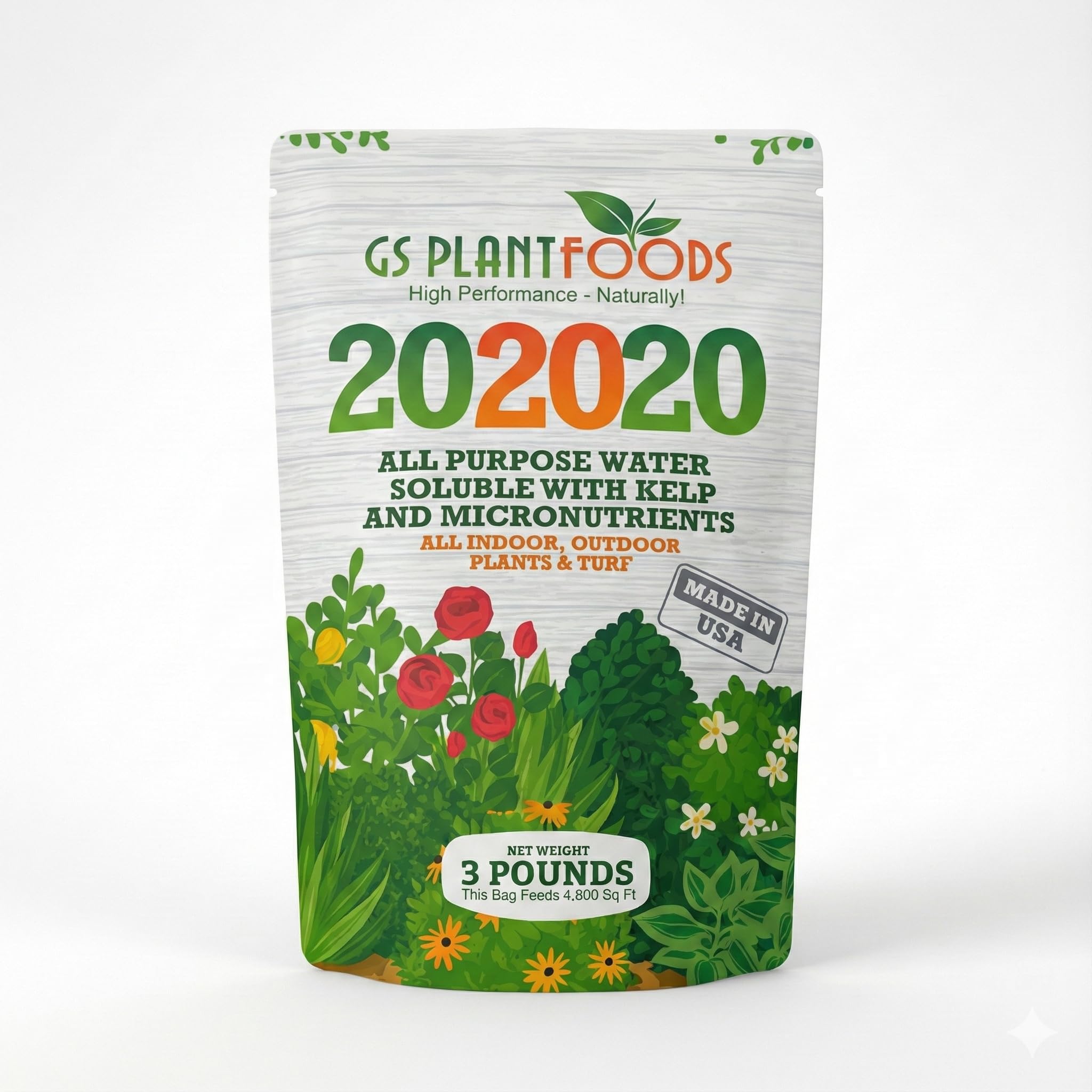
When a plant looks truly desperate — yellow leaves, stunted growth, dropping leaves — the fastest way to turn it around is a water-soluble fertilizer with a balanced, high-number ratio like 20-20-20. This GS Plant Foods powder dissolves completely in water and delivers nutrients directly to the roots within hours, not weeks. Shoppers say that applied to unhealthy purple orchid trees, within a week the treated tree had dark green, larger leaves versus yellow and brown on the untreated one. The downside you accept is that this is not organic — it is a mix of kelp and industrially produced minerals. It feeds the plant, not the soil, so you will need to apply it every one to two weeks and still use compost or a slow-release organic for long-term soil health. The 3 lb bag covers up to 4,800 sq ft of turf if used as directed, making it a great value for lawns and large container collections. For a price-to-performance read, this is the cheapest way to get a dramatic, fast visual result. If you are a houseplant enthusiast who wants to see immediate improvement or a lawn owner looking for a quick spring green-up, this delivers exactly that — but do not expect it to build healthy soil on its own. Use the Jobe’s 4-4-4 or FoxFarm Happy Frog for that.
The upsides
- Instant nutrient availability — visible results within a week
- Balanced 1:1:1 ratio suits almost any plant type
- Contains kelp extract (Ascophyllum nodosum) for natural growth stimulants
Keep in mind
- Not organic; it is a synthetic mineral blend
- Requires mixing and frequent reapplication every 1-2 weeks
- Does not improve soil biology or long-term fertility
5. Jobe’s Organics Granular All Purpose Fertilizer 4-4-4

For the price of a smaller bag from a premium brand, this Jobe’s Organics bag gives you 16 pounds of balanced 4-4-4 granules — which is 5.3x more product by weight than the GS Plant Foods 20-20-20 bag and 4x the FoxFarm Happy Frog. If you have a large vegetable garden, fruit trees, or a lawn you want to feed organically, this is the most economical way to cover a lot of ground without constantly reordering. What you give up is the specialized N-P-K advantage: at 4-4-4 it is perfectly neutral, so it will not give you the bloom boost of the Down To Earth 4-6-2 or the fast green-up of the FoxFarm 6-4-5. Buyers report it works great on lawns when applied with a hand-crank spreader, and that the granules do not create a dust cloud like some powders. Some reviewers also found that mixing 1 cup of granules to 1 gallon of water for 24 hours created a liquid feed that opened flower buds within 48 hours, giving you flexibility in how you use it. This is the exact pick for the budget-conscious organic gardener with a lot of ground to cover. If you want a single bag that feeds your whole yard — vegetables, shrubs, lawn, and trees — while staying affordable, this is the one to buy. Just know that you will need to supplement with the Down To Earth if you want a heavy tomato harvest.
Why we’d pick it
- Massive 16 lb bag provides excellent value per pound
- OMRI listed, 100% organic with no synthetic chemicals
- Versatile — can be applied dry or steeped into a liquid tea
A few caveats
- Balanced 4-4-4 ratio is not optimized for flowering or fruiting
- Pungent smell, though milder than raw manure according to buyers
- Requires application every 2-3 weeks during the growing season
6. Espoma Garden Food 10-10-10
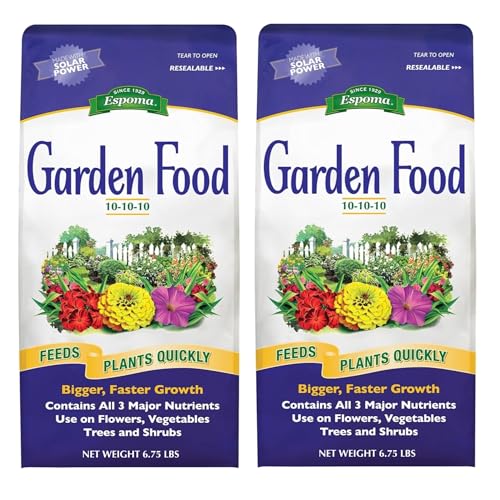
If you want the power of a synthetic fertilizer without the weekly mixing chore of a water-soluble powder, this Espoma Garden Food 10-10-10 is your best option. It is a granular formula that you sprinkle around the drip line and water in — no measuring scoop, no dissolving, no mess. The 10-10-10 ratio is three times more concentrated than a balanced organic like Jobe’s 4-4-4, so a little goes a lot further. What that money gets you is two bags (13.5 lb total) of a fast-acting synthetic that owners mention dramatically improved a 57-year-old lightning-damaged Magnolia tree and pushed a fig tree to yield roughly 5,000 fruits. It feeds plants quickly because the nutrients are already in a form roots can absorb immediately, unlike organics which need soil microbes to break them down first. The one reason to choose this over the organic options is if you have heavy-feeding plants like mature trees, large shrubs, or fruiting vines that need a strong, predictable nutrient hit. Just keep in mind that synthetic fertilizers can build up salts in containers and do not feed the soil microbes, so rotate it with compost or an organic feed like the FoxFarm Happy Frog if you care about long-term soil health.
Strong points
- High 10-10-10 concentration means a small amount covers a lot of ground
- Granular form is easy to apply with no mixing required
- Fast-acting — customers note dramatic growth in trees and heavy crops
Before you buy
- Synthetic formula does not improve soil biology or organic matter
- Risk of salt buildup in container plants if over-applied
- Not suitable for certified organic gardens
Understanding the Specs
N-P-K Ratio: The Three Numbers That Matter Most
Every fertilizer label shows three numbers separated by dashes, like 4-4-4 or 20-20-20. The first number is Nitrogen (N), which drives leaf and stem growth. The second is Phosphorus (P), which supports root development, flowers, and fruit. The third is Potassium (K), which strengthens overall plant health, disease resistance, and drought tolerance. A balanced ratio like 4-4-4 or 5-3-3 is safe for almost everything, while a high number like 20-20-20 is a concentrated fast-feed for hungry plants or lawns.
Organic vs. Synthetic: How They Feed Differently
Organic fertilizers come from natural sources like bone meal, blood meal, kelp, and rock minerals. They need soil microbes to break them down into plant-available forms, which takes time but builds healthy living soil. Synthetic fertilizers are manufactured mineral salts that dissolve instantly in water and go straight into the plant roots. They work faster but can build up salts that harm soil life over time if used exclusively. The “OMRI Listed” seal on a bag means the product is approved for certified organic production.
FAQ
Can I use a tomato-specific fertilizer on my lawn?
How often should I apply an all purpose granular fertilizer?
What is the difference between “slow-release” and “water-soluble”?
Final Thoughts: The Verdict
For the majority of shoppers, the best all purpose fertilizer winner is the FoxFarm Happy Frog because it combines a slightly nitrogen-rich 6-4-5 ratio with live soil microbes for fast visible results on almost any plant. If you grow heavy-feeding vegetables like tomatoes and peppers, grab the Down To Earth 4-6-2 for its high-phosphorus bloom boost. And for the budget-conscious gardener with a large yard, the massive Jobe’s Organics 16 lb bag gives you the most coverage for your money without sacrificing organic certification.