
You spot the first holes in your rose leaves, or maybe a sticky film on your tomato stems. The real question is simple: which spray actually stops the bugs without hurting your plants — and how much work will it take? This guide compares six of the most popular bug killers for plants on Amazon, breaking down what each one does best, what it costs in effort, and where it falls short, so you can grab the right one and get back to enjoying your garden.
I’m Rikta — the co-founder and writer behind Lawn Gear Lab. This guide is built by comparing the manufacturers’ published specifications and the patterns across verified customer reviews, so you get each pick’s real strengths and trade-offs instead of marketing spin.
Whether you are fighting aphids on your houseplants or Japanese beetles on your prize-winning roses, finding the best bug killers for plants means matching the active ingredient to the pest and the application style to your routine.
How To Choose The Best Bug Killers For Plants
The right bug killer depends entirely on what pest you are fighting, where your plant lives, and how much effort you want to put into mixing and spraying. A ready-to-use spray bottle is perfect for a quick fix on a few rose bushes, while a concentrate that makes 16 gallons is better if you have a whole vegetable patch to protect. Below are the key factors to think through before you buy.
Contact Kill vs. Systemic Action
A contact killer (a spray that kills bugs only when it directly hits them) works immediately but usually washes off with rain and often needs reapplication every week or two. A systemic insecticide (a chemical the plant absorbs into its leaves and stems, poisoning any bug that takes a bite) lasts much longer — up to four weeks — because the protection is inside the plant. The catch is that systemic formulas are often synthetic and may not be safe for edible crops or flowers that attract bees.
Organic vs. Synthetic Ingredients
If you garden organically or plan to eat what you grow, look for an OMRI Listed label (a certification from the Organic Materials Review Institute confirming the product meets organic standards) or a FIFRA 25(b) exemption (meaning the EPA considers the ingredients safe enough that the product doesn’t need a full pesticide registration). Natural options like neem oil (a cold-pressed oil from the neem tree) or B.t. (a naturally occurring soil bacterium that kills caterpillars) are highly effective on specific pests but often require more frequent spraying.
Ease of Use: Ready-to-Use vs. Concentrate
A ready-to-use (RTU) trigger spray bottle lets you start spraying immediately, and it is the best choice if you have a handful of pots or a few bushes. A concentrate (a liquid you measure and mix with water in a sprayer) makes many gallons of spray at a lower cost per bottle, but you have to mix it each time and clean your equipment afterward. Concentrates are the smarter buy if you have a large garden, many beds, or a recurring pest problem.
Targeting the Right Pest
No single spray kills every bug. Neem oil is excellent against soft-bodied insects like aphids, mealybugs, and spider mites, and it also works as a fungicide against powdery mildew. B.t. only kills caterpillars and worm-type larvae — it is harmless to bees and earthworms. A broad-spectrum synthetic formula might kill 100+ listed insects, but it can also kill beneficial bugs. Check the product label against the specific pest you have before buying.
Safety: Plants, Pets, People, and Pollinators
Most bug killers are safe for the listed plants when used as directed, but some can scorch leaves if applied in direct sunlight or at high temperatures. Many products claim to be bee-safe once the spray dries, but it is best to avoid spraying open flowers. If you have pets or kids playing nearby, look for formulas that are specifically labeled as safe around children and animals once dry, and always wait for the spray to dry before letting anyone back into the area.
Quick Comparison
On smaller screens, swipe sideways to see the full table.
| Model | Category | Best For | Key Spec | Amazon |
|---|---|---|---|---|
| Grower’s Ally Crop Defender 3 | Organic | Indoor & outdoor leaves & buds | 1.7 lb RTU bottle | Amazon |
| Ortho Rose & Flower Insect Killer | Systemic | Roses & blooms, 4-week protection | 1.5 lb RTU spray | Amazon |
| Miracle-Gro Nature’s Care | Contact | Quick daily-use spot spray | 1.54 lb RTU bottle | Amazon |
| Monterey B.t. | Organic | Caterpillars & worms on edibles | 8 fl oz concentrate | Amazon |
| Botanical Tradesman Neem Oil | Organic | Soft-bodied pests & powdery mildew | 3.4 fl oz concentrate | Amazon |
| Bonide Systemic Insect Control | Systemic | Ornamentals & shrubs | 16 oz concentrate | Amazon |
In‑Depth Reviews
1. Grower’s Ally Crop Defender 3 – Ready-to-Use Miticide, Insecticide, Fungicide
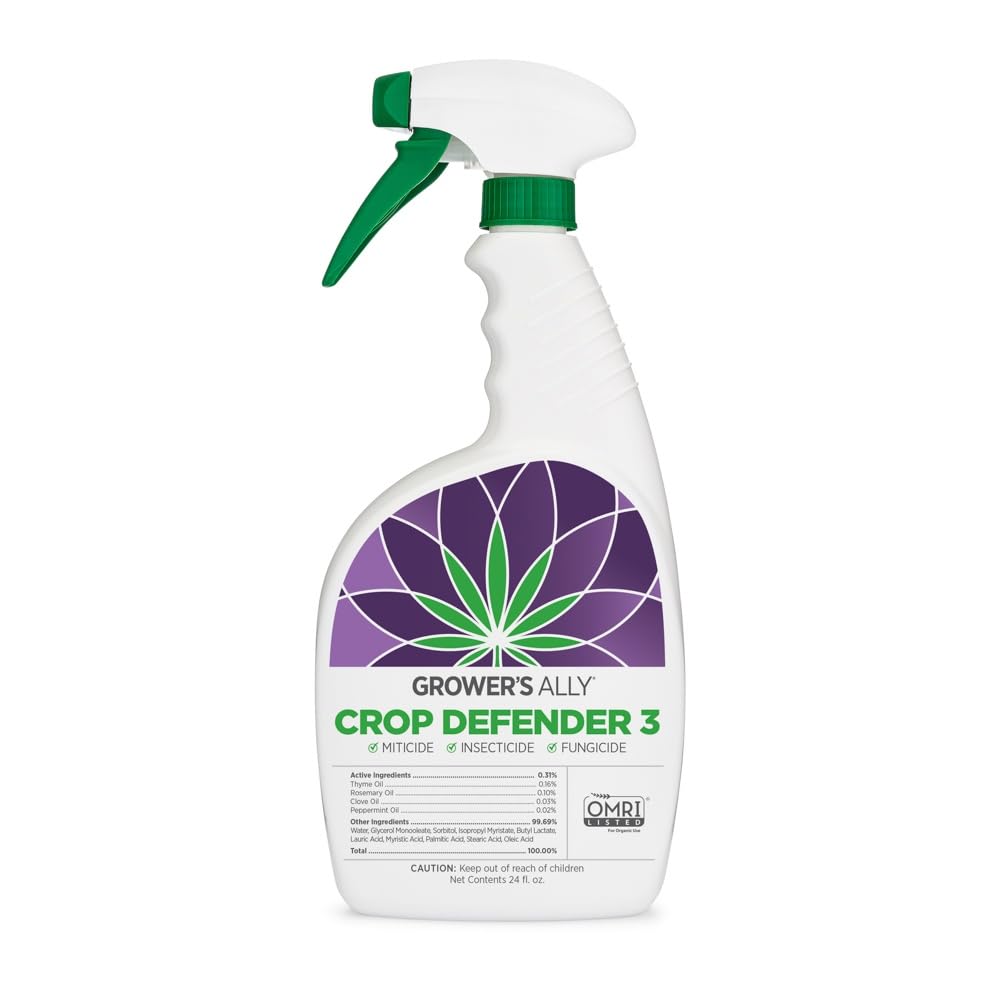
24 ounces ready-to-use, no mixing required — this is the one for growers who need a single spray that handles both spider mites on indoor herbs and aphids on outdoor potted tomatoes without burning seedlings. The 1.7-pound bottle feels solid but comfortable in one hand for a quick pass over your plants.
The triple-action formula combines a miticide, insecticide, and fungicide in one blend of botanical oils, killing soft-bodied insects and their eggs on contact while also tackling powdery mildew. Buyers report they “already ordered a larger bottle” after seeing results on aphids and spider mites, and they love that it “smells sooooo good too” — an unusual compliment for a bug spray. It is OMRI Listed for organic gardening, so you can spray it right up to harvest day or on flowering plants without worrying about toxins.
For the grower who values a safe, effective, all-in-one formula that won’t scorch even delicate seedlings, the Crop Defender 3 earns its top spot.
Why it’s great
- Triple-action (miticide + insecticide + fungicide) in one bottle
- OMRI Listed and bee-safe once dry
- Ready-to-use with no mixing needed
- Does not burn leaves, even on seedlings
Good to know
- Requires weekly reapplication for continuous protection
- 24-ounce bottle may not last long for large gardens
2. Ortho Rose and Flower Insect Killer, 24-Ounce

Where the Grower’s Ally requires weekly spraying, the Ortho uses a dual-action formula that kills bugs on contact plus a systemic action (the plant absorbs it into its foliage) that protects for up to four weeks. That means fewer trips to the garden with the spray bottle — a huge advantage if you are busy or have a lot of plants. However, at 1.5 pounds, it is 13% lighter than the Crop Defender 3 (1.7 pounds), so you get a slightly smaller bottle of the ready-to-use spray.
This spray is built for roses and flowering ornamentals, and it kills over 100 listed insect types including Japanese beetles, aphids, and spider mites. One reviewer dealing with Japanese beetles said, “I had to spray every other week or so, but they are finally gone!” — the systemic part means you do have to reapply at the label interval, but the protection between sprays is much more consistent than a contact killer gives you.
If your main pests hit your roses and flowers, and you prefer the convenience of spraying every three to four weeks instead of every week, the Ortho’s extended protection window makes it the smarter choice over the Grower’s Ally. Just note that the systemic action means it is not recommended for edible vegetables or fruits.
Where it shines
- Systemic action protects plants internally for up to 4 weeks
- Kills over 100 types of insects on contact and by ingestion
- Won’t harm blooms when used as directed
Worth noting
- Not labeled for use on edible plants
- Some users find the systemic effect weak on heavy mealybug infestations
3. Miracle-Gro 0754210 RTU24 Nature’s Care Garden Insect Control
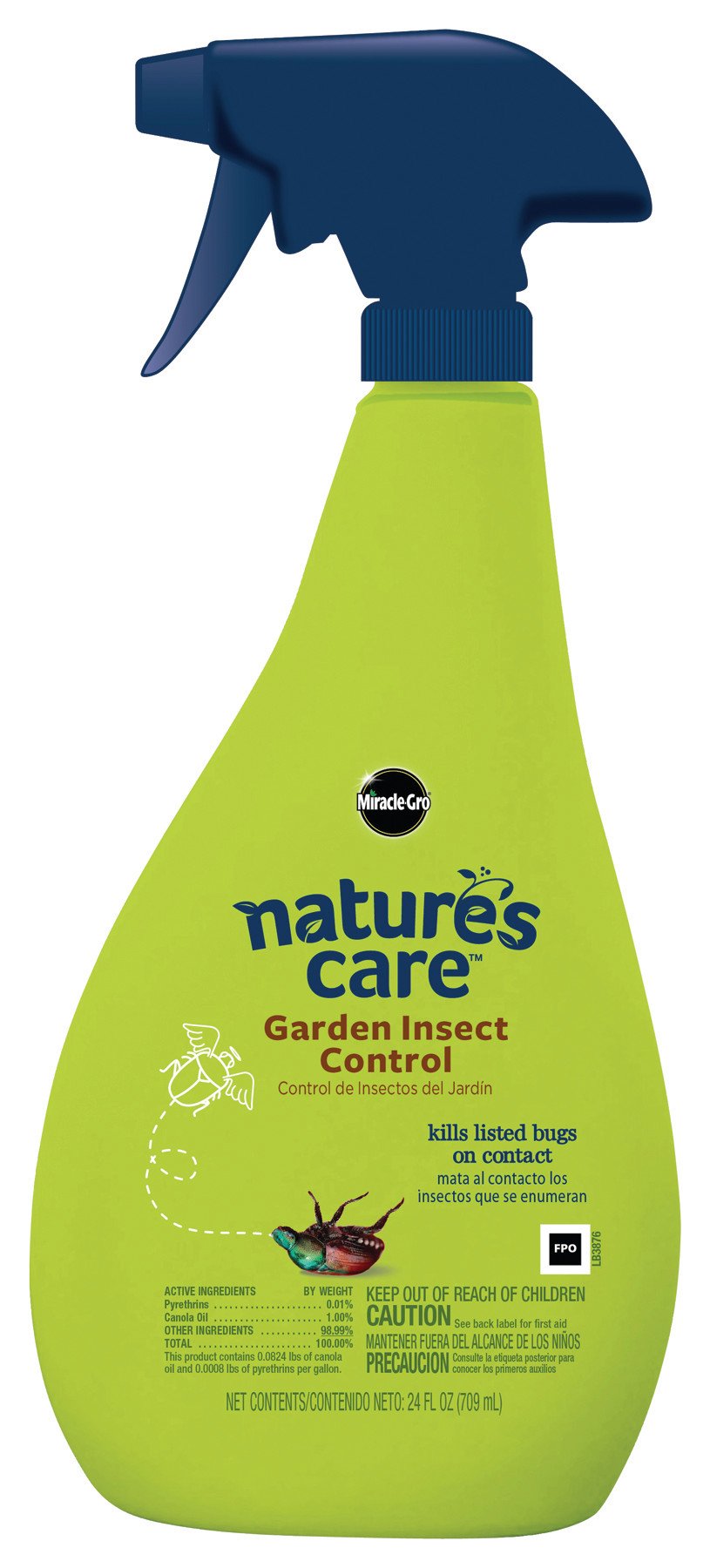
Picture this: you spot a cluster of aphids on your desk plant or ants marching up a rose stem, and you need them gone in the next ten seconds without a chemical smell bothering your workspace. This Miracle-Gro Nature’s Care spray is the closest thing to a fire extinguisher for a small, immediate pest situation. It is a ready-to-use 24-ounce bottle at 1.54 pounds that you just point and spray.
Buyers specifically note the “two nozzle settings (spot/wider spray)” — a feature that makes it easy to treat a single leaf or cover a whole bush. One office user described how weekly use after an alcohol wipe-down “eliminated mealybugs; plant recovered in <3 weeks” and emphasized that the product has “no strong odor” and is “office-safe.” It kills Japanese beetles, mites, and aphids on contact, and it can be applied right up to the day you harvest vegetables like tomatoes or peppers.
The stand-out spec here is the zero-odor formula — if you are spraying indoors, on a balcony, or in any space where a strong chemical or neem smell would be a problem, this is the only pick on the list that genuinely smells like nothing at all.
What stands out
- Two nozzle settings for spot or wide coverage
- Virtually no odor, safe for indoor use near people
- Can be applied up to day of harvest on edibles
The trade-offs
- Contact-only action; does not provide lasting systemic protection
- Some users report it reduces pests but does not fully eradicate heavy infestations
4. Monterey B.t. Bundled with Measuring Spoon – Caterpillar & Worm Killer Organic Gardening – 8 oz
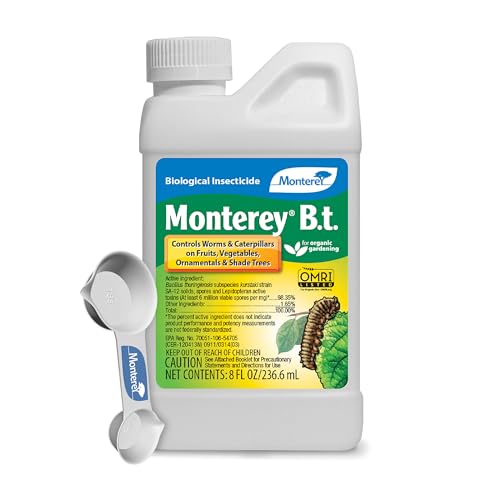
If cabbage loopers, bagworms, or tomato hornworms are chewing your vegetable patch to shreds, the single number that matters most is the unit count: the 8-fluid-ounce bottle of Monterey B.t. concentrate makes far more spray than any ready-to-use bottle — you mix it with water yourself. This makes it the most efficient weapon when your problem is specifically caterpillar-type larvae.
The downside is that B.t. (Bacillus thuringiensis, a naturally occurring soil bacterium that produces a protein toxic only to caterpillars) does nothing against aphids, mites, or beetles. It is a one-trick pony, but it is an incredibly safe one: it has no effect on birds, earthworms, honeybees, or ladybugs. One buyer confirmed this perfectly: “BT effectively eliminated cabbage loopers that destroyed flower seedlings last year; this year, seedlings and cilantro thrive.”
For the vegetable gardener who wants pinpoint accuracy against leaf-eating worms without hurting pollinators, this is the most cost-effective and environmentally precise choice on the list. The included measuring spoon makes mixing the concentrate a no-brainer, delivering strong price-to-value for targeted caterpillar control.
The upsides
- Completely safe for bees, earthworms, and beneficial insects
- OMRI Listed for organic gardening
- Concentrate form is very cost-effective for the volume of spray it produces
Keep in mind
- Only targets caterpillars and worm-type larvae; not a general insecticide
- Requires mixing with water and a separate sprayer
5. Botanical Tradesman Neem Oil Spray for Plants (Makes 320 Fl Oz) – Pure Cold Pressed Neem Oil

At the budget-friendly end of the lineup, what you actually get with this neem oil kit is a 3.4-fluid-ounce bottle of 100% cold-pressed neem concentrate plus a reusable 16-ounce trigger spray bottle. When you dilute the concentrate according to the instructions, it makes roughly 320 fluid ounces of spray — that is about 20 full refills of the included spray bottle. That is a huge volume of spray for the money.
What you give up is convenience and smell. Neem oil is thick and sticky, and buyers caution that “the oil is very thick and not easily mixed with water” — you need to shake it thoroughly, and the product label recommends adding a mild liquid soap as an emulsifier. The scent is also divisive; one buyer described it as “smells terrible but effective,” while another noted the smell lingers. On the plus side, it worked: reviewers report it got rid of thrips and scale in just two treatments, and another saw fungus gnat counts drop from 3-8 per plant down to 1-2 after a 4-week cycle.
This kit is perfect for the thrifty gardener who already has a sprayer and is willing to tolerate a bit of mixing and a strong earthy smell in exchange for an organic, multi-purpose concentrate that works on aphids, mites, thrips, scale, and even powdery mildew.
Why we’d pick it
- Extremely cost-effective: makes up to 320 fl oz of spray from one bottle
- 100% cold-pressed, organic neem oil concentrate
- Effective on a wide range of soft-bodied pests and fungal issues
A few caveats
- Strong, lingering smell that some find unpleasant
- Oil is thick and requires careful mixing with warm water and soap
6. Bonide Systemic Insect Control, 16 oz Concentrate – Makes 16 Gallons

This Bonide concentrate is perfect for the budget-conscious gardener who needs to treat a very large outdoor area—think multiple shrubs, trees, or extensive flower beds—without spending a fortune on ready-to-use sprays. The 16-ounce bottle makes 16 gallons of finished spray, which is 2,048 fluid ounces of treatment from one container, a volume no ready-to-use or small concentrate bottle can match.
What that money buys is a potent systemic insecticide containing acephate, a synthetic compound absorbed by the plant, that targets thrips, mealybugs, scale, spider mites, and whiteflies. It works fast and kills bugs hiding in the soil or under leaves where contact sprays never reach. However, it is for outdoor ornamental plants only—no vegetables or fruit—and the smell is extremely strong; owners mention it “smells like actual poop, noticeable indoors” and “is like a dumpster that’s been baking in the sun for a week.”
The one reason to choose this over everything else is raw power and coverage for large yards with arborvitae trees, rose beds, and shrubs hit by persistent scale or bagworms year after year. Just be gentle with its one weakness: the overwhelming odor makes it unsuitable for use near windows, patios, or any area where people gather.
Strong points
- Extremely economical: makes 16 gallons from one 16 oz bottle
- Systemic action reaches pests contact sprays miss
- Fast-acting on thrips, scale, mealybugs, and spider mites
Before you buy
- Very strong, unpleasant odor during application
- Not for use on edible plants; outdoor ornamental use only
- Can cause leaf burn if sprayed in direct sun
Understanding the Specs
Active Ingredient
The chemical or natural compound that actually kills the pests. Common ones are neem oil (blocks bugs from feeding and breeding), B.t. (a bacterium that dissolves caterpillar guts), and acephate (a synthetic systemic that the plant absorbs). Always match the active ingredient to the specific pest you have — a broad-spectrum synthetic might kill everything including the good bugs, while a targeted organic ingredient like B.t. leaves bees and butterflies alone.
Form: Ready-to-Use (RTU) vs. Concentrate
A ready-to-use bottle is filled with pre-diluted spray so you can start spraying immediately — no mixing, no measuring, no cleanup. A concentrate is a small bottle of pure active ingredient that you dilute with water in a separate sprayer. RTU is convenient for a few plants; a concentrate is much more cost-effective for a big garden because one small bottle can make many gallons of mixed spray.
Contact vs. Systemic Action
A contact insecticide (a spray that works only when it hits the bug directly) kills instantly but washes off with rain and has no leftover protection. A systemic insecticide (a chemical the plant absorbs through its roots or leaves) stays inside the plant, poisoning any bug that takes a bite for weeks afterward. Systemics are more convenient but usually synthetic and often restricted from use on food crops.
OMRI Listed & FIFRA 25(b) Exempt
OMRI Listed means the Organic Materials Review Institute has verified that the product meets USDA organic standards — it is safe to use on certified organic farms and in organic gardens. FIFRA 25(b) exempt means the EPA has determined the ingredients (typically botanical oils or biologicals like B.t.) pose minimal risk, so the product does not require a full EPA pesticide registration. Both labels mean you are using a product that is safe for edible plants, pollinators, and the environment.
FAQ
Can I use these bug killers on my vegetable garden?
How often do I need to spray my plants?
Will these sprays hurt my bees or ladybugs?
What is the difference between neem oil and B.t.?
Final Thoughts: The Verdict
For most gardeners, the best bug killers for plants winner is the Grower’s Ally Crop Defender 3 because it delivers a safe, triple-action organic formula that kills mites, insects, and fungus on contact without burning delicate leaves. If you want four weeks of protection with fewer spray sessions, grab the Ortho Rose and Flower Insect Killer. And for an ultra-specific, pollinator-safe solution against caterpillars on your vegetables, the standout is the Monterey B.t. concentrate.