
Your shrubs look tired — maybe the leaves are pale, growth has slowed, or blooms just aren’t happening this year. The difference between a so-so shrub and a lush, thriving one often comes down to one decision: what you feed it. With so many bags, spikes, and powders promising results, the real trick is matching the right formula and form to your specific plants and your schedule.
I’m Rikta — the co-founder and writer behind Lawn Gear Lab. This guide is built by comparing the manufacturers’ published specifications and the patterns across verified customer reviews, so you get each pick’s real strengths and trade-offs instead of marketing spin.
Whether you need a quick boost for flowering azaleas or a complete slow-release plan for your entire yard, the right shrub fertilizer delivers visible results without the guesswork or the risk of burning your plants.
How To Choose The Best Shrub Fertilizer
Picking the wrong fertilizer is like putting diesel in a gas engine — the numbers and the form matter more than you think. Here is what to look for so you get greener leaves and more blooms without the headache.
Decode the NPK Ratio (The Three Numbers)
Every fertilizer label shows three hyphenated numbers like 19-8-10 or 4-4-4. The first is Nitrogen (N) — it drives leaf and stem growth. The second is Phosphorus (P) — it boosts roots and flowers. The third is Potassium (K) — it strengthens overall health and disease resistance. A balanced all-purpose feed like 4-4-4 works for general shrubs, while a high-nitrogen 19-8-10 is better for established trees and evergreens that need a green-up boost.
Choose Your Form: Granules vs. Spikes vs. Water-Soluble
Granules are the workhorse — you sprinkle them around the drip line (the circle under the outermost branches) and water them in, and they break down over weeks. Spikes are the lazy gardener’s dream: you hammer them into the soil and they feed slowly for an entire season. Water-soluble powders give you instant results (you see greener leaves within a week), but you have to reapply every 7-14 days. Your schedule determines the winner here.
Organic vs. Synthetic: Pick Your Speed
Organic fertilizers (like those labeled OMRI or Bio-tone) release nutrients slowly as soil microbes break them down — they won’t burn your plants and they improve soil health over time. Synthetic formulas deliver a faster, more concentrated jolt of nutrients, which is ideal for rescuing a struggling shrub but riskier if you over-apply. If you have kids or pets playing near your shrubs, organic is the safer bet.
Quick Comparison
On smaller screens, swipe sideways to see the full table.
| Model | Category | Best For | Key Spec | Amazon |
|---|---|---|---|---|
| Miracle-Gro Water Soluble Azalea, Camellia, Rhododendron Plant Food | Water-Soluble | Acid-loving plants & fast green-up | 5 lb. powder, 80 oz. | Amazon |
| Espoma Organic Plant-Tone 5-3-3 Natural & Organic All Purpose Plant Food | Organic Granules | All-purpose organic feeding | 4 lb. bag, 128 oz. | Amazon |
| Fertilome (13865) Tree and Shrub Food 19-8-10 | Granules | High-nitrogen green-up for trees & shrubs | 1.5 lb. bag, 19-8-10 | Amazon |
| Jobe’s Organics Granular All Purpose Fertilizer, 16 lbs | Organic Granules | Large gardens & heavy feeders | 16 lb. bag, 4-4-4 | Amazon |
| Jobe’s Tree Fertilizer Spikes, 16-4-4, 30 Spikes | Fertilizer Spikes | No-mess, season-long feeding | 30 spikes, 16-4-4 | Amazon |
| Espoma Organic Holly-Tone 4-3-4, 36 lb. | Organic Acid-Loving | Acidic soil plants & evergreens | 36 lb. bag, 4-3-4 | Amazon |
| The Old Farmer’s Almanac Tree & Shrub Fertilizer Spikes, 24 Count | Fertilizer Spikes | Easy, fast-acting spike application | 24 spikes, 13-3-3 | Amazon |
In‑Depth Reviews
1. Miracle-Gro Water Soluble Azalea, Camellia, Rhododendron Plant Food

5 pounds of water-soluble powder that delivers greener leaves and bigger blooms within a week — this is the top pick for gardeners who want the fastest visible payoff from a shrub fertilizer and who own acid-loving plants like azaleas, camellias, rhododendrons, gardenias, and hydrangeas. The 5-pound bag dissolves instantly in water and feeds through both roots and leaves, and it is designed specifically for plants that prefer low-pH soil. One buyer reports that “this truly helped our rhododendron to recover and look stunning this summer.”
You mix it at a ratio of 1:144 for indoor plants or 1:18 for outdoor shrubs (about 1 tablespoon per gallon of water), then apply every 7-14 days with a watering can or garden feeder. The resealable bag keeps the powder dry between uses, and buyers report the Velcro seal works well as long as no powder gets on the closure. At 80 ounces total, this is a solid value for a season of weekly feeding.
Your shrubs will green up fast, but the catch is you have to stick to a regular schedule — skip two weeks and the boost fades. This is the pick for the gardener who enjoys weekly tending and wants dramatic, visible results.
Why it’s great
- Fast visible results within days
- Perfect for acid-loving plants like hydrangeas and azaleas
- Easy mix-and-pour application
Good to know
- Requires reapplication every 7-14 days
- Not ideal for all-purpose shrubs that need balanced 4-4-4 nutrition
2. Espoma Organic Plant-Tone 5-3-3 Natural & Organic All Purpose Plant Food

If the Miracle-Gro is the quick boost, this organic granule feed is the long game — it releases nutrients slowly as soil microbes (tiny organisms in the dirt) break it down, so you feed the soil, not just the plant. The 5-3-3 ratio is gentler than high-nitrogen synthetics (compare to Fertilome’s 19-8-10), and the 4-pound bag covers roughly 100 square feet of garden bed. Owners mention it “works quickly; saw rapid spring growth” and call it the best organic option they’ve used.
The key advantage here is the Bio-tone formula (a mix of beneficial microbes and mycorrhizae, a type of fungus that helps roots absorb water) that strengthens root systems over time. You apply it in spring and fall around the drip line, then water it in — no mixing, no measuring. Reviewers love that it doesn’t burn plants even if you accidentally over-apply, but one honest note: it smells like chicken manure, so stand upwind when spreading.
Choose this over the Miracle-Gro if you want a single feed that lasts months rather than weeks, and if gardening organically matters to you. It is also the better pick for mixed beds where you have flowers, vegetables, and shrubs all in one area.
Where it shines
- Slow-release organic feed lasts all season
- Bio-tone formula boosts root health
- Safe for all plants — won’t burn foliage
Worth noting
- Strong manure-like smell during application
- Slower to show results than water-soluble options
3. Fertilome (13865) Tree and Shrub Food 19-8-10
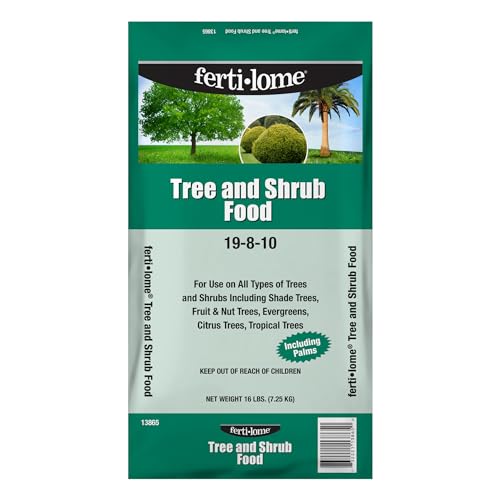
If you have mature trees and shrubs that look pale or have stalled growth, this high-nitrogen 19-8-10 formula is the jolt they need — the first number (Nitrogen, the nutrient that drives leaf growth) is nearly four times higher than all-purpose feeds like Espoma’s 5-3-3, pushing intense green leaf production. One buyer “applied twice in early spring to oaks, Bartlett pear, hollies, evergreens, and shrubs” and reported “unprecedented spring growth” even on trees where they underapplied the dose.
You simply sprinkle the granules around the drip line (the circle under the outermost branches) and water in — no digging required. The 1.5-pound bag goes a long way because the concentration is so high. A landscape professional recommended this product, and customers note they’ve used it for years with consistent results. The downside is that the high nitrogen means you must follow the dosage carefully to avoid burning grass or tender plants underneath the shrubs.
This is the specialist’s choice for established trees and evergreens that need a steady green-up, not for tender flowering shrubs where a balanced 4-4-4 is safer — a 19-8-10 ratio that delivers nearly four times the leaf-driving nitrogen of standard all-purpose feeds.
What stands out
- Extremely high nitrogen for rapid green-up
- Easy sprinkle application, no digging
- Visible results in days on trees and evergreens
The trade-offs
- Easy to over-apply and damage surrounding grass
- 1.5 lb. bag is small — better for targeted feeding than large yards
4. Jobe’s Organics Granular All Purpose Fertilizer, 16 lbs

The single most important number for a large garden is how much coverage you get per bag — the 16-pound bag of Jobe’s Organics is 10.7 times heavier than the Fertilome 1.5-pound bag, meaning you can feed a whole yard of shrubs, trees, flowers, and vegetables from one purchase. The balanced 4-4-4 NPK ratio works for everything, and the OMRI certification (Organic Materials Review Institute — a seal that means it is approved for organic gardening by the USDA) means it is safe for edible gardens.
The trade-off with such a large bag is that granules can take 2-3 weeks to show visible results compared to water-soluble feeds. One creative reviewer mixed it into a liquid feed (1 cup granules to 1 gallon dechlorinated water, steeped for 24 hours) and found the brown liquid produced “massive harvest” of squash with flower buds opening within 48 hours. The leftover solids went into the compost, making this a zero-waste option.
At the cost per pound, this is the smart buy for anyone with a large property or multiple raised beds who wants organic feeding without buying multiple bags.
The upsides
- Massive 16 lb. bag covers entire yards
- OMRI certified organic, safe for edible gardens
- Can be used dry or steeped into liquid feed
Keep in mind
- Slower results than synthetic or water-soluble options
- Strong organic smell when first applied
5. Jobe’s Tree Fertilizer Spikes, 16-4-4 Time Release, 30 Spikes

You get 30 pre-measured 16-4-4 spikes that you simply hammer into the soil around your shrubs — no hauling bags, no measuring scoops, no mixing. Each spike releases nutrients continuously for an entire season, delivering high nitrogen for leaf growth directly to the active root zone with zero runoff and zero smell.
One reviewer noted they were “effective for drought-stressed trees; tree recovered well” after a single season of use. The 30-spike pack covers about 30 shrubs or small trees, and you apply just once in early spring. Reviewers love that there is no risk of over-fertilizing because the slow-release design meters out the nutrients gradually. One limitation is that spikes work best in soft, damp soil — if you have clay-heavy ground, pre-drill a hole with a screwdriver to avoid the spike snapping.
This is the perfect fit for the weekend gardener who wants results without the weekly routine of mixing and pouring.
Why we’d pick it
- No measuring, no mixing, no mess
- Continuous feeding for a full season
- Safe — won’t burn plants even if you over-place
A few caveats
- Hard to hammer into dry or clay-heavy soil
- Less precise control over nutrient distribution vs. granules
6. Espoma Organic Holly-Tone 4-3-4, 36 lb. Bag

If your yard is full of azaleas, hydrangeas, rhododendrons, blueberries, and evergreens, the 36-pound bag of Espoma Organic Holly-Tone 4-3-4 is the only fertilizer you’ll need all year — it is the original formula for acid-loving plants, with a 4-3-4 ratio and 5% sulfur to lower soil pH. The sheer size (36 pounds) covers roughly 900 square feet of garden bed, making it the most cost-effective option per square foot for anyone with extensive acidic-soil plantings.
The organic Bio-tone formula feeds slowly through the season, and buyers rave that “you will never have so many blooms on your azaleas” after switching to Holly-Tone. Apply it in spring and again in fall around the drip line, then water in. One reviewer in the Bay Area specifically bought it for their magnolias and saw excellent results. The honest trade-off is that it only works for plants that prefer acidic soil (pH 4.5-6.0).
If you have a dedicated acid-lovers bed or a row of evergreens, this single bag replaces multiple smaller purchases and delivers consistently vibrant blooms — just don’t use it on neutral-loving shrubs like lilacs or clematis, or you’ll stress them.
Strong points
- Massive 36 lb. bag covers 900 sq. ft.
- Organic and safe for edible acid-loving plants like blueberries
- Proven results on azaleas, hydrangeas, and evergreens
Before you buy
- Only for acid-loving plants — not universal
- 36 lb. bag is heavy to carry and store
7. The Old Farmer’s Almanac Tree & Shrub Fertilizer Spikes, 24 Count
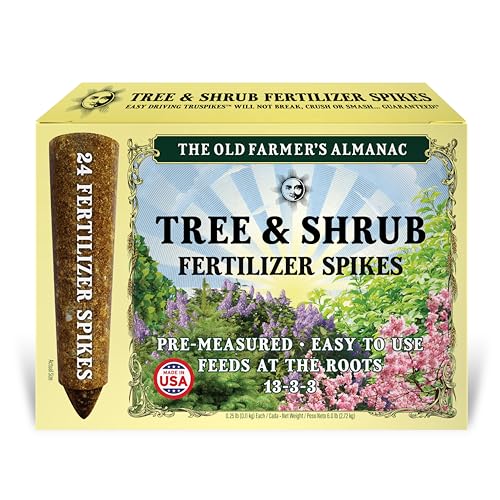
Compared to the Jobe’s spikes, these Old Farmer’s Almanac spikes come in a 13-3-3 ratio (slightly less nitrogen but still growth-focused) and use natural ingredients like molasses to feed the root zone directly. At 24 spikes per box, you get about the same coverage as the Jobe’s 30-count for a similar price, but the spikes are 5 inches long and built to stay intact even when hammered into tough clay soil.
Reviewers noticed results fast — one said “it’s only been 3 weeks since I staked them in and they’re already working,” with a visible circle of greener grass forming around the tree. Another used them on a Japanese Stewartia and fountain beech and saw more flowers and fuller leaves than ever before. The compromise is that some buyers found the spikes crack when hammered into hard ground, so pre-drilling a hole (or at least watering the soil first) is a smart precaution.
If you want the simplicity of spikes but prefer a brand with natural ingredients and a slightly lower nitrogen ratio for gentler feeding, this is your pick over the Jobe’s option.
What we like
- Natural ingredients including molasses for root health
- Visible results in as little as 3 weeks
- Spikes stay intact in clay soil
The downsides
- Can crack when hammered into dry, hard ground
- 24 spikes cover fewer plants than Jobe’s 30-count
Understanding the Specs
NPK Ratio — The Three Numbers That Matter
Every fertilizer label shows three hyphenated numbers like 4-4-4 or 19-8-10. The first is Nitrogen (N) — it drives leafy green growth and is what gives your shrubs that deep healthy color. The second is Phosphorus (P) — it supports root development, flowers, and fruit. The third is Potassium (K) — it strengthens cell walls, improves disease resistance, and helps the plant handle drought. A balanced all-purpose feed like 4-4-4 works for most shrubs, while a high-nitrogen 19-8-10 is for established trees that need a fast green-up boost.
Water-Soluble vs. Granules vs. Spikes
Water-soluble powder (like the Miracle-Gro option) dissolves in water and feeds plants instantly through both roots and leaves — great for a quick rescue or a weekly boost, but you have to reapply often. Granules (like Jobe’s Organics 16 lb. bag) are sprinkled on the soil and break down over weeks or months, requiring fewer applications but taking longer to show results. Fertilizer spikes (like Jobe’s or Old Farmer’s Almanac) are hammered into the ground and release nutrients slowly for an entire season — the most hands-off option, but less precise if you have many different plant types in one area.
Organic vs. Synthetic Fertilizers
Organic fertilizers (like Espoma Plant-Tone or Jobe’s Organics) use natural ingredients such as composted manure, bone meal, and feather meal. They feed the soil microbes first, which then release nutrients to the plant slowly — this improves long-term soil health and practically eliminates the risk of burning your shrubs. Synthetic fertilizers (like Fertilome 19-8-10) are chemically formulated for rapid, concentrated feeding. They work faster but can damage roots or kill surrounding grass if over-applied. If you have kids or pets, organic is the safer choice.
Acid-Loving vs. All-Purpose Formulas
Some shrubs — azaleas, rhododendrons, hydrangeas, camellias, blueberries, and evergreens — thrive in acidic soil (pH 4.5-6.0). Products like Espoma Holly-Tone or Miracle-Gro Azalea food include sulfur or other acidifiers to lower the soil pH around these plants. Using an all-purpose fertilizer on acid-lovers can lead to yellowing leaves and poor blooms. Conversely, using an acid-lover formula on neutral-pH shrubs like lilacs or clematis can stress them. Check which camp your shrubs fall into before choosing.
FAQ
How often should I fertilize my shrubs?
What is the best NPK ratio for flowering shrubs?
Can I use lawn fertilizer on my shrubs?
How do I apply granular fertilizer to shrubs without burning them?
Are fertilizer spikes better than granules?
Final Thoughts: The Verdict
For most buyers, the shrub fertilizer winner is the Miracle-Gro Water Soluble Azalea, Camellia, Rhododendron Plant Food because it delivers the fastest, most visible results for acid-loving shrubs and is incredibly easy to use with a watering can. If you want organic, slow-release feeding that builds soil health over time, grab the Espoma Organic Plant-Tone 5-3-3. And for the lowest-maintenance option — no mixing, no measuring, just hammer and forget — the standout is the Jobe’s Tree Fertilizer Spikes.