
Living in an apartment doesn’t mean you can’t compost your kitchen scraps — but a bin that smells, leaks, or takes up too much counter space will make you quit within a week. The right apartment composter hides odors, fits neatly on your counter, and makes it easy to collect food waste without attracting fruit flies or creating a mess. This guide breaks down the five best options, focusing on what actually works in a small kitchen: airtight seals, effective charcoal filters, easy cleaning, and a size that won’t feel like an eyesore.
I’m Rikta — the co-founder and writer behind Lawn Gear Lab. This guide is built by comparing the manufacturers’ published specifications and the patterns across verified customer reviews, so you get each pick’s real strengths and trade-offs instead of marketing spin.
Whether you are new to composting or upgrading from a smelly plastic tub, this breakdown of the best apartment composter options will help you pick the bin that fits your counter and your routine without the guesswork.
How To Choose The Best Apartment Composter
An apartment composter has one main job: keep food scraps contained and smelly until you can move them to a drop-off or outdoor pile. Here are the three things that separate a good bin from a regret.
Odor Control: The Filter Is Everything
Without a sealed lid and a replaceable charcoal filter, your kitchen will start to smell like a pile of old vegetable peels. The charcoal filter (a small disc or block of activated carbon that traps odor molecules) is the single most important part. You want a bin where the filter is easy to replace and the lid forms a tight seal — that is what keeps fruit flies out and smells in.
Size and Capacity: How Often Do You Want to Empty It?
Apartment composters range from about 1.1 to 1.75 gallons. A 1.1-gallon bin is small enough to tuck in any corner but will need emptying every 2 to 3 days. A 1.75-gallon bin gives you more room but takes up more counter space. Think about how much food waste you produce in a typical week and pick accordingly — too big and it encourages smell buildup, too small and you are walking to the trash bin constantly.
Ease of Cleaning: Smooth Surfaces Win
Bins with welded seams, corners, or textured interiors trap food residue and take forever to scrub. Look for a composter with a smooth interior, a removable inner bucket, or dishwasher-safe parts. Stainless steel resists stains and odors better than plastic, but good-quality plastic with a smooth surface can be just as easy to maintain if it has no hard-to-reach crevices.
Quick Comparison
On smaller screens, swipe sideways to see the full table.
| Model | Category | Best For | Key Spec | Amazon |
|---|---|---|---|---|
| EPICA 1.3 Gallon | Stainless Steel | Odor-free countertop bin | 1.3 gal capacity / 11″ tall | Amazon |
| KIBAGA Beautiful 1.1 Gal | Carbon Steel | Style & stink-proof lid | 1.1 gal / 10.2″ tall | Amazon |
| OXO Good Grips 1.75 Gal | Plastic | Largest capacity & smooth interior | 1.75 gal (6.62 L) / 12″ tall | Amazon |
| Dullrout 1.13 Gallon | Rectangular | Low-profile countertop bin | 1.13 gal / 6.8″ tall | Amazon |
| KAZAI. Elin 1.2 Gal | Bamboo Lid | Low-profile & stylish design | 1.2 gal (4.5 L) / 6.5″ tall | Amazon |
In‑Depth Reviews
1. EPICA Countertop Compost Bin (1.3 Gallon)

The 1.3-gallon capacity (11 inches tall, 7.16 inches wide) makes the EPICA the top pick for anyone who needs a countertop bin that goes several days between empties without smelling, thanks to its replaceable activated-charcoal filter and airtight lid. It is the pick for anyone who wants a no-nonsense composter that looks like a kitchen appliance, not a plastic bucket.
Buyers report that “with proper handling, the filter lasts over six months,” which means you are not constantly buying replacements. The one-piece molded stainless steel body resists rust and leaks — unlike welded bins that fall apart over time — and it is easy to clean because there are no seams for food to hide in.
The only real limit is the shape: at 11 inches tall, it is taller than some other options, so check your cabinet clearance if you plan to store it underneath. For most counters, though, it fits right in. This is the confident, do-it-all winner for the typical apartment kitchen.
Why it’s great
- 1.3 gallon capacity is the sweet spot for everyday use
- Charcoal filter keeps odors completely locked in
- One-piece stainless steel is rust-proof and dishwasher-safe
Good to know
- Taller design may not fit under low cabinets
- Weighs only 0.01 ounces listed — bin is actually solid metal
2. Beautiful Kitchen Compost Bin (1.1 Gallon)
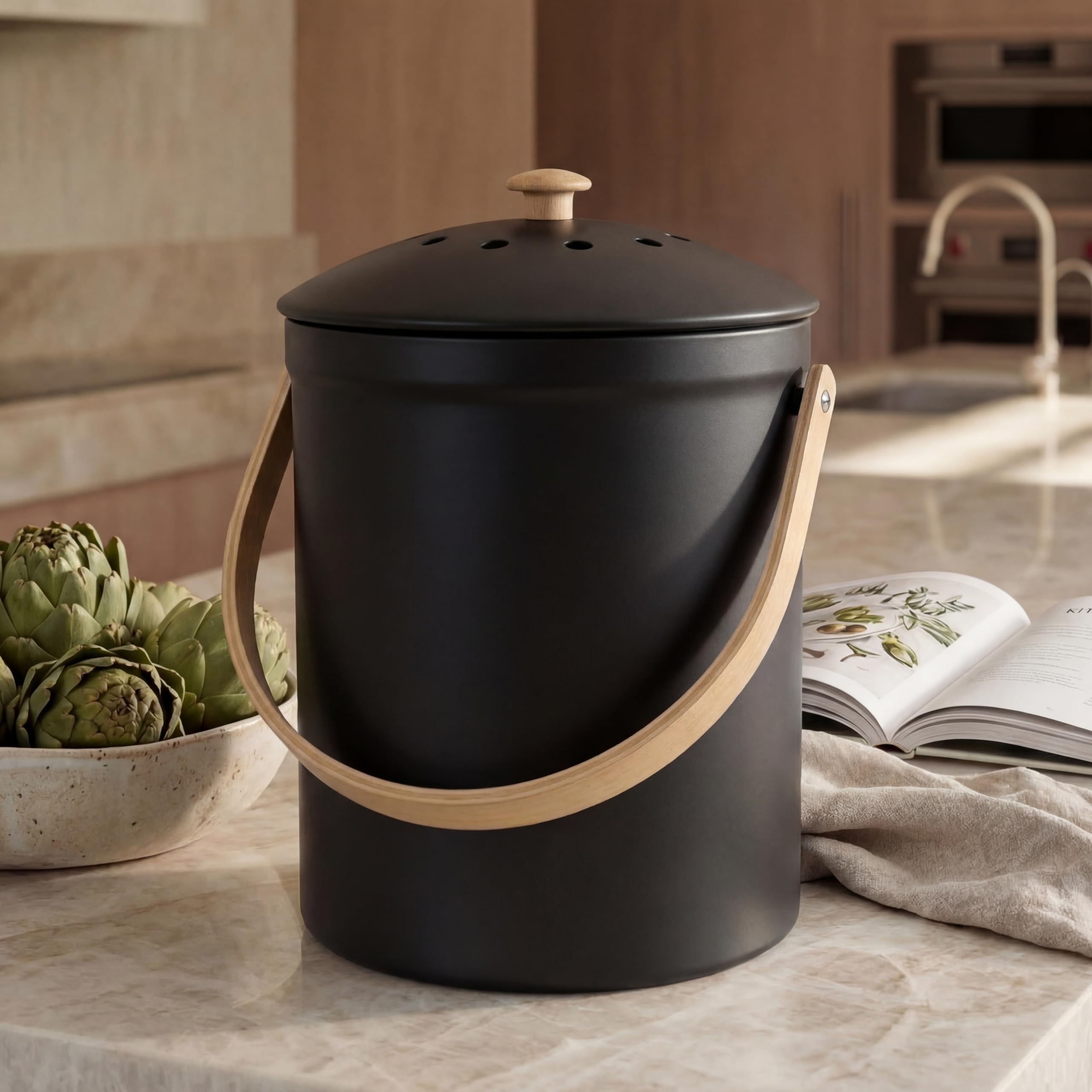
Where the EPICA is all business, this KIBAGA bin beats it on looks — the powder-coated carbon steel body and wooden handle bring a warm, modern feel to your countertop that blends with decor, not hides from it. It trades a bit of capacity (1.1 gallons vs EPICA’s 1.3) and comes in 64% heavier at 1.21 kilograms (about 2.7 pounds), so it feels substantial and does not slide around when you scrape plates.
The built-in charcoal filter compartment and air holes in the lid provide aeration (small vents that let air circulate so the compost doesn’t go anaerobic and stink) while the filter absorbs smells. Its 10.2-inch height is actually 0.8 inches shorter than the EPICA, meaning it fits better under cabinets.
Choose this one over the EPICA if the look of the bin matters as much as the function — it is the rare composter that you would be happy to leave out on your counter all the time, and its odor control is just as reliable.
Where it shines
- Stylish black finish and wooden handle elevate the look
- Includes two charcoal filters to get you started
- Rust-free carbon steel is built to last
Worth noting
- Lid is non-removable, making full cleaning a bit trickier
- Heavier than most plastic bins at 1.21 kg
3. OXO Good Grips Easy-Clean Compost Bin (1.75 Gallon)

If you cook a lot and want to minimize trips to the drop-off bin, the OXO offers the largest capacity here at 1.75 gallons (6.62 liters) — a full 41% more volume than the 1.13-gallon Dullrout bin. That extra room means you can empty it once or twice a week instead of every other day, and the smooth, seam-free interior makes cleaning genuinely easy: nothing sticks to the plastic.
The soft-close lid (a hinge that lowers gently without slamming) stays open while you are chopping so you can toss scraps one-handed, then seals shut to contain odors. Oxygen flows through the lid vents to reduce moisture and smells. Owners mention that the bin is “easy to line” and the lid prevents bags from drooping inside. However, after two years, one reviewer reports that “the liner lets in water, and the interior has stained” — a sign that the plastic will eventually show wear.
The standout spec here is the 1.75-gallon capacity in a compact 8.3-by-10.15-by-12-inch footprint. That is the single reason to choose it: maximum holding power in a kitchen without the bulk of a full-size bin.
What stands out
- Largest capacity of the group at 1.75 gallons
- Smooth, crevice-free interior is a breeze to wash
- Soft-close lid allows one-handed operation during cooking
The trade-offs
- Plastic may stain over years of use
- Weighs just 0.74 kg — very light but less premium-feeling
4. Dullrout Compost Bin (1.13 Gallon)

The single number that matters most in an apartment composter is whether the lid seals properly, and the Dullrout scores well here with its press-button, pop-up lid that flips down to lock in odors. At 1.13 gallons, it holds enough for a day or two of scraps and fits in tight corners thanks to its rectangular shape (9.9 by 7.4 by 6.8 inches) — it is 41% shorter than the KIBAGA bin (6.8 inches vs 10.2 inches), making it one of the lowest-profile options.
The catch is that the pop-up button mechanism can stick over time — a few buyers mention it gets hard to open with full hands. The exterior is hard to clean around the lip where water and bits can collect. On the plus side, the removable inner bucket lifts out for easy emptying and the whole thing seals smells well enough. One reviewer who has had it over a year says it still works great and contains odor completely.
You get the combination of a rectangular footprint (fits flush against a wall or under cabinets) and a removable inner bucket at a reasonable price point — solid value for the space-conscious apartment dweller who does not need the largest bin.
The upsides
- Compact rectangular shape fits in tight spaces
- Removable inner bucket makes emptying easy
- Pop-up lid seals odors well when closed
Keep in mind
- Button can stick over time, making opening tricky
- Exterior lip can trap water during cleaning
5. KAZAI. Compost Bin ‘Elin’ (1.2 Gallon)

At 6.5 inches tall and 9.9 inches wide, the KAZAI Elin is the lowest-profile bin on this list — it sits shorter than a coffee mug and slides under cabinets with room to spare. What you actually get at this lower price is 1.2 gallons of capacity (4.5 liters), enough for daily scraps from a one or two-person household, in a bin that is completely dishwasher-safe (body and inner bucket), has a tight silicone seal around the bamboo lid, and includes an activated-charcoal filter to trap smells.
The bamboo top and off-white body look like a farmhouse accessory, not a utility bin. One reviewer who bought it for a 70-year-old friend with arthritis says it is light enough and easy to open one-handed.
This is the exact buyer it is perfect for: someone with a small kitchen who wants a low, wide bin that does not block the backsplash, looks beautiful on the counter, and rinses clean in the dishwasher without effort.
Why we’d pick it
- Lowest profile at 6.5 inches tall — fits under cabinets
- Body and inner bucket are dishwasher-safe
- Bamboo lid and off-white finish look premium on the counter
A few caveats
- Smaller capacity means more frequent emptying
- Bamboo lid may absorb odors if not cleaned regularly
Understanding the Specs
Charcoal Filter Effectiveness
The activated-charcoal filter (a small block of porous carbon that traps odor molecules as air passes through) is what makes indoor composting bearable. Without one, your kitchen will smell like rotting food within a day. A good filter lasts three to six months before needing replacement, depending on humidity and how often the bin is opened. Bins with a sealed gasket around the lid keep odors contained even when the filter gets old.
Capacity & Emptying Frequency
Capacity, measured in gallons or liters, determines how long you can go between emptying. A 1-gallon bin fills up in about two days for a typical two-person household. A 1.75-gallon bin gives you three to four days. More capacity also means a larger footprint and more weight, so if you plan to carry the bin to a drop-off site, consider lighter models under 2 pounds when empty.
Material: Stainless Steel vs Plastic vs Carbon Steel
Stainless steel resists rust, stains, and odors better than anything else, but it can be heavier and more expensive. Powder-coated carbon steel looks great and resists rust if the coating stays intact, but chips can lead to corrosion. High-quality plastic is lightweight and easy to mold into smooth, crevice-free shapes, but it can stain over time and feel less premium.
Ease of Cleaning & Dishwasher Safety
A smooth interior with no seams, corners, or welded joints is the number one predictor of how easy it is to clean. Removable inner buckets make dumping and washing much simpler. If the bin is labeled dishwasher-safe, you can toss the bucket in the top rack and skip scrubbing by hand. Check that the charcoal filter is removable before washing — most filters are not dishwasher-safe and need to be replaced after getting wet.
FAQ
How often should I replace the charcoal filter in my apartment composter?
Can I put all food scraps in an apartment composter?
Does the bin need to be placed on the counter or under the sink?
How do I prevent fruit flies in my kitchen compost bin?
Final Thoughts: The Verdict
For most buyers, the apartment composter winner is the EPICA 1.3 Gallon Bin because it delivers the best balance of odor control, durable construction, and countertop-friendly size. If you want a stylish bin that looks great on display, grab the Beautiful Kitchen Compost Bin. And for maximum capacity without taking over your counter, the standout is the OXO Good Grips 1.75 Gallon Bin.