
You drag a hose to your raised beds and the spray blasts your tomato leaves flat, packing the soil into mud. The real trick for garden beds is a gentle, targeted system that delivers water right where roots drink — not on paths or leaves. The 60 Ft Drip Irrigation System earns the top spot because its 5/16-inch tubing (about 7.9 mm wide) and 19 copper nozzles let you aim a fine mist exactly at the root zone without wasting a drop.
I’m Rikta — the co-founder and writer behind Lawn Gear Lab. This guide is built by comparing the manufacturers’ published specifications and the patterns across verified customer reviews, so you get each pick’s real strengths and trade-offs instead of marketing spin.
Finding the right setup saves water, time, and back strain — and this breakdown of features and real-world performance helps you choose the sprinkler for garden beds that actually fits the way you garden.
How To Choose The Best Sprinkler For Garden Beds
Not every sprinkler is built for a bed. A standard oscillating lawn sprinkler dumps water on leaves and pathways, wasting a lot before it reaches the soil. For garden beds, you want a system that puts water exactly where the roots are — either through drip irrigation (tiny tubes with adjustable misting nozzles) or a soaker hose (a porous pipe that weeps water along its length). Here is what matters most when picking one.
Tubing Size and Water Flow
Tubing diameter controls how much water reaches the far end of your bed. A 1/4-inch hose is common and works for short runs, but a 5/16-inch hose (about one-third wider) lets more water pass through without pressure dropping at the last nozzle. If your bed is longer than 30 feet, the wider tube makes a real difference in keeping all your plants evenly watered.
Nozzle Material and Adjustment
The spray heads are the part that wears out first. Solid brass or copper nozzles resist rust and clogging far better than plastic. Look for “360° adjustable” nozzles — they let you aim a fine mist up, down, or sideways, so you can water around a tomato cage or under broad squash leaves without blasting the foliage.
Installation and Leak-Proof Connections
You should be able to set up a drip kit in under 20 minutes without tools. Push-to-connect fittings (sometimes called “pneumatic quick-connects”) are the gold standard — they snap onto the tubing and stay sealed without glue or clamps. A good kit also includes a pipe cutter, extra plugs, and cable ties so you can customize the layout around your specific bed shape.
Quick Comparison
On smaller screens, swipe sideways to see the full table.
| Model | Category | Best For | Key Spec | Amazon |
|---|---|---|---|---|
| 60 Ft Drip Irrigation System | Mid-Range | First-time drip users | 19 copper nozzles, 5/16″ tubing | Amazon |
| Thiswing 50 FT System | Mid-Range | Small-to-medium beds | 16 copper nozzles, 5/16″ tubing | Amazon |
| 120Ft 1/4″ Drip System | Premium | Large gardens with many beds | 26 copper nozzles, 120 ft length | Amazon |
| DXront Soaker Hose 50 ft | Premium | Flower beds and hedges | Dual-mode soaker/sprinkler, 50 ft | Amazon |
| Apgooface Soaker Hose 100 ft | Entry-Level | Budget multi-bed setups | Flat soaker, 4 x 25 ft sections | Amazon |
In‑Depth Reviews
1. 60 Ft Drip Irrigation System for Garden – Drip Irrigation Kit with 19 Nozzles

60 feet of 5/16-inch tubing and 19 solid brass nozzles make this the top pick for anyone with a single raised bed who wants even, clog-resistant watering without tools. The wider tubing (one-third wider than standard 1/4-inch) prevents pressure drop at the last nozzle, and buyers report it “covered an 8x8ft C-shaped raised bed using all heads” with leftover tubing to spare. Push-to-connect fittings snap together in about 10 minutes with no tools, and the 5/16-inch tubing (about 7.9 mm) resists clogging better than narrower hoses.
The honest trade-off is the long-term durability unknowns. One reviewer noted a nozzle dripped, and the brand does not appear to sell replacement parts separately. If you are a new drip user who wants a forgiving, leak-proof setup that works out of the box for a standard bed — this is it. skip it if you plan to expand across several beds next season, because the 60-foot run may leave you short.
For a single, standard-sized raised bed, this kit delivers even coverage and easy installation that no other pick matches.
Why it’s great
- 5/16-inch tubing prevents clogging and maintains water pressure across the whole run
- 19 solid brass nozzles with 360° rotation for precise misting
- Tool-free, leak-proof push-to-connect fittings install in about 10 minutes
Good to know
- Replacement parts for individual nozzles may not be available separately
- Included cable ties are short — you may want your own for thicker support stakes
2. Thiswing 360° Adjustable Drip Irrigation System – 50 FT

Thiswing edges ahead of the 60-foot PNNEQ kit in repeatability — you get 16 copper nozzles plus 40 total pieces, including a replacement core and a dedicated pipe cutter, making it easier to expand later. One buyer confirms a “50ft x 3ft bed, misters spaced 2ft, adequate watering” — right on target for a typical raised bed. The solid copper nozzles rotate 360° and lock at any angle, so you can aim a fine mist under delicate seedlings or along a fence line.
Reviewers who struggled with cheap plastic drip kits call this “the misting system to buy.” One user reordered a second 100-foot set for a new planter. Compared to the PNNEQ pick, the Thiswing gives you more spare components but 19 fewer feet of hose. The honest limit: no written manual, just a picture guide — though owners mention it was enough. Best for gardeners who want a single-system that can daisy-chain into a larger layout later.
Choose this over the top pick if you value extra spare parts and copper nozzles over maximum hose length, and if you prefer a system that can expand incrementally without buying a whole new kit.
Where it shines
- Solid copper nozzles with built-in metal tubing bend to lock at any 360° angle
- 40-piece kit includes a replacement core, pipe cutter, and extra fixing nails
- Pneumatic tee connections create a leak-proof seal that can be disconnected and reconnected
Worth noting
- No written instruction manual — only a picture guide, though reviewers found it sufficient
- At 50 feet, you may need a second kit for very large gardens
3. 120Ft 1/4″ Drip Irrigation System for Garden – 26 Copper Nozzles
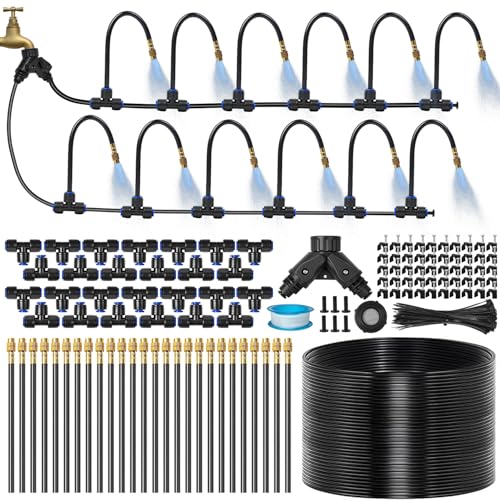
If you need to water a long row of raised beds, a greenhouse, and a flower border from a single connection, this kit delivers 120 feet of 1/4-inch tubing and 26 adjustable copper nozzles — 2.4 times the hose length of the Thiswing kit. One buyer says the “120ft hose provides excellent coverage for entire garden” with even distribution and no pressure drop at the far end. The 1/4-inch tubing (about 6.35 mm) is narrower than the 5/16-inch on the PNNEQ and Thiswing, keeping it light and flexible around corners, though it means slightly less flow to the last nozzle if your water pressure is low.
Buyers running it on a 4-zone Bhyve smart timer report precise watering for raised beds. The three adjustable modes — spray, drip, and mist — let you switch from a root soak to a cooling overhead mist. Tool-free quick-connect fittings use an upgraded rubber ring seal that customers note “does not leak” after repeated disconnects. If your garden sprawls and you want the most coverage per dollar, this is the pick. pass on it if your home water pressure is below 40 PSI — the narrower tubing may struggle.
With 120 feet of tubing and 26 copper nozzles, you get more coverage per connection than any other kit in this guide.
What stands out
- 120 feet of 1/4-inch tubing covers over twice the area of standard 50 ft kits
- 26 copper nozzles with three spray modes (drip, mist, spray) and 360° rotation
- UV-resistant PE tubing resists sun damage and rust-proof nozzles hold up through seasons
The trade-offs
- 1/4-inch tubing has a smaller inner diameter than 5/16-inch, so flow can taper with very low water pressure
- The larger number of connections means more time spent laying out and securing each tee
4. DXront Sprinkler Soaker Hose 50ft

The single number that matters most in this category is 60 PSI — the maximum water pressure this thick PVC hose can handle without bursting, a solid score for durability. Flip this hose one way and it sprays a fine overhead mist over a wide area; flip it over and it becomes a slow ground-level soaker that seeps into the root zone without wetting leaves. At 1.18 inches in outside diameter, the thick PVC construction handles up to 60 PSI (pounds per square inch — the force pushing water through) without bursting. One reviewer says it “waters 20 arborvitae trees quickly,” and another calls it “faster than a fabric soaker.”
The catch for this versatility is precision — unlike drip nozzles you can aim individually, this hose sprays along its entire length through micro-holes, so you cannot skip a patch of weeds. The hose tends to twist without enough stakes, so budget time to anchor it fully. It is the pick for flower beds and hedges where you want a simple, durable snake-and-go setup without assembling 40 connectors.
Given its dual-mode design and 60 PSI burst rating, this hose delivers strong price-to-value for gardeners who want one product that can mist or soak without extra parts.
The upsides
- Dual-mode design switches between overhead sprinkler and ground-level soaker by flipping the hose
- High-strength PVC withstands 60 PSI and weather exposure without cracking
- Includes metal garden stakes, extra filter, and Teflon tape — installs in about 20 minutes
Keep in mind
- Cannot target specific plants — the entire length sprays or soaks continuously
- Hose tends to twist without enough stakes, so budget time to anchor it fully
5. Apgooface Flat Soaker Hose 100 ft (4 x 25 ft Pack)
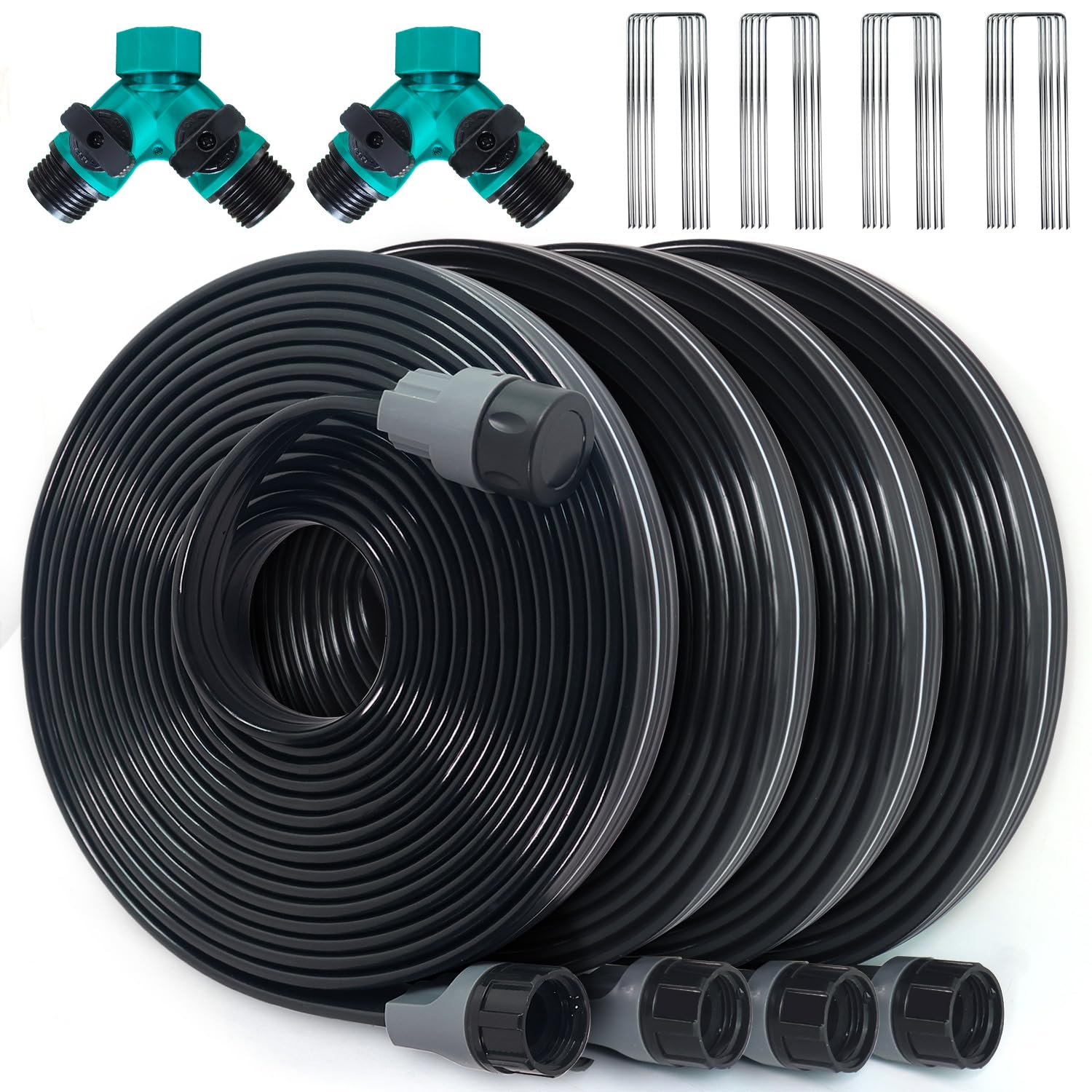
You get four separate 25-foot flat soaker hoses — enough to water four distinct beds independently or connect them into one 100-foot run. The flat design lies flush against the soil without kinking, and the unidirectional spray pattern keeps water directed downward so you reduce leaf wetness and mildew risk. One buyer confirms “best purchase for my 2 raised garden beds” even a year later.
The real limit is pressure drop: one reviewer with a 100-foot run says “the first half sprays intensely, the end only trickles.” The included splitter helps you divide flow between sections, but the narrow 0.1-inch wall thickness makes the PVC less durable than the DXront’s heavier construction. If you have two or three small raised beds on a strict budget and want to set a timer and walk away, this pack gets the job done — just plan to keep each 25-foot section on its own splitter valve rather than daisy-chaining them.
This is the perfect budget buy for the gardener managing a few small raised beds who needs a functional soaker setup without spending for heavy-duty materials.
Why we’d pick it
- Four 25-foot sections let you water separate beds independently with the included splitter
- Flat, tangle-free design lays flush on soil and rolls back easily for storage
- Unidirectional spray keeps water off leaves, reducing the risk of fungal disease
A few caveats
- Water pressure drops significantly toward the end of a long daisy-chain run
- One buyer mentioned a fitting broke on first assembly — check connections before burying the hose
Understanding the Specs
Tubing Diameter (1/4-inch vs 5/16-inch)
The inner width of the hose controls how much water can move through. A 1/4-inch tube (about 6.35 mm) is standard for short runs under 30 feet, but a 5/16-inch tube (about 7.9 mm) has roughly 55% more cross-sectional area — meaning more water reaches the last nozzle without a pressure drop. If your bed is long or you plan to run several nozzles, the wider 5/16-inch tubing keeps everything evenly watered.
Nozzle Material and Adjustability
Solid brass or copper nozzles resist corrosion and mineral buildup far better than plastic, which can crack or clog after a season. “360° adjustable” means the nozzle head rotates fully and the stem can bend at any angle, so you can aim a mist up toward the underside of leaves or down into the soil around a root ball. Detachable, washable nozzles let you clear debris without replacing the whole head.
Water Pressure (PSI)
PSI (pounds per square inch) is the force pushing water through your hose. Most household outdoor faucets deliver 40–60 PSI. Drip irrigation kits work best between 20–40 PSI — too much pressure can blow off push-fit connections. Soaker hoses like the DXront handle up to 60 PSI, but if your home pressure is higher, adding a simple pressure regulator (about 10 dollars) protects the system and prevents misting nozzles from turning into firehoses.
Soaker Hose vs Drip Irrigation
A soaker hose is a single porous pipe — water seeps out through tiny holes along the entire length. It is simple to lay down but waters everything it touches, including weeds. Drip irrigation uses separate nozzles on individual tubes, so you can water each plant or section independently, skip bare soil, and adjust the spray pattern per plant. Drip kits take a bit longer to assemble but give you far more control over where the water actually goes.
FAQ
Will a drip irrigation kit work with my existing garden hose?
How many nozzles can I run on one hose without losing pressure?
Can I leave a drip irrigation system out in winter?
What is the difference between misting and dripping modes?
Final Thoughts: The Verdict
For most gardeners, the sprinkler for garden beds winner is the 60 Ft Drip Irrigation System because its 5/16-inch tubing and 19 copper nozzles deliver a forgiving, easy-to-install system that works right out of the box for a standard raised bed. If you need to water a row of beds or a greenhouse, grab the 120Ft 1/4″ Drip System — its 26 nozzles and 120-foot hose cover far more ground. And for a simple, no-assembly soaker that snakes through flower beds, the DXront Soaker Hose 50ft gives you a dual-mode design that switches between overhead mist and ground-level soak with a flip of the hose.