
You have finally gotten those tiny seeds to sprout, and now the real worry sets in: will they grow into strong, healthy plants or just flop over and die? The difference between a wimpy seedling and one that takes off usually comes down to what you feed it in those first few crucial weeks. This guide breaks down the best plant food for seedlings so you can stop second-guessing your watering can.
I’m Rikta — the co-founder and writer behind Lawn Gear Lab. This guide is built by comparing the manufacturers’ published specifications and the patterns across verified customer reviews, so you get each pick’s real strengths and trade-offs instead of marketing spin.
With these seven formulas, you can find the exact plant food for seedlings that fits your gardening style and keeps those baby plants alive and thriving.
How To Choose The Best Plant Food For Seedlings
Picking the wrong fertilizer can burn delicate seedling roots or simply not give them the boost they need. Focus on two things: the numbers on the label and how the food is applied.
Understand the NPK Ratio
The three numbers on a fertilizer bag stand for Nitrogen (N), Phosphorus (P), and Potassium (K). For seedlings, you want a formula higher in Phosphorus (the middle number) because it is what drives strong root development — a low first number (Nitrogen) prevents the plant from growing too much leaf before the roots are ready.
Liquid vs. Granular
Liquid concentrates mix instantly in water and are gentle on tender roots, making them perfect for weekly feeding. Granular formulas release nutrients slowly into the soil, which is better for mixing into the planting hole if you are transplanting seedlings outside.
Look for Mycorrhizae
Mycorrhizae are beneficial fungi that attach to plant roots and help them absorb water and nutrients more efficiently. Products that include both ecto and endo mycorrhizae can reduce transplant shock and help seedlings establish much faster.
Quick Comparison
On smaller screens, swipe sideways to see the full table.
| Model | Category | Best For | Key Spec | Amazon |
|---|---|---|---|---|
| Dr. Earth 701P | Granular Organic | Transplanting & Tender Seedlings | 4 Pounds | Amazon |
| FoxFarm Grow 2-1-6 | Liquid Concentrate | Vegetative Growth & Weekly Feeding | 2-1-6 NPK Ratio | Amazon |
| Espoma Bio-Tone Plus | Granular Organic | Fast Root Establishment & Organic Gardening | 4-3-3 NPK with 5% Calcium | Amazon |
| Happy Frog Jump Start | Granular with Mycorrhizae | Reduce Transplant Shock | 3-4-3 NPK | Amazon |
| Fertilome Root Stimulator | Liquid Starter | Stimulating New Root Growth | 4-10-3 NPK | Amazon |
| MAXIROOT Seedling Solution | Organic Liquid | Gentle Feeding for Fragile Seedlings | 32 Fluid Ounces | Amazon |
| Farmer’s Secret Booster | Super Concentrated Liquid | Long-Lasting Supply & High Phosphorus | 32 Fluid Ounces (1:384 dilution) | Amazon |
In‑Depth Reviews
1. Dr. Earth 701P Organic 2 Starter & Transplant Fertilizer

2-2-2 NPK analysis makes Dr. Earth 701P Organic 2 Starter & Transplant Fertilizer the top pick for gardeners who want one bag that handles seedlings, transplants, and established plants without guesswork, feeding for several months without burning tender roots — something buyers report makes their shrubs and annuals “show new growth daily.”
The standout here is what the bag contains beyond basic nutrients: seven champion strains of beneficial soil microbes plus both ecto and endo mycorrhizae (the two types of root-friendly fungi that help plants drink up water and minerals). At just 1 pound, this bag is 9.7 times lighter than the Fertilome Root Stimulator (which comes in at 9.7 pounds), making it far easier to handle and store for small-space gardeners. It covers up to 2000 square feet, so a single purchase lasts most home gardens an entire season.
The one honest limit is that it is formulated specifically for starter and transplant use — it lacks the higher nitrogen needed later for heavy leafy growth on mature vegetables. For the seedling-to-ground stage, however, this is the most complete and forgiving option on the list. If you feed your transplants once at planting, this product does the rest of the work for months.
Why it’s great
- 100% organic with no GMOs, chicken manure, or sewage sludge
- Includes 8 strains of beneficial mycorrhizae for drought tolerance
- Safe for the most tender transplants in pony packs and 4-inch pots
Good to know
- Not ideal for heavy-feeding mature plants that need a nitrogen boost
- Granular form requires mixing into soil rather than watering on
2. FoxFarm Cultivation Nation Grow Liquid Plant Food, 2-1-6
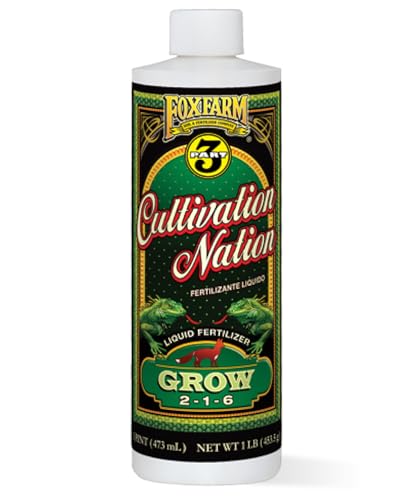
Compared to the top pick Dr. Earth’s balanced 2-2-2, the FoxFarm Grow’s 2-1-6 NPK ratio delivers significantly more Potassium (the last number, which supports overall plant health and disease resistance) and less Nitrogen and Phosphorus, making this a targeted choice for vegetable growers who want to push green growth early on. Its liquid form also beats the Dr. Earth on convenience: you can mix it directly into your watering can and feed seedlings weekly without disturbing soil structure.
For seedlings, owners mention that the manufacturer’s feeding instructions are spot-on: mix just 1/2 teaspoon (2.5 mL) per gallon of water once a week. That tiny dose makes the 16-ounce pint bottle stretch a very long time — one reviewer noted it is so strong that “you’ll only need a fraction of the recommended strength.” It works seamlessly as step one in FoxFarm’s three-part feeding program for vegetative growth, though it works fine on its own too.
Choose this over the top pick if you prefer the control of liquid feeding and want a predictable weekly schedule. It is especially good for indoor seed starts and hydroponic setups where granular food is impractical.
Where it shines
- Simple weekly feeding schedule — 1/2 tsp per gallon for seedlings
- Designed specifically for the vegetative growth stage
- Works as part of a complete 3-part feeding system
Worth noting
- More expensive per ounce than granular options
- Bottle corners can arrive dented in shipping
3. Espoma Organic Bio-Tone Starter Plus 4-3-3
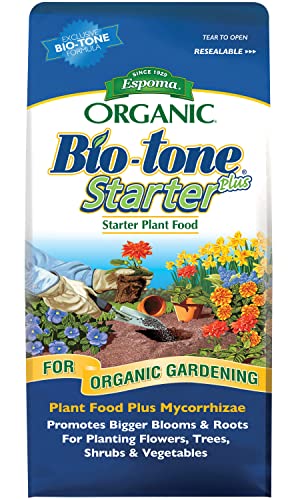
Imagine you have just planted a tiny tree sapling or a delicate perennial — you want it to catch up to plants that have been in the ground for years. Espoma’s Bio-Tone Plus is built for exactly that scenario. Customers note that “one tree planted with it surpassed a two-year-old tree in one year,” which is the kind of result that gets attention from serious gardeners.
The formula packs a 4-3-3 NPK analysis with a special 5% calcium boost (calcium strengthens cell walls and prevents common seedling issues like blossom-end rot later on). It uses both endo and ecto mycorrhizae and is OMRI-listed for organic gardening, meaning it meets all requirements for organic production. You simply mix it thoroughly with the soil you use to backfill the planting hole — a 1:1 ratio of fertilizer to soil by volume — and it works for everything from flowers to vegetables to shrubs.
The catch? Some reviewers point out that it has a strong odor (one reviewer called it “a stinker, but in a good way” — it smells like natural organic material breaking down). If you are sensitive to smells, mix it outdoors or hold your breath while applying. For the fast root establishment it delivers, the smell is a small price to pay.
What stands out
- Proven results — dramatically accelerates growth vs. untreated plants
- Contains both endo and ecto mycorrhizae for maximum root efficiency
- Approved for organic gardening and contains no sludges
The trade-offs
- Strong natural odor that some find unpleasant
- Must be mixed with soil rather than sprinkled on top
4. Happy Frog Jump Start Fertilizer 3-4-3

The single number that matters most for seedlings is the middle one — Phosphorus — and this Happy Frog Jump Start delivers a 3-4-3 NPK ratio that puts Phosphorus front and center (4 for root growth). This makes it the most root-focused granular option in this list, targeting the moment a seedling moves from a tiny pot into the ground or a larger container.
The downside for that root focus is that it is less versatile than the Dr. Earth or Espoma options — it is formulated specifically for transplanted seedlings and re-potted container plants, not for long-term feeding of mature gardens. Buyers appreciate that “it was clean from big chunks of wood that I have had from other companies,” so you get a consistent texture that mixes smoothly into potting soil without clumps. It also supplies mycorrhizal fungi (the beneficial root helpers) and a calcium boost, both of which reduce the shock of moving plants.
Price-for-value, the Happy Frog sits squarely in the mid-range and delivers exactly what it promises: a quick, reliable start for seedlings that need to establish after a move. If your primary worry is transplant shock, start here.
The upsides
- High phosphorus (4) directly targets root development
- Clean, consistent granules with no large wood chunks
- OMRI Listed for organic gardening
Keep in mind
- Not designed for ongoing feeding of mature plants
- Targeted use for transplant and re-potting only
5. Fertilome (10650) Root Stimulator & Plant Starter Solution 4-10-3

What you actually get at this lower price is a liquid starter that uses a plant hormone (Indole-3-butyric acid, a naturally occurring compound that triggers root cells to divide and grow) instead of just fertilizer nutrients. The 4-10-3 NPK ratio is extremely high in Phosphorus (the 10), which is the highest middle number on this entire list — it is designed to give roots an aggressive head start.
At 9.7 pounds for a full gallon, this bottle is heavy and more than 9 times heavier than the small 1-pound Dr. Earth bag. That gallon amount, though, goes a very long way since you only need 0.25 tablespoons per 1 pint of water. One reviewer described rescuing a plant that was “wilted after raccoon damage,” and after applying a diluted solution, it “revived within days, new growth in a week.” That kind of recovery comes from the hormone-based formula, not just standard NPK nutrition.
The honest trade-off: this is a specialist tool. It is not meant for weekly feeding of established plants — it is a jump-starter for seeds, cuttings, and transplants during their first fragile days. If you are starting a lot of seeds or moving plants into the ground, it works brilliantly. For ongoing maintenance, pair it with a balanced all-purpose food. This is the perfect budget buyer for a gardener who wants a single concentrated bottle to kickstart dozens of seedlings or transplants without buying separate rooting hormones and fertilizers.
Why we’d pick it
- Contains Indole-3-butyric acid, a proven root-forming hormone
- Extremely concentrated — a little goes a very long way
- Effective for reviving stressed or damaged plants
A few caveats
- Not a complete fertilizer for long-term feeding
- Heavy bottle (9.7 pounds) makes storage less convenient
6. MAXIROOT Organic Seedling Solution, 32 oz
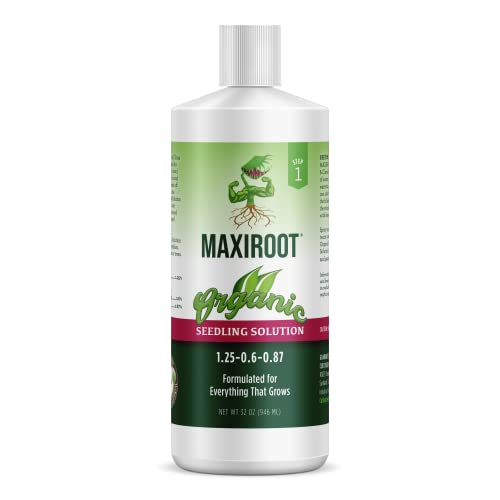
If you are the type of gardener who worries about giving chemical anything to your baby plants, this 100% natural seaweed and fish-based liquid is designed for you. It is specifically labeled “for seedlings, cuttings, clones, starter plants, herbs, and vegetables,” leaving no guesswork about whether it is safe for delicate roots.
Made with natural seaweed and fish-derived ingredients, it provides gentle nutrition with an NPK ratio that is balanced for early growth stages. You dilute 2 ounces per gallon of water and apply weekly — no measuring tiny fractions of a teaspoon. The 32-ounce bottle lasts a while, though be warned: multiple reviewers call out the smell. One described it as “the stench of stale excrement,” while another said “it smells like the ocean.” If the odor bothers you, mix and apply outdoors and don’t leave the watering can sitting open inside.
One gentle caution: this is the lightest-weight product on the list at just 14.3 ounces for the bottle, and it is CDFA OIM listed for organic production. If you want a truly gentle, certified-organic option and can handle the fishy smell, this is your match. It is not the strongest option for pushing fast growth, but it is the safest. For the most fragile heirloom seedlings, the trade-off for peace of mind is worth it.
Strong points
- Made from natural seaweed and fish ingredients — no synthetics
- CDFA OIM listed for organic production
- Simple 2 oz per gallon dilution
Before you buy
- Strong fishy odor that lingers if left open
- Not as potent as synthetic or high-phosphorus formulas
7. Farmer’s Secret Plant Booster (32 oz)

Price-wise, the Farmer’s Secret Plant Booster is the most extreme concentration play on the list. Its dilution ratio is a staggering 1 teaspoon per 2 gallons of water (a 1:384 ratio — far more concentrated than the MAXIROOT’s 16:1 or the FoxFarm’s instructions). That single 32-ounce bottle will make dozens of gallons of seedling feed, making it the most economical option per use.
What that money actually gets you is a high-phosphorus formula designed to help plants convert sunlight to energy more effectively. Shoppers say that “a little goes a LONG way,” and one buyer mentioned they “could see a difference in my garden within days of applying.” The manufacturer recommends feeding every 2-4 weeks, which is less frequent than the weekly schedule of most liquid foods. It is made in Kentucky and puts the know-how of “award-winning farmers” into a bottle.
The one clear reason to choose it is if you want a product that lasts all season from a single purchase. At this concentration, you will likely finish the season with some left over. It is not organic-certified like the Dr. Earth or Espoma, so if organic is a must, look elsewhere. For sheer value and convenience, it is the field-vs-this standout for budget-conscious growers who hate running out of supplies mid-season.
What we like
- Extremely concentrated — 1 tsp makes 2 gallons of feed
- High phosphorus formula for strong early energy conversion and root growth
- Only needs application every 2-4 weeks, not weekly
The downsides
- Not certified organic like some other options
- Very easy to over-fertilize if you don’t measure precisely
Understanding the Specs
NPK Ratio and What It Means for Seedlings
The three numbers on a fertilizer bag (for example, 2-1-6 or 4-10-3) stand for the percentage of Nitrogen (N), Phosphorus (P), and Potassium (K) by weight. For seedlings, Phosphorus — the middle number — is the most critical because it stimulates root growth. A high middle number (like the 10 in Fertilome) means aggressive root development, while a higher first number (Nitrogen) is best saved for when the plant is older and needs leafy growth. Look for a formula where the middle number is at least equal to or higher than the first number during the seedling stage.
Mycorrhizae and Beneficial Microbes
Mycorrhizae are a type of fungi that form a symbiotic relationship with plant roots, essentially extending the root system so the plant can reach more water and nutrients. The bag label may list “ecto mycorrhizae” (which wrap around the outside of roots) and “endo mycorrhizae” (which penetrate the root cells). Products like Dr. Earth and Espoma include both types, which can dramatically reduce transplant shock and help seedlings grow faster than they would with fertilizer alone. If you are planting directly into the ground, these microbes are a huge advantage.
FAQ
When should I start feeding my seedlings with fertilizer?
Is liquid or granular fertilizer better for seedlings?
Final Thoughts: The Verdict
For most people, the plant food for seedlings winner is the Dr. Earth 701P because it combines a gentle organic NPK blend with beneficial mycorrhizae in an easy-to-store 4-pound bag that covers everything from tender transplants to established plants. If you want the convenience of weekly liquid feeding with precise control, grab the FoxFarm Cultivation Nation Grow 2-1-6. And for the fastest possible root development when transplanting, the standout is the Espoma Bio-Tone Starter Plus with its proven track record of supercharging growth in a single season.