
You want weeds gone — fast, for good, and without accidentally killing the plants you actually like. But the shelf at the hardware store is a wall of spray bottles, jugs, and powders, each promising instant results. So which one actually delivers without forcing you to re-spray every two weeks or worrying about your pet’s safety?
I’m Rikta — the co-founder and writer behind Lawn Gear Lab. This guide is built by comparing the manufacturers’ published specifications and the patterns across verified customer reviews, so you get each pick’s real strengths and trade-offs instead of marketing spin.
Below I break down the six most effective formulas — from ready-to-use sprays for a quick sidewalk tidy-up to heavy-duty concentrates for clearing an overgrown fence line — so you can confidently choose the right weed and grass killer for your yard, your timeline, and your peace of mind.
How To Choose The Best Weed And Grass Killer
Choosing the right weed killer means matching the formula to your specific weeds, your timeline, and the safety needs of your family and pets. Here are the main factors worth understanding.
Active Ingredient: The Real Muscle
The active ingredient is what actually kills the plant. The most common is glyphosate — a non-selective herbicide (meaning it kills everything green it touches, including your flower bed, so aim carefully). It travels to the roots and typically takes 1–2 weeks for a full kill. Diquat is faster — you can see wilting in hours — but it is a contact killer, so it only damages the parts of the plant it touches (it does not travel to the roots as well, meaning tougher perennials may regrow). Vinegar (acetic acid) is a natural option that dries out foliage quickly, but it rarely kills strong roots. For serious long-term control, glyphosate-based concentrates are the gold standard.
Ready-to-Use vs. Concentrate
If you only have a handful of dandelions on a small patio, a ready-to-use (RTU) trigger spray is the easiest route — no mixing, no measuring, just point and spray. But if you are tackling a long fence line, a driveway crack explosion, or an entire patch of crabgrass, a concentrate you mix with water in a tank sprayer will be far cheaper per square foot and often more potent. The Roundup concentrate (1 gallon) makes up to 60 gallons of spray solution, while an RTU bottle covers 300 sq ft.
Rainfast Time: The Weather Window
Rainfast time is how long the product needs to stay dry on the leaves to fully absorb. A short rainfast time — like Roundup III’s 10 minutes or Spectracide’s 15 minutes — means you can spray even if a stray shower is possible. Longer windows (like Roundup₄’s 30 minutes) require better weather planning. If rain washes the chemical off before it absorbs, you have to reapply, wasting time and money.
Pet and Environmental Safety
Traditional herbicides like glyphosate can pose risks to bees, butterflies, and aquatic life if sprayed on flowering plants or near water. Pet-safe formulas — often vinegar or ammonium nonanoate-based — are gentler, but they also tend to be less effective on deep-rooted perennial weeds. If you have a dog that patrols the fence line, a dedicated pet-safe spray like the Just For Pets option gives you peace of mind at the cost of needing more frequent reapplication.
Quick Comparison
On smaller screens, swipe sideways to see the full table.
| Model | Category | Best For | Key Spec | Amazon |
|---|---|---|---|---|
| Control Solutions Eraser | Concentrate | Total vegetation control on large areas | 41% Glyphosate | Amazon |
| Ortho GroundClear | Super Concentrate | Tall grass and tough broadleaf weeds | 2240 sq ft coverage | Amazon |
| Roundup III RTU | Ready-to-Use | Quick spot treatments with visible foam | 3000 sq ft coverage | Amazon |
| Roundup₄ Concentrate | Concentrate | Large-scale lawn prep and plot clearing | 1 Gallon concentrate | Amazon |
| Spectracide Concentrate | Concentrate | Budget-friendly curb and crack control | Diquat Dibromide | Amazon |
| Just For Pets | Pet Safe | Pet-friendly household weed spot treatment | 128 oz Vinegar | Amazon |
In‑Depth Reviews
1. Control Solutions 82004318 Eraser & Grass Killer Concentrate
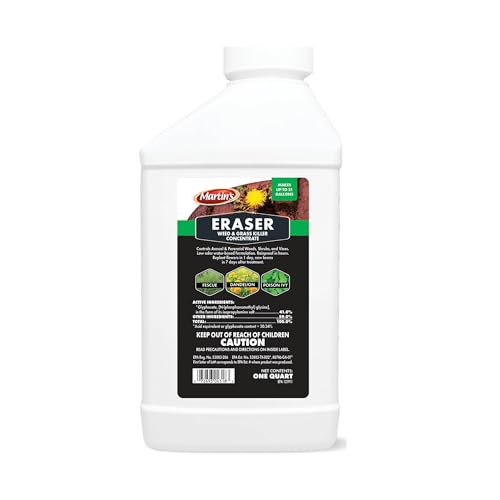
41% glyphosate — nearly double the concentration of consumer-grade Roundup — makes this the top pick for anyone who needs total non-selective vegetation control and wants to use less liquid per gallon of spray mix for the same kill power. It kills everything from grass to poison ivy to saplings. Buyers report mixing 8 ounces per gallon and seeing “everything green 100% dead in 1–2 weeks.” The formula has no residual soil activity, so you can replant after it breaks down, and it is much more affordable per gallon than consumer Roundup — one reviewer who has used it for 17 years calls it “a killer for sure.” A single quart makes up to 8 gallons of ready spray mix.
The catch: glyphosate is a slow-burn herbicide. Unlike diquat-based formulas that show wilting in hours, this one takes patience — no visible effect for two days, yellowing in 4–7 days, and full death in 7–14 days. It absolutely works, but you have to wait. If you need faster results, the Roundup₄ concentrate shows visible results in hours.
For patient users who want the most concentrated, cost-effective total kill, this is the killer for sure.
Why it’s great
- Very high 41% glyphosate concentration for maximum potency
- Excellent value — a single quart makes multiple gallons of spray mix
- Works on everything from annual weeds to woody vines and trees
Good to know
- Slow acting — takes 7–14 days for full kill
- Non-selective — kills any plant it touches, so use carefully
2. Ortho GroundClear Weed and Grass Killer Super Concentrate
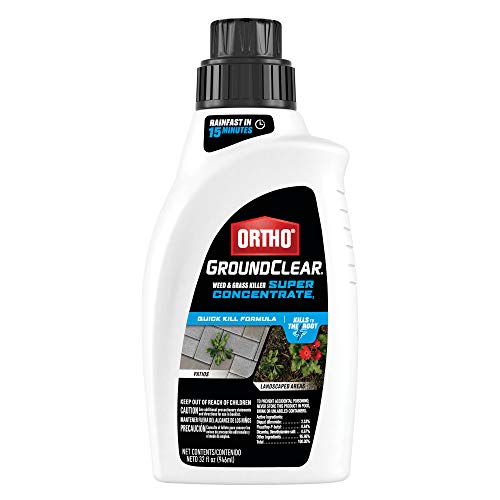
Compared to the top pick, the Ortho GroundClear Super Concentrate treats up to 2,240 square feet per 32 oz bottle — exactly double the 1,120 sq ft the label originally stated, and a full 2.2x more coverage than the Spectracide concentrate offers at 1,350 sq ft. That makes it the go-to for large patios, long driveways, or overgrown fence lines. One buyer used it on foot-tall grass along a fence and noted “about 3 or 4 days later you could see it working.” The formula starts working immediately on contact and is rainfast in 15 minutes, so a passing shower will not ruin the application. Another reviewer said they “made 5 gallons of solution with the 32 oz bottle,” which gives you an idea of the dilution power. It is also odor-free during mixing.
The downside: coverage can vary — the label states 1,120 sq ft, while some tech specs list 2,240, likely depending on weed type. Still, it handily beats the competition on area treated per dollar.
Choose this over the top pick if you need to cover a very large area quickly and want visible results in under a week rather than two, making it a better pick than the Control Solutions Eraser for speed.
Where it shines
- Treats up to 2,240 sq ft — best coverage in this guide
- Fast-acting — visible results in 3–4 days on tall grass
- Odor-free concentrate, easy to mix in a tank sprayer
Worth noting
- Works best on actively growing weeds with temperatures above 60°F
- Not a “one spray and done” — some buyers use slightly more concentrate for stubborn perennials
3. Roundup Weed & Grass Killer₄ Concentrate, 1 gal.

When you have a massive job — prepping a garden plot, clearing a whole field, or chemically renovating a lawn — a 1-gallon jug of Roundup₄ concentrate is the lowest cost per finished gallon in this guide. One buyer explains the dilution rate: “6 ounces of concentrate to 1 gallon of water.” That means a single gallon jug makes over 21 gallons of spray solution, covering over 6,300 sq ft at 300 sq ft per finished gallon. The formula combines triclopyr, triethylamine salt, fluazifop-P-butyl, and diquat dibromide — a multi-ingredient cocktail that tackles dandelion, large crabgrass, poison ivy, clover, and spotted spurge. It is rainproof in 30 minutes and you can see results in hours.
Owners mention it is “very effective weed killer” but caution that “long sleeves, hat, gloves, full-face respirator” are necessary because of the active mixture — this is a serious chemical, not a casual spray. One reviewer honestly says “it does NOT prevent new weeds or grass from popping up.” Like almost all non-selective herbicides, it kills existing foliage and roots but leaves no soil barrier for future seeds. This is a buy for a kill, not a prevention.
At 6 ounces per finished gallon, that jug makes over 21 gallons of spray solution.
What stands out
- Best cost-per-gallon value — makes over 21 gallons of spray solution
- Kills the toughest weeds including poison ivy and crabgrass
- Visible results in hours, rainproof in 30 minutes
The trade-offs
- Requires full PPE (long sleeves, gloves, respirator) during mixing and spraying
- Does not prevent new weeds — only kills existing growth
4. Roundup 5003410 Weed and Grass Killer III Ready-to-Use Trigger Spray

Speed matters most in this category, and this Roundup III ready-to-use spray has the shortest rainfast time on this list — just 10 minutes — and starts showing results in 6 hours. The real standout is the foaming technology: the spray comes out as a visible foam so you can see exactly where you have sprayed, which is a huge help for spot-treating individual weeds in a flower bed without accidentally nuking your petunias. It covers 3,000 sq ft — the most of any ready-to-use spray here.
The active ingredients are triclopyr and diquat — not glyphosate, despite what some buyers initially assume. This formula kills roots (diquat burns foliage, triclopyr travels down) and is rainfast very quickly. One reviewer notes it “works better than local store brands” and “cleared weeds quickly.” Another says it is “effective on Tree-of-Heaven suckers,” which are notoriously hard to kill. One buyer reports that “our dandelions require a second spray after a week, still not dead,” so tough perennials may need a follow-up.
The RTU format is convenient but expensive per sq ft compared to a concentrate, making it best for small-to-medium spot jobs where convenience trumps cost.
The upsides
- Foam technology lets you see where you have sprayed — avoids overspray
- Rainfast in just 10 minutes — ideal for unpredictable weather
- Covers 3,000 sq ft, the largest RTU coverage in this guide
Keep in mind
- Tough perennials like dandelions may need a second spray
- RTU format is more expensive per sq ft than buying a concentrate
5. Spectracide Weed and Grass Killer Concentrate, 32 oz
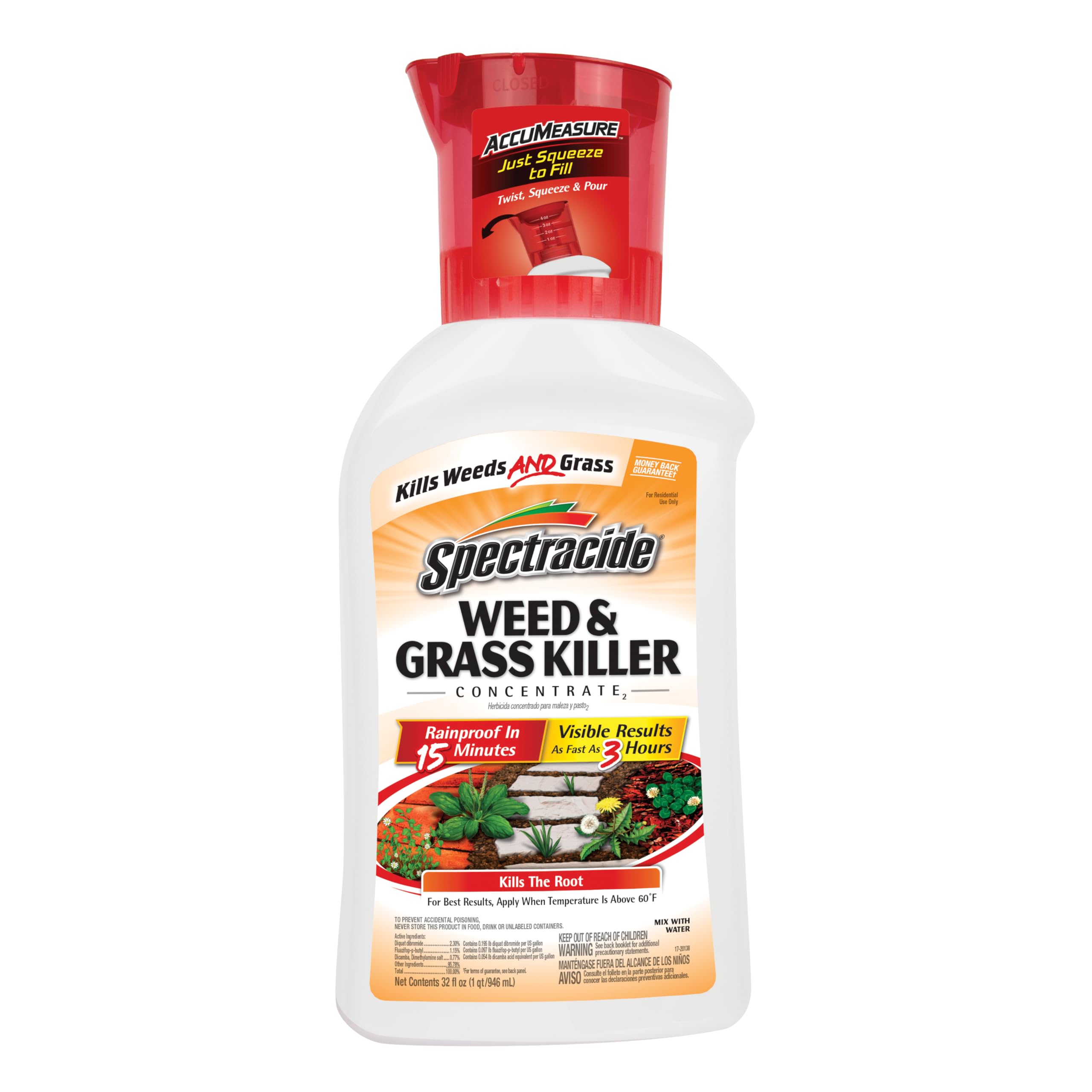
At a low price, this diquat-based concentrate delivers visible results in as fast as 3 hours. One buyer says: “I mix this up in my reusable Spectracide 1-gallon sprayer and it kills the weeds along my curb within a day.” The formula is rainfast in 15 minutes, and the Accumeasure cap is designed to make pouring and mixing cleaner — though several customers note the cap is finicky and replace it with a standard lid. Diquat is a contact killer (it only damages the leaves and stems it touches, not the roots), so deep-rooted perennials like dandelions or poison ivy are much more likely to regrow. Coverage is the joint smallest here at 1,350 sq ft — less than half the Roundup III RTU spray. You trade long-term root kill for immediate leaf wilting. This suits the budget-conscious buyer with mostly annual weeds (crabgrass, chickweed) in cracks and along curbs who does not mind a second application.
Why we’d pick it
- Shows results in as fast as 3 hours — incredibly fast knockdown
- Budget-friendly concentrate price for small-to-medium jobs
- Rainfast in 15 minutes for flexible application timing
A few caveats
- Contact killer — may not fully kill deep-rooted perennials
- Coverage at 1,350 sq ft is limited compared to competitors
6. Just For Pets Pet Safe Weed Killer Spray, 128 oz
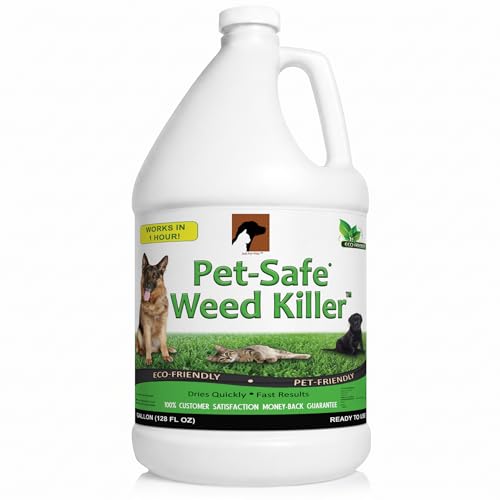
If you share your yard with dogs that sniff everything or kids who roll in the grass, this is the only formula on this list that prioritizes safety above speed. It is vinegar-based (acetic acid), contains no glyphosate, and uses naturally derived ingredients. One buyer calls it “safe for pets and wild critters” and says “it kills all the weeds growing in my driveway.” Another reports it is “effective on creeping charlie and cabbage weeds when used with borax mix,” with visible wilting within a day. At 128 oz in the refill jug, you get a massive supply of ready-to-use spray with zero mixing. The vinegar action dries out the foliage quickly — you can literally watch weeds wilt. However, vinegar is a contact killer, not a root killer, so tougher perennial weeds will almost certainly grow back within a few weeks. The smell is strong: buyers describe it as “vinegar/oregano smell that fades quickly” but note “it smells for days” if applied heavily indoors. The applicator on the jug is widely criticized as “flimsy, hard-to-use, needing three hands.” Buy the jug for the liquid and pour it into a better spray bottle. This is for you if you want a non-toxic, fast-acting weed die-down for patios, walkways, and rock beds where pets roam — but expect to reapply.
Strong points
- No glyphosate — safe for dogs, pets, and wildlife when used as directed
- Visible results in 1 hour — fast-acting vinegar formula
- Large 128 oz refill size gives you plenty of ready-to-use spray
Before you buy
- Not a root killer — tough perennial weeds will regrow and need reapplication
- Buyers strongly dislike the spray applicator — plan to use your own bottle
Understanding the Specs
Glyphosate vs. Diquat vs. Vinegar
Glyphosate is a systemic herbicide (it travels through the plant’s vascular system to the roots). It is slow — 1–2 weeks — but kills the entire plant, including the root system, so it stays dead. Diquat is a contact herbicide (it burns whatever leaf tissue it touches). It works in hours, but roots often survive and the plant can regrow. Vinegar (acetic acid) desiccates foliage by drawing out moisture. It is non-toxic and safe for pets, but it is the weakest on roots — expect regrowth.
Concentrate vs. Ready-to-Use (RTU)
Concentrate formulas require you to mix a small amount of chemical with water in a tank or hose-end sprayer. They cost less per square foot of coverage and let you adjust the strength for different weed types. RTU sprays come pre-mixed in a trigger bottle — you pay more per application, but they are easier for small, fast jobs like a few sidewalk weeds. For any area larger than a couple hundred square feet, a concentrate will save you significant money.
Rainfast Window
Rainfast time is the minimum period the spray must stay dry on the leaves to be fully effective. If rain hits within that window, the chemical washes off and you must reapply. The shortest windows here are Roundup III at 10 minutes and Spectracide at 15 minutes — great for risky weather. Roundup₄ concentrate is 30 minutes, which gives you a narrower window but usually means a more potent formula that absorbs more deeply once it dries.
Non-Selective vs. Selective
All six products in this guide are non-selective herbicides (they kill every green plant they contact). They do not distinguish between a weed and your prized rose bush. If you are spraying near desirable plants, use a shield (like a piece of cardboard) to block drift, or use the foam technology of the Roundup III RTU to see exactly where your spray lands. A selective herbicide targets specific weed types (like crabgrass or dandelions) without harming lawn grass, but those are a different product category.
FAQ
Will a weed and grass killer prevent new weeds from growing?
How soon can I plant flowers or grass after using a weed killer?
Is foaming spray better than regular spray for spot treating weeds?
Can I use these products safely around vegetable gardens?
Final Thoughts: The Verdict
Across the board, the weed and grass killer winner is the Control Solutions Eraser concentrate because its 41% glyphosate concentration delivers unmatched root kill at a price per gallon that beats consumer brands. If you need faster visible results and can sacrifice a bit of root-kill power, the Spectracide concentrate is the budget-friendly choice that shows results in hours. And for pet owners or families who want a natural, non-toxic option, the Just For Pets spray offers peace of mind — though be prepared for the smell and the possibility of needing to reapply.