
If you grow roses in pots, you know the struggle: one day the leaves turn yellow, the next the buds drop before they open. The problem is almost always nutrition — container soil runs out of food fast because you can’t rely on the earth below. The picks on this list are all formulated for container roses, so you get the right balance of nutrients to keep your potted plants thriving without guesswork.
I’m Rikta — the co-founder and writer behind Lawn Gear Lab. This guide is built by comparing the manufacturers’ published specifications and the patterns across verified customer reviews, so you get each pick’s real strengths and trade-offs instead of marketing spin.
You need a fertilizer for roses in pots that feeds blooms without burning roots in tight soil. The right one fixes yellowing leaves fast or feeds slowly all season.
How To Choose The Best Fertilizer For Roses In Pots
Container roses rely entirely on you for their food — there is no deep soil to draw from. That means the fertilizer you choose must work fast enough to correct deficiencies but stay gentle enough not to burn roots in a confined space. Here are the key differences that matter for potted roses.
Liquid vs Granular: Pick by your feeding rhythm
Liquid fertilizers (like the Growth Technology GT Rose Focus or Neptune’s Harvest) enter the soil almost immediately — you see results within days. They are perfect for rescuing a wilting plant or for weekly feeding during the growing season. Granular feeds (like the Burpee Organic Bloom) release slowly over two or three months. That makes them ideal if you want to apply once and forget it for weeks, but you need to water them in thoroughly so the granules dissolve in the pot’s limited soil volume.
NPK ratio: what the numbers mean for your roses
The three numbers on the bottle (for example 2-6-4 on Neptune’s Harvest) stand for Nitrogen, Phosphorus, and Potassium. Nitrogen grows leaves and stems, but container roses that get too much nitrogen produce tall weak growth with few flowers. You want a middle or slightly higher middle number (Phosphorus) for blooms — a ratio around 1-2-1 or 2-6-4 works well. The Burpee has a balanced 1-1-1, which is safe for long-term maintenance in pots without burning.
Calcium and trace minerals: why container plants need extras
Potted roses can’t reach subsoil minerals, so they depend entirely on what you feed them. A formula with added calcium (like the Growth Technology GT Rose Focus) strengthens cell walls and prevents blossom-end problems. Trace minerals like iron, zinc, and manganese — found in the Great Big Roses booster — prevent yellowing between the leaf veins and keep foliage dark green without extra nitrogen.
Quick Comparison
On smaller screens, swipe sideways to see the full table.
| Model | Category | Best For | Key Spec | Amazon |
|---|---|---|---|---|
| Burpee Organic Bloom | Granular | Long-term maintenance, large containers | 4 lb bag, feeds up to 3 months | Amazon |
| Growth Technology GT Rose Focus | Liquid | Precise feeding, calcium for strong stems | 250 ml concentrate, 8.45 fl oz | Amazon |
| All-Purpose Rose Plant Food | Liquid Spike | No-mess quick rescue, small pots | 12 bottles, 38 ml each (0.5 lb total) | Amazon |
| Great Big Roses Booster | Liquid Concentrate | Blooming revival, soil activation | 32 fl oz, 70 trace minerals | Amazon |
| Neptune’s Harvest Rose & Flowering | Liquid Organic | Organic feeding, foliar spray option | 36 oz (1064 ml), 2-6-4 NPK | Amazon |
In‑Depth Reviews
1. Burpee Organic Bloom Granular All-Natural Food for Roses

The 4-pound bag covers 213 square feet, making it the top pick for potted rose growers who want a single application to feed a half-dozen large containers for an entire growing season. Buyers report it “stopped yellowing leaves on roses within days; new leaves look great,” which is exactly the rescue you need when container soil runs out of steam.
The granules are fine enough to spread evenly inside a pot — you mix a small handful into the top inch of soil and water it in. Because it’s OMRI-listed (Organic Materials Review Institute-approved) for organic use and contains beneficial microbes, it improves the soil biology in your containers rather than just dumping synthetic salts.
Your only real consideration is that granular feeds need thorough watering to dissolve, so if you are the type who forgets to water for days, the granules sit dry in the pot and do nothing. But for anyone who waters their roses regularly, the Burpee is the set-and-forget winner for container roses — spread it, water it, and your roses eat for two months.
Why it’s great
- Feeds for up to 3 months from a single application
- 4-pound bag covers 213 square feet of container soil
- OMRI-listed for organic gardening — safe around kids and pets
- Owners mention yellowing leaves reversed within days
Good to know
- Granules must be watered in thoroughly to activate in containers
- Not ideal for an immediate “emergency feed” compared to liquids
2. Growth Technology GT Rose Focus Liquid Plant Food
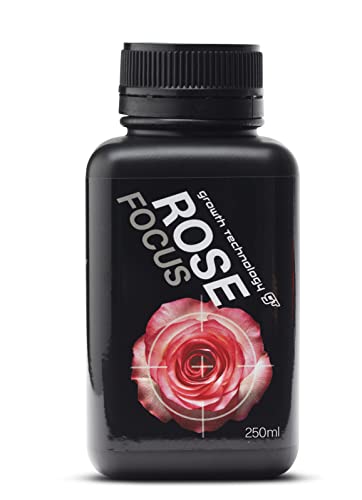
The Growth Technology GT Rose Focus beats the top pick Burpee on precision and speed — it is a liquid concentrate that enters the soil within minutes, so you see results in days rather than weeks. Where the Burpee holds the edge on total volume (4 pounds vs this bottle’s 250 ml), the GT Rose Focus leads on composition: it includes extra soluble calcium for stronger cell walls and a complete 12-mineral profile that the Burpee’s simpler formula lacks. Customers note it’s a “little pricey but it’s the best stuff I’ve found,” and they are right — one cap (20 ml) mixed with a liter of water feeds several pots, so the small bottle lasts through a season.
This product shines if you grow hybrid teas, floribundas, or modern roses in containers because those varieties need precise nutrient timing to keep reblooming. The recommended mix is 3–7 ml per liter of water for soil — you feed every watering during the growing season and flush with plain water once a month to prevent salt buildup. The pH-buffered formula means it won’t swing your soil’s acidity, which is critical in a small pot where pH shifts happen fast.
If you want total control over what your potted roses eat and are willing to measure each dose, choose the GT Rose Focus over the top pick. It is ideal for the attentive grower who values ingredient quality over bag size.
Where it shines
- Extra calcium strengthens stems and prevents flower drop in pots
- pH-buffered formula safe for container soil chemistry
- Highly concentrated — 250 ml makes up to 80 liters of feed
- Works for hydroponics and soil, so it’s versatile for indoor setups
Worth noting
- More expensive per application than granular options
- Reviewers point out the bottle can leak during shipping — check the cap seal
3. Bioplenafeed All-Purpose Rose Plant Food Fertilizer (12 Spikes)
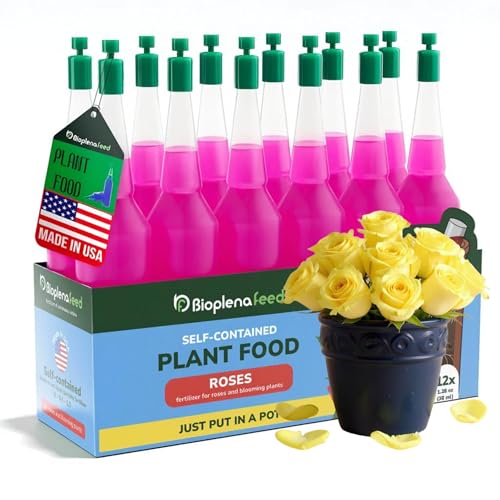
If you have ever spilled granular feed across your patio or splashed liquid concentrate on your hands, the Bioplenafeed spikes solve that frustration entirely — you just cut the tip and insert the bottle upside down into the pot. Each of the 12 bottles holds 38 ml of concentrated liquid, and because the total kit weighs only 0.5 pounds, it is dramatically lighter and less messy than the 4-pound Burpee bag. Shoppers say one spike “revived a dying clearance plant in 4 days,” which makes sense because the liquid drips directly into the root zone without you having to mix or pour anything.
The “cut and stick” design works best in small to medium containers (8–14 inch pots) where one spike can sit close to the root ball. You place the bottle upside down, and the liquid seeps out over several days, providing a steady drip-feed. This is perfect if you travel for a few days or tend to under-water — the spike keeps feeding slowly even when the soil starts to dry. Since each bottle is sealed until you cut it, there is no leftover half-bottle to store or spill.
The stand-out spec here is the sheer convenience: 12 individual no-mix, no-measure applications in a 0.5-pound package.
What stands out
- Zero mixing or measuring — cut the tip and insert into soil
- Buyers report reviving near-dead plants within 4 days
- 12 sealed bottles keep fresh and spill-free for months
- Made in the USA with a concentrated formula
The trade-offs
- Each bottle feeds just one application — not cost-effective for large collections
- The 38 ml per spike is a smaller total volume than the liquid concentrates
4. Great Big Roses and Flowers Liquid Fertilizer Booster
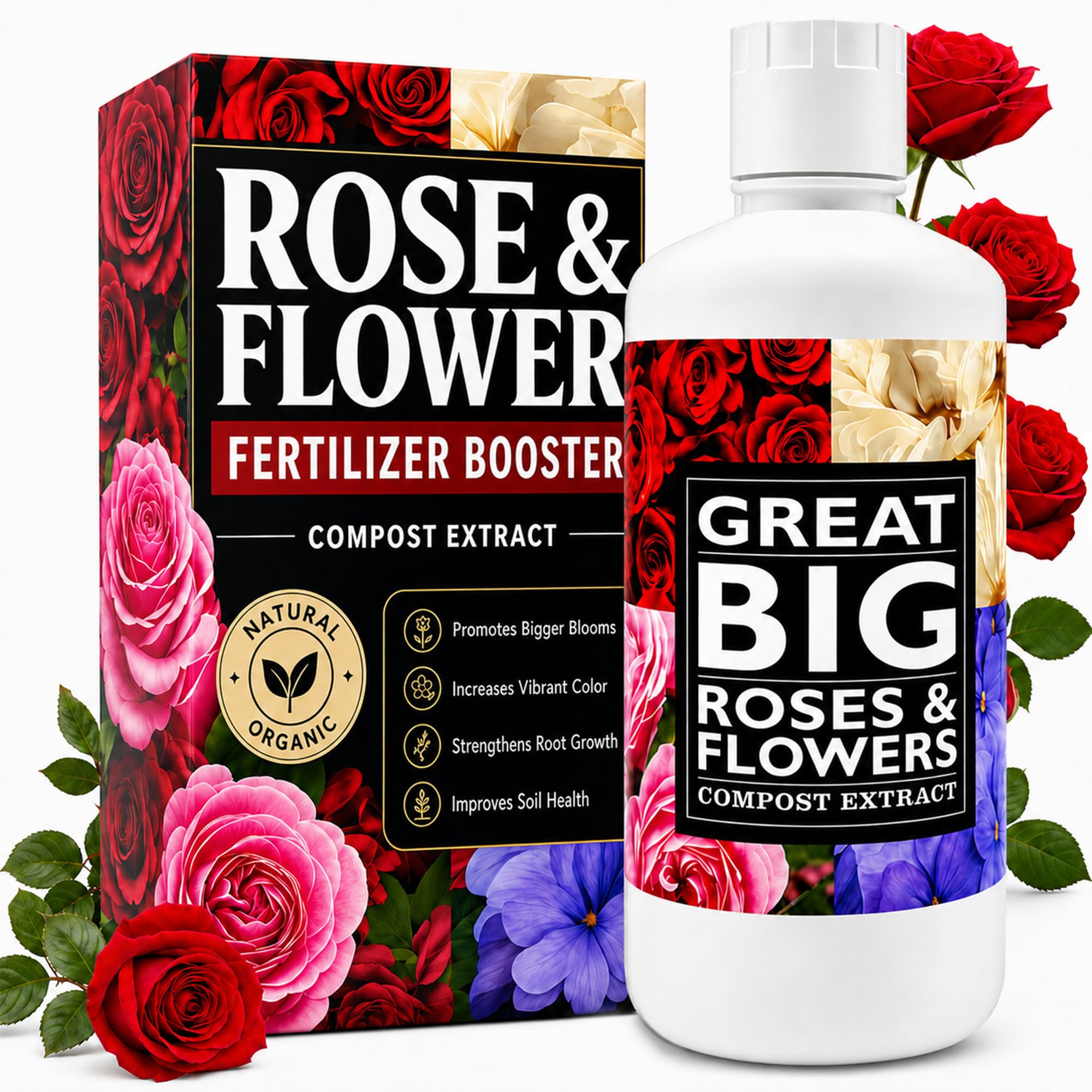
The single number that defines this product is 70 — it packs over 70 chelated trace minerals (minerals bonded to amino acids for easy plant uptake) plus humic acids and seaweed extract into a 32-ounce bottle. That mineral diversity matters for potted roses because container soil lacks the microbial ecosystem that would normally unlock nutrients from organic matter. Owners mention rose bushes that had not bloomed in years producing big, beautiful flowers within weeks, which is a testament to how aggressively this booster activates dormant soil biology.
The catch is the bottle design — the wide mouth makes it hard to pour without spilling, and customers note they cringe every time they lose expensive concentrate. At 32 fluid ounces, this bottle holds nearly 4 times the volume of the GT Rose Focus (8.45 fl oz), and one gallon of diluted feed covers an entire growing season for a typical container rose collection. The mixing ratio is 4 ounces per gallon of water, which gives you 8 full applications from one bottle.
If you have a rose in a pot that hasn’t bloomed properly in years and you have tried other fertilizers without success, the Great Big Roses Booster is worth the premium. It does not replace a balanced NPK feed — it amplifies whatever fertilizer you already use by making soil nutrients more available to the roots.
The upsides
- 70 chelated trace minerals and humic acid unlock locked-up soil nutrients
- 32-ounce bottle makes 8 full applications per season
- Reviewers point out reviving non-blooming roses within weeks of first use
- Works alongside any existing fertilizer to multiply results
Keep in mind
- The jug shape makes it easy to spill concentrate when measuring
- Expensive upfront cost, though it stretches across many applications
5. Neptune’s Harvest Rose & Flowering Fertilizer (2-6-4)
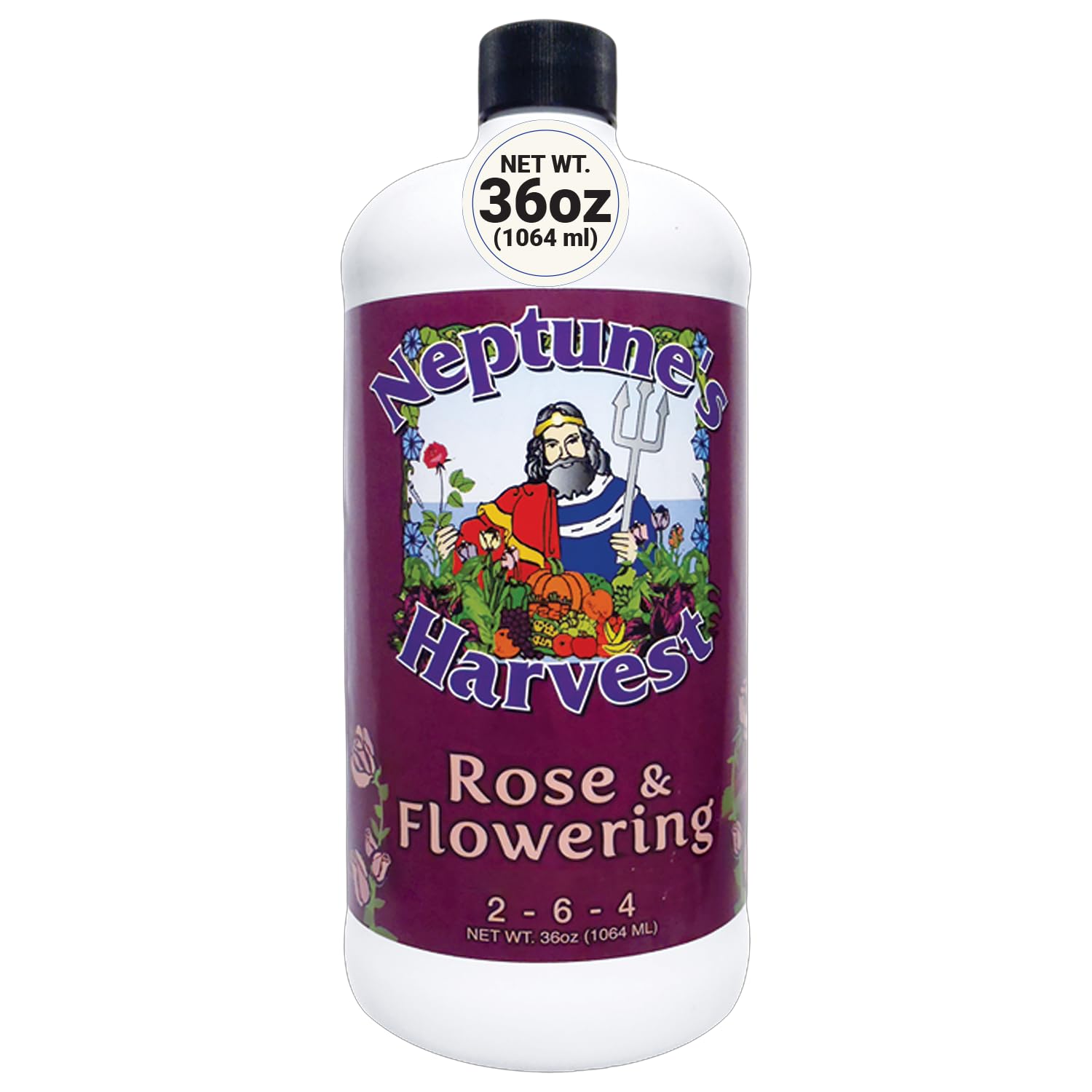
At 36 ounces (1064 ml), Neptune’s Harvest gives you the largest liquid volume in this roundup, and the 2-6-4 NPK ratio is perfectly dialed for flowering — high phosphorus (the middle number) fuels bud production while moderate potassium strengthens roots and stems. The formula is built from fish, seaweed, molasses, humic acids, and yucca extract, which means it feeds the soil microbes in your container as much as it feeds the rose itself. Shoppers say their flowers “go crazy” with this stuff, and one reviewer pulled 102 bell peppers from 9 plants using the same bottle.
What you give up is convenience — the fish-based ingredient gives off a noticeable smell during application. Reviewers describe it as “a bit of a smell” that fades once dry, but if you keep your potted roses on a balcony or near a window, the odor during mixing is real. You mix 1 ounce per gallon of water for outdoor containers (1 tablespoon per gallon for houseplants), and you can apply it as a foliar spray on the leaves for faster absorption.
This is the ideal choice for the organic gardener who grows everything naturally and wants one versatile bottle that feeds both soil and foliage. The 36-ounce size is budget-friendly per application, and the 2-6-4 ratio is specifically designed to push flowers, not just leaves. Choose it if you want a single organic liquid that handles everything from feeding to foliar spraying without needing multiple bottles — it is perfect for the budget-conscious organic grower who values volume and flower output over odor-free convenience.
Why we’d pick it
- 2-6-4 NPK is specifically formulated for flower production in containers
- 36-ounce bottle is the largest liquid volume in this list — excellent value per feed
- Can be used as both a soil drench and a foliar spray for faster absorption
- Organic ingredients (fish, seaweed, molasses) feed soil biology
A few caveats
- Fish-based formula has a noticeable odor during mixing (fades once dry)
- Requires measuring and mixing — not as grab-and-go as the Bioplenafeed spikes
Understanding the Specs
NPK Ratio
The three numbers on every fertilizer label stand for Nitrogen (leaves and stems), Phosphorus (roots and flowers), and Potassium (overall health and disease resistance). For potted roses, you want a middle number that is equal to or higher than the first — a ratio like 1-1-1 (Burpee) for maintenance, or 2-6-4 (Neptune’s Harvest) for pushing blooms. Too much nitrogen in a container creates leafy plants with few flowers.
Liquid Volume vs Application Count
A 250 ml concentrate like the GT Rose Focus sounds tiny compared to a 36 oz (1064 ml) bottle from Neptune’s Harvest, but concentration makes the difference. GT Rose Focus uses 3–7 ml per liter, so 250 ml makes roughly 35–80 liters of feed. Neptune’s Harvest uses 30 ml per gallon (~3.8 liters), so a 1064 ml bottle makes about 35 gallons. Always check the mixing ratio, not just the bottle size, to understand real value.
Granular vs Liquid in Containers
Granular fertilizers (Burpee) release nutrients slowly as the soil microbes break them down — ideal for long-term feeding, but they require consistent soil moisture to activate. Liquids (all other products on this list) enter the root zone immediately, which is better for fixing deficiencies fast. In small pots (under 10 inches), liquids are safer because granular buildup can concentrate salts in a confined space.
Trace Minerals and Calcium
Potted roses cannot access minerals from deep soil, so they depend on what you supply. Products with added calcium (GT Rose Focus) prevent weak stems and blossom drop. Products with a broad mineral profile like the Great Big Roses Booster (70 trace minerals) correct micronutrient deficiencies that cause leaf yellowing between veins. If your potted roses have dark green leaves but no blooms, a mineral booster often fixes the imbalance faster than a standard NPK feed.
FAQ
How often should I fertilize roses in pots compared to garden roses?
Can I use the same fertilizer for indoor potted roses?
What is the best NPK ratio specifically for blooming potted roses?
Why are my potted rose leaves turning yellow between the veins even with regular feeding?
Final Thoughts: The Verdict
For most growers, the fertilizer for roses in pots winner is the Burpee Organic Bloom Granular because it combines a generous 4-pound bag with slow-release feeding that lasts three months — perfect for anyone who wants to feed and forget. If you want precise liquid control with extra calcium for stronger stems, grab the Growth Technology GT Rose Focus. And for the organic gardener who wants one versatile bottle that works as both soil feed and foliar spray, the standout is the Neptune’s Harvest Rose & Flowering Fertilizer.