
If your indoor compost bin smells bad, is hard to use, or lets worms escape, you will likely quit within a month. The best indoor worm composter quietly turns your kitchen scraps into rich, dark fertilizer (called castings) for your houseplants or garden, without any odor or fuss. This guide breaks down six real systems for 2024 and beyond, from compact starter kits to large continuous-flow bags, so you can pick the one that actually fits your space and your schedule.
I’m Rikta — the co-founder and writer behind Lawn Gear Lab. This guide is built by comparing the manufacturers’ published specifications and the patterns across verified customer reviews, so you get each pick’s real strengths and trade-offs instead of marketing spin.
Whether you have a tiny apartment counter or a whole garage to dedicate, this roundup of the best indoor worm composter options gives you the honest, numbers-based answer instead of a guess.
How To Choose The Best Indoor Worm Composter
Picking the right worm bin comes down to three questions: how much waste you produce, where you will keep the bin, and how much effort you want to put into harvesting the finished compost. Here is what to look for.
Tray Count and Total Capacity
The number of trays (or layers) determines how much food your worms can process. A 1-person household or light kitchen-waste producer can get by with a 3-tray system (about 32 quarts or 30 liters), while a family of 4 will want a 5-tray bin with 50 liters or more. More trays also give you flexibility — you start with one tray and add more as the worm population grows.
Odor Control and Ventilation
For an indoor bin, the smell is the single biggest dealbreaker. Look for systems with ventilation slits or holes in every tray that let oxygen in (so the compost stays aerobic and doesn’t rot) without letting odors out. A tight-fitting lid and a spigot to drain excess liquid (worm tea) are also critical for keeping the bin from getting soggy and smelly.
Ease of Harvesting
Harvesting worm castings is the most tedious part of vermicomposting (worm-based composting). Stackable tray systems let you stop feeding the bottom tray and let worms migrate up to fresh food, leaving you with pure castings below. Continuous-flow bins (like the Urban Worm Bag) let you scoop finished compost from the bottom while adding scraps at the top — no tray-stacking required.
Build Quality and Material
Most indoor worm bins are made from polypropylene (PP) plastic or thick fabric (like 900D oxford). Plastic bins are rigid, stack neatly, and seal well, but some budget models have poor lids that let worms escape. Fabric bags breathe naturally (great for moisture control) but require a sturdy frame and can dry out faster.
Quick Comparison
On smaller screens, swipe sideways to see the full table.
| Model | Category | Best For | Key Spec | Amazon |
|---|---|---|---|---|
| Blütezeit 3-Tray | Mid-Range | Beginners with small kitchens | 32QT / 30L capacity | Amazon |
| VermiHut 5-Tray | Premium | Reliable odor-free performance | 50L capacity, 5 trays | Amazon |
| VIVOSUN 5-Layer | Mid-Range | Quick 5-minute setup | 50L / 13 Gal capacity | Amazon |
| Blütezeit 5-Tray (Gold) | Premium | Family-sized indoor composting | 53QT / 50L, 5 trays | Amazon |
| TOP XIAN 5-Tray | Value | High 100L capacity at a low price | 100L / 26.4 Gal capacity | Amazon |
| Urban Worm Bag V2 | Premium | Easy continuous-flow harvesting | 150.75L capacity, fabric | Amazon |
In‑Depth Reviews
1. VermiHut 5-Tray Worm Composter
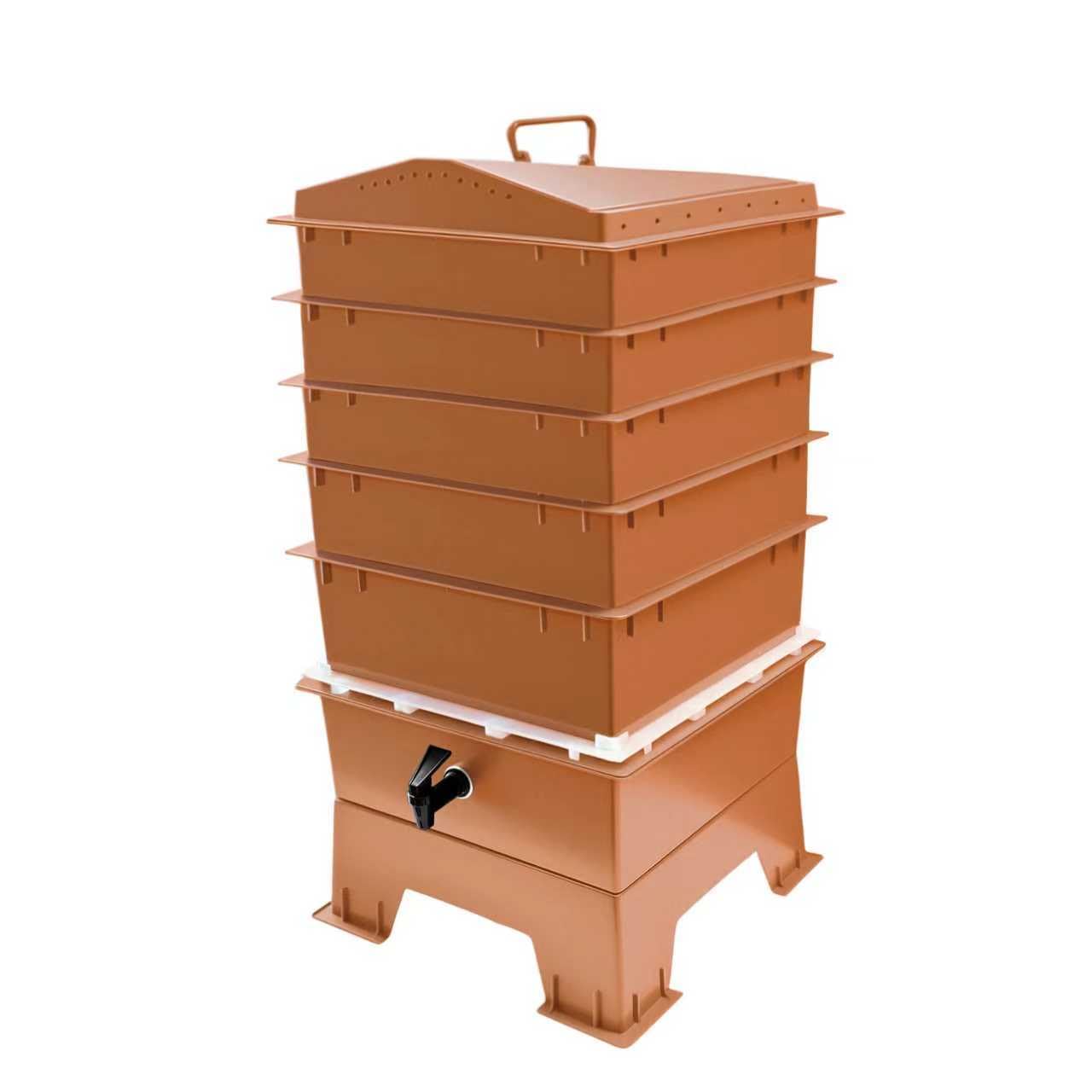
5 trays and 50 liters make the VermiHut the top pick for a family that wants to reliably compost kitchen scraps indoors without sacrificing floor space — its 16-inch by 16-inch footprint fits a counter corner or small balcony.
The “worm saver” tray at the bottom prevents worms from dropping into the liquid collection reservoir, so you keep your full composting crew when draining worm tea. Buyers report that after two months, “worms migrate upward naturally,” making harvest simple: remove the bottom finished tray while worms have already moved to fresh food above. The catch is that when fully loaded with 5 trays, the bin becomes top-heavy and the legs can spread slightly — one reviewer noted it “becomes top-heavy when full; legs may spread,” so place it on a stable, level surface.
For most people, that is a minor consideration for a system that consistently delivers clean, odor-free composting indoors — the VermiHut is the most reliable indoor worm composter you can buy.
Why it’s great
- 5-tray, 50-liter capacity handles a family’s weekly scraps comfortably
- Worm saver tray prevents worm loss during tea collection
- Compact 16-inch square footprint fits tight indoor spaces
Good to know
- Gets top-heavy when full; need a stable surface
- Lid seal can be weak on some units, requiring a bungee or weight
2. Urban Worm Bag Version 2

The Urban Worm Bag is a continuous-flow system, unlike the top pick’s tray-stacking design — you feed from the top and harvest finished castings from the bottom without ever dumping out trays. It holds 150.75 liters, which is 3 times the capacity of a typical 5-tray plastic bin like the Blütezeit or VIVOSUN, making it ideal for heavy-waste households. Made from 900D oxford fabric (the same material used for heavy-duty luggage), the bag breathes naturally, preventing anaerobic rot that causes bad smells — buyers with over 10 years of experience report this system “produces light, fluffy castings ready to use, not soggy,” unlike the wet, clumpy output from plastic tower bins.
Assembly takes about 15 minutes with no tools required, and the steel frame handles over 100 pounds of material. The downside is the price premium and the fact that the fabric dries out faster than a sealed plastic bin, so you need to watch moisture levels — one experienced user noted the “breathable cloth dries faster; needs moisture management.” If you compost more than a few pounds of scraps per week and hate the hassle of separating worms from trays, this bag is a genuine upgrade, but it costs more than twice as much as a basic stackable system.
Choose this over the top pick if you generate large volumes of kitchen waste and want a continuous-harvest system that avoids the tray-separation chore of a plastic stackable bin.
Where it shines
- 150.75-liter continuous-flow design eliminates tray-stacking forever
- Breathable 900D fabric prevents odor and produces dry, fluffy castings
- Tool-free assembly in under 15 minutes on a sturdy steel frame
Worth noting
- Fabric dries out faster than plastic; requires moisture monitoring
- Frame tubing can be wobbly and may need a DIY reinforcement
3. Blütezeit 5-Tray Worm Compost Bin (Gold)

If you are looking to start worm composting without spending a premium, the Blütezeit 5-tray model gives you the same 50-liter capacity as the VermiHut at a lower price — its rectangular footprint (16.2 by 12.6 inches) is 32% wider than the VIVOSUN’s base, so you get more surface area per tray for spreading scraps and keeping worms happy. The complete starter kit includes a turning fork, shovel, soil meter, coco-coir brick, non-woven fabric, cup, and spigot — everything except the worms. Reviewers consistently praise the quality of the PP plastic trays, noting “the quality is excellent” and that setup is straightforward, with one buyer reporting after five days that “the worms look healthy in there” on a diet of lettuce.
The honest downside: some experienced composters find the seal between the lid and top tray less than airtight, with one reviewer noting “poor seal (worms escape sides/lid)” and “insufficient clearance for liquid collection.” At 7 pounds, it is only 0.2 pounds heavier than the 3-tray version, meaning the plastic is not much thicker — so trays may flex under rough handling. Skip this if you need a completely escape-proof seal right out of the box; the VermiHut is more reliable there.
For the price, you get a 50-liter worm bin that is 32% wider than the VIVOSUN and comes with a full starter kit — just add worms.
What stands out
- Full 53QT/50L capacity with wide trays for better scrap distribution
- Includes soil meter, tools, coco-coir, spigot — worms not required
- Ventilation holes in each tray control odor effectively for indoor use
The trade-offs
- Lid-to-tray seal can let worms escape if not pressed down firmly
- Bottom tray clearance for liquid collection is tight
4. VIVOSUN 5-Layer Worm Compost Bin
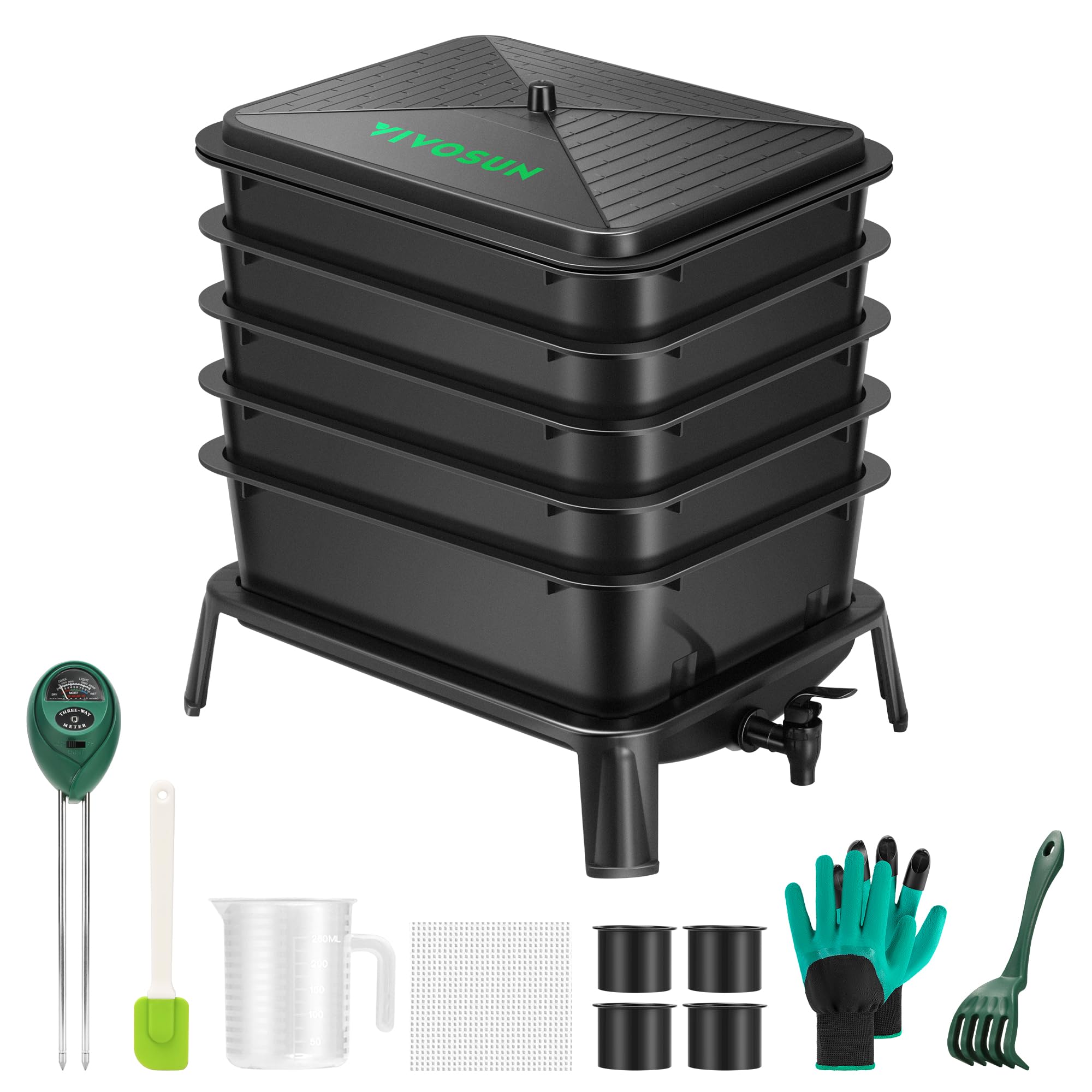
The single number that matters most in this category is the 5-minute setup time — the VIVOSUN 5-Layer Worm Compost Bin scores the fastest assembly of any model here, with the manufacturer claiming “complete the setup in just 5 minutes with detailed instructions.” Its 50-liter capacity matches the VermiHut and Blütezeit 5-tray at a lower entry price, hitting the sweet spot where cost and quality meet for beginners. You do trade some build quality for the lower price — the PP plastic trays are functional but not as thick as the premium models, and the included instruction manual is sparse, with one reviewer losing a star because “so little in instruction manual.” The bin is also noticeably smaller in footprint (12.3 inches by 13.18 inches) than the Blütezeit 5-tray, which means less surface area per layer for the worms to work.
At its price point, the VIVOSUN gives you a solid 50-liter system that works well for moderate household waste, especially if you do your own research on tray rotation and harvesting. It suits the buyer who wants a functional bin that does not break the bank and is willing to put in a little extra learning time — this is a very capable entry into vermicomposting if you are not expecting premium plastic thickness.
For the price, you get a functional 50-liter system that undercuts the competition on cost while matching their capacity, making it a strong price-to-value read for budget-conscious beginners.
The upsides
- 5-minute setup with clear instructions — fastest assembly on the list
- 50L/13 Gal capacity at a competitive price for a 5-layer system
- Includes soil meter, scraper, gloves, non-woven fabric — complete kit
Keep in mind
- Thinner PP plastic feels less durable than premium alternatives
- Instruction manual lacks detail on tray rotation and harvesting methods
5. Blütezeit 3-Tray Worm Composter

At this lower price you actually get a 32-quart (30-liter) system with 3 stackable trays plus a complete starter kit: a turning fork, shovel, soil meter, coco-coir brick, cup, and spigot — everything except worms and kitchen scraps. For a single person or a couple with modest food waste, 30 liters handles about 1-2 pounds of scraps per week without overstuffing. The obvious trade-off is capacity: 3 trays instead of 5 means you cannot process as much waste at once, and you will need to harvest more frequently to free up a tray. Multiple reviewers noted it is “just kind of smaller than I thought,” and one experienced composter called it “small” with concerns about “poor seal (worms escape sides/lid).”
This is the best pick for the apartment-dweller who wants to test-drive worm composting without spending premium money — if you discover you love it, you can always add more trays or upgrade to a 5-tray system later. It is compact enough (16.14 inches by 12.6 inches) to sit on a countertop, and the spigot makes draining excess liquid straightforward. Experienced composters who already know they want volume should skip this and go straight to a 5-tray bin.
This is the exact budget buyer it is perfect for: the cautious first-timer who wants a low-cost, complete starter kit to try indoor worm composting before committing to a larger system.
Why we’d pick it
- Affordable starter kit with soil meter, tools, coco-coir, and spigot
- 32QT/30L capacity fits a single person’s or couple’s weekly scraps
- Modular design — add more trays later as your worm population grows
A few caveats
- 3 trays limit total processing volume; frequent harvesting needed
- Lid seal may allow worm escapes without modification
6. TOP XIAN 5-Tray Worm Composter

This TOP XIAN 5-Tray Worm Composter is perfect for the budget-conscious, high-volume composter who needs to process a very large amount of kitchen scraps and prioritizes raw capacity per dollar above all else.
At a full 100 liters, it offers double the capacity of the VermiHut or Blütezeit 5-tray for roughly the same price, making it a remarkable capacity-per-dollar value. Each of its 5 trays (20 inches by 15 inches) is significantly larger than the standard 16-inch-square trays, giving your worms more surface area to work through scraps. The added tools (gloves, coconut bricks, shovel, silicone scraper) are a welcome bonus, but the lack of a soil meter or spigot means you will need to buy those separately.
However, you trade ease of assembly, a secure worm-proof seal, and a complete tool kit for that raw capacity — it is a compromise bin for the composter who already knows the basics and needs sheer volume above all else, but be cautious: the bin includes no printed instructions, and multiple reviewers report that “worms escape no matter what I do to prevent it,” suggesting the lid seal and tray fit have gaps.
Strong points
- Giant 100L capacity processes 2-3x more waste than standard 50L bins
- Wide 20-inch by 15-inch trays give worms ample surface area
- Includes gloves, coconut bricks, shovel, and scraper for setup help
Before you buy
- Zero assembly instructions included — you must find guides online
- Worm escapes reported due to poor lid and tray seal fit
Understanding the Specs
Capacity (Quarts and Liters)
This tells you how much total material the bin can hold across all trays. A 50-liter bin (about 53 quarts) is the standard for a household of 3-4 people. Smaller 30-liter bins work for singles or couples, while 100-liter bins handle heavy waste but take up more floor space. More capacity also means more finished castings at harvest time.
Ventilation and Odor Control
Worm bins need oxygen to stay aerobic (without oxygen, the compost rots and stinks). Look for ventilation slits or small holes in each tray. A tight-fitting lid is equally important — it keeps smells in and prevents flies and pests from getting inside. The best indoor bins have both: holes for airflow and a lid that seals properly.
Worm Tea Collection (Spigot)
Worm tea is the liquid that drains from the composting process — it is a nutrient-rich fertilizer for your plants. A spigot at the bottom tray lets you drain this liquid without opening the bin or disturbing the worms. Without a spigot, the liquid can pool and make the bin soggy and smelly.
Material: Polypropylene (PP) vs Fabric
Most plastic bins are made from PP, a food-safe, rigid material that stacks easily and seals well. Fabric bins (like the Urban Worm Bag) use thick woven material that naturally regulates airflow and moisture but requires a support frame and can dry out faster in low-humidity environments.
Harvesting Method: Tray-Based vs Continuous-Flow
Tray-based systems work by adding new trays on top as the worms finish eating the food below. When a bottom tray is fully composted, you remove it and the worms have already moved up to fresh food. Continuous-flow bins let you feed at the top and remove finished castings from the bottom at the same time — no tray stacking involved. For frequent harvesters, continuous-flow is faster and less messy.
FAQ
Can I keep a worm composter in my kitchen without it smelling?
How many worms do I need to start an indoor composter?
Will a worm bin attract fruit flies or other pests?
How often do I need to harvest the worm castings?
What can I put in my indoor worm composter?
Final Thoughts: The Verdict
For most buyers, the best indoor worm composter winner is the VermiHut 5-Tray because its 50-liter capacity, worm saver tray, and proven odor-free performance make it the most reliable and easiest to use for families and beginners alike. If you want the absolute easiest harvesting experience with no tray-stacking and a massive 150-liter capacity, grab the Urban Worm Bag V2. And for the budget-conscious beginner who wants to test the waters with a complete starter kit, the Blütezeit 3-Tray is the smartest entry point into vermicomposting.