
If your plants look a little sad, a little pale, or just not as vigorous as you’d hoped, the missing piece might be seaweed. Unlike standard synthetic fertilizers that feed the plant directly, seaweed fertilizer works from the ground up — it conditions the soil, feeds the helpful microbes living there, and delivers a broad spectrum of trace minerals that your plants can pull from whenever they need them, for steady, resilient growth.
I’m Rikta — the co-founder and writer behind Lawn Gear Lab. This guide is built by comparing the manufacturers’ published specifications and the patterns across verified customer reviews, so you get each pick’s real strengths and trade-offs instead of marketing spin.
By the end of this guide, you’ll know exactly which best seaweed fertilizer fits your garden’s needs and your preferred way of feeding your plants — whether you want a dry meal to mix into the soil, a liquid concentrate for weekly watering, or a soluble powder for making huge batches.
How To Choose The Best Seaweed Fertilizer
Not all seaweed fertilizers work the same way. The first big decision you need to make is whether you want a slow-release soil builder (a kelp meal you mix into the dirt once) or a fast-acting liquid/water-soluble concentrate you apply every week or two. The choice comes down to how much time you have and whether you are starting a new garden bed or nursing existing plants through a rough patch.
Form Matters: Meal vs. Liquid vs. Powder
Kelp meal is a dry, granular product you mix directly into the top few inches of soil. It breaks down slowly over weeks or months as soil microbes digest it, feeding the soil life and releasing nutrients gradually — perfect for pre-planting bed prep or top-dressing around trees and perennials. Liquid concentrates and soluble powders, on the other hand, dissolve in water and get to the roots (or leaf surfaces) almost immediately after you water, making them ideal for container plants, hydroponics, or giving struggling plants a quick boost.
Reading the Numbers: N-P-K and Trace Minerals
The labeling on a fertilizer shows three numbers separated by dashes — for example, 1-0-17. That stands for Nitrogen-Phosphorus-Potassium. Seaweed is naturally low in nitrogen (the first number) and phosphorus (the middle number) but can be quite high in potassium (the last number), which is vital for root development, stress tolerance, and flower/fruit production. Many of the real benefits from seaweed, though, come from the stuff not listed on that label: over 70 trace minerals, vitamins, and natural plant hormones (cytokinins and auxins) that promote cell division, root growth, and overall plant vigor. These hidden extras are what make seaweed fertilizers stand apart from simple chemical feeds.
Organic Certification and Processing Method
If you grow fruits, vegetables, or herbs, you probably want a product that is OMRI Listed (Organic Materials Review Institute — a certification that the product meets organic farming standards). The way the seaweed is processed also matters: cold-pressed concentrates retain more of the fragile growth hormones than heat-extracted ones, so look for “cold-processed” or “cold-pressed” on the label if maximizing those biological compounds is your goal.
Quick Comparison
On smaller screens, swipe sideways to see the full table.
| Model | Category | Best For | Key Spec | Amazon |
|---|---|---|---|---|
| FoxFarm Bush Doctor Kelp Me Kelp You | Liquid | All-Around Easy Feeding | 1 Pint bottle, 0.5-0-0.5 | Amazon |
| Neptune’s Harvest Organic Kelp Meal | Meal | Long-Term Soil Health | 4 lb resealable bag, 1-0-2 | Amazon |
| Wallace Organic Wonder Soluble Seaweed Powder | Powder | Concentrated Value for Large Gardens | 10.7 oz makes 65 gallons, 1-0-17 | Amazon |
| MaxiCrop Pure Seaweed Extract Powder | Powder | Serious Growth & Rooting | 10.7 oz, makes 65 gal, 0-0-17 | Amazon |
| Kelp Bliss Kelp Meal | Meal | Budget-Friendly Soil Prep | 2 lbs (32 oz) bag, 100% natural | Amazon |
| Growganica Kelp it Real Powder | Powder | Huge Batch, Minimal Storage | 8 oz makes 200 gallons, 0-0-14 | Amazon |
| Age Old Fish & Seaweed Liquid | Liquid | Fast Results for Struggling Plants | 32 oz bottle, 3-3-2 | Amazon |
In‑Depth Reviews
1. FoxFarm Bush Doctor Kelp Me Kelp You Seaweed Plant Food

0.5-0-0.5 N-P-K ratio makes this the top pick for any grower who wants a foolproof liquid seaweed concentrate that works in soil, hydroponics, or drip irrigation — just mix 1 to 2 teaspoons per gallon of water.
Buyers report it has been a “lifesaver for my plants to combat transplant shock” and heat stress, making it ideal for moving plants in or out of the house or dealing with a sudden heatwave. The 1 Pint (16-ounce) bottle lasts several months for the average houseplant collection or small vegetable garden before needing a refill.
One honest trade-off: it costs more per ounce of concentrate than some other options, but the brand has been greenhouse-testing its formulas since 1984. The verdict is that this is the easiest, most versatile entry point if you want a liquid seaweed fertilizer that simply works across everything you grow.
Why it’s great
- Works in any growing method — soil, hydroponics, drip irrigation
- Easy-to-measure 1-2 tsp per gallon mixing ratio
- Trusted brand with decades of greenhouse testing
Good to know
- Higher price per ounce than bulk powders or meals
- 1-pint bottle may need frequent reordering for large gardens
2. Neptune’s Harvest Organic Kelp Meal (1-0-2)
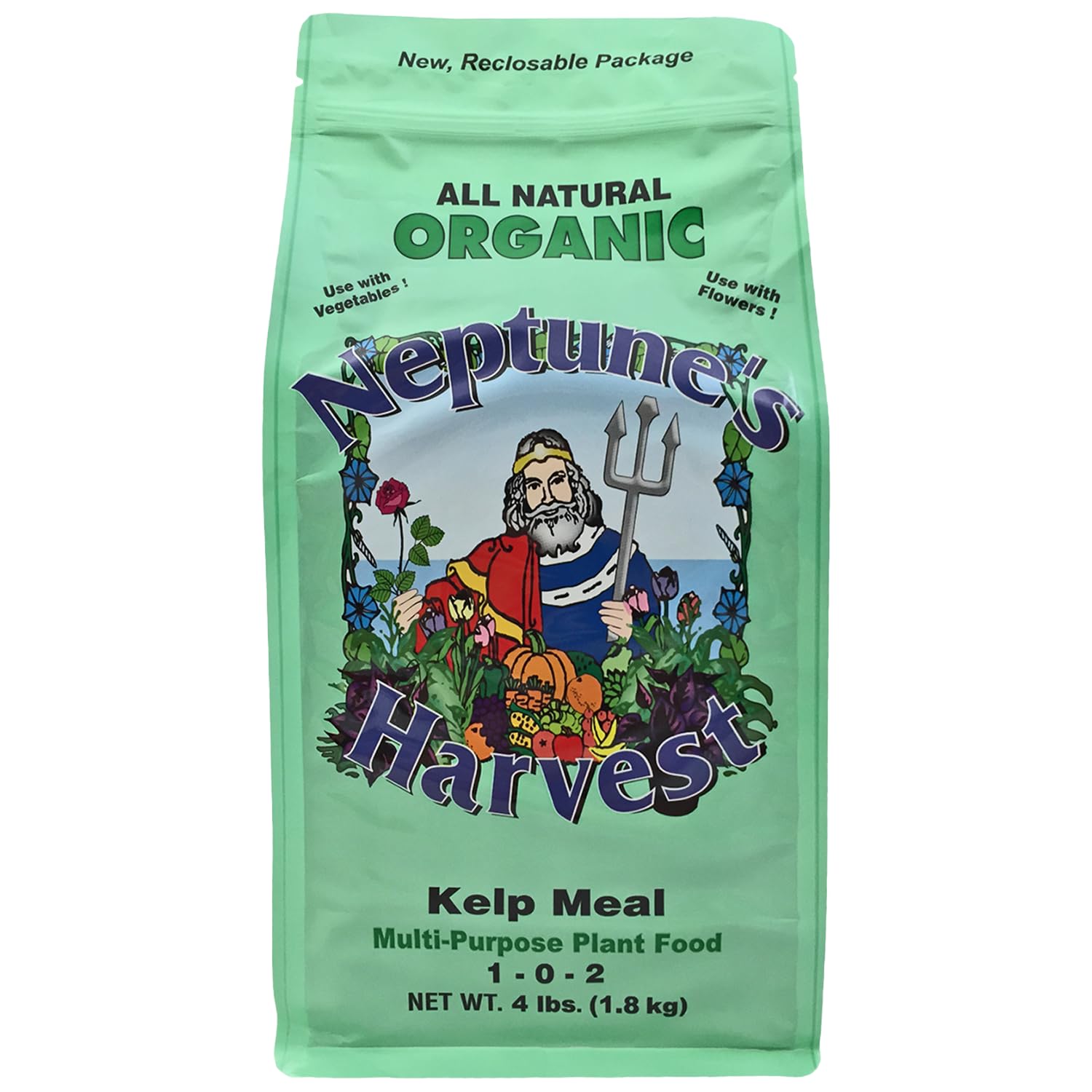
Compared to the top-pick FoxFarm liquid, Neptune’s Harvest Organic Kelp Meal (1-0-2) delivers a 4-pound bag of dry meal that breaks down over weeks or months rather than fading in a couple of weeks, adding organic matter and conditioning soil structure each time it gets wet.
Its N-P-K ratio is 1-0-2, providing a small amount of nitrogen and a good dose of potassium for root and overall plant health. It is also OMRI Listed (certified for organic farming use by the Organic Materials Review Institute), so it is safe for vegetable gardens. One reviewer noted that “there is no burn risk” because the meal has no synthetic salts, making it an ideal choice if you have ever accidentally over-fertilized with a chemical product.
Because this is a dry meal, it is best incorporated into the soil early in the season or top-dressed around established plants. It will not give you the instant revival that a liquid provides, but for perennial beds, fruit trees, and building soil year after year, choose this over the liquid picks for the long game. Choose this over the top-pick FoxFarm if you are planting a new garden bed or feeding mature trees — skip it if you are nursing a stressed houseplant that needs help today.
Where it shines
- Slow-release feeding builds soil health over months
- No risk of burning plants, even with generous use
- OMRI Listed for organic vegetable gardening
Worth noting
- Requires incorporation into soil or top-dressing — not instant
- Heavier bag (4 lbs) may be more than needed for small collections
3. Wallace Organic Wonder Soluble Seaweed Powder (1-0-17)

Imagine this: you have a large vegetable garden, a bunch of houseplants, and maybe a few fruit trees, and you want a single product that feeds them all without costing a fortune per feeding. The Wallace Organic Wonder powder is exactly for that situation — a 10.7-ounce bag that makes roughly 65 gallons of liquid feed using only 1 teaspoon of powder per gallon of water.
Its N-P-K analysis is 1-0-17, meaning it is extremely high in potassium (the element that strengthens roots and improves flowering and fruiting). The powder dissolves easily in water, so you can use it in a watering can, a hose-end sprayer, or a foliar spray bottle (spraying directly on the leaves). One buyer who has used it for two years says it “significantly improved crop quality” and “dissolves easily in water, mixes well with nutrients.”
Just store the bag in a dry spot, since the fine powder can clump if it gets damp. This is the go-to choice for anyone with a large garden who wants the lowest cost per feeding on this list — if you only have a few pots on a balcony, the small FoxFarm bottle will be more convenient and waste less.
What stands out
- Makes 65 gallons — excellent value for large gardens
- Very high potassium (17) for strong roots and blooms
- Fully water-soluble for foliar spray or soil drench
The trade-offs
- Must be kept in a dry place to prevent clumping
- Not a complete fertilizer — best used alongside a balanced feed
4. MaxiCrop Pure Seaweed Extract Soluble Powder (0-0-17)

The single number that tells you everything about this product is its 0-0-17 N-P-K ratio — it is almost pure potassium, which is exactly what plants need when you want to boost root density, flower set, and stress tolerance without adding extra nitrogen that would push leafy growth. Like the Wallace powder, the 10.7-ounce bag makes about 65 gallons of liquid feed at a mixing ratio of 1 heaping teaspoon (about 5 grams) per gallon of water.
The catch you accept with MaxiCrop is the packaging: owners mention that the bag can sometimes leak or that the powder can solidify into lumps over time, as one buyer mentioned: “it solidifies into lump over time, making half unusable.” The fine powder is best transferred to an airtight jar immediately after you open the bag to keep it dry.
Price-to-performance, this sits at the premium end of the powder options, but it has a long reputation among serious gardeners and commercial growers for its reliable effects on rooting and cloning. If you propagate cuttings or grow plants in hydroponic systems where root health is everything, the higher upfront cost is worth it for the pure, predictable formula you get. For rooting cuttings, this edges out the Wallace powder because of the zero-nitrogen profile — pass on it if you are trying to feed vigorous leafy greens that need more balanced nutrition.
The upsides
- Very high potassium (17) for intense root and flower growth
- Makes a large 65-gallon batch for long-term use
- Widely trusted for cloning and hydroponic applications
Keep in mind
- Bag can leak or powder can clump — store in an airtight container
- Premium price per bag compared to some other powder brands
5. Kelp Bliss (2lbs) Kelp Meal for Plants

What you actually get at this lower price is a 2-pound bag (32 ounces) of 100% natural Norwegian kelp meal in granular form, applied at a rate of 1 to 2 pounds per 100 square feet, mixed into the top 3 inches of soil before planting.
What you give up compared to the Neptune’s Harvest meal is the OMRI Listed organic seal and the larger bag size — this is a smaller bag meant for home gardeners with modest beds or a collection of container plants, not for large-scale landscaping. One owner reported that they “mix this with mycorrhizal and azos, and bury them in small holes around the trees” with noticeable results after just one application, which tells you the meal itself is effective, especially for trees and shrubs.
It is also a low-risk way to improve water retention in sandy soil, as the organic matter in the meal helps the soil hold moisture longer. If you are just getting started and want the lowest-cost meal to test, this beats the bigger Neptune’s bag on upfront price — it’s not for you if you are a serious organic gardener who needs OMRI certification for your produce. The exact budget buyer it is perfect for: anyone starting out with organic gardening who wants to try kelp meal without committing to a bigger, pricier bag.
Why we’d pick it
- Very affordable entry point for trying kelp meal
- Improves soil water retention and microbial activity
- 100% natural with no synthetic additives
A few caveats
- Smaller bag (2 lbs) better for small to medium gardens
- Not OMRI Listed like some premium meal brands
6. Growganica Kelp it Real Organic Seaweed Fertilizer
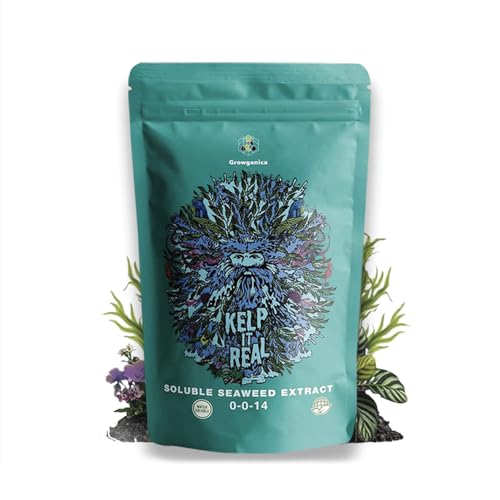
If you have a very large garden or you want to stock up once and not think about buying more for a year, the Kelp it Real powder is designed for you. Its single defining spec is that an 8-ounce bag makes 200 gallons of liquid feed — that is more than three times the volume of the Wallace or MaxiCrop powders for a comparable bag weight.
It is a cold-pressed kelp concentrate with an N-P-K ratio of 0-0-14, and buyers specifically note that the potassium comes from the kelp itself, not from added potassium hydroxide. One reviewer called it “the best, cleanest Soluble Seaweed/Kelp extract I’ve found yet,” and pointed out that you only need 1/4 teaspoon per gallon of water rather than a full teaspoon, which is how the 8-ounce bag stretches so far.
The honest limit is its price per bag: it is comparable to other powders but contains only 8 ounces by weight, so if you are not measuring the tiny quarter-teaspoon dose correctly, you may feel the value is not there — one buyer did mention feeling it was “overpriced for weight.” But if you stick to the recommended tiny dose, this is the most cost-effective batch you can get. If your garden is measured in acres, this powder yields more gallons for the money than any other pick here — look elsewhere if you are a casual gardener who might not measure a 1/4 teaspoon accurately.
Strong points
- 8 oz makes an incredible 200 gallons of fertilizer
- Cold-pressed to preserve natural plant hormones
- Very low dose (1/4 tsp/gal) reduces waste
Before you buy
- Requires precise measuring of small doses
- Some users have reported pH swings in their water
7. Age Old Fish and Seaweed Liquid Fertilizer (3-3-2)
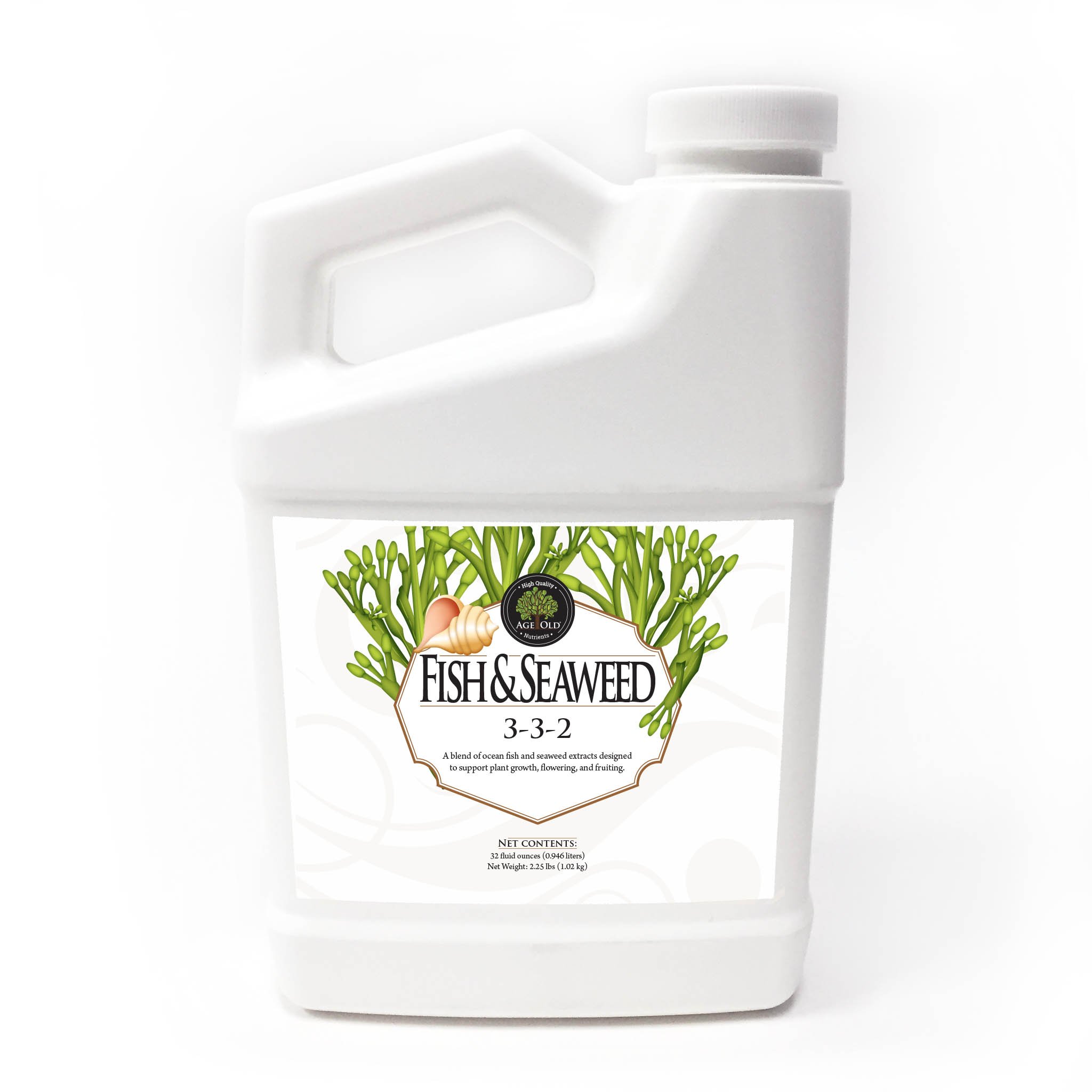
Compared to all the other liquids and powders on this list, the Age Old blend stands alone in one way: it combines fish emulsion with seaweed extract, giving you a more balanced 3-3-2 N-P-K ratio that actually feeds plants with nitrogen and phosphorus, not just potassium. That makes it a more complete fertilizer you could use as your primary feed rather than just a supplement.
What that 32-ounce (fluid ounces) bottle gives you in practice is a potent, all-natural nutrient source that customers note can revive struggling plants quickly — one customer observed it “revived old cannabis plants; new growth appeared within a week, enabling a second harvest.” The fish content gives it a mild but noticeable fishy smell that dissipates after the soil dries, so it is best used outdoors or in well-ventilated areas.
The one reason to choose this over the others: you want a single-bottle solution that delivers both the trace minerals and growth hormones from seaweed plus the nitrogen and phosphorus from fish in one pour. It is not as concentrated as the powders (the Kelp it Real powder makes 200 gallons from 8 ounces, whereas this 32-ounce bottle makes far less), but it is a complete feed straight from the bottle. This is the fastest-acting option if your plants look yellow and weak — steer clear if you are sensitive to smells or garden primarily indoors with limited ventilation.
What we like
- Fish + seaweed combo provides a balanced 3-3-2 NPK
- Works fast — visible new growth within a week per reviews
- Can be used as both a soil drench and a foliar spray
The downsides
- Has a noticeable fishy smell for about 24 hours
- Less concentrated than powder options — bottle covers less area
Understanding the Specs
N-P-K Ratio
Every fertilizer label shows three hyphenated numbers that stand for Nitrogen-Phosphorus-Potassium. In seaweed products, the first two numbers (nitrogen and phosphorus) are often very low or even zero, while the last one (potassium) can be as high as 14 or 17. This makes seaweed a poor choice as a complete, balanced meal for leafy greens that need lots of nitrogen, but an excellent choice for root development, flower production, fruit set, and helping plants tolerate stress like drought or heat waves.
Dry vs. Liquid Concentration
The “makes X gallons” number on a powder tells you exactly how much liquid feed you can create from the whole bag. For example, a product that makes 200 gallons requires a much smaller dose per gallon (like 1/4 teaspoon) than one that makes 65 gallons (like a full teaspoon). A larger batch number means better value per gallon but demands more precise measuring. Liquid concentrates, by contrast, typically list the bottle volume in fluid ounces and have a standard mixing ratio like 1-2 tablespoons per gallon of water.
FAQ
Can I use seaweed fertilizer on all types of houseplants?
Is there a difference between kelp meal and seaweed extract?
Will seaweed fertilizer burn my plants if I use too much?
Can I use seaweed fertilizer during the flowering or fruiting stage?
Final Thoughts: The Verdict
For most buyers, the best seaweed fertilizer winner is the FoxFarm Bush Doctor Kelp Me Kelp You because it combines a trusted brand, an easy-to-use liquid formula, and proven results for transplant shock and general plant growth in both soil and hydroponic systems. If you want to build long-term soil health with a slow-release meal, grab the Neptune’s Harvest Organic Kelp Meal. And for the absolute best value covering the most area per dollar with a soluble powder, the standout is the Wallace Organic Wonder Soluble Seaweed Powder.