
Trying to keep that signature silvery-blue color on your Colorado Blue Spruce often fails because you use the wrong fertilizer. Blue spruces are acid-loving trees that need specific nutrients (like Nitrogen for needle growth and sulfur for soil pH), not generic food. This guide picks five proven fertilizers, explains what each delivers, and matches each to a specific tree situation — so you get greener, fuller needles.
I’m Rikta — the co-founder and writer behind Lawn Gear Lab. This guide is built by comparing the manufacturers’ published specifications and the patterns across verified customer reviews, so you get each pick’s real strengths and trade-offs instead of marketing spin.
The best colorado blue spruce fertilizer for most people is the TPS Spruce Tree Fertilizer, because it is a 32-ounce fast-acting liquid that buyers report turns needles greener within weeks. But the right pick for you depends on whether you want quick results, organic soil health, or total convenience.
How To Choose The Best Colorado Blue Spruce Fertilizer
Colorado Blue Spruces need a steady supply of nutrients, but they are sensitive to over-fertilization. The wrong product can cause chemical burns or leggy, weak growth. Here are the key factors to consider before buying.
1. N-P-K Ratio: The Magic Numbers
The three numbers on a fertilizer bag — Nitrogen (N), Phosphorus (P), and Potassium (K) — tell you the balance of nutrients. For blue spruces, you want a higher first number (Nitrogen) to support green needle growth without overloading the roots. A ratio like 4-3-4 or 11-3-4 is ideal; the Nitrogen drives lush growth, while the middle number (Phosphorus) for bloomers is much less important for evergreens.
2. Liquid vs. Granules vs. Spikes
Liquid fertilizers (like the TPS Nutrients options) work fast — you see results in weeks — but need monthly application. Granular fertilizers (like Espoma Evergreen-Tone) release nutrients slowly, so you only feed twice a year. Spikes (like Jobes) are the most hands-off: just hammer them into the ground, and they feed the roots for a whole season. Your choice depends on whether you prefer speed or convenience.
3. Organic vs. Synthetic Nitrogen Sources
Organic fertilizers (Espoma’s line) use natural ingredients like chicken manure, which releases nitrogen slowly and improves soil biology. Synthetic sources (TPS and Jobes) provide a quicker green-up. For a Colorado Blue Spruce, organic is safer for young trees to avoid chemical burn, while synthetic can give a dramatic boost to established trees that need fast recovery from stress or poor soil.
Quick Comparison
On smaller screens, swipe sideways to see the full table.
| Model | Category | Best For | Key Spec | Amazon |
|---|---|---|---|---|
| TPS Spruce Fertilizer | Liquid | Fast results for established trees | 32 oz ready-to-use liquid | Amazon |
| TPS Evergreen Fertilizer | Liquid | Budget pick for small trees | 32 oz concentrated liquid | Amazon |
| Espoma Evergreen-Tone | Granular | Best organic slow-release | 4-3-4 ratio, 18 lb bag | Amazon |
| Espoma Holly-Tone | Granular | Acid-loving plant feeding | 4-3-4 ratio, 36 lb bag | Amazon |
| Jobes Evergreen Spikes | Spikes | Bulk feeding for large properties | 11-3-4 ratio, 38.89 lbs | Amazon |
In‑Depth Reviews
1. TPS Spruce Tree Fertilizer – Liquid Plant Food
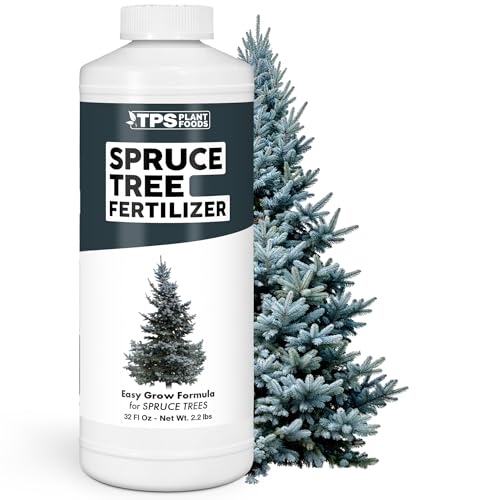
If you want a fast color change in your Blue Spruce, this 32-ounce liquid (a ready-to-use form you pour directly on the soil) delivers nutrients in days. Owners mention that their “Blue Spruce has filled out since we used the fertilizer (2 times).” The formula focuses on promoting fuller branching and richer green needles, so the classic silvery-blue color has a healthy glow underneath. A single bottle covers a medium-sized tree for a couple of months, and it is made in the USA.
It requires monthly reapplication, so it is more hands-on than the Espoma granules you only feed twice a year. For an established tree that needs immediate help, the TPS Spruce delivers the fastest visible turnaround of all the picks here. skip it if you want a set-it-and-forget-it option; pick the Espoma Evergreen-Tone instead for that.
Why it’s great
- Fast-acting liquid format
- Specifically formulated for spruce trees
- Made in the USA
Good to know
- Needs monthly reapplication
- Small bottle may not cover large trees long
2. TPS Evergreen Tree Fertilizer – Liquid Plant Food
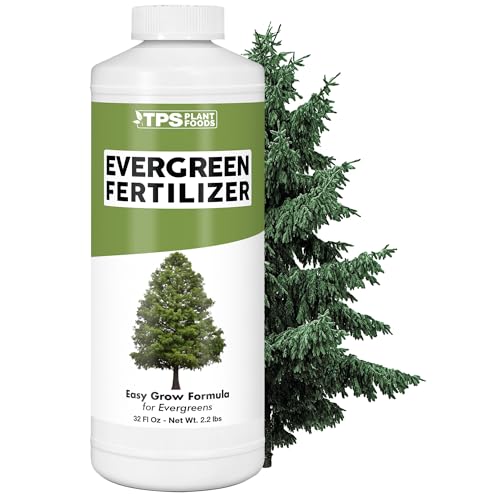
Compared to the Spruce-specific TPS top pick, this 32-ounce concentrate (you mix 1 teaspoon per quart of water) targets all evergreens, not just spruces, and its 1:256 dilution ratio makes the bottle stretch further than the Spruce format if you dilute it properly. One reviewer noted it “gave my seedling trees a boost,” suggesting it works well on young transplants, and customers note their “blue spruce is looking refreshed and healthy” after use.
However, a few reviewers point out it “caused chemical burn on small trees (2.5-7 ft)” when used at full strength — halve the dose for younger trees.
Choose this over the Spruce version if you need to feed pines, firs, and junipers alongside your Blue Spruce on a budget — it is the best value for a mixed landscape.
Where it shines
- Concentrated formula extends use
- Works on multiple evergreen types
- Good for seedling trees
Worth noting
- Can burn young trees if not diluted
- Bottle runs out fast on large trees
3. Espoma Organic Evergreen-Tone 4-3-4

Spread these organic granules (they are made from natural ingredients like chicken manure) around your Blue Spruce’s base in early spring, water them in, and forget about feeding until autumn. That is the whole point of Espoma’s Evergreen-Tone — an 18-pound bag with a balanced 4-3-4 N-P-K ratio that releases nutrients slowly over months. One buyer mentioned it “made my evergreens bright green just after a couple of weeks!” It includes Espoma’s Bio-tone formula, which adds beneficial microbes to the soil, and the 5% sulfur content helps maintain the acidic soil pH (5.0 to 6.5) that Colorado Blue Spruces crave.
You apply it only twice a year — early spring and late fall — making it the lowest-maintenance option on this list. The 4:3:4 mixing ratio provides high Nitrogen for needle growth without shocking your tree’s roots. It has a strong barnyard smell because of the chicken manure, and the 18-pound bag gives less coverage than the Holly-Tone 36-pound bag. Choose this certified organic, slow-release solution if you want long-term soil health and a hands-off schedule.
With just two annual applications, you get months of steady feeding from a certified organic formula that includes Bio-tone microbes and 5% sulfur to lock in the acidic pH your Blue Spruce demands.
What stands out
- Certified organic formula
- Slow-release for twice-yearly feeding
- Includes Bio-tone for soil microbes
The trade-offs
- Has a strong barnyard smell
- Only 18 lbs — less coverage than Holly-Tone
4. Espoma Organic Holly-Tone 4-3-4

The single number that matters most here is 36 — the weight in pounds of this bag. At 36 lbs, the Holly-Tone offers 100% more product than the 18 lb Evergreen-Tone, using the exact same 4-3-4 N-P-K ratio with 5% sulfur, but is formulated for all acid-loving plants (holly, azaleas, hydrangeas, blueberries) — which includes Blue Spruces perfectly fine. It is also certified organic and includes the Bio-tone formula, so the soil benefits are identical to Evergreen-Tone.
Buyers appreciate “the good price on a 36 lb bag,” noting it is enough for both spring and fall feedings. The catch is it is not specifically marketed as an “evergreen” fertilizer. For a large property with multiple Blue Spruces and other acid-loving shrubs, the Holly-Tone 36 lb bag gives more feeding power per dollar than the Evergreen-Tone 18 lb bag. pass on it if you only have one or two trees; the Evergreen-Tone is enough.
This makes the Holly-Tone 36 lb bag a strong price-to-value pick for those with multiple acid-loving plants, delivering more product per dollar than the smaller Evergreen-Tone option.
The upsides
- Massive 36 lb bag for large landscapes
- Same great organic formula as Evergreen-Tone
- Versatile for all acid-loving plants
Keep in mind
- Not specifically labeled “evergreen”
- Heavy bag can be awkward to store
5. Jobes 02611 Evergreen Tree Fertilizer Spikes 11-3-4 Bulk

You get 160 pre-measured spikes in a single bulk box, each with an 11-3-4 N-P-K ratio that delivers the highest Nitrogen concentration of all the picks here for dramatic growth. Shoppers say that using these spikes led to “dramatic results with tree growth” even in infertile ground, and one owner reported they “revived a dying Austrian pine.” The spikes eliminate waste from spilled granules and need no mixing, but there is a catch: the spikes often “fracture as I hammer them into the ground,” so some users recommend pre-drilling a hole with a cordless drill and an auger bit for a cleaner installation.
For a windbreak or large garden with many Blue Spruces, this is the fastest feeding solution — you hammer a few spikes around the drip line of each tree once a season, and you are done. The 11-3-4 ratio gives faster green-up than the 4-3-4 Espoma options, but it is synthetic, so it is less forgiving on young trees.
This is the pick for the budget buyer who wants total hands-off convenience with big results.
Why we’d pick it
- Extremely convenient yearly application
- High Nitrogen for fast growth
- No waste or spillage
A few caveats
- Spikes can fracture when hammered in
- High initial cost for the bulk pack
Understanding the Specs
N-P-K Ratio
This is the three-number code you see on every bag or bottle, like 4-3-4 or 11-3-4. It stands for Nitrogen (N) – Phosphorus (P) – Potassium (K). For Blue Spruces, the first number (Nitrogen) is the most important: it drives the growth of new needles and the deep green color in the foliage. The second number (Phosphorus) supports root and flower growth (less critical for evergreens), while the third (Potassium) helps overall tree health and disease resistance. A ratio with a higher first number, like the 11-3-4 in the Jobes spikes, will give a faster green-up, while a balanced 4-3-4 ratio is safer for slower, steady growth.
Acid-Loving Plant Requirements
Colorado Blue Spruces thrive in soil with a pH between 5.0 and 6.5 — that is mildly acidic. If your soil is too alkaline (high pH), the tree cannot absorb iron and other nutrients, causing the needles to turn yellow. Fertilizers labeled “for acid-loving plants” (like Espoma’s Holly-Tone) often include sulfur or other acidifiers to lower soil pH. Granular fertilizers with 5% sulfur help maintain this acidity over time, which is why many safe picks include it in their formula. If your soil is already acidic, you can use a standard fertilizer; if you are unsure, an acid-based formula is the safer bet.
FAQ
How often should I fertilize my Colorado Blue Spruce?
What is the best N-P-K ratio for a Blue Spruce?
Can I use a general-purpose fertilizer on my Blue Spruce?
Why are my Blue Spruce needles turning yellow?
Is organic or synthetic fertilizer better for Blue Spruces?
Final Thoughts: The Verdict
For most Blue Spruce owners, the best colorado blue spruce fertilizer winner is the TPS Spruce Tree Fertilizer because it is a targeted liquid formula that works fast and effectively on established trees. If you prefer a no-fuss organic approach that builds soil health over the long term, grab the Espoma Evergreen-Tone. And for those managing a large property with many evergreens, the standout is the year-long convenience of the Jobes Evergreen Spikes.