
Your azaleas’ leaves are yellowing, the blooms are sparse, or the growth is just sluggish. The fix is almost always the soil pH (a measure of acidity or alkalinity) or a lack of the nutrients they need at the right time. This guide covers seven fertilizers that are made for acid-loving plants, so you can match one to your garden’s size, your feeding schedule, and whether you want organic or synthetic ingredients.
I’m Rikta — the co-founder and writer behind Lawn Gear Lab. This guide is built by comparing the manufacturers’ published specifications and the patterns across verified customer reviews, so you get each pick’s real strengths and trade-offs instead of marketing spin.
We break down every detail, from quick-release powders to slow-release organics, so you can confidently choose the best food for azaleas and for every other acid-loving plant in your garden.
How To Choose The Best Food For Azaleas
Azaleas, along with rhododendrons and camellias, are acid-loving plants (often called “ericaceous”). They thrive when the soil pH is between 4.5 and 6.0. Picking the right fertilizer means understanding a few key specs: the N-P-K ratio, the form of the fertilizer, and whether you want organic ingredients or a quick synthetic boost.
Understand the N-P-K Ratio
Every fertilizer bag has three numbers printed on it. They represent the percentage of nitrogen (N), phosphorus (P), and potassium (K) by weight. Nitrogen pushes leaf growth, phosphorus encourages root development and flowers, and potassium supports overall health and disease resistance. For azaleas and their relatives, a formula with a higher middle number (phosphorus)—for example, 4-8-8 or 5-4-3—is a good starting point, as it puts energy into those spectacular blooms.
Choose Your Form: Granules vs. Water-Soluble Powder
Granular fertilizers (slow-release) are sprinkled on the soil, where they break down over weeks or months. You apply them less often—usually twice per year—and they feed your plants gradually. Water-soluble powders, like the Miracle-Gro product listed here, dissolve in water and deliver nutrients right away. You need to apply them every 7 to 14 days during the growing season. The catch is convenience and staying power (granules win) versus speed of results (water-soluble wins).
Check for Sulfur Content
Sulfur is a key ingredient that helps lower soil pH naturally, making it easier for azaleas to take in iron and other micronutrients. A yellowing leaf (a condition called chlorosis) is often a sign the soil isn’t acidic enough. A fertilizer that includes sulfur, like the True Organic option below, does two jobs: it feeds the plant and adjusts the pH at the same time.
Organic vs. Synthetic: What’s the Difference?
Organic fertilizers (like the Dr. Earth and Espoma picks in this guide) come from natural materials such as feather meal, bone meal, seabird guano, or composted manure. They feed the soil microbes along with the plant and improve the long-term health of your soil. Synthetic fertilizers (like Miracle-Gro) deliver nutrients in a pure, fast-acting form but do less for the soil biology. Both can grow beautiful azaleas. Your choice depends on whether you prioritize speed or long-term soil-building.
Quick Comparison
On smaller screens, swipe to see the full table.
| Model | Category | Best For | Key Spec | Amazon |
|---|---|---|---|---|
| Miracle-Gro Water Soluble | Water Soluble | Quick recovery & fast feeder | 5 lb bag / 80 oz | Amazon |
| Dr. Earth Acid Lovers | Organic Granules | Organic, pet-safe feeding | 4 lb bag | Amazon |
| Espoma Organic Holly-Tone | Organic Granules | Large gardens & all acid-lovers | 36 lb bag | Amazon |
| GARDENWISE 8-4-8 | Slow-Release Granules | Year-round feeding with iron | 1 qt / 32 oz | Amazon |
| True Organic Azalea Food | Organic Granules | Naturally lowering soil pH | 12 lb bag | Amazon |
| Schultz ACR 14-7-7 | Slow-Release Granules | Budget pick & quick results | 1 lb bag | Amazon |
| SouthernGRO 04-08-08 | Slow-Release Granules | Budget pick & large area | 4 lb bag / 64 oz | Amazon |
In-Depth Reviews
1. Miracle-Gro Water Soluble Azalea, Camellia, Rhododendron Plant Food

If your azaleas or rhododendrons need a fast, visible boost—yellow leaves turning green, weak stems strengthening, or buds forming—the Miracle-Gro Water Soluble formula is the fertilizer that delivers that quick turnaround. It comes as a 5-pound bag of fine powder that you mix with water and apply with a watering can or hose feeder every 7 to 14 days. This makes it a good fit for gardeners who want active, hands-on feeding.
Buyers report that “this truly helped our rhododendron to recover and look stunning this summer,” with results visible in about a week. You mix it at two strengths: a weaker 1:144 ratio for indoor plants on your bookshelf, and a stronger 1:18 ratio for outdoor garden beds—so the same bag feeds both houseplants and landscape shrubs.
The downside is that water-soluble feeding takes more effort over time. You have to remember a regular schedule, whereas a slow-release granule can sit in the soil for months. But if you want speed and control, this is the one. That makes it the top overall pick for rapid, reliable results on acid-loving plants. This one is for you if you want to see a change in a week and don’t mind mixing up a fresh batch every couple of weeks.
Why it’s great
- Shows results in about a week for stressed plants
- Works on 8+ plant types (azaleas, rhododendrons, gardenias, hydrangeas, orchids)
- Comes in a resealable bag that seals easily
Good to know
- Requires mixing and feeding every 7-14 days
- Weighs 5 pounds vs. the 1-pound Schultz bag, so it takes more storage space
2. Dr. Earth Acid Lovers Azalea, Camellia, Rhododendron & Maple Fertilizer

While the Miracle-Gro delivers fast synthetic results, the Dr. Earth Acid Lovers fertilizer goes a different route. It is the only Non-GMO Project Verified fertilizer on this list, and it is completely free of synthetic chemicals. The 4-pound bag uses human- and feed-grade ingredients like multi-minerals, proteins, and humic acids (natural substances that improve nutrient uptake in soil). It is also certified organic by OMRI (the Organic Materials Review Institute), so if you garden organically, this is the most transparent option here.
Owners mention it “revived sad camellias” after one simple application: just tossing the granules on the soil and watering them in. One reviewer noted they saw new leaves quickly, and even nearby agapanthus plants bloomed a month early. The formula has a mild 0.3-0.4-3 N-P-K ratio—very low in nitrogen—so it feeds gently without burning leaves. This makes it ideal for stressed or weaker plants that cannot handle a heavy synthetic dose.
The trade-off is that at 4 pounds, the bag is smaller than the 36-pound bag of Espoma Holly-Tone, so you may need to buy more than one bag for a larger garden. But for small beds or container plants, it is a top-tier choice. It stands out as the only fertilizer here verified Non-GMO Project and OMRI-listed, with multi-minerals and humic acids. Choose this over the top pick if you want organic, Non-GMO Project Verified feeding for small beds or container plants.
Where it shines
- Non-GMO Project Verified and OMRI-listed organic
- Safe for people and pets, no synthetic chemicals
- Revives stressed plants with gentle, low-nitrogen feeding
Worth noting
- Bag is 4 pounds, smaller than the 36-pound Espoma bag
- Lower nitrogen ratio may need supplementary feeding for leaf-heavy growth
3. Espoma Organic Holly-Tone 4-3-4 Natural & Organic Evergreen & Azalea Plant Food

If you have a large garden with multiple acid-loving shrubs—azaleas, rhododendrons, hydrangeas, blueberries, and evergreens—the 36-pound bag of Espoma Organic Holly-Tone is the workhorse you want. It is a slow-release granular formula that you apply just twice a year (spring and fall), and it covers significantly more ground than smaller bags. That makes it the most economical choice for big landscapes.
Customers note it delivers “more blooms on azaleas and hydrangeas than ever before” and that tree growth becomes “incredible” after using it. The formula includes 5% sulfur, which naturally lowers soil pH to help azaleas access iron and other micronutrients. It also features Espoma’s exclusive Bio-tone formula (a proprietary blend of beneficial microbes that improve root growth and nutrient absorption). It requires no mixing—just sprinkle around the drip line of each plant and water in.
The main consideration: at 36 pounds, the bag is physically large and heavy, so you need storage space and some strength to carry it. But if you are managing a yard full of acid-loving plants, the price-per-pound advantage over smaller bags makes it a smart choice. No other pick on this list gives you this much organic, low-pH-formulated food for this little per pound.
What stands out
- 36-pound bag covers large gardens for spring and fall feeds
- Contains 5% sulfur to naturally lower soil pH
- Approved for organic gardening, no toxic ingredients
The trade-offs
- Large, heavy bag, requiring storage and handling
- Slow-release formula may take 1-2 weeks before visible results
4. GARDENWISE 8-4-8 Acidic Fertilizer for Azaleas, Camellias, Hydrangeas, Blueberries
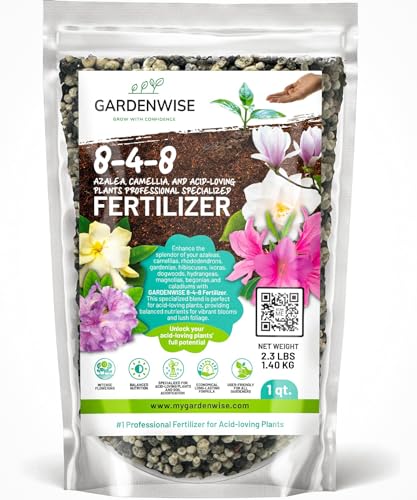
The single number that matters most in this category is iron content, and GARDENWISE 8-4-8 scores high by being enriched with iron, magnesium, and manganese—three micronutrients often locked out of plants when soil pH is too high. It comes as slow-release granules in a 1-quart bag (32 ounces), and you only need to apply it three times per year for year-round feeding.
One limitation: this formula is designed strictly for acid-loving plants. If you use it on plants that prefer neutral soil, the active iron content could cause problems. Reviewers point out that it doubled the size of a newly planted rhododendron, and one reviewer says their “Rhododendron came back to life” with greener leaves and more blooms the following season. The 8-4-8 N-P-K ratio provides a balanced, moderate hit of nutrients that won’t overwhelm sensitive plants.
The bag is 32 ounces, so it is best for small to medium beds. If iron deficiency (yellow leaves with green veins) is your plant’s specific problem, this is the targeted fix. It is sharper at correcting that than the more general Espoma bag, making its price-to-value read best for targeted correction rather than broad coverage.
The upsides
- Enriched with iron, magnesium, and manganese for chlorosis prevention
- Only requires 3 applications per year, very low maintenance
- Slow-release granules reduce risk of burning roots
Keep in mind
- 32 oz bag covers less area than 5 lb or 36 lb options
- Not suitable for plants that prefer neutral or alkaline soil
5. True Organic Azalea, Camellia & Rhododendron Food – 12lb Bag
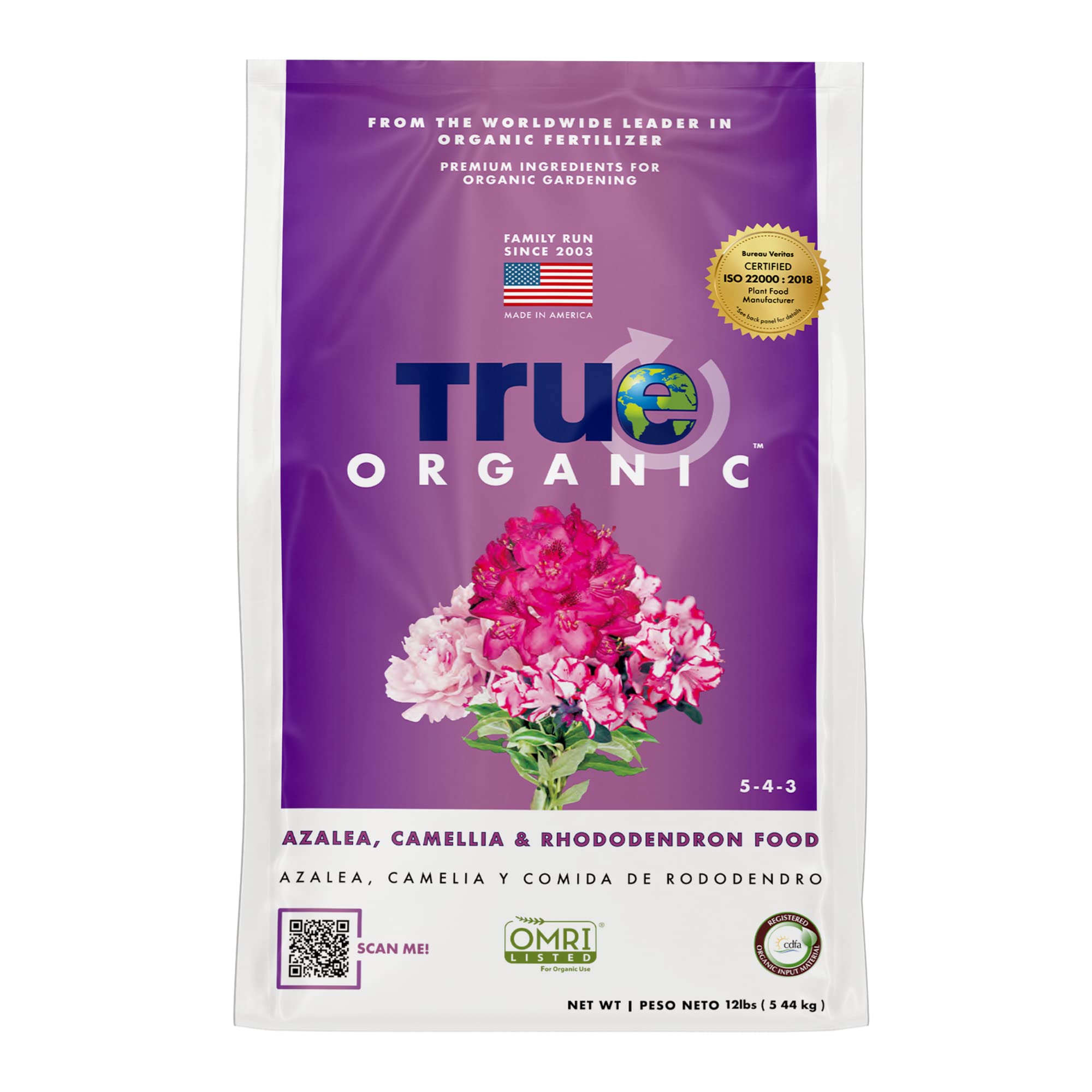
With the True Organic Azalea, Camellia & Rhododendron Food – 12lb Bag, you get a 12-pound bag of organic fertilizer that covers up to 261 square feet and requires just two applications per year (spring and fall). The formula includes 5% soil sulfur to actively lower soil pH as it feeds, helping azaleas and camellias access existing garden nutrients.
The granules have a mild earthy smell typical of organic fertilizers made from seabird guano, shrimp shell meal, and crab meal (all listed in the ingredients). One buyer mentioned it is very cost-effective compared to expensive liquid fish fertilizers and has no fishy odor after watering. The 5-4-3 N-P-K ratio provides moderate, steady feeding that prioritizes foliage growth (nitrogen) while still supporting blooms.
Choose this if you want an organic, pH-lowering fertilizer for a medium garden and prefer to feed twice a year rather than every week. It bridges the gap between the small Dr. Earth bag and the huge Espoma bag. This is your pick if you need more volume than a 4-pound bag but do not have a full acre to cover. skip it if you want the absolute fastest results—go for the Miracle-Gro. This is the perfect budget buyer for the organic gardener who wants a cost-effective, low-labor feeding schedule for a medium-sized azalea bed.
Why we’d pick it
- Contains 5% sulfur to naturally lower soil pH
- Organic formula with seabird guano, shrimp, and crab shell meal
- Twice-yearly application schedule
A few caveats
- Earthy smell typical of organic fertilizers
- 12 lb bag is heavy and requires storage space
6. Schultz Azalea, Cameillia, Rhododendron, ACR 14-7-7 Slow Release Plant Food

This is for a weekend gardener with a few potted azaleas or a small front-yard shrub. At 1 pound, the Schultz ACR 14-7-7 bag is the smallest and most affordable entry point on this list. It is a slow-release granular formula that requires no mixing, and you simply sprinkle it around the base of your plants and water it in. The 14-7-7 ratio is the highest nitrogen content of any product reviewed here, which means it pushes very aggressive foliage growth (green leaves) before flowers.
What you give up: because it is only 1 pound, the bag covers far less ground than the 5-pound Miracle-Gro or the 36-pound Espoma options. Shoppers say “visible results in about a week with vibrant blooms and lush foliage,” and many gardeners use it yearly on their camellia bushes, noting they “bloom luscious and are so healthy.” The bag is light enough to hold in one hand, making it ideal for small containers, a single bush, or anyone new to fertilizing.
If you only need to feed a couple of plants and want to see quick results without committing to a large bag, this is your match. It is especially suited for the first-time gardener or apartment-dweller with container azaleas who wants visible growth in one week. Skip the huge Espoma bag and start here. Just remember: that high nitrogen boost fuels leaves first, so if your azaleas are already leafy but shy on blooms, this formula may not correct the balance you need.
Strong points
- No mixing required, just sprinkle and water
- Buyers report visible results in about one week
- Ideal for small gardens and container plants
Before you buy
- 1 lb bag covers a very small area
- High nitrogen may push leaf growth over flowering if overused
7. SouthernGRO Azaleas, Camellia, Gardenia Fertilizer 04-08-08 – 4lb Bag
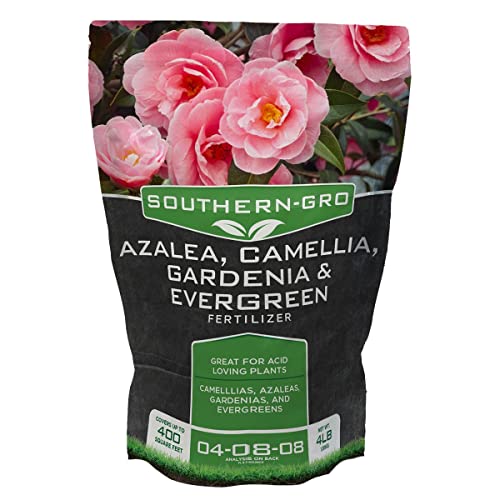
The SouthernGRO 04-08-08 is a budget-friendly option that gives you a generous 4-pound bag of slow-release granules for a similar price to the 1-pound Schultz bag. The 04-08-08 ratio is noticeably lower in nitrogen and higher in phosphorus and potassium, which means it prioritizes root development and flower production over fast foliage growth.
That money gets you a 64-ounce bag (4 pounds) that works on azaleas, camellias, gardenias, and evergreens. Buyers comment it is a “good quality shrub/bush food” that is “easy to apply,” and one owner reported their “Encore azaleas had good blooms in the fall” after using it. The manufacturer claims a “unique blend of nutrients” for greener foliage and deep root growth. However, it is not certified organic—it appears to be a synthetic-mineral blend.
The main weakness is that the formula does not actively lower soil pH the way the True Organic or Espoma products do. If your soil is already neutral or alkaline, you may need to add sulfur separately. The one clear reason to choose it: you want a larger bag of slow-release granules (4 pounds) for a modest garden without paying premium organic prices.
What we like
- 4 lb bag offers generous coverage for the price
- 04-08-08 ratio supports root and bloom development
- Easy to apply, suitable for beginners
The downsides
- Not certified organic, does not actively lower soil pH
- Some users report modest results; not as potent as premium brands
Understanding the Specs
N-P-K Ratio
This is the three-number code on every bag. It stands for the percentage of nitrogen (N), phosphorus (P), and potassium (K). Nitrogen drives leaf and stem growth. Phosphorus supports root development and flower production. Potassium boosts overall plant health and disease resistance. For azaleas, a formula with a higher middle number (like 04-08-08 or 8-4-8) is ideal because it pushes those colorful blooms rather than just leafy growth.
Slow-Release vs. Water-Soluble
Slow-release granules break down gradually in the soil, feeding your plants for weeks or months after a single application. You apply them once or twice a season. Water-soluble powders (like the Miracle-Gro pick) dissolve immediately in water and deliver nutrients to roots within hours. You apply them every 7–14 days. The compromise is convenience vs. speed: slow-release is lower maintenance, but water-soluble acts faster for stressed plants.
Sulfur Content
Sulfur is a key mineral that naturally lowers soil pH. Azaleas and their relatives need an acidic soil pH of about 4.5 to 6.0 to absorb iron and other micronutrients. A fertilizer containing sulfur (like the True Organic and Espoma picks, both with 5% sulfur) helps correct yellowing leaves (chlorosis) by making the soil more acidic as it feeds.
Organic Certification
Organic fertilizers are made from natural ingredients like bone meal, feather meal, seabird guano, or compost. They improve soil health over time by feeding beneficial microbes. Look for certifications like OMRI (Organic Materials Review Institute) or Non-GMO Project Verified on the bag. Synthetic fertilizers deliver nutrients in a pure, fast-acting form but do not contribute to long-term soil structure. Choose organic if you prioritize soil-building; choose synthetic for rapid correction of nutrient deficiencies.
FAQ
How often should I feed my azaleas?
Can I use regular plant food on azaleas?
What is the best N-P-K ratio for azaleas?
How do I apply granular fertilizer to azaleas?
Can over-fertilizing damage my azaleas?
Final Thoughts: The Verdict
If you want one dependable pick, the best food for azaleas is the Miracle-Gro Water Soluble Plant Food because it delivers the fastest, most reliable results for a wide range of acid-loving plants, from azaleas to rhododendrons and gardenias. If you prefer organic gardening and want a product that builds long-term soil health, grab the Dr. Earth Acid Lovers Fertilizer. And for a large garden with many shrubs, the Espoma Organic Holly-Tone 36 lb bag is the most economical pick for its massive coverage and twice-yearly feeding.