
Walking your lawn after a rain and spotting a fresh crop of dandelions, clover patches, or stubborn creeping charlie is a specific kind of frustration that only a targeted broadcast spray can solve. The difference between a temporary top-kill and a deep-root systemic elimination depends entirely on the active-herbicide chemistry—dicamba, triclopyr, and 2,4-D esters—in your concentrate.
I’m Rikta — the co-founder and writer behind Lawn Gear Lab. I spend my time digging into formulation data, comparing active-ingredient ratios, studying weed-dieback timelines from horticultural field trials, and analyzing hundreds of verified owner reports to separate the sprays that truly sterilize the root zone from those that just brown the leaves for a week.
Whether you are managing a cool-season fescue lawn or a warm-season Bermuda turf, this guide breaks down the concentrated solutions, coverage capacities, and application nuances that define the best lawn weed killer spray for sustained weed-free results.
How To Choose The Best Lawn Weed Killer Spray
The market is flooded with hose-end jugs, ready-to-use trigger sprays, and concentrated gallons all claiming to wipe out your weed problem. Three factors separate the formulations that eliminate the root system from those that just cause temporary cosmetic wilting.
Active Ingredient Chemistry: The Cocktail Matters
A single-ingredient spray rarely cuts it against a diverse weed population. The most effective post-emergent, selective lawn formulas combine 2,4-D, dicamba, and MCPP (Mecoprop-p) or carfentrazone-ethyl. Dicamba and triclopyr are essential for hard-to-kill broadleaf perennials like ground ivy and creeping charlie, while 2,4-D handles dandelions and plantain. If your primary nemesis is clover, look for triclopyr in the mix; if nutsedge is the problem, you will need a sulfentrazone or halosulfuron component.
Rainfast Window and Temperature Tolerance
The time a spray needs to dry on the leaf surface before rain washes it off—the rainfast window—varies from 3 hours (SpeedZone) to 6 hours (Spectracide). Cool-weather performance also differs: some esters work at temperatures as low as 40°F, while others stall below 60°F. If you are applying in early spring or late fall, prioritize formulas labeled for low-temperature efficacy.
Concentrate vs. Ready-to-Use and Coverage Ratio
A 32-ounce concentrate treating 16,000 square feet offers vastly different economics than a 128-ounce ready-to-use hose-end bottle covering 10,000 square feet. Concentrates require a separate sprayer but deliver better control over dosage. Ready-to-use bottles are convenient for small patches but often contain less-active Ingredient per ounce. Check the label’s coverage rate per gallon—some premium formulas (SpeedZone) treat only 1,000 sq ft per 1.5 ounces, which is potent but runs out faster on large lawns.
Quick Comparison
On smaller screens, swipe sideways to see the full table.
| Model | Category | Best For | Key Spec | Amazon |
|---|---|---|---|---|
| SpeedZone EW | Concentrate | Fast knockdown, cool weather | Rainfast in 3 hours | Amazon |
| Ferti-lome Weed Free Zone | Concentrate | Creeping charlie / ground ivy | Kills 80+ broadleaf weeds | Amazon |
| Agrisel GrassOut Max | Selective Grass Killer | Grassy weeds in flower beds | Targets 50+ grassy weeds | Amazon |
| PBI/Gordon Trimec | Concentrate | Cool-season lawns, large area | Covers 32,000–64,000 sq ft | Amazon |
| Spectracide Large Plot | Concentrate | Big lawns, fast rainfast | Covers 32,000 sq ft | Amazon |
| Bonide Chickweed & Clover Killer | Ready-to-Use | Chickweed, clover patches | 128 oz ready-to-use | Amazon |
| BioAdvanced Weed Killer | Concentrate | Budget-friendly, 200+ weeds | Covers 16,000 sq ft | Amazon |
In‑Depth Reviews
1. SpeedZone EW Lawn Weed Killer

SpeedZone EW is the closest thing to a professional-grade post-emergent that the residential market openly carries. The formulation uses carfentrazone-ethyl combined with 2,4-D ester, dicamba, and MCPP, which is why visible wilting often appears within hours—not days—on dandelion, clover, spurge, and ground ivy. The 3-hour rainfast window means you can spray in the morning and not worry about an afternoon shower washing away your work, a major advantage in humid climates where unpredictable storms are common.
The 20-ounce concentrate is more concentrated than most competitors: at 1.5 fluid ounces per 1,000 square feet for cool-season grasses, a single bottle treats roughly 13,000 square feet. Owners consistently report full weed death in two days, with the grass ready for reseeding in as little as seven days. The label explicitly covers Kentucky bluegrass, tall fescue, perennial ryegrass, Bermuda, and zoysia, making it one of the most versatile grass-safe options on the market.
The trade-off is that the concentrated potency demands precise measurement—the cap holds roughly 0.2 fluid ounces, so you will need a graduated mixing cup for accurate dosages. A small number of users note that spurge can regrow within two months on heavy infestations, requiring a follow-up treatment, which the label permits but limits to twice per year. For anyone who needs the fastest possible visual results without harming their turf, SpeedZone delivers.
What works
- Visible wilting within hours, complete kill in two days
- 3-hour rainfast window for flexible application timing
- Safe on both cool- and warm-season turf types
- Allows reseeding in as little as 7 days
What doesn’t
- No measuring cup included; cap is impractical for precise dosing
- May require multiple applications for persistent spurge infestations
- Higher cost per square foot compared to standard concentrates
2. Fertilome Weed Free Zone (32 oz)
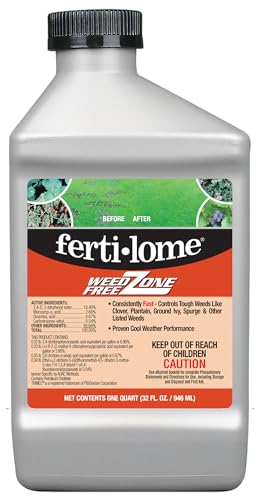
Ferti-lome Weed Free Zone occupies a unique niche: it is widely considered the most reliable residential product for eliminating creeping charlie (Glechoma hederacea), a problematic ground ivy that resists standard 2,4-D-only formulas. The active chemistry—primarily dicamba with a supporting cast of 2,4-D and MCPP—penetrates the waxy leaf surface of creeping charlie and translocates to the root system, causing visible injury within hours and complete death in two to five days.
The 32-ounce concentrate mixes at a standard rate, but users frequently report that the label-recommended dose underperforms on clover and spurge. Experienced owners often increase the concentration by 1.5x to 2x and add three drops of dish soap per gallon as a non-ionic surfactant to improve leaf adhesion. The product is remarkably selective: it can be sprayed near hostas, sedums, lilies, and other ornamentals without damage, as long as overspray is minimal.
The cost per ounce is higher than many competitors, and the need for experimentation to find the right strength can waste a full application on first use. But for anyone fighting ground ivy or creeping charlie that has survived multiple applications of cheaper sprays, Fertilome is the verified solution. The small bottle size (32 ounces) runs out fast on larger properties, so budget for a second bottle if your infestation covers more than 5,000 square feet.
What works
- The most effective selective spray against creeping charlie and ground ivy
- Safe for use near many flowers and ornamentals with careful spraying
- Fast visible injury within hours on most broadleaf weeds
What doesn’t
- Label-recommended dose is often too weak for clover; requires experimentation
- Per-ounce cost is higher than standard concentrates
- Small bottle size is not economical for large lawns
3. Agrisel GrassOut Max Weed Killer

Agrisel GrassOut Max flips the typical selective-herbicide script: instead of killing broadleaf weeds while sparing grass, it targets grassy weeds while leaving broadleaf ornamentals—flowers, shrubs, ground covers—unharmed. This makes it the right tool for flower beds and ornamental gardens invaded by crabgrass, foxtail, annual bluegrass, and barnyard grass, where spraying a standard broadleaf killer would do nothing.
The recommended mix rate of 1.1 to 2.3 ounces per 1,000 square feet is extremely concentrated; a 32-ounce bottle handles roughly 14,000 to 29,000 square feet depending on the dilution. Users report that the formula is slow-acting—visible results take 7 to 14 days, and heavy grass stands may require up to three applications spaced two weeks apart. The product works best when combined with a crop oil surfactant to improve uptake through the grass leaf blade.
Several owners caution that GrassOut Max does not kill sedges (nutsedge), which require a dedicated sedge herbicide like halosulfuron. The instructions also warn that this product kills desirable grasses, so it must never be used on a lawn. For the niche use case of clearing grassy weeds from a broadleaf flower bed, it is one of the few selective options available. The slow action can be frustrating, but patience is built into the chemistry.
What works
- Selectively kills grassy weeds without harming flowers and shrubs
- Very concentrated; one bottle covers up to 29,000 sq ft
- EPA approved for residential ornamental landscaping
What doesn’t
- Very slow-acting; can take two weeks or more to show results
- Does not kill sedges or nutsedge
- Kills all grasses—must not be used on lawns or near desirable grass
4. PBI/Gordon Trimec Lawn Weed Killer (1 Gallon)

PBI/Gordon Trimec is a legacy formulation known among turf management professionals for its reliable broad-spectrum control across cool-season grasses. The Trimec active blend—a proprietary mix of 2,4-D, MCPP, and dicamba—has been a standard in the industry for decades. The one-gallon jug treats 32,000 to 64,000 square feet, making it the highest-coverage option on this list and the most economical for properties over half an acre.
Users consistently report that Trimec kills dandelion, clover, and plantain thoroughly without browning the surrounding turf, especially when applied in spring or fall. The formula is more forgiving of application errors than SpeedZone: it is slower-acting (5–7 days for full kill) but less likely to cause turf burn even at slightly higher concentrations. Several owners note that creeping charlie and Virginia buttonweed may require a stronger ratio—doubling or tripling the Trimec portion for those specific weeds.
The biggest drawback is that the label is formulated specifically for cool-season grasses (fescue, bluegrass, ryegrass). Warm-season lawns like Bermuda and zoysia may tolerate it at reduced rates, but the label does not explicitly endorse them. Some buyers also report receiving a rebranded “Weed-Out” bottle from ferti-lome instead of the PBI/Gordon branded jug, though the chemistry is effectively identical. For large northern lawns needing affordable, time-tested weed control, Trimec is the volume king.
What works
- Highest coverage per dollar—up to 64,000 sq ft per gallon
- Proven Trimec formula with reliable broadleaf control
- Forgiving on turf; low risk of burn at recommended rates
What doesn’t
- Labeled for cool-season grasses only; warm-season use is not endorsed
- Slow-acting compared to carfentrazone-based formulas
- May require double-strength mix for tough weeds like creeping charlie
5. Spectracide Large Plot Weed Stop for Lawns Concentrate

Spectracide Weed Stop for Lawns is the gallon-sized workhorse for homeowners with substantial acreage. The 128-ounce concentrate treats up to 32,000 square feet of northern grasses (fescue, bluegrass, ryegrass) or 42,500 square feet of southern grasses (Bermuda, centipede, zoysia). This is the largest single-bottle coverage in the standard retail channel, and the 6-hour rainfast window is competitive for a product at this volume price point.
The formulation—2,4-D, dicamba, and MCPP—covers the typical broadleaf spectrum: dandelion, clover, chickweed, dollar weed, and plantain. Users report visible wilting within two days on most species, with full dieback in five to seven days. The product is particularly well-reviewed for centipede grass safety; several owners with centipede lawns note no damage even after heavy application, which is uncommon among competitive weed killers.
The trade-off appears on stubborn weeds. Bull head sticker weed and foxtail show little to no response, and some customers report needing two or three applications for nutsedge suppression. The label claims “results in hours,” but actual user experience consistently describes a slower kill speed than SpeedZone or Fertilome. For the homeowner with a 1-acre northern grass lawn and standard weed pressure, Spectracide offers the best coverage-to-price ratio in the conventional aisle.
What works
- Best value for very large lawns—up to 42,500 sq ft of southern grass coverage
- Safe on centipede grass at label rates
- Rainfast in 6 hours; flexible application scheduling
What doesn’t
- Ineffective on bull head sticker weed and foxtail
- Slower kill speed than premium concentrates
- May require multiple applications for nutsedge
6. Bonide Chickweed, Clover & Oxalis Killer (128 oz)

Bonide Chickweed, Clover & Oxalis Killer is a ready-to-use 128-ounce spray that eliminates the need for mixing and measuring. The active lineup includes triclopyr and dicamba, which gives it a specific edge against clover species that resist 2,4-D-only sprays. The formula is clear, nearly odorless, and works best when combined with a non-ionic surfactant to help the droplets adhere to waxy leaf surfaces.
On chickweed and oxalis, the kill rate is excellent—users report visible browning within 24 to 48 hours. The manufacturer recommends applying when no rain is forecast for 48 hours and when daytime temperatures are moderate, which may restrict application windows in transitional climates.
The biggest downside is inconsistency on clover. Some user reports describe excellent clover control, while others report the spray only slightly burned the top leaves without penetrating to the root. The integrated hand sprayer nozzle is adequate for small patches but fatiguing and slow for any area larger than 500 square feet. For targeted spot treatment of chickweed patches, this is a capable no-mix solution, but owners with heavy clover infestations should consider the concentrate version or a pump sprayer instead.
What works
- Ready-to-use—no mixing required
- Contains triclopyr for effective chickweed and oxalis control
- Clear and nearly odorless during application
What doesn’t
- Inconsistent clover kill; some applications only burn top leaves
- Hand sprayer is poor for large areas—pump sprayer recommended
- Not a pre-emergent; existing weeds only
7. BioAdvanced Weed Killer for Lawns (32 oz)

BioAdvanced (formerly Bayer Advanced) Weed Killer for Lawns is the entry-level concentrate that hits the essential broadleaf spectrum—dandelion, clover, dollar weed, chickweed—with a dicamba and MCPP blend. The 32-ounce bottle treats 16,000 square feet, which is standard for this concentration tier, and the application process is straightforward: connect the bottle to a hose, press the tab, and spray. Owners with manicured lawns particularly praise its ability to eliminate dollar weed without harming the turf.
User-reported results are split. Positive reviews highlight fast knockdown on dollar weed and dandelion, with best outcomes when followed by a 13-13-13 fertilizer application. Several homeowners with smaller lawns (under 5,000 sq ft) report completely clearing their property with a single container. The “press the tab” hose-end mechanism, however, receives consistent criticism for being difficult to activate on the first attempt—several owners report struggling to lock the spray valve open.
Negative reviews point to poor performance against certain clover varieties and a tendency to temporarily brown Bermuda grass if oversprayed. One reviewer noted that a different BioAdvanced formulation (the twice‑priced version) worked far better. For the budget-conscious homeowner dealing with a moderate weed load on a northern grass lawn, BioAdvanced delivers baseline control. Those with heavy infestations or warm-season Bermuda may need to step up to a more targeted formula.
What works
- Affordable per-square-foot cost for standard broadleaf control
- Effective on dollar weed, dandelion, and chickweed
- Hose-end-sprayer application is fast for small to medium lawns
What doesn’t
- Hose-end tab mechanism is difficult to press on the first try
- Inconsistent performance on clover and tougher broadleaf species
- Can temporarily brown Bermuda grass with heavy application
Hardware & Specs Guide
Active Ingredient (AI) Ratio
The total percentage of active herbicide in the bottle dictates how much concentrate you need per gallon of water. SpeedZone EW uses 0.34% carfentrazone plus 2,4-D ester for a fast-acting cocktail that requires only 1.5 fl oz per 1,000 sq ft. By comparison, many standard concentrates like BioAdvanced use a lower ratio of dicamba and MCPP, requiring a higher volume (2–3 fl oz per gallon) to achieve the same effect. Higher AI concentration means smaller doses, fewer refills, and typically faster knockdown, but also higher risk of turf injury if measured incorrectly.
Rainfast Window
The rainfast window is the time the spray must remain undisturbed on leaf surfaces before rain or irrigation can rinse it off. SpeedZone EW sets the benchmark at 3 hours, allowing application in the morning before unpredictable afternoon thunderstorms. Spectracide and BioAdvanced require 6 hours, which narrows the daily application window. If you live in a region with frequent afternoon rain, a 3-hour rainfast product (SpeedZone or Fertilome) is a practical advantage that reduces the risk of wasted product and reapplication labor.
Coverage Rating (Sq Ft per Gallon)
This spec measures how much lawn area a gallon of concentrate will treat at the label’s recommended dilution. Trimec’s 1-gallon jug covers 32,000 to 64,000 sq ft, making it the most economical for properties over half an acre. Spectracide treats 32,000 sq ft (northern) or 42,500 sq ft (southern). The 32-ounce bottles from BioAdvanced and Fertilome cover roughly 16,000 sq ft each. For lawns under 5,000 sq ft, smaller bottles are fine; for 1-acre lawns, a gallon-sized jug is the only sensible buy.
Grass Type Compatibility
Not every weed killer is safe on every grass. Cool-season grasses (fescue, Kentucky bluegrass, perennial ryegrass) tolerate the full Trimec and 2,4-D cocktail at label rates. Warm-season grasses (Bermuda, zoysia, centipede, St. Augustine) are more sensitive: St. Augustine often cannot tolerate dicamba at standard rates, while centipede is safer with Spectracide’s formula. Always check the “Grass Tolerance” section on the product label—if your grass type is not listed, start with a reduced rate on a small test patch to avoid dead spots.
FAQ
Can I reseed my lawn after applying a selective weed killer spray?
Why does my lawn weed killer say it kills broadleaf weeds but some weeds survive?
Should I mow before or after applying lawn weed killer spray?
What is a non-ionic surfactant and when should I use one?
Final Thoughts: The Verdict
For most gardeners, the lawn weed killer spray winner is the SpeedZone EW because it combines the fastest rainfast window, the quickest visible knockdown, and broad grass-type compatibility in a single concentrate. If you are specifically fighting creeping charlie or ground ivy, grab the Ferti-lome Weed Free Zone. And for large-acreage cool-season lawns where value per gallon matters above all, nothing beats the PBI/Gordon Trimec one-gallon jug.