
Spurge lives low to the ground and spreads fast, making it one of the most frustrating broadleaf weeds to remove from a lawn. Its shallow root system allows it to take over bare spots before you even notice, and most general-purpose weed killers lack the specific chemistry to stop it from returning. The right selective herbicide makes the difference between a temporary fix and lasting control.
I’m Rikta — the co-founder and writer behind Lawn Gear Lab. I’ve sifted through hundreds of herbicide labels, cross-referenced active ingredient profiles with spurge-specific results, and analyzed owner reports on knockdown speed and application ease to build this guide.
Whether you are dealing with a sudden invasion or an annual recurrence, this roundup of the best weed killer for spurge will help you select a formula that targets the weed without damaging your grass.
How To Choose The Best Weed Killer For Spurge
Spurge is a warm-season annual that germinates in late spring and thrives in thin, stressed turf. Unlike dandelions or clover, spurge is highly resistant to single-ingredient formulas, which is why the most effective products use a three-way blend of selective herbicides. Focus on these three factors to ensure you pick a spray that works on your specific lawn type.
Active Ingredient Blend and Concentration
The gold standard for spurge control is a combination of MCPA, Triclopyr, and Dicamba. Each ingredient attacks the weed differently: MCPA targets leaf tissue, Triclopyr disrupts root growth, and Dicamba moves through the vascular system. Products that list all three (like Monterey Spurge Power and Fertilome Weed Free Zone) provide the fastest knockdown with fewer reapplications. If you need a non-selective option for driveways or patios, high-concentration glyphosate (41% or above) is the better choice.
Selective vs. Non-Selective: Know Your Surface
Spraying a non-selective glyphosate concentrate on your lawn will kill every blade of grass it touches. For lawn use, always choose a selective broadleaf herbicide that lists your turf type (such as Bermuda, Fescue, or Zoysia) on the label. For bare-ground areas, gravel, or fence lines, the heavy-duty glyphosate products like Control Solutions Eraser or Hi-Yield Killzall are faster and more economical.
Coverage and Concentrate Value
Spurge infestations vary from a few isolated plants to a yard-wide outbreak. A 32-ounce bottle of concentrate typically covers 4,000 to 6,000 square feet, but some premium gallon jugs can stretch to over 30,000 square feet. Compare the total square-foot coverage, not just the bottle size, to avoid running out halfway through treatment. Budget-conscious buyers benefit most from the PBI/Gordon gallon, which offers the highest coverage per unit cost.
Quick Comparison
On smaller screens, swipe sideways to see the full table.
| Model | Category | Best For | Key Spec | Amazon |
|---|---|---|---|---|
| Monterey Spurge Power | Selective / Lawn | Targeting tough spurge specifically | MCPA + Triclopyr + Dicamba blend | Amazon |
| Fertilome Weed Free Zone | Selective / Lawn | Fast visible results on first spray | Dicamba-based, 80+ broadleaf weeds | Amazon |
| PBI/Gordon Trimec (Gal) | Selective / Cool-season | Large-area lawn treatment | 64,000 sq ft coverage per gallon | Amazon |
| Southern Ag Trimec 32oz | Selective / Lawn | Budget-friendly lawn weed control | 2 oz per gallon for up to 5000 sq ft | Amazon |
| Control Solutions Eraser 41% | Non-selective | Spot-kill in flower beds or hardscapes | 41% Glyphosate concentration | Amazon |
| Hi-Yield Killzall 365 | Non-selective | Total bare-ground vegetation control | Non-selective, 4300 sq ft per 32 oz | Amazon |
| Martin’s Eraser Max Super Conc. | Non-selective | Deep-rooted and woody weed elimination | Glyphosate 43.68% + Imazapyr 0.78% | Amazon |
In‑Depth Reviews
1. Monterey Spurge Power
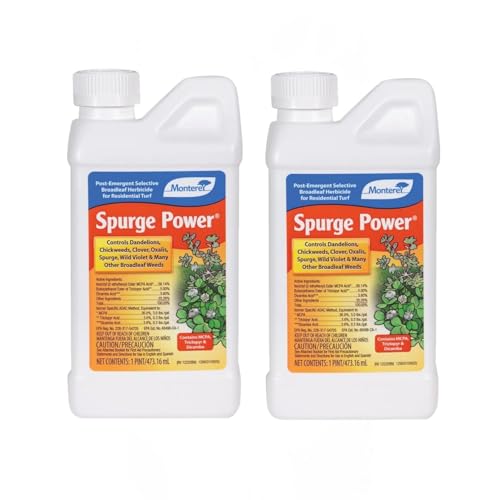
Monterey formulated this concentrate specifically for weed species that laugh at basic two-way herbicides. The blend of MCPA, Triclopyr, and Dicamba attacks spurge through three biological pathways, which leads to visible wilting in as little as two days on actively growing plants. It is safe on tall Fescue, Kentucky Bluegrass, Bermuda, Bahia, Rye, and Zoysia lawns, so you can spray the whole yard without worrying about dead patches.
The 16-ounce bottle covers up to 16,000 square feet when mixed at the standard rate, making it a high-value mid-range option relative to its performance. Several verified owners reported that it eliminated spurge that had resisted previous treatments, and one user noted it finally cleaned up wild violet after a three-year struggle. The concentrate mixes easily in a pump sprayer or hose-end unit, and the liquid leaves minimal odor after drying.
The only real catch is the price — it sits at the top of the middle tier, and you need to follow the mixing instructions carefully to avoid underdosing on dense infestations. Some reviewers recommend a second application at the label rate if the spurge is fully mature or has already spread into thick mats. Overall, this is the weapon of choice if spurge is your primary enemy and you want a targeted, lawn-safe solution.
What works
- Triple-active formula attacks spurge via multiple mechanisms
- Safe on all major warm- and cool-season grass types
- Visible results within 48 hours on most weeds
What doesn’t
- Premium price point for a 32-ounce total volume (two 16-oz bottles)
- Requires protective gear during mixing and application
2. Fertilome Weed Free Zone
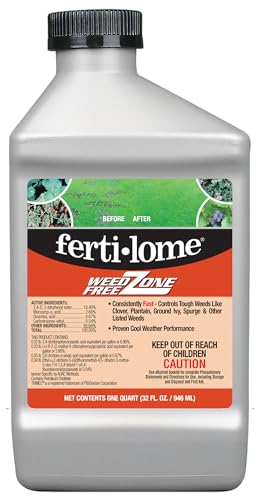
Fertilome’s Weed Free Zone distinguishes itself with a high concentration of Dicamba and other selective agents that produce injury evidence within hours — not days. Several owners confirm seeing spurge and dandelions curl up overnight after application. It is labeled for use on Bermudagrass, Bahiagrass, Zoysiagrass, Kentucky Bluegrass, and other common turf varieties, giving it broad compatibility across different lawns.
The 32-ounce bottle is a liquid concentrate that mixes quickly with water. Users report that it kills creeping Charlie and spurge effectively, though some found the recommended concentration too light for mature clover and needed to double the dose. Adding a few drops of dish soap improves leaf adhesion, especially on the waxy, low-lying leaves of spurge. The formula is also rainfast within a few hours, which reduces scheduling stress.
Where this product falls short is consistency across weed types. While it crushes spurge and dandelions, stubborn weeds like wild violet may need two or three sprays. The cost is noticeably higher than the basic Trimec options, making it more of a premium buy for fast-results seekers rather than the most economical coverage per square foot.
What works
- Rapid visual response — spurge often shows stress within hours
- Works on a wide range of broadleaf species
- Rainfast after drying, forgiving on application timing
What doesn’t
- Weaker on certain tough broadleaf weeds without double-strength mix
- Premium price for the 32-ounce size
3. PBI/Gordon Trimec Lawn Weed Killer (Gallon)

PBI/Gordon Trimec is the workhorse of the selective herbicide world. The one-gallon jug covers an impressive 32,000 to 64,000 square feet depending on the dilution rate, making it the best large-area value in this lineup. It is specifically designed for cool-season grasses, so if you manage a northern lawn of Fescue, Bluegrass, or Ryegrass, this is the most cost-effective option for long-term spurge suppression.
The Trimec formula combines three synergistic active ingredients that attack spurge above and below the soil line. Users over 70 years old have called it the best weed killer they have ever used, with reports of Creeping Charlie dying in two to three days and Virginia Buttonweed perishing within two weeks. The concentrate pours easily and mixes smoothly in a standard backpack or hose-end sprayer.
The downside: this product is labeled almost exclusively for cool-season turf. Warm-season grass owners should check the fine print carefully, and some users found the standard mixture too weak for heavy, established spurge mats. The manufacturer recommends doubling or tripling the Trimec ratio for stubborn patches, which reduces the total coverage claim.
What works
- Best cost-per-square-foot for large lawns
- Proven knockdown of Creeping Charlie and spurge
- Easy-to-pour gallon container with measuring cap
What doesn’t
- Optimized for cool-season grasses only
- May require stronger mix ratio for tough infestations
4. Southern Ag Trimec Lawn Weed Killer 32oz

Southern Ag’s Trimec formula is the entry-level ticket to three-way selective weed control. The patented combination of 2,4-D, MCPP, and Dicamba works effectively on nine different turf types, including Bermuda, Zoysia, Centipede, St. Augustine, and Fescue. The 32-ounce bottle covers roughly 5,000 square feet, which is adequate for standard residential lots with moderate weed pressure.
Owner reports confirm that this product wipes out spurge, chickweed, clover, and dandelions without harming the lawn when applied per the label. Users specifically note that mixing 2 ounces per gallon and avoiding rain for 24 hours delivers solid results. The liquid is practically odorless and works through both pump sprayers and hose-end units without clogging or excessive foaming.
The main limitation is longevity. Multiple reviews mention that weeds, including spurge, begin regrowing within a few weeks, requiring a follow-up application. This is not a season-long solution. It also struggles with more aggressive species like onion grass and mature clover, where a surfactant or a higher concentration is sometimes necessary. For the price, it is a capable starter kit, not a one-and-done treatment.
What works
- Compatible with nine common turf types
- Low-odor, easy-to-mix concentrate
- Solid knockdown of young spurge and dandelions
What doesn’t
- Requires reapplication every few weeks to prevent regrowth
- Not strong enough for mature spurge without surfactant
5. Control Solutions Eraser 41% Glyphosate
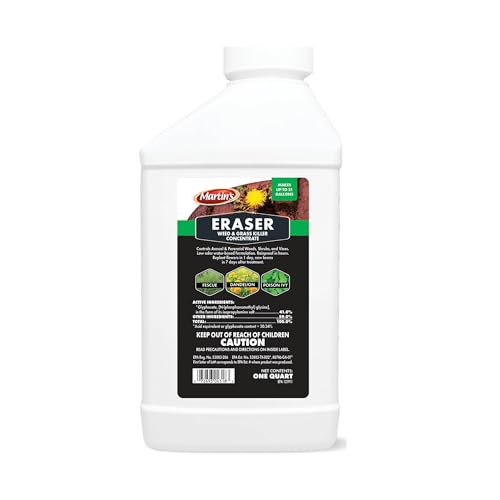
If you want to kill spurge in areas where you do not care about surrounding vegetation — driveways, patios, gravel paths, or flower beds before replanting — the Control Solutions Eraser with 41% Glyphosate is a highly effective non-selective option. This is the same active ingredient concentration used in professional-grade Roundup but sold at a fraction of the price per ounce. It has a low-odor, water-based formula that is rainproof within hours.
Users who have switched from consumer-brand glyphosate report that this concentrate outperforms them on poison ivy, brush, and vigorous annual weeds like spurge. Mix roughly 8 ounces per gallon for general spot treatment, and expect to see yellowing within four to seven days and full death in one to two weeks. For woody weeds, a higher concentration or the addition of a surfactant is advised.
The obvious limitation is that this is a non-selective killer. Any overspray onto lawn grass will result in dead brown patches, so careful application is essential. It also requires patience — the first two days show no visible effect, which can make impatient users think it failed. This product is best reserved for targeted spot treatment on hard surfaces or in areas where bare soil is acceptable.
What works
- Professional-grade 41% glyphosate at a strong value
- Low odor and rainfast within hours
- Effective against tough woody weeds and spurge
What doesn’t
- Non-selective — kills any grass it touches
- Slow action; no visible effect for several days
6. Hi-Yield Killzall 365

Hi-Yield Killzall 365 is positioned as a total vegetation control product for non-lawn areas. The 32-ounce bottle treats up to 4,300 square feet, and the formula is rain-resistant — several reviewers reported successful kills even when rain fell the day after application. It is designed to kill broadleaf weeds, grasses, trees, brush, and vines, making it a strong choice for cleaning up fence lines, gravel drives, and patio cracks where spurge likes to establish.
The product label explicitly warns against use on lawns, so this is strictly for bare-ground situations. Users love that it handles stubborn weeds with a single pass, though some noted that moss and well-established spurge mats may require two or three applications across the growing season. The concentrate mixes at a rate of 6 ounces per gallon for spot control or up to 7.4 ounces for full bare-ground treatment.
The “365” in the name suggests season-long control, but real-world feedback shows that heavy spurge pressure can return within a couple of months. It is not a soil sterilant in the truest sense, and some buyers were disappointed by the need for re-treatment. Viewed as a strong, affordable non-selective concentrate rather than a permanent solution, it delivers good value for its price tier.
What works
- Rainfast formula — survives precipitation after drying
- Covers large non-lawn areas economically
- Effective against broadleaf weeds, vines, and brush
What doesn’t
- Does not provide true full-season bare-ground control
- Not safe for use on any lawn grass
7. Martin’s Eraser Max Super Concentrate
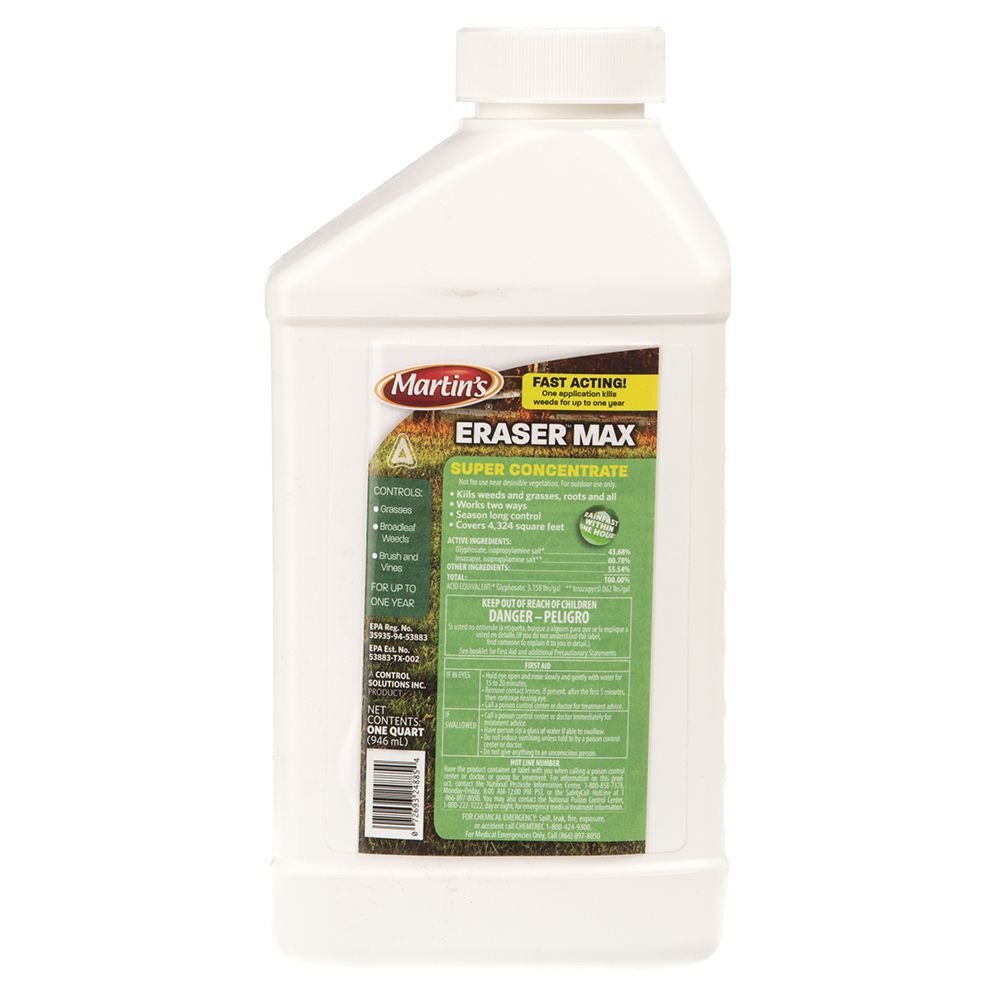
Martin’s Eraser Max takes non-selective weed control a step further by combining 43.68% Glyphosate with 0.78% Imazapyr. The Imazapyr component adds soil-residual activity, meaning it continues to prevent germination of new weeds for several weeks after application. This makes it particularly effective against deep-rooted spurge and woody invaders like kudzu and poison ivy that other formulas struggle to kill permanently.
Users with decades of spraying experience rate this as the best they have ever used for fence lines and gravel areas. Results take roughly two weeks to fully develop, but the kill is comprehensive — grass, broadleaf weeds, and brush all die off and rarely return in the same season. The 32-ounce bottle is highly concentrated, requiring only small amounts per gallon, which extends the coverage significantly compared to standard 41% products.
The main drawback is the residual soil activity. Because Imazapyr lingers in the soil, you cannot replant desirable grass or ornamentals in treated areas for months. This product is strictly for spots where you want absolutely nothing to grow. It is also an oil-based formulation, so it requires thorough cleaning of sprayers to prevent residue from damaging future applications.
What works
- Imazapyr provides long-lasting residual weed prevention
- Highest glyphosate concentration in the lineup
- Wipes out woody vines and deep-rooted spurge
What doesn’t
- Soil residual prevents replanting for weeks or months
- Oil-based formula requires meticulous sprayer cleaning
Hardware & Specs Guide
Selective vs Non-Selective Active Ingredients
Selective herbicides use compounds like 2,4-D, MCPP, Dicamba, and Triclopyr that target broadleaf weeds while leaving grass unharmed. These are the only safe choice for application on established lawns. Non-selective formulas rely on Glyphosate (usually 41% or higher) to kill any green tissue they contact. For spurge, selective blends with at least three active ingredients produce the fastest lawn-safe results. Non-selective products are best reserved for driveways, patios, and bare-soil areas where total vegetation removal is desired.
Coverage and Mix Ratios
Concentrated weed killers require dilution before spraying. A standard 32-ounce bottle of selective concentrate typically covers 4,000 to 5,000 square feet at the label mix rate of 2 to 4 ounces per gallon of water. Larger gallon jugs (like PBI/Gordon) can cover over 60,000 square feet, making them far more economical for big lawns. Non-selective concentrates usually mix at 6 to 8 ounces per gallon. Always calculate your lawn’s square footage before buying to avoid running short mid-spray or wasting unused product.
Rainfast Window and Application Timing
Most selective and non-selective herbicides require a rain-free window of 1 to 4 hours after spraying to fully absorb into the leaf tissue. Formulas containing Dicamba or Imazapyr tend to have shorter rainfast times, while standard Trimec blends benefit from a full 24 hours without precipitation. Apply when temperatures are between 60°F and 85°F and weeds are actively growing — early morning on a calm, sunny day yields the best leaf uptake and reduces off-target drift.
Adding a Surfactant
Surfactants (also called wetting agents or non-ionic surfactants) reduce the surface tension of the spray droplets, helping the herbicide stick to and penetrate the waxy leaf cuticle of spurge. Spurge leaves are low-growing and often coated in a natural wax film that repels water. Adding a few drops of dish soap or a dedicated surfactant like Southern Ag’s Surfactant for Herbicide significantly improves uptake, especially in hot, dry weather when the leaf surface is even tougher.
FAQ
Why does spurge keep coming back after I spray it?
Can I use a non-selective glyphosate spray on my lawn to kill spurge?
How long should I wait before mowing after spraying weed killer for spurge?
Will weed killer for spurge also kill clover and dandelions?
Final Thoughts: The Verdict
For most gardeners, the weed killer for spurge winner is the Monterey Spurge Power because its three-way blend of MCPA, Triclopyr, and Dicamba delivers the fastest selective knockdown on spurge without harming your grass. If you want maximum coverage for a large cool-season lawn, grab the PBI/Gordon Trimec Gallon. And for total bare-ground control in driveways and patios where nothing should grow, nothing beats the Control Solutions Eraser 41%.