
Houseplants stretching toward a window and seedlings turning leggy under a grow light both point to the same problem: insufficient light. A lux meter tells you how bright a space looks to your eyes, but plants rely on the photons driving photosynthesis—a metric measured in micromoles, not foot-candles. Choosing the wrong meter type leaves you guessing while your plants suffer.
I’m Rikta — the co-founder and writer behind Lawn Gear Lab. I spend my time comparing sensor specs, studying horticultural light-response curves, and analyzing thousands of owner reviews to identify which meters deliver readings you can actually act on.
Whether you manage a grow tent, a greenhouse, or a sun-drenched windowsill, matching your tool to the crop’s requirements is everything. This guide cuts through the confusion to help you pick the best light meter for plants for your specific setup and budget.
How To Choose The Best Light Meter For Plants
Choosing a plant light meter comes down to matching its measurement method to your grow setup. Meters fall into two categories: lux/FC meters, which measure illuminance (human-perceived brightness), and quantum PAR meters, which measure photon flux in the 400–700 nm range used by plants. Pick the wrong type and your readings won’t translate to healthy growth.
Lux vs. PAR vs. PPFD — What Your Plants Actually Need
A lux meter quantifies light as perceived by the human eye, peaking in the yellow-green spectrum. Photosynthetically Active Radiation (PAR) covers the 400–700 nm waveband that drives photosynthesis. PPFD (Photosynthetic Photon Flux Density) reports the number of photosynthetically active photons hitting a square meter each second, measured in µmol/m²/s. If you grow anything under LED grow lights, a quantum PAR meter is far more useful than a general-purpose lux meter.
Spectral Range and Sensor Accuracy
Entry-level meters often claim ±4% to ±5% accuracy under reference conditions, but real-world performance depends on the light source’s spectrum. Meters designed for incandescent or fluorescent bulbs may underreport LED outputs. Quantum sensors specifically calibrated for the 400–700 nm band give reliable readings under full-spectrum LEDs, HPS, and CMH fixtures. Always check whether the sensor is cosine-corrected for angled light, which matters at canopy edges.
DLI — The Daily Dose Your Plants Drink
Daily Light Integral (DLI) is the cumulative PPFD your plants receive over 24 hours, expressed in mol/m²/d. High-light crops like tomatoes need 20–30 mol/m²/d, while low-light foliage plants manage on 5–10. Some premium quantum meters calculate DLI automatically, saving you the step of logging hourly readings. If you manage more than one grow zone, a meter with a DLI function plus data logging (100 readings or more) will pay for itself in fewer light-burned or underperforming harvests.
Quick Comparison
On smaller screens, swipe sideways to see the full table.
| Model | Category | Best For | Key Spec | Amazon |
|---|---|---|---|---|
| BTMETER BT-881E | Lux Meter | Budget light checks | 300,000 lux / 30,000 FC | Amazon |
| Dr.meter 1332B | Lux Meter | LED/HPS light mapping | 200,000 lux tripod mount | Amazon |
| BTMETER BT-881D | Lux Meter | High-range ambient tests | 400,000 lux / 40,000 FC | Amazon |
| AH-Quantuv PAR Meter | PAR Meter | Spectrum-aware growers | RGB PAR + UVA breakdown | Amazon |
| DANOPLUS DP-355 | PAR Meter | Greenhouse PAR mapping | 0–5000 µmol/m²/s, tripod | Amazon |
| VidalKraft VK131 | PAR Meter | DLI tracking for tents | Built-in DLI, data logging | Amazon |
| PHOTOBIO LGBQM2 | PAR Meter | Commercial-level precision | 99-readings, remote sensor | Amazon |
In‑Depth Reviews
1. PHOTOBIO LGBQM2 Advanced Quantum Sensor PAR Meter

The PHOTOBIO LGBQM2 is the quantum PAR meter serious growers reach for when they need lab-grade readings without the lab-grade price. Its remote cosine-corrected sensor covers the full 400–700 nm photosynthetic waveband, and the main unit stores up to 99 measurements for post-adjustment reference. Two included cables—a short coiled and a 12-foot straight—let you position the sensor at canopy level while the display stays at eye height, a setup advantage no lux meter in this guide offers.
Owners consistently report that readings stabilize almost instantly under both LED and HPS sources, and the numbers track closely against far more expensive industrial meters. The protective carrying case keeps the sensor and cables organized, which matters when you’re moving between multiple grow zones. At just over a pound, the kit feels solid without being cumbersome.
Where this meter truly earns its premium spot is repeatability. Multiple reviewers mention using the PHOTOBIO to benchmark other, cheaper meters and confirm their accuracy. If you manage a commercial canopy, run a breeding project, or simply want one meter that eliminates all guesswork about light dose, the LGBQM2 is the benchmark device for this category.
What works
- Cosine-corrected remote sensor delivers lab-adjacent accuracy
- Included coiled and long cables cover most canopy heights
- Sturdy case protects investment between uses
What doesn’t
- No built-in DLI calculation
- Premium price point compared to lux/FC meters
2. VidalKraft VK131 Quantum PAR Meter with DLI

The VidalKraft VK131 is the first meter in this lineup to integrate a Daily Light Integral function directly into the handheld unit, a capability that saves indoor growers from manual hourly logging. Its remote quantum sensor reads up to 4000 µmol/m²/s across the 400–700 nm band, and the device logs 100 historical PPFD and DLI values. The ergonomic layout includes a 1/4-inch tripod mount and two detachable cables—a 5-foot coiled cable for close work and a 12-foot straight cable for reaching tall plants or overhead fixtures.
Reviewers highlight the DLI setup as surprisingly intuitive: set your target light hours, and the meter calculates cumulative daily mol/m²/d automatically. Several growers note that the plastic housing feels lighter and cheaper than its price suggests, but the electronics inside deliver readings nearly identical to a well-calibrated smartphone app with a diffuser. For a grow-tent operator running multiple photoperiods, the data-logging and DLI function alone justify the investment.
Where the VK131 falls short is tactile quality. The casing has no rubber overmold or weight, so it feels like a toy in the hand despite performing like a pro tool. If your priority is function over hand-feel and you want DLI tracking without a separate computer, this is the mid-range winner for indoor vertical farming and home grows alike.
What works
- Built-in DLI calculation removes guesswork from daily light dose
- Two cable lengths offer flexibility for tall or crowded canopies
- Data logging helps track PPFD changes over time
What doesn’t
- Plastic casing feels flimsy for the price
- Display brightness could be higher in direct sun
3. AH-Quantuv PAR Meter with UVA and RGB Breakdown
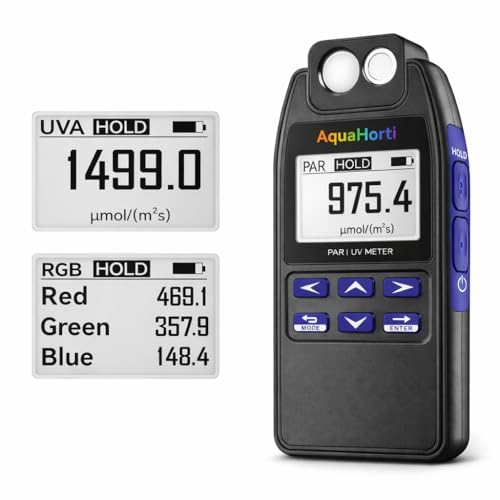
The AH-Quantuv brings something to the plant light meter category that no other product here offers: a separate readout for blue, green, and red PAR contributions plus UVA irradiance in the 320–400 nm band. This spectrum-level breakdown matters for growers tuning lights to specific growth stages—more blue for vegetative stretch, more red for flower and fruit set. The PAR sensor uses a Japanese semiconductor chip and shows a single cumulative PPFD value plus the RGB split on demand.
Owner feedback praises the clear display and responsive controls. Several reviewers mention using it to compare spectrum output across different LED brands and positioning seedlings based on blue/red ratios. The meter logs up to 100 PAR readings for distribution mapping, helping you identify hot spots and dark corners in a grow tent or greenhouse. UVA measurement is an uncommon addition at this price level and gives advanced growers data on secondary stress responses.
The trade-off is that the A-H Quantuv doesn’t calculate DLI and uses a fixed sensor (no remote cable). You have to hold the unit at canopy level, which can be awkward for tall plants or overhead fixtures. For the hobbyist who wants to understand exactly what their LEDs are delivering in terms of color spectrum, this meter provides insight that pure PPFD meters hide.
What works
- RGB PAR breakdown helps optimize light spectrum by growth stage
- UVA measurement is rare at this price point
- 100-reading log useful for canopy mapping
What doesn’t
- No DLI function built in
- Fixed sensor can be awkward for high-hanging fixtures
4. DANOPLUS DP-355 Quantum PAR Meter

The DANOPLUS DP-355 is a dedicated quantum PAR meter with an upper limit of 5000 µmol/m²/s, covering even the most intense LED bar arrays without hitting the ceiling. Its spectral filter targets the 400–700 nm band with ±10 nm tolerance at the cut-on and cut-off, and the device stores 100 measured values for later review. A real-time display shows the last four readings, which simplifies iterative adjustments when raising or dimming lights.
Users running grow tents and greenhouses report that the DP-355 reliably reveals which household “grow bulbs” fall below minimum PAR requirements. The tripod socket lets you mount the meter at a fixed canopy height and walk away to read the display from a distance, a feature that speeds up multi-point mapping across a 4×4 or 5×5 area. Several reviewers note that it exposed their big-box-store lights as inadequate for high-light crops.
On the downside, the DANOPLUS uses a fixed body sensor rather than a detachable remote head, so you have to position the entire unit at canopy level. The build quality is solid for the price but not as robust as the PHOTOBIO. For greenhouse operators and indoor growers who need PAR mapping capability without the added complexity of spectrum breakdown or DLI, this is the most straightforward quantum meter in the mid-range tier.
What works
- High 5000 µmol/m²/s ceiling covers intense LED arrays
- Tripod mount speeds up canopy light mapping
- Four most recent readings displayed for fast iterative checks
What doesn’t
- Fixed sensor requires whole-unit positioning at canopy level
- No DLI calculation or spectrum breakdown
5. Dr.meter 1332B Professional LED Light Meter

The Dr.meter 1332B is a lux/FC meter optimized for LED, HPS, CMH, and T5 fixtures. It offers four manual ranges—200, 2000, 20,000 and 200,000 lux—so you can match sensitivity to the environment. The optical detector head rotates 270 degrees, allowing you to take angled readings without repositioning the body. A tripod screw on the base enables hands-free operation during multi-point surveys.
Reviewers appreciate the straightforward operation: press the power button, select the unit, and point the sensor. The inclusion of a battery in the box means it works right out of the package.
The main limitation is that the Dr.meter measures illuminance, not PPFD. Without a tailored conversion chart for your specific light spectrum, the lux readings can mislead. It also lacks data logging. For the grower who wants to spend under and is willing to learn the conversion math, this meter punches above its weight as a lux-to-PAR learning tool.
What works
- 270-degree swivel sensor adapts to awkward fixture angles
- Tripod mountable for stable hands-free operation
- Four range settings improve resolution in low-light zones
What doesn’t
- Measures lux, not PPFD—conversion varies by light source
- No data logging or DLI capability
6. BTMETER BT-881D Digital Illuminance Light Meter

The BTMETER BT-881D pushes the lux ceiling to 400,000 lux (40,000 FC), giving it the widest range in this guide among non-quantum meters. The 270-degree rotating sensor lets you take readings from multiple angles without moving the body, and the internal memory stores 33 readings with a relative mode that shows the difference between the current value and stored data. It also includes a thermometer function for ambient temperature logging.
Owners report that this device lasted over five years in acceptable condition when stored in the included zip pouch, making it one of the most durable options in the budget tier. The backlit display and inclusion of a tiny screwdriver for the battery compartment are thoughtful touches for frequent use. Several reviewers used it to settle municipal lighting disputes and test LED grow light arrays with success.
As with all lux meters, the BT-881D reports human-centric illuminance, not photosynthetic photons. Owners working with high-CRI or full-spectrum LEDs should treat the readings as ballpark references rather than absolute PPFD values. The relative mode is handy for A/B comparisons between lights or positions, but you cannot export the data for long-term tracking.
What works
- Highest lux range (400k) in the budget tier
- 33-reading memory includes relative comparison mode
- Screwdriver and pouch included for protected storage
What doesn’t
- Lux measurement is not directly useful for photosynthesis tuning
- No tripod mount or data export option
7. BTMETER BT-881E Digital Illuminance/Light Meter

The BTMETER BT-881E is the entry-level light meter that gives first-time plant owners a quantitative answer to the question “is this spot bright enough?” With a 0.01–300,000 lux range and a 0.4-second response time sampling 2–3 times per second, it delivers instant readings for quick passes around a room. The 270-degree rotating sensor and 33-reading memory mirror the features of the more expensive BT-881D, but with a slightly lower maximum lux ceiling.
Reviewers consistently call it easy to operate and accurate for its price. One grower used it to check vegging plants and praised the intuitive interface and included carrying case. The thermometer mode adds a small convenience for environmental logging. Customer service receives positive mentions—a broken connector tab was proactively replaced with a free unit.
The BT-881E shares the same fundamental limitation as every lux meter here: it measures luminous flux per area, not photons available for photosynthesis. For houseplant owners who simply want to confirm a windowsill gets more light than a hallway, this is the most affordable path from guessing to knowing. But if you plan to optimize a grow light schedule or calculate DLI, skip straight to a quantum PAR meter.
What works
- Fast 0.4-second response for quick room scans
- 33-reading memory with relative comparison mode
- Carrying case and batteries included out of the box
What doesn’t
- Lux output requires manual conversion for meaningful plant data
- No tripod mount for repeatable positioning
Hardware & Specs Guide
PPFD vs Lux — The Sensor Difference
A lux sensor peaks in sensitivity around 555 nm (yellow-green), corresponding to human photopic vision. A quantum PAR sensor uses a filter that passes 400–700 nm roughly evenly, so it counts photons regardless of color. This is why a 5000K LED bar at 40,000 lux might deliver 800 µmol/m²/s, while a high-pressure sodium lamp at the same lux reading might deliver only 600 µmol/m²/s. Any meter you choose must match the light source’s spectral output to be useful for plant growth decisions.
Cosine Correction and Angle Response
Light from overhead fixtures hits the sensor at varying angles—directly from above at the center of the canopy, more obliquely at the edges. A cosine-corrected sensor adjusts its response proportionally to the angle of incidence, so a meter held at 45 degrees to the light source will read roughly 70% of the direct value. Without cosine correction, edge-of-canopy readings are artificially low, leading to unnecessarily raised lights or dimmer mixing. Premium meters like the PHOTOBIO LGBQM2 explicitly state cosine correction; budget lux meters typically omit this refinement.
FAQ
Can I use a photography light meter for my plants?
What is the difference between PPFD and DLI?
Why does my lux meter give different PAR values for different lights at the same brightness?
Final Thoughts: The Verdict
For most gardeners, the light meter for plants winner is the PHOTOBIO LGBQM2 because it delivers commercial-grade PPFD accuracy with a remote sensor, rugged build, and enough data-logging capacity to dial in any canopy. If you want built-in DLI tracking without needing a spreadsheet, grab the VidalKraft VK131. And for a budget-friendly starting point that still teaches you about light levels without the quantum price, nothing beats the BTMETER BT-881E.