
Fuchsias in pots are heavy feeders with a specific need: low nitrogen and high potash to fuel continuous bloom without burning sensitive container roots. Dump a generic high-nitrogen lawn food on them, and you’ll get lush leaves and zero flowers. The right fuchsia fertilizer shifts the plant’s energy toward those iconic teardrop blossoms.
I’m Rikta — the co-founder and writer behind Lawn Gear Lab. I’ve spent hundreds of hours cross-referencing NPK ratios, analyzing liquid vs granular release profiles, and filtering through verified owner feedback to determine which formulas actually perform in container environments.
Whether you grow trailing or upright varieties, this guide breaks down the nitrogen-phosphorus-potassium balance and slow-release vs liquid feeding strategies to help you pick the best fertilizer for fuchsias in pots and keep your display vibrant from spring to first frost.
How To Choose The Best Fertilizer For Fuchsias In Pots
Container fuchsias cannot spread roots to scavenge nutrients, so every dose matters. You need a formula that supplies ample potassium and phosphorus without excessive nitrogen that pushes leaf mass at the expense of flowers. Selecting the wrong product means either burned roots from chemical overload or weak blooms from nutrient imbalance.
NPK Ratio: Why the Last Two Numbers Matter Most
Fuchsias in pots require a phosphorus-rich middle number (to support root and bloom development) and a potassium-heavy last number (to strengthen cell walls and prolong flowering). A ratio around 10-30-20 or something close to that burst pattern works far better than a balanced 20-20-20 general feed. Look for the middle and last numbers adding up to at least 10 points higher than the first nitrogen number.
Liquid vs Granular: Matching Your Watering Routine
Potted fuchsias are watered frequently, which leaches nutrients fast. Liquid fertilizers let you dose weekly or bi-weekly, giving precise control. Granular slow-release formulas require less frequent application but release based on soil moisture and temperature, which can be less predictable in small containers. For most fuchsia growers, a quality liquid bloom booster used with every other watering delivers the most reliable results.
Organic vs Synthetic: How Container Microbiology Changes the Choice
In a pot, the soil microbiome is smaller and more fragile than in open ground. Synthetic fertilizers provide immediate, measurable NPK numbers but can accumulate salts that damage fuchsia roots over time. Organic granular fertilizers feed slowly as microbes break them down, but in a small pot, bacterial activity is limited. A hybrid strategy — an organic granular base feed with a liquid synthetic bloom supplement — offers the best of both worlds for container fuchsias.
Quick Comparison
On smaller screens, swipe sideways to see the full table.
| Model | Category | Best For | Key Spec | Amazon |
|---|---|---|---|---|
| Lilly Miller Bulb & Bloom | Granular | High-bloom potted fuchsias | NPK 4-10-10 | Amazon |
| Schultz Slow-Release Bloom | Granular | Low-maintenance weekly feeding | NPK 12-24-12 | Amazon |
| Miracle-Gro LiquaFeed Bloom | Liquid | Instant liquid boost | NPK 1-0 ratio | Amazon |
| FoxFarm Happy Frog All Purpose | Organic Granules | Organic container soil health | NPK 6-4-5 | Amazon |
| Miracle-Gro All Purpose | Water-Soluble | Budget-friendly quick feed | NPK 24-8-16 | Amazon |
| Jobe’s Organics All Purpose | Organic Granules | Nitrogen deficiency correction | NPK 4-4-4 | Amazon |
| Espoma Organic Holly-Tone | Acid-Loving Granules | Acid-loving fuchsia varieties | NPK 4-3-4 | Amazon |
In‑Depth Reviews
1. Lilly Miller Bulb & Bloom Food 4-10-10

The 4-10-10 NPK ratio on this granular formula is the ideal profile for fuchsias in pots because it delivers extremely low nitrogen and high potassium relative to the other numbers. The low first number (4) prevents the leafy overgrowth that plagues container fuchsias given a balanced feed, while the elevated phosphorus and potassium directly support root development and flower set. The slow-release coating extends feeding over several weeks, which reduces the risk of salt buildup common in small containers dosed every few days.
Many growers report that fuchsias treated with this formula produce noticeably larger, darker blooms and maintain color longer into late summer compared to plants receiving standard 10-10-10 granular food. The powder form mixes into the top inch of potting soil easily without dissolving immediately, so you don’t get the sudden nitrogen spike that can cause buds to drop. Users also note that it works effectively for other acid-loving container plants like potted blueberries and acid-tolerant shrubs.
One limitation is that the 4-pound bag covers roughly 80 square feet, so small pot collections may find it lasts multiple seasons. For those who prefer instant liquid feed or need a weekly schedule, the slow-release nature may feel less responsive than a water-soluble alternative. It can also be hard to find in local garden centers, making online ordering the most reliable source.
What works
- Near-perfect 4-10-10 ratio for container fuchsia blooms
- Slow release minimizes root burn risk
- Effective on other acid-loving potted plants
What doesn’t
- Slow acting compared to liquid feed
- 4 lb bag size may be large for small collections
2. Schultz Slow-Release Bloom Fertilizer 12-24-12

The 12-24-12 NPK ratio is precisely what fuchsias need to push flower production without excessive leaf growth. The middle number (24) is twice the nitrogen level, which supports strong root structure and bud initiation inside the pot. The slow-release granular form means you apply once every six weeks, making it a lower-effort option for gardeners who want consistent feeding without measuring liquid concentrates multiple times per week.
Verified buyers consistently report visible results within a few days — deeper green foliage, tighter bud clusters, and flowers that last longer before dropping. The granules scatter easily around the pot’s drip line and dissolve gradually with each watering, so the plant gets a steady nutrient supply rather than a sudden surge. Many users compare it favorably to more expensive bloom boosters and call it their go-to for roses and annuals in pots as well.
Because the nitrogen is still relatively high at 12, it’s possible to overapply in very small containers, leading to salt accumulation. The formula works best for fuchsias in at least 8-inch pots where the root mass can buffer the release. Some gardeners note that it doesn’t provide as strong an organic soil biology boost as an organic granular blend.
What works
- Ideal 12-24-12 ratio for fuchsia bloom stimulation
- Slow release every 6 weeks cuts watering effort
- Visible results in days
What doesn’t
- Best for pots 8 inches or larger
- Not organic; lacks soil microbe ingredients
3. Miracle-Gro LiquaFeed Bloom Booster Flower Food

For fuchsia growers who prefer a weekly liquid schedule, this bloom booster delivers nutrients directly to the root zone without any granular mixing or waiting for slow-release particles to break down. The liquid formulation is specifically designed for flower growth, giving the plant an immediate supply of phosphorus and potassium that triggers bud formation within days. The 4-pack provides 64 total fluid ounces, enough for multiple containers over a full growing season.
Users regularly describe how their fuchsias went from modest bloomers to heavy flower producers within two weeks of switching to LiquaFeed. The application is straightforward — attach the bottle to a hose-end feeder or mix directly into a watering can at the recommended rate. It also works well as a quick rescue treatment for fuchsias showing pale leaves or sparse buds, providing near-instant greening and flower development.
Because it’s liquid, you must apply every 7–14 days to maintain results, and missing a feeding window can cause a bloom drop. The NPK ratio is not published in the standard three-number format, so you rely on the brand’s bloom-boost guarantee rather than reading the exact analysis. Some organic-focused growers prefer a microbial-rich alternative for soil health in containers.
What works
- Instant nutrient availability for fast bloom response
- Simple hose-end or watering can application
- 4-pack provides good seasonal supply
What doesn’t
- Requires weekly reapplication to maintain blooms
- Exact NPK ratio not clearly listed
4. FoxFarm Happy Frog All Purpose Fertilizer 6-4-5

This OMRI-listed granular fertilizer brings something most bloom boosters don’t — live soil microbes and mycorrhizal fungi that improve nutrient uptake in the confined root zone of a pot. The 6-4-5 ratio is more balanced than ideal for fuchsias, but the organic matrix releases nitrogen slowly, reducing the risk of overfeeding. The beneficial microbes help fuchsias access trace elements locked in the potting mix, which is especially valuable in containers where soil life is limited.
Happy Frog has a strong reputation among container gardeners who grow fuchsias alongside other ornamentals. Users report that the gentle feeding leads to lush, deep-green foliage and steady flower production without the explosive growth spurts that cause bud drop. The granular form is easy to top-dress onto pot soil, and the microbes activate with standard watering, creating a healthier container environment over multiple seasons.
It has a strong natural odor — many describe it as barnyard-like — which can be unpleasant for indoor or balcony use on fuchsias kept near seating areas. The all-purpose 6-4-5 ratio is not as bloom-focused as a dedicated flower food, so heavy-blooming fuchsia varieties may still benefit from a supplemental liquid bloom booster during peak summer months.
What works
- Contains beneficial microbes for container soil health
- OMRI listed for organic gardening
- Slow nutrient release prevents root burn
What doesn’t
- Strong natural smell, unpleasant for indoor use
- NPK ratio not optimized for heavy bloom production
5. Miracle-Gro Water Soluble All Purpose Plant Food 24-8-16

This blue powder is the most widely recognized plant food on the market, and for good reason: it dissolves instantly in water and provides a rapid green-up that keeps fuchsia foliage healthy. The 24-8-16 ratio is high in nitrogen compared to what fuchsias need for peak bloom, but as a general supplement used at half strength, it can support overall plant vigor during early growth stages. The 3-pound container covers up to 1,200 square feet, making it a budget-friendly option.
Users consistently mention that their fuchsias show greener leaves within one week of the first application, and the formula contains chelated iron that prevents interveinal chlorosis common in container plants. For gardeners who use it on multiple plant types — vegetables, houseplants, and ornamentals — it’s a single-bag solution that simplifies storage. The water-soluble crystals mix easily without clumping when added to a watering can or hose-end feeder.
The high nitrogen content can push foliage at the expense of flowers if applied at full strength throughout the season. Fine blue powder can also leave stains on hands, patio surfaces, and light-colored pots. It is a synthetic salt-based fertilizer, which means overapplication can lead to root burn in small containers if not diluted properly.
What works
- Widely available and easy to mix
- Contains chelated iron for green leaves
- Great value for multi-plant feeding
What doesn’t
- High nitrogen reduces fuchsia bloom focus
- Powder stains pots and hands
6. Jobe’s Organics Granular All Purpose Fertilizer 4-4-4

With a balanced 4-4-4 NPK, this organic granular formula is best used as a soil conditioner for fuchsia pots rather than a dedicated bloom driver. The key advantage is the beneficial archaea microbes, which break down organic matter and improve nutrient cycling in container soil. For fuchsias that have been in the same pot for multiple seasons, this helps rejuvenate spent potting mix and support root health.
Users report dramatic revivals of pale, nitrogen-starved fuchsias within a week, with leaves deepening in color and new growth nodes appearing rapidly. The granular form is simple to sprinkle onto the soil surface and water in, and it feeds for several weeks without requiring frequent reapplication. The 4-pound bag is resealable, keeping the product fresh between uses.
The strong natural odor — often described as manure-like — can be off-putting for indoor or patio use, and it attracts dogs who try to dig in the pots. The balanced 4-4-4 ratio does little to push flower production, so fuchsias on this feed alone may produce fewer blooms than those on a high-potash formula. It works best as an organic base feed supplemented with a liquid bloom booster.
What works
- Beneficial archaea microbes improve container soil
- Safe for organic gardens and edible plants
- Revives nutrient-starved fuchsias quickly
What doesn’t
- Strong odor; attracts pets
- Balanced ratio won’t maximize bloom count
7. Espoma Organic Holly-Tone 4-3-4
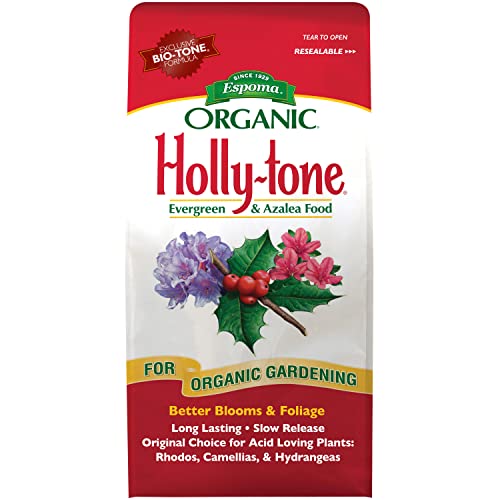
Holly-tone is engineered for plants that thrive in acidic soil, and some fuchsia varieties — particularly those with deep purple or blue-toned blooms — benefit from a lower soil pH. The 4-3-4 analysis includes 5% sulfur, which incrementally lowers pH in containers over multiple applications. The proprietary Bio-tone formula adds beneficial microbes that help fuchsia roots access nutrients in the slightly acidic environment.
Experienced fuchsia growers note improved flower color intensity — especially in dark-hued cultivars — when using this product during the main growing months. The granules break down slowly over 8 to 10 weeks, so a single spring application can carry fuchsias through early summer. Espoma’s long history since 1929 adds confidence, and the OMRI-compliant formulation is safe for organic container gardening.
If your potting mix already sits at a low pH, adding this can tip the balance too far, locking out calcium and magnesium. The 4-3-4 ratio is not bloom-boosting, so it will not maximize flowers on its own. It requires several weeks to see pH shifts, so it’s not a quick fix for struggling plants.
What works
- Lowers soil pH for acid-loving fuchsia varieties
- Bio-tone microbes aid nutrient absorption
- OMRI listed for organic gardening
What doesn’t
- Can over-acidify neutral potting mixes
- Not a high-potash bloom formula
Hardware & Specs Guide
NPK Ratio Interpretation for Fuchsias
The three numbers on a fertilizer bag represent Nitrogen (first) for leaf growth, Phosphorus (second) for root and flower development, and Potassium (third) for overall plant health and stress resistance. Potted fuchsias need a low first number (under 10) and higher second and third numbers. A ratio like 4-10-10 pushes energy into blooms without producing floppy, nitrogen-driven foliage. Avoid ratios above 15 for the first number when feeding fuchsias in containers.
Slow-Release vs Liquid Release Rate
Granular slow-release fertilizers are coated with a semi-permeable layer that dissolves over temperature and moisture cycles, typically feeding for 4 to 12 weeks. Liquid fertilizers provide all nutrients immediately upon application, which is ideal for weekly feeding but requires more consistency from the gardener. In a pot, slow-release granules are less prone to leaching than in garden soil, making them a dependable option for fuchsias when applied correctly.
Signal Elements
Chelated iron prevents interveinal chlorosis (yellowing between leaf veins), a common issue in container fuchsias due to restricted root volume and overwatering. Magnesium aids chlorophyll production, and calcium strengthens cell walls. Look for these secondary nutrients on the label, especially in liquid fertilizers, because small pots deplete micronutrients faster than garden beds.
Measuring Application Rates
One pound of granular fertilizer covers roughly 20 square feet of pot area when spread evenly. For a 10-inch diameter pot (0.55 square feet), you need about 0.4 ounces — roughly a tablespoon. Liquid fertilizers typically recommend 1-2 teaspoons per gallon of water. When in doubt, use half the recommended strength for the first two applications, as container fuchsias are more sensitive than in-ground plants due to limited soil volume.
FAQ
How often should I fertilize fuchsias in pots?
What NPK ratio is best for fuchsias in containers?
Can I use tomato fertilizer on fuchsias in pots?
Final Thoughts: The Verdict
For most gardeners, the fertilizer for fuchsias in pots winner is the Lilly Miller Bulb & Bloom Food 4-10-10 because its 4-10-10 ratio is almost purpose-built for container fuchsia bloom production. If you want the convenience of a fast-acting weekly schedule, grab the Miracle-Gro LiquaFeed Bloom Booster. And for organic growers who want to build container soil microbiology alongside nutrition, nothing beats the FoxFarm Happy Frog All Purpose Fertilizer 6-4-5.