
A pruning saw that binds or blunts mid-cut turns a five-minute trimming job into a battle. Whether you are reaching up to deadwood a heavy limb or sawing through a knotty branch at ground level, the tool’s tooth geometry, blade rigidity, and handle ergonomics decide how much effort you waste. The wrong saw chips, jumps, or leaves a ragged wound that invites disease. The right one takes clean, rapid strokes and lets you move on to the next branch.
I’m Rikta — the co-founder and writer behind Lawn Gear Lab. I’ve spent dozens of hours dissecting blade steels, tooth configurations, and handle designs across the pruning category, cross-referencing technical specs with thousands of verified owner reports to separate the tools that deliver genuine cutting performance from those that only look good on the shelf.
After that deep analysis, three distinct formats emerged as the smartest buys for different scenarios. This guide breaks down the most efficient pruning saw options for your specific needs, from a tiny pocket folder to a battery-powered mini-chainsaw.
How To Choose The Best Pruning Saw
The right pruning saw hinges on branch diameter and reach. A folding saw with a 5-inch blade is perfect for clearing a trail, but it will frustrate you on an 8-inch limb. An 18-foot pole saw solves height problems but is useless for a quick clip of a low branch. Match the format to the work.
Blade Material and Hardening
High-carbon steel (SK5, 65Mn) holds an aggressive edge and is easy to sharpen, but it rusts if neglected. Chrome-plated blades resist sap and corrosion better in wet conditions. Impulse hardening heats only the tooth tips, making them stay sharp roughly three times longer than unhardened teeth — a feature worth seeking for heavy seasonal pruning.
Tooth Configuration and Cut Type
Most pruning saws cut on the pull stroke, which keeps the blade tensioned and prevents buckling in thin, curved blades. A higher teeth-per-inch (TPI) number yields a finer finish, while large teeth (5-7 TPI) remove material aggressively and suit green wood. Three-sided, razor-ground teeth like Corona’s RazorTOOTH remove more material per pass and resist clogging in sappy cuts.
Handle Ergonomics and Safety
A non-slip rubberized handle with a guard prevents your hand from sliding onto the teeth during a pull stroke. For folding saws, a reliable locking mechanism (rotating ring, slide lock, or button) is non-negotiable — a blade that closes mid-cut is dangerous. For pole saws, a lightweight aluminum shaft reduces arm fatigue during extended overhead use.
Cut Capacity and Reach
Check the manufacturer’s maximum cut capacity. A folding saw rated for 2.6 inches will bog down on a 4-inch limb. A 14-inch fixed blade handles up to 8 inches in one pass if you have the arm strength to control it. Pole saws extend your reach to 18 feet, but a long shaft amplifies every wobble — a rigid extension mechanism is critical.
Quick Comparison
On smaller screens, swipe sideways to see the full table.
| Model | Category | Best For | Key Spec | Amazon |
|---|---|---|---|---|
| Corona RS 7395 | Fixed Blade | Heavy yard pruning | 14 in. blade, SK5 steel | Amazon |
| Silky BIGBOY 360mm | Folding | Large-diameter logs | 14.2 in. blade, 7.1 in. cut | Amazon |
| Gerber Freescape | Folding Camp | Backpacking & survival | 12 in. blade, 4 pivot points | Amazon |
| Silky PocketBoy 130mm | Folding | Light trimming on the go | 5 in. blade, 6.8 TPI | Amazon |
| EZDAILY Pole Saw 18ft | Pole Saw | High, unreachable branches | 18 ft reach, 65Mn blade | Amazon |
| Opinel No. 12 | Folding Pocket | Ultra-compact carry | 3.15 in. blade, Virobloc lock | Amazon |
| DeWalt DCCS623B | Chainsaw | High-volume power pruning | 8 in. bar, 20V battery | Amazon |
In‑Depth Reviews
1. Corona Tools 14-Inch RazorTOOTH Pruning Saw (RS 7395)

The Corona RS 7395 is the benchmark for fixed-blade pruning saws. Its 14-inch Japanese SK5 high-carbon steel blade uses three-sided razor teeth that remove more material per stroke than standard two-sided grind patterns, meaning you complete each cut faster with less arm fatigue. The chrome plating reduces friction against green, sappy wood and protects the blade from corrosion when stored in a damp shed. Impulse-hardened teeth stay sharp approximately three times longer than non-hardened steel, and the curved profile naturally hooks into the branch, preventing the blade from skipping off the bark on the first pull.
Weighing just over ten ounces, this saw is light enough for single-hand use on overhead branches yet stiff enough to handle limbs up to 8 inches in diameter. The ergonomic pistol-grip handle with a rubberized coating provides a locked-in hold even with sweaty or gloved hands, and the heavy-gauge metal spine resists bending when you lever the blade inside a tight crotch. Multiple long-term owners report using it for years on hardwood species like maple and birch without significant edge degradation, needing only a wipe of motor oil to prevent surface rust.
The only recurring complaint involves the two small bolts securing the handle — a few owners found they loosened during aggressive cutting, which can cause the blade to separate from the grip. The fix is straightforward: apply thread-locking compound during initial assembly and check tightness periodically. For anyone who needs a dedicated, no-fuss pruning tool for serious yard maintenance, this Corona delivers professional-grade cutting speed at a mid-range investment.
What works
- RazorTOOTH three-sided grind cuts faster and cleaner than standard saw teeth.
- Chrome-plated SK5 steel resists sap buildup and rust in wet conditions.
- Lightweight yet rigid enough for 8-inch limbs without flex.
What doesn’t
- Handle attachment bolts can loosen without thread-locker or periodic tightening.
- No included scabbard — an aftermarket leather sheath is recommended for safe carry.
- Fixed 14-inch blade is not pack-friendly for hiking or tight storage.
2. Silky Professional BIGBOY Folding Saw 360mm (354-36)

The Silky BIGBOY is a folding saw that cuts like a fixed-blade tool. Its 14.2-inch hard chrome-plated blade is taper-ground to reduce resistance, and the large-tooth configuration (5.9 TPI) clears 4-inch logs in under 20 seconds and handles branches up to 7.1 inches in diameter. The pull-cut design is typical of high-end Japanese saws — the thin blade flexes slightly to avoid binding in the kerf, and the impulse-hardened teeth slice through green wood without tearing the bark. A two-handed, cushioned rubber grip gives you the leverage to push through thick hardwood without blisters.
Owners consistently praise the cutting speed on 2- to 6-inch trees, noting that limbs under 3 inches fall in just two strokes. The bright red handle is easy to spot among camping gear, and the locking mechanism holds the blade rigidly open during use. It folds down to roughly 16 inches, making it compact enough for a larger backpack or trunk kit. Silky’s reputation in the professional arborist world is backed by decades of Japanese saw manufacturing, and the BIGBOY is a favorite among bushcraft enthusiasts and hunters who need reliable performance off-grid.
The trade-off is noticeable at the checkout counter — this is a premium investment. Some users wish the blade locked when folded for safer carry, and the pull-cut stroke takes a brief adjustment period for anyone used to pushing a Western saw. But for raw cutting speed on large-diameter material, no folding saw in this comparison matches the BIGBOY’s efficiency. It earns its price for anyone who regularly processes firewood, clears trail debris, or trims substantial limbs around the property.
What works
- Extremely fast cutting — 4-inch log in under 20 seconds with minimal effort.
- Two-handed rubberized handle provides superior leverage and comfort for heavy cuts.
- Chrome-plated, impulse-hardened blade resists rust and stays sharp for years with proper care.
What doesn’t
- Pull-cut only — users accustomed to push-stroke saws may struggle initially.
- Thin blade flexes noticeably on larger cuts, requiring controlled strokes to avoid binding.
- No locking mechanism when folded — the blade can open inside a pack if not secured.
3. Gerber Freescape Camp Saw Folding Hand Saw
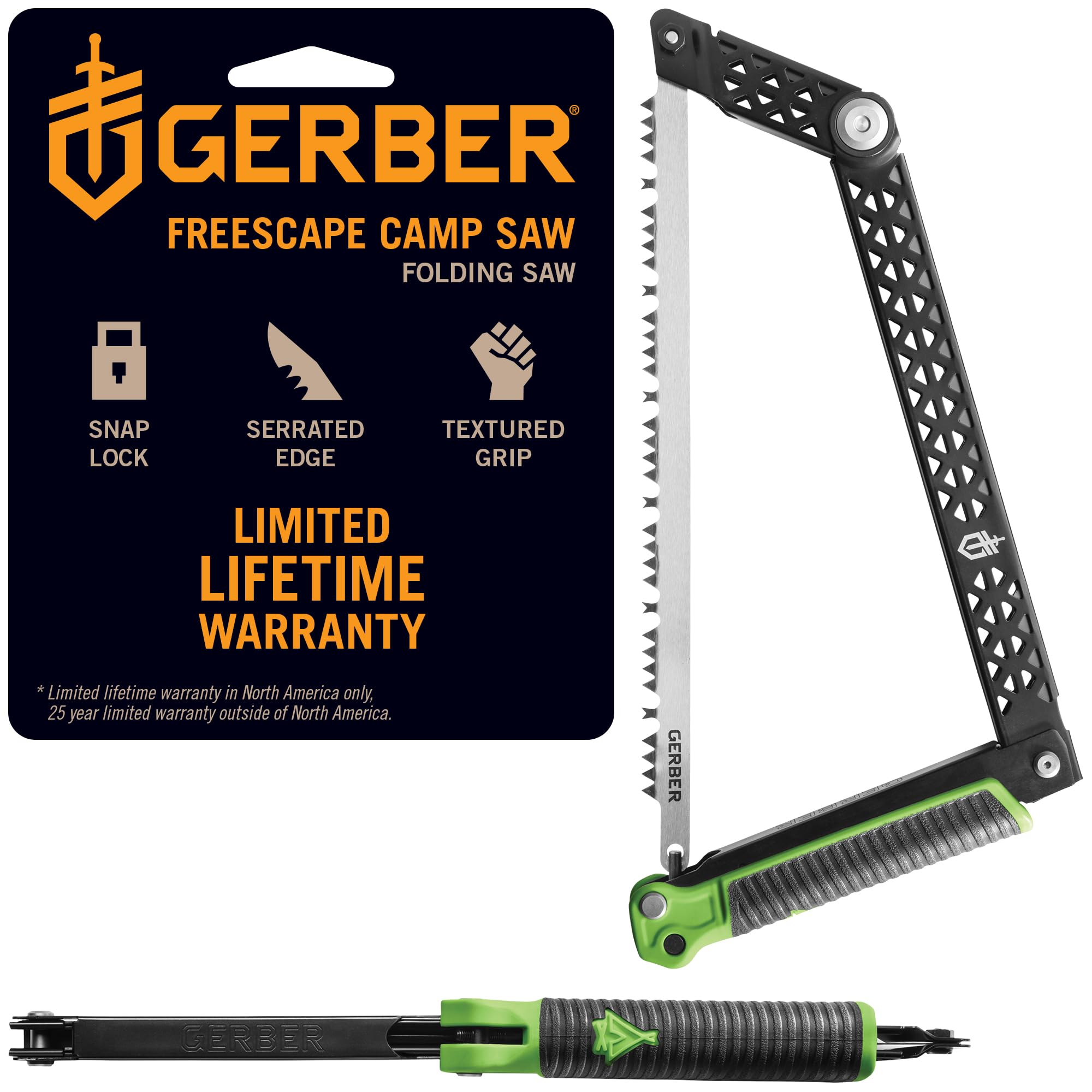
Gerber’s Freescape rethinks the folding camp saw. Instead of a traditional hinge, four pivot points allow the 12-inch blade to fold completely flat while staying fully assembled — nothing to disassemble or lose. This design maximizes usable blade length within a compact footprint, enabling you to cut through 8-inch trees in about 7 minutes despite the saw’s lightweight profile. The bright green accents help you spot it in a cluttered pack, and the textured rubber handle stays secure in wet or cold conditions.
Backpackers and Scout leaders love the Freescape’s low pack weight of one pound and its ability to process campfire fuel efficiently. The blade is replaceable and uses a standard aluminum-oxide coating for decent cut longevity. The folding mechanism’s rigidity is impressive for the weight class — there is minimal lateral wobble during aggressive strokes. However, the included factory blade has a lower tooth count (roughly 7 TPI), which increases the effort per stroke compared to a dedicated pruning saw like the Silky PocketBoy.
The main drawback is the blade’s tooth geometry. Several experienced users swapped the stock blade for a finer-tooth replacement to reduce cutting effort on smaller branches. Additionally, the complex pivot system introduces more potential wear points than a simple single-hinge folder, though Gerber’s warranty and build quality generally satisfy owners. For the ultralight backpacker who needs a capable saw that packs flat, the Freescape is an intelligent design that earns its place in the kit.
What works
- Folds completely flat — takes up negligible space in a backpack compared to traditional folders.
- 12-inch blade length delivers good cutting reach for a sub-compact pack frame.
- Rubberized textured handle provides firm grip even with wet or cold hands.
What doesn’t
- Stock blade has too few teeth per inch, making cuts feel slow on small branches.
- Complex 4-pivot design introduces additional potential failure points over a single hinge.
- Higher price point than many simpler folding saws for the same cutting capacity.
4. Silky PocketBoy Curved Blade Folding Saw 130mm (726-13)

The Silky PocketBoy is the gold standard for a pocket-sized pruning saw that actually cuts. Its 5-inch curved blade fits in a large pants pocket or the included hard plastic belt case, yet it still manages to bite through 2.6-inch branches with surprising speed. The curved profile combined with Silky’s trademark pull-cut technology delivers about 15-20% faster cutting than an equivalent straight-blade folder. Taper-grinding reduces friction, and the impulse-hardened large teeth (6.8 TPI) stay sharp roughly three times longer than standard teeth.
Hunters, hikers, and gardeners alike report this saw living in their pack for years without rust because of the hard chrome plating. Owners in tropical rainforest climates confirm the blade does not corrode despite constant humidity. The plastic composite handle feels dense and secure, and the folding mechanism locks both open and closed. It is compact enough to be a secondary tool for quick trail-side trimming without lugging a larger saw.
The limitation is obvious: a 2.6-inch cut capacity means you will not process firewood with this tool. It is strictly for light pruning, trail work, and small camp tasks. At roughly 8 ounces with the case, it is not the absolute lightest pocket folder, but the cutting performance per ounce is exceptional. If you need a saw that disappears into your gear but still delivers genuine cutting force on small branches, the PocketBoy is the definitive choice.
What works
- Curved blade with pull-cut technology cuts 15-20% faster than straight alternatives.
- Chrome-plated impulse-hardened teeth resist rust and maintain sharpness for years.
- Compact enough for pocket carry with hard plastic belt case included.
What doesn’t
- Limited to branches 2.6 inches or smaller — not suitable for large-diameter logs.
- Pull-cut movement can cause the thin blade to bind if forward pressure is applied.
- Price is elevated for the short blade length — you pay for Silky’s Japanese engineering premium.
5. EZDAILY Tree Pruner Pole Saw (18ft Extendable)
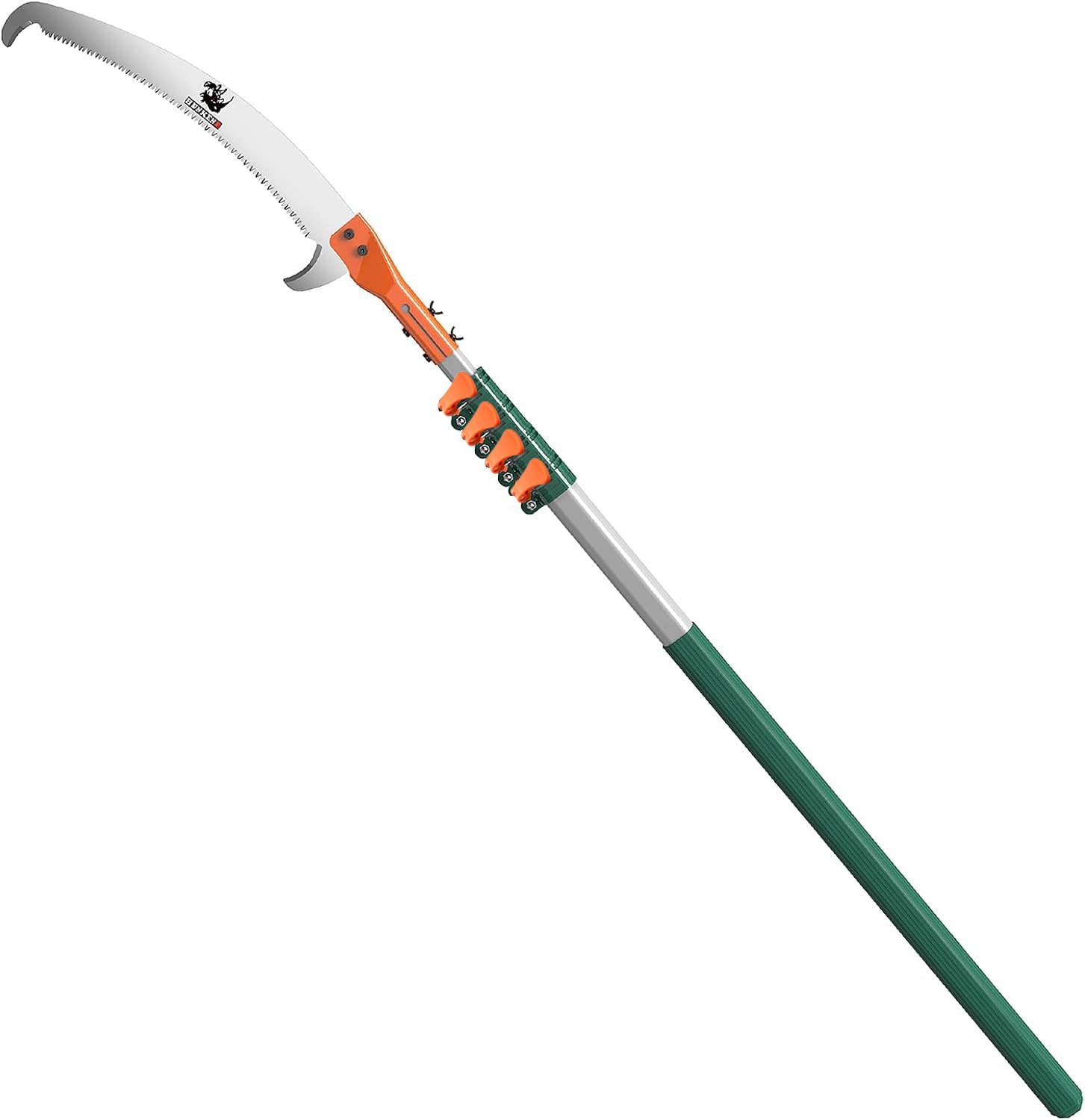
An extendable pole saw solves the problem of high, unreachable branches without paying for a professional climber or renting a bucket truck. The EZDAILY pole saw extends to 18 feet using a telescoping aluminum shaft and collapses to 52 inches for storage in a garage or shed. The saw blade is made from 65Mn manganese steel — a material commonly used in high-end pole pruners — and its three-sided arc design clears small vines and larger limbs efficiently. The 45-degree cutting angle lets you position the blade flat against a branch for a clean, flush cut without overreaching.
Property owners with tall palm fronds, oak limbs, or maple branches report that this saw cuts smoothly even at full extension, with the aluminum handle resisting bending under moderate force. The blade is extremely sharp out of the box and saws through 4- to 6-inch branches without binding when the proper pull-stroke technique is used. The straightforward twist-lock mechanism is simpler and more rigid than the screw-together connectors found on budget pole saws, and the weight is manageable for a single person working overhead for short durations.
The aluminum shaft has a documented weakness: a falling limb striking the pole sideways can snap it, as several owners discovered. This is a risk inherent to any long, thin pole saw — the vertical compression strength is good, but lateral impacts may cause failure. The included warranty and seller customer service are responsive, but you should clear the drop zone before cutting. For the price, this is the most practical solution for occasional overhead pruning without investing in gas-powered or battery-powered pole equipment.
What works
- 18-foot reach eliminates the need for ladders on most residential trees.
- 65Mn blade steel provides sharp, durable cutting performance straight from the box.
- Telescoping aluminum shaft with twist-lock is simpler and sturdier than multi-section screw-in poles.
What doesn’t
- Aluminum pole can snap if struck sideways by a falling limb — clear the drop zone.
- Heavy at full extension — moderate arm strength is needed for extended overhead use.
- No scissor-style pruning head included — this is a saw-only system.
6. Opinel Folding Saw No. 12 (Beechwood Handle)

The Opinel No. 12 is a minimalist design that prioritizes portability above all else. Weighing just 3.6 ounces with an 8-centimeter (3.15-inch) carbon steel blade, it folds into a slim profile that barely occupies space in a fishing bag, backpack, or even a large jacket pocket. The signature Virobloc safety ring — a rotating stainless steel collar invented by Marcel Opinel in 1955 — locks the blade securely open and closed, preventing accidental closure during a cut or opening if the saw shifts in your pack. The beechwood handle is warm, comfortable, and visually classic, though it benefits from a light sanding and stain to improve water resistance.
Because the blade is uncoated carbon steel, it takes and holds an extremely sharp edge that cuts remarkably well on branches up to 2 inches in diameter. The pull-stroke action is smooth once you learn to release forward pressure to prevent binding. Owners who carry this saw for day hikes, fishing trips, or lightweight camping appreciate that they barely notice it until they need it. For the user who already carries a folding knife, adding a 3.6-ounce saw opens up limb-trimming capability without adding meaningful weight.
The trade-off for that ultra-light form is capacity and maintenance. The saw is not effective on branches larger than about 2 inches — attempting larger cuts risks binding and damage. Carbon steel requires vigilance: sap and moisture must be wiped off immediately to prevent rust, and the blade should be oiled periodically. The wooden handle can also crack if left in rain. For the ultralight backpacker or emergency kit builder who values every gram, this Opinel is a purpose-built specialist, not a general-purpose pruning tool.
What works
- Exceptionally light at 3.6 ounces — disappears into a pocket or pack.
- Virobloc safety ring locks the blade securely in both open and closed positions.
- Classic beechwood handle with carbon steel blade provides a traditional, sharp cutting experience.
What doesn’t
- Limited to branches 2 inches or less — no capacity for larger limbs.
- Carbon steel requires diligent rust prevention — not suitable for wet environments without care.
- Wooden handle and thin blade feel less durable than modern composite and chrome-plated alternatives.
7. DeWalt 20V MAX Cordless Pruning Chainsaw (DCCS623B)

The DeWalt DCCS623B is a battery-powered mini-chainsaw designed for heavy pruning where a hand saw would cause fatigue. With an 8-inch bar and a 20V brushless motor delivering 2.8 horsepower, it cuts through branches up to 7 inches in diameter in seconds. The tool-only design means you supply your own DeWalt 20V battery, but owners report fantastic runtime — a single 6Ah charge lasts an entire weekend of moderate trimming. Weighing just over 4.5 pounds, it is light enough for a 70-year-old user to operate with one hand, yet powerful enough to clear small trees and thick underbrush efficiently.
This saw replaces the need for manual pull-cut effort on dozens of branches in a single session. The low-kickback chain and auto-oiling system with biodegradable bar oil reduce maintenance, and the compact bar lets you reach into tight crotches between limbs where a larger chainsaw would not fit. Owners note that the saw works best on branches 1 inch or thicker — very small, flimsy twigs can cause the chain to jam due to the relatively low RPM compared to a gas unit. For property maintenance, trail clearing, and serious yard pruning, this is a massive labor saver.
The biggest limit is not the tool itself but the battery ecosystem — this is a bare tool, so the total cost jumps significantly if you do not already own DeWalt 20V batteries and a charger. The 8-inch bar also limits the maximum cut depth, so it will not replace a full-size chainsaw for large felling tasks. But for the specific job of pruning branches up to 7 inches, this cordless unit delivers chainsaw speed with hand-tool portability and quiet electric operation.
What works
- Cuts through 7-inch branches in seconds with zero manual sawing effort.
- Lightweight (4.5 lbs) and well-balanced — easily operated one-handed by users of all ages.
- Excellent battery life — a 6Ah battery lasts through a full weekend of pruning tasks.
What doesn’t
- Bare tool only — you must already own or purchase DeWalt 20V batteries and charger separately.
- Relatively low chain RPM causes stalling on very small, flimsy branches under 1 inch.
- 8-inch bar limits cut capacity — not suitable for felling larger trees or processing firewood.
Hardware & Specs Guide
Blade Length and Cut Capacity
Blade length determines both reach and the maximum branch diameter you can cut in a single stroke. A 5-inch blade handles up to about 2.6 inches, while a 14-inch fixed blade can manage 8 inches — but requires more arm strength to control. Match the blade to your typical branch size; using an undersized blade forces multiple passes and increases binding risk.
Impulse Hardening vs Standard Hardening
Impulse hardening heats only the tooth tips via induction, creating a harder edge that lasts roughly three times longer than standard heat-treated teeth. This is a critical feature for heavy pruning on abrasive green wood. Chrome plating adds a slick surface layer that resists sap adhesion and prevents rust on high-carbon steel substrates like SK5 and 65Mn.
FAQ
What is the difference between a pruning saw and a carpenter’s handsaw?
Should I buy a curved blade or a straight blade for pruning?
How do I prevent my pruning saw blade from rusting between uses?
Final Thoughts: The Verdict
For most gardeners, the pruning saw winner is the Corona RS 7395 because its 14-inch RazorTOOTH blade offers the fastest cutting speed per dollar in a fixed-blade format that handles limbs up to 8 inches. If you want a folding saw that processes big wood without sacrificing portability, grab the Silky BIGBOY 360mm. And for high-volume power pruning with zero arm fatigue, nothing beats the DeWalt DCCS623B 20V chainsaw.