
Hand-watering a sprawling vegetable patch or a row of raised beds eats up hours each week and nearly always leaves some plants parched while others get flooded. A proper drip line system delivers water directly to the root zone, eliminates runoff, and frees your evenings—provided you pick a kit that matches your layout’s water pressure and tubing length.
I’m Rikta — the co-founder and writer behind Lawn Gear Lab. I’ve spent countless hours comparing hundreds of irrigation kits, analyzing tubing diameters, emitter flow rates, and connector designs, and cross-referencing real owner feedback to identify which systems actually hold up season after season.
Whether you’re outfitting a small greenhouse or a long vegetable garden, the right setup balances a leak-resistant connection method with adjustable emitters and enough mainline length to reach every corner. This guide breaks down the seven best options on the market to help you find the ideal drip line irrigation system for your space.
How To Choose The Best Drip Line Irrigation System
Building an effective drip network starts with understanding a few critical specifications. Focus on these three factors first, and you’ll avoid the most common mistakes that lead to weak water distribution, frequent clogs, or frustrating leaks.
Mainline Diameter & Tubing Length
The mainline (usually 1/2-inch or 5/16-inch) is the backbone of your system. A 1/2-inch mainline carries water farther with less pressure drop than a 5/16-inch line, which is important for runs longer than 50 feet. Most comprehensive kits include 33 to 50 feet of 1/2-inch mainline plus 100 to 200 feet of 1/4-inch distribution tubing. If your garden stretches beyond 60 feet, prioritize a kit with a larger mainline to keep flow strong at the far end.
Connector Type: Push-to-Connect vs. Barbed Fittings
Push-to-connect fittings have largely replaced old-style barbed connectors because they create a tighter seal without forcing tubing onto sharp ridges. They also lock in place, reducing pop-offs caused by fluctuating water pressure. Barbed fittings are still common in repair kits and are perfectly fine for short runs, but for a full new installation, push-to-connect systems save time and reduce frustration—especially for beginners.
Emitter Adjustability & Flow Rate
Not all plants drink the same volume. Kits that include a mix of stream, vortex, and misting emitters let you tailor water delivery for different plant types in the same bed. Adjustable emitters with twistable caps allow fine-tuning from a gentle drip to a wide spray. Pay attention to the number of emitters included—32 to 38 is typical for a mid-sized kit—and whether they come with integral stakes to keep them upright and positioned at the root zone.
Quick Comparison
On smaller screens, swipe sideways to see the full table.
| Model | Category | Best For | Key Spec | Amazon |
|---|---|---|---|---|
| Spalolen Push-to-Connect | Mid-Range | Long garden layouts with 2 zones | 50 ft 1/2″ mainline | Amazon |
| Bonviee 230FT | Mid-Range | Medium beds & potted plants | 33 ft 5/16″ + 197 ft 1/4″ | Amazon |
| DFDNFF 200FT Quick-Connect | Budget | Beginner DIY setups | 72-piece kit, 2 zones | Amazon |
| Rain Bird DRIPKITBAG | Mid-Range | Repair & expansion | 100 ft 1/4″ tubing, 40 emitters | Amazon |
| GGAQHLK 230FT Copper Nozzle | Premium | Bendable copper nozzles & 2 zones | 33 ft 1/2″ mainline, 38 nozzles | Amazon |
| MIXC 200FT Copper Nozzle | Premium | Fine mist & flexible positioning | 32 bendable copper nozzles | Amazon |
| Garden In Minutes 3×6 Grid | Premium | Square foot raised beds | Pre-assembled, 16 streams/sq ft | Amazon |
In‑Depth Reviews
1. Spalolen Push-to-Connect Drip Irrigation System Kit
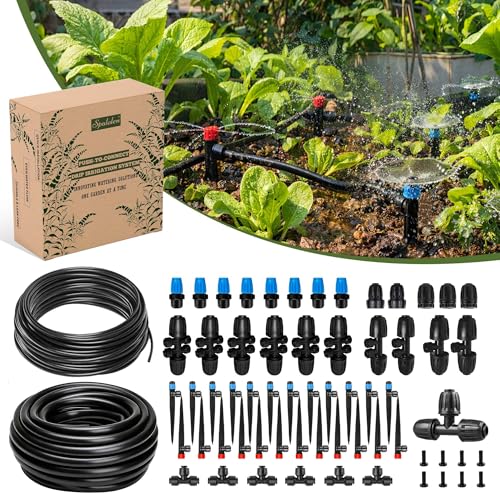
The Spalolen kit stands apart because it includes a full 50-foot 1/2-inch mainline, which is longer than most competitors and crucial for maintaining water pressure across extended garden beds or greenhouse rows. The push-to-connect fittings lock with an audible click and use internal O-rings to minimize leaks, a notable improvement over traditional barbed connectors that can pop off during pressure shifts. The kit also comes with 115 feet of 1/4-inch tubing and 32 adjustable emitters, stream nozzles, and sprayers, giving you enough hardware to build two independent watering zones.
Owner reports consistently highlight the straightforward assembly—several users mention completing the setup in under an hour without any tools. The locking clips provide extra security, and the adjustable emitters allow you to fine-tune from a gentle drip for seedlings to a wider stream for established shrubs. The mainline’s flow stability means even the emitters at the far end of a 75-foot run (when extended with standard 3/4-inch hose) still deliver usable pressure.
For anyone starting from scratch with a medium to large garden, this kit offers the best balance of mainline length, fitting quality, and emitter variety. The push-to-connect design reduces the learning curve dramatically, and the ability to split into two zones gives you flexibility for different watering schedules across your property.
What works
- Long 50 ft mainline keeps pressure even across long runs
- Push-to-connect fittings with locking clips for leak resistance
- Complete 2-zone setup with 32 adjustable emitters
What doesn’t
- No included pipe cutter for clean 1/2″ cuts
- Some users may need additional 1/4″ tubing for very large layouts
2. Garden In Minutes 3×6 Garden Grid Watering System
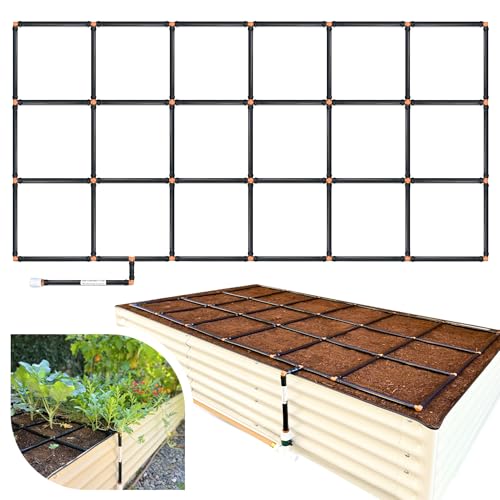
The Garden Grid takes a completely different approach from traditional tubing-and-emitter kits. It arrives in pre-assembled rigid grid sections that sit on top of a 3×6-foot raised bed, delivering 16 gentle streams of water per square foot directly at soil level. There are no individual emitters to install, no tangled 1/4-inch lines to route, and no pressure regulators to dial in—just connect a standard garden hose to the inlet and you’re done in roughly two minutes.
The UV-resistant polypropylene construction is built to withstand full sun exposure and freezing temperatures, with units from 2013 still reported in active use. The grid’s square-foot layout doubles as a planting template for square-foot gardening, making it easier to space plants evenly. Owners consistently note that it waters every plant uniformly without the dry spots common with soaker hoses or the clog-prone emitters found in traditional drip kits. A built-in fine mesh filter screen keeps debris from clogging the internal passages.
This is the ideal solution if you have a standard raised bed and want to eliminate the complexity of assembling a modular drip system. The higher upfront cost is offset by years of maintenance-free operation—no emitters to replace, no tubes to reposition, and no uneven watering to troubleshoot. It also pairs seamlessly with a hose-end timer for fully automatic watering.
What works
- Two-minute tool-free setup with no emitter assembly
- Even 16-stream coverage per square foot eliminates dry spots
- UV-resistant materials with reported 10+ year lifespan
What doesn’t
- Fixed size (3×6 ft) limits compatibility with non-standard beds
- Higher initial cost compared to modular tubing kits
3. GGAQHLK 230FT Drip Irrigation System with Copper Nozzles
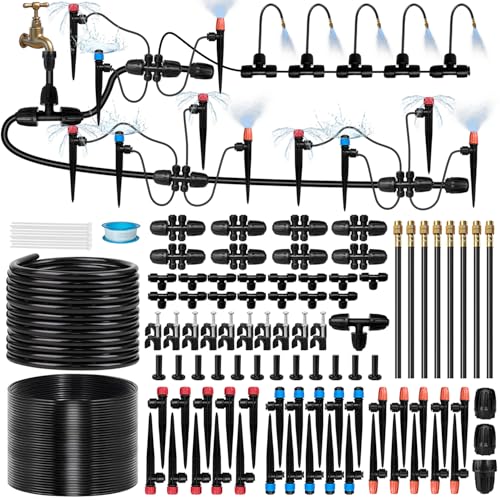
This kit upgrades the typical all-plastic emitter design with eight 360-degree bendable copper nozzles that can be twisted and fixed into any position, letting you direct water exactly where it’s needed—overhead for misting or low for targeted root watering. The system includes a 33-foot 1/2-inch mainline and 197 feet of 1/4-inch distribution tubing, plus three nozzle types: vortex, stream, and misting. The 1/2-inch tee connector lets you split the mainline into two independent zones for different watering schedules.
Assembly uses push-to-connect fittings that secure instantly without glue or heat, and the 1/2-inch to 1/4-inch 4-way connectors make branching straightforward. Owners report that the copper nozzles hold their position after adjustment and don’t crack like plastic alternatives after a season of UV exposure. The adjustable sprinkler heads allow flow control by rotating the cap, giving you granular control from a fine mist for delicate seedlings to a solid stream for established plants.
This is a strong choice for gardeners who need both overhead misting for cooling and ground-level drip for deep watering. The 38-piece nozzle assortment covers a wide range of plant types, and the 1/2-inch mainline provides sufficient flow for runs up to about 60 feet before pressure drop becomes noticeable.
What works
- Bendable copper nozzles hold position and resist UV damage
- Three emitter types cover misting, vortex, and stream needs
- Tee connector enables two independent watering zones
What doesn’t
- Mainline length limited to 33 ft for the 1/2″ section
- Plastic stakes feel less durable than metal alternatives
4. Bonviee 230FT Drip Irrigation System

Bonviee’s offering packs 230 feet of total tubing—33 feet of 5/16-inch mainline and 197 feet of 1/4-inch distribution line—at a very competitive price point. The push-to-connect fittings create a tight seal without requiring tools, and the kit includes three types of adjustable stake sprayers so you can fine-tune from a gentle drip to a full spray pattern. It’s designed to connect to a standard hose timer for automated watering, making it a solid choice for busy gardeners who need reliable coverage while away.
Users consistently praise the straightforward setup, with several reporting full installation for six 4×4-foot raised beds in under 30 minutes. The multi-stream stake nozzles deliver more even coverage than basic Orbit-style emitters, and the system holds up well under normal household water pressure without leaks at the connection points. The 5/16-inch mainline handles medium-length runs adequately, though for runs beyond 50 feet you may notice slightly lower flow at the far end compared to a 1/2-inch mainline.
This kit is best suited for gardeners with medium-sized layouts—a group of raised beds, a greenhouse bench, or a mix of in-ground and container plants. The timer compatibility is a standout feature at this price level, and the included assortment of fittings and emitters covers most common configurations without requiring additional purchases.
What works
- Very easy push-to-connect setup, installs in under 30 minutes
- Compatible with hose timers for automatic operation
- Multi-stream stake nozzles provide even coverage
What doesn’t
- 5/16″ mainline has lower flow capacity than 1/2″ lines
- Additional stakes needed for very complex layouts
5. MIXC 200FT Drip Irrigation System with Copper Nozzles
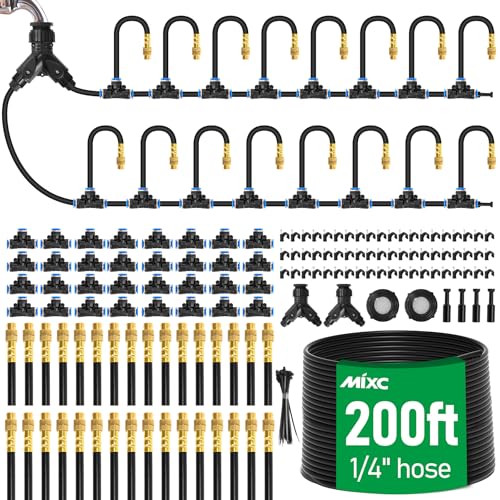
The MIXC system focuses on precision and universality. It uses standard 1/4-inch components that are fully compatible with US-market hoses and fittings, avoiding the sizing mismatches that sometimes plague 5/16-inch systems. The headline feature is the set of 32 adjustable copper nozzles, each with a 20-centimeter bendable aluminum core that allows you to position the water stream exactly where you need it—overhead for misting or angled toward the base of a plant. The kit also includes 200 feet of 1/4-inch tubing, two 2-way quick connectors, and 32 three-way connectors for branching.
Owners report that the copper nozzles hold their shape after repositioning and deliver consistent flow from a fine mist to a solid stream depending on how far the cap is rotated. The push-fit connectors are genuinely tool-free, and the 3-position connectors make it easy to tee off to multiple plants from a single line. Note that the manufacturer recommends connecting no more than eight adjustable rods per 50 feet of tubing to maintain adequate pressure—a useful guideline for planning your layout.
This kit is ideal for potted plant arrangements, greenhouse benches, or small garden beds where you want the flexibility to redirect water overhead or down to the soil surface. The all-1/4-inch format keeps components uniform and easy to expand, though you may need to add a 1/2-inch to 1/4-inch adapter if you’re running a long mainline from a faucet.
What works
- Durable copper nozzles with bendable aluminum core hold position
- All 1/4″ components eliminate sizing compatibility issues
- Adjustable from fine mist to strong stream
What doesn’t
- No end plugs included for terminating tubing runs
- Limited to 8 nozzles per 50 ft of tubing for best pressure
6. Rain Bird DRIPKITBAG Drip Irrigation Repair and Expansion Kit

Rain Bird’s DRIPKITBAG isn’t a complete installation kit—it’s a thoughtfully curated repair and expansion set designed for people who already have a mainline in place. It contains 102 professional-grade components including 100 feet of self-dispensing 1/4-inch distribution tubing, 40 pressure-compensating emitters (10 at 0.5 GPH, 20 at 1.0 GPH, and 10 at 2.0 GPH), and an assortment of barbed couplers, tees, plugs, and stakes. The included Emitter Installation/Removal Tool makes inserting and extracting emitters much easier than doing it by hand.
The bag itself is a zippered plastic pouch with internal pouches that keep fittings organized. Owners consistently note that having a range of GPH-rated emitters on hand makes it easy to match water delivery to specific plant needs—low-flow for succulents, higher flow for tomatoes. The barbed fittings create reliable connections when installed correctly, though they require more force to push onto the tubing than push-to-connect alternatives. The pressure-compensating emitters maintain consistent output even when pressure fluctuates across the run.
This is the right choice if you already have a mainline installed and need to add branches, replace damaged emitters, or extend coverage to new beds. It’s also a useful complement to a basic kit that includes a mainline but limited fittings. The professional-grade components are noticeably higher quality than many generic no-name fittings and will hold up longer under continuous pressure.
What works
- Pressure-compensating emitters maintain consistent GPH output
- Emitter removal tool saves time and frustration
- Portable zip pouch with organized internal storage
What doesn’t
- No mainline tubing or connectors included
- Barbed fittings require more force than push-to-connect
7. DFDNFF 200FT Quick-Connect Drip Irrigation System
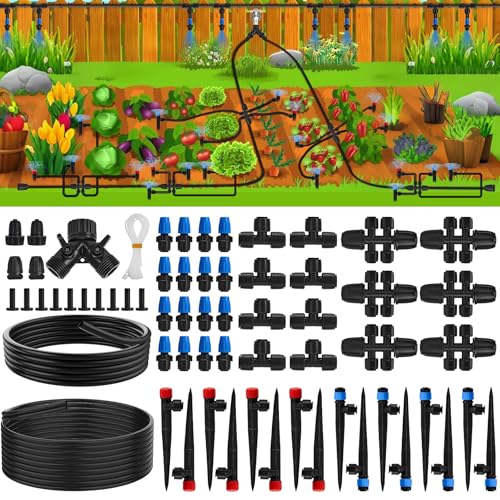
This 72-piece kit from DFDNFF provides a complete entry-level drip system at a very accessible price. It includes 40 feet of 5/16-inch mainline tubing and 160 feet of 1/4-inch distribution tubing, along with 32 adjustable drip emitters split between stream, vortex, and misting types. The quick-connect fittings are straightforward to assemble—insert and secure the tubing without tools—and the included 2-way hose splitter lets you build two independent watering zones from a single faucet.
Owners highlight the value for money and report that the system works well for small raised beds, flower borders, and greenhouse setups. The emitters are removable and easy to clean, which helps prevent clogging over time. The primary drawback noted by users is that the kit does not include a pipe cutter, and the 5/16-inch mainline may not maintain adequate pressure for runs longer than 40 feet. Some owners also mention that the barbed connectors require a firm push to seat properly.
This is a solid option if you’re new to drip irrigation and want to test a system on a small garden without a large investment. The component count is generous for the price, and the ability to split into two zones gives you room to expand. Just plan to keep your runs under 40 feet to avoid pressure loss at the far end.
What works
- Very affordable entry price with 72 components included
- 2-way hose splitter enables dual-zone watering
- Emitters are removable and easy to clean
What doesn’t
- No pipe cutter included for clean tubing cuts
- Mainline runs longer than 40 ft may lose pressure
Hardware & Specs Guide
Mainline Diameter & Pressure Drop
The mainline tubing diameter directly determines how far water can travel before pressure drops below usable levels. A 1/2-inch mainline (outside diameter ~0.433 inches) can carry water 60 to 80 feet with minimal pressure loss, while a 5/16-inch line (outside diameter ~0.433 inches) starts losing noticeable flow beyond 40 feet. For gardens longer than 50 feet from the faucet, always select a kit that includes at least 33 feet of 1/2-inch mainline and plan to use 1/4-inch distribution tubing only for the final few feet to each plant.
Emitter Flow Rate & Pressure Compensation
Emitter flow rates are measured in gallons per hour (GPH), with common values ranging from 0.5 GPH for slow-drip applications to 2.0 GPH for thirsty vegetables. Pressure-compensating emitters maintain a consistent GPH output even when water pressure fluctuates due to elevation changes or long tubing runs. Non-compensating emitters will output more water near the faucet and less at the far end. If your garden has elevation changes or runs longer than 30 feet, prioritize kits with pressure-compensating emitters or adjustable nozzles that let you dial in the flow at each station.
FAQ
What size mainline do I need for a 100-foot garden run?
How do I prevent emitters from clogging in a drip line system?
Can I connect a drip irrigation system to a hose-end timer?
Final Thoughts: The Verdict
For most gardeners, the drip line irrigation system winner is the Spalolen Push-to-Connect Kit because it combines a full 50-foot 1/2-inch mainline with reliable push-to-connect fittings and enough emitters to cover two zones without pressure drop. If you want a maintenance-free setup that installs in two minutes, grab the Garden In Minutes 3×6 Garden Grid. And for a budget-friendly entry point that still delivers solid coverage, the DFDNFF 200FT Quick-Connect Kit is a capable starter system for small gardens and first-time builders.