
Broadleaf weeds like dandelion, clover, and dollar weed don’t just ruin the look of a lawn — they compete aggressively with turf for water and nutrients, often winning the underground battle. A selective herbicide that targets these invaders while leaving grass untouched is the only efficient solution for a healthy, uniform lawn.
I’m Rikta — the co-founder and writer behind Lawn Gear Lab. My process for this guide involved cross-referencing active ingredient ratios, coverage rates, and weed-specific efficacy data from hundreds of verified owner experiences to separate the short-term solutions from the real performers.
After evaluating concentrate potency, application flexibility, and grass-type safety across seven top candidates, this analysis reveals which concentrate earns the title of the best 2 4 d weed killer for delivering fast results without collateral turf damage.
How To Choose The Best 2 4 D Weed Killer
Selecting a 2,4-D concentrate isn’t about picking the cheapest bottle. The real differentiators are the active ingredient blend, the concentration strength, and the specific weed spectrum each formula targets. A single-ingredient product works fine for dandelions, but stubborn perennials like wild violet or creeping Charlie require a multi-active approach.
Active Ingredient Complexity
A straight 2,4-D amine formulation with around 46% active ingredient is potent for common broadleaf weeds but may require multiple applications on tougher species. Formulations that add Dicamba, Triclopyr, MCPA, or Sulfentrazone broaden the weed control spectrum and often show visible results in 24 to 48 hours rather than a week. Products with four active ingredients generally perform better on hard-to-kill species like Virginia buttonweed and ground ivy.
Coverage Volume and Mixing Ratio
A 32-ounce quart typically treats 8,000 to 16,000 square feet depending on the mix rate, while a full gallon covers 40,000 square feet or more. Check the fluid ounces per 1,000 square feet recommended on the label — some products require 1.5 ounces per gallon, others need 2.8 ounces. Higher concentration means fewer refills during large applications but demands careful measuring to avoid over-application and grass burn.
Grass Type Compatibility
Not all 2,4-D blends are safe on every turf type. Cool-season grasses like Kentucky bluegrass, perennial ryegrass, and tall fescue generally tolerate amine formulations well. Warm-season grasses like Bermuda, Zoysia, and St. Augustine are more sensitive — some products explicitly label restrictions for St. Augustine or Centipede grass. Always verify the bottle lists your specific grass type before mixing.
Quick Comparison
On smaller screens, swipe sideways to see the full table.
| Model | Category | Best For | Key Spec | Amazon |
|---|---|---|---|---|
| Select Source Triad TZ | 4-Way Herbicide | Stubborn Broadleaf Weeds | 4 active ingredients incl. Triclopyr | Amazon |
| SpeedZone EW | Fast-Acting | Quick Visible Results | Visible curling in hours | Amazon |
| Liquid Harvest | Three-Way Concentrate | Low-Odor Application | 30.89% 2,4-D + MCPA + Dicamba | Amazon |
| ALLIGARE 2,4-D Amine | Straight 2,4-D | Farm & Pasture Use | 47.2% active, 1 gallon | Amazon |
| Southern Ag Trimec | Three-Way Blend | General Lawn Weeds | Patented 3-active formula, 1 gal | Amazon |
| BioAdvanced Weed Killer | Lawn Concentrate | Easy Spot Spraying | Covers 16,000 sq ft, 32 oz | Amazon |
| Hi-Yield 2,4-D | Selective Weed Killer | Budget-Friendly Spot Treatment | Straight 2,4-D, 32 oz | Amazon |
In‑Depth Reviews
1. Select Source Triad TZ

The Triad TZ formula combines 2,4-D, Dicamba, Triclopyr, and Sulfentrazone — a four-way attack that covers the broadest weed spectrum in this roundup. Owner reports confirm effectiveness on dandelion, clover, spurge, ground ivy, Virginia buttonweed, and wild violet, with visible wilting within 24 hours on many species. The inclusion of Sulfentrazone gives it suppression capability against yellow nutsedge, a feature most straight 2,4-D products lack entirely.
The EPA label notes weed control is most effective when daytime air temperatures are above 50°F, since cooler conditions slow herbicide uptake into the weed. The product is labeled for residential lawns, athletic fields, golf courses, and commercial sod production, making it a versatile choice for both homeowners and professionals. At the labeled broadcast rate for cool-season turf (3.25 to 4 pints per acre), the quart bottle covers roughly 22,000 to 27,000 square feet, which is efficient for small to mid-sized lawns.
The main drawback is the strong chemical odor during mixing and application — several owners note the smell lingers and recommend wearing a respirator or at minimum a long-sleeve shirt and separate shoes. A few units arrived with leakage around the cap seal, so inspecting the bottle upon delivery is advised. Despite these handling nuisances, the weed control performance is consistently rated as superior to simpler two-way blends.
What works
- Four active ingredients tackle the widest weed spectrum including nutsedge suppression
- Visible results within hours on sensitive weeds like spurge and dandelion
- Safe on tall fescue, bluegrass, and ryegrass with proper mixing
What doesn’t
- Strong odor requires protective gear during application
- Some bottles arrive with leaking caps due to loose seals during shipping
2. SpeedZone EW Lawn Weed Killer

SpeedZone EW is formulated with Carfentrazone-ethyl, a rapid-acting herbicide that triggers weed curling and browning within hours rather than days. Owners consistently describe seeing spurge and clover leaves shrivel within 3 to 6 hours of application, with full weed death occurring in roughly 48 hours. This makes it the top choice for anyone who wants visible proof the product is working before the end of the day.
The formula includes 2,4-D, Dicamba, Mecoprop-p, and Carfentrazone, and is labeled for both cool-season grasses (Kentucky bluegrass, tall fescue, perennial ryegrass) and warm-season types (Bermuda, Zoysia). It controls 90+ listed weeds and allows reseeding in as little as 7 days, which is a significant advantage for lawn renovation projects. The 20-ounce bottle treats roughly 11,000 to 18,000 square feet of cool-season turf, or up to about 26,000 square feet of warm-season turf, depending on the labeled mix rate.
The primary limitation is that some persistent weeds like spurge may re-emerge within two months, and the label restricts reapplication to twice per year. A few users noted the included mixing cap lacks clear measurement marks, requiring careful calculation. Over-application can damage surrounding grass, so precise spot spraying is recommended rather than blanket coverage on delicate turf.
What works
- Fastest visible results in this lineup — weed curling within hours
- Rainfast in only 3 hours, ideal for unpredictable weather
- Reseed as soon as 7 days after application
What doesn’t
- Some weeds like spurge can regrow within 2 months
- No measuring cup included; cap measurement is approximate
3. Liquid Harvest Lawn Weed Killer
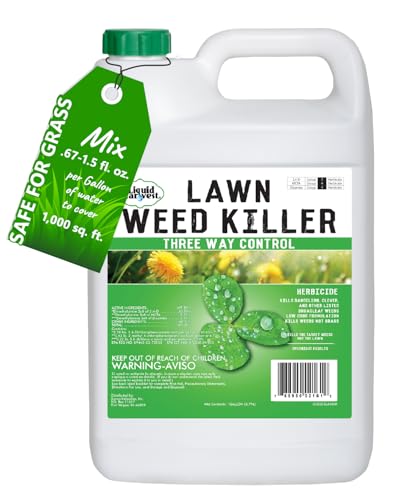
Liquid Harvest stands out for its low-odor formulation, a meaningful improvement for homeowners who find traditional 2,4-D concentrates overpowering during application. The three-way active blend combines 30.89% 2,4-D with MCPA (8.23%) and Dicamba (2.77%), delivering a balanced spectrum of control against dandelion, clover, crabgrass, and most common broadleaf weeds. Owner reports show visible whitening and die-back on dandelions within 4 days, with the surrounding lawn remaining healthy and green.
The gallon size is a strong value proposition for owners of large lots — mixing at the standard rate of 1.5 fluid ounces per gallon of water covers roughly 85,000 square feet per bottle. This means a single purchase can last multiple seasons for most residential properties. The low odor makes it tolerable for use around homes where neighbors are close and wind drift could carry chemical smells into adjacent yards.
Some users noted temporary yellowing of grass blades after application, especially when applied during warmer temperatures or on stressed turf. The yellowing resolved within a week in most cases, but it’s a sign to avoid application during heat waves or drought conditions. The bottle lacks a built-in measuring system, so a separate measuring cup or graduated sprayer tank is necessary for accurate mixing.
What works
- Significantly lower odor than standard 2,4-D concentrates
- Excellent coverage per gallon — ideal for large properties
- Visible results on dandelion and clover within 4 days
What doesn’t
- May cause temporary grass yellowing if applied during heat stress
- No built-in measuring system — requires separate measuring tools
4. ALLIGARE 2,4-D Amine Weed Killer
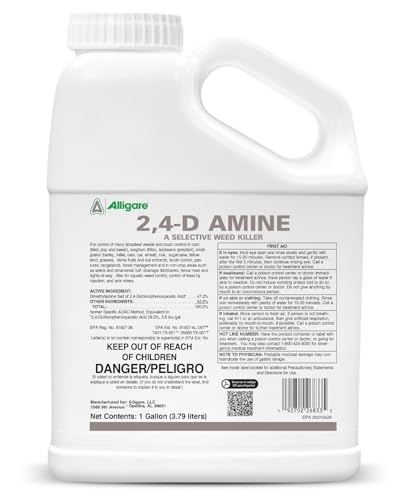
ALLIGARE’s 2,4-D Amine concentrate hits a high 47.2% active ingredient concentration, making it one of the most potent straight 2,4-D formulations available without a commercial license. The gallon size and farm-grade strength make it a logical choice for pasture management, fence rows, drainage ditches, and large-acreage turf. Owner reports confirm effective knockdown of pigweed, thistle, ragweed, and common broadleaf weeds within a few days when mixed at label rates.
The product is labeled for use on lawns, pastures, croplands, forests, and aquatic sites, offering versatility that single-use concentrates cannot match. Bermudagrass owners specifically report excellent results with no turf damage when using a water-soluble dye to track spray coverage. The concentrate mixes easily with water, and a few ounces per gallon treat significant square footage — a single gallon can last several seasons for most residential users.
The major limitation is availability — the product cannot be shipped to Texas, and some other states have restrictions due to local 2,4-D regulations. Since this is straight 2,4-D without Dicamba or Triclopyr, it may require multiple applications on stubborn perennials like wild violet or ground ivy. Owners also caution that precise measuring is critical to avoid grass burn, especially on sensitive warm-season turf types.
What works
- Highest active concentration at 47.2% for maximum potency per ounce
- Versatile labeling for lawns, pastures, and aquatic sites
- Large gallon size provides exceptional value per application
What doesn’t
- Not available for shipment to Texas and some other states
- Straight 2,4-D requires multiple apps on tough perennials
5. Southern Ag Lawn Weed Killer with Trimec

Southern Ag’s Trimec formulation is a patented three-way blend of 2,4-D, Mecoprop, and Dicamba, proven effective over decades of residential and commercial use. Owner reports consistently highlight its performance on clover, thistle, dandelion, wild strawberries, creeping Charlie, and burweed — with visible wilting occurring within 2 days and full yellowing within 1.5 weeks. At the labeled rate of 1 to 2 tablespoons per gallon of water (covering 200 square feet per gallon of mix, depending on grass type), a single gallon of concentrate stretches across roughly 0.6 to 1.2 acres per application.
The one-gallon bottle provides massive coverage for the investment, making it one of the most cost-efficient options for owners with acreage. It is labeled for use on 9 different turf types including Bermuda, Zoysia, Centipede, and St. Augustine, though centipede grass owners note some temporary weakening after application. The concentrated formula mixes easily in both conventional tank sprayers and hose-end sprayers, with a recommended rate of 2 tablespoons per gallon of water for spot treatment.
Lespedeza and certain hard-to-kill legumes may require multiple applications spaced 3 weeks apart for full control, as noted by several owners. The product lacks a surfactant, so adding a non-ionic surfactant improves adhesion on waxy-leaved weeds like thistle. Some users mention the packaging could be more durable — the gallon jug can arrive with minor dents or cap leaks if improperly handled during shipping.
What works
- Excellent cost per square foot for large properties and acreage
- Proven Trimec blend effective on clover, thistle, and creeping Charlie
- Compatible with 9 turf types and both sprayer types
What doesn’t
- Hardy legumes like lespedeza need multiple follow-up applications
- No surfactant included — requires separate purchase for waxy weeds
6. BioAdvanced Weed Killer for Lawns

BioAdvanced positions itself as an accessible entry point for homeowners who want a simple, effective solution without measuring concentrates. The 32-ounce bottle uses a dial-style sprayer that attaches directly to a garden hose, eliminating the need for a separate tank sprayer. The formula contains 2,4-D (7.59%), Mecoprop-P (1.83%), and Dicamba (0.84%) — all formulated as dimethylamine salts — covering over 200 broadleaf weeds including clover, dandelion, dollar weed, and poison ivy.
Owners report noticeable improvements after a single application, with one bottle covering up to 16,000 square feet. The product is labeled for both southern and northern lawns, though users note it can temporarily brown Bermuda grass if over-applied. The ready-to-spray design is especially convenient for smaller properties or spot treatments where speed matters more than raw concentrate value.
The biggest complaint involves the hose-end sprayer mechanism — several users report difficulty with the “press the tab” activation, requiring two-handed effort to get the spray flowing. A few owners with heavy nutgrass or dollar weed infestations found the results underwhelming compared to higher-concentration concentrates, requiring multiple applications spaced weeks apart. The 32-ounce volume is less economical per square foot than gallon-sized options for large properties.
What works
- Hose-end sprayer eliminates need for separate tank or measuring
- Kills over 200 listed weed types including tough dollar weed
- Good for quick spot treatments on small to mid-size lawns
What doesn’t
- Hose-end activation mechanism can be difficult to operate
- Less effective on heavy nutgrass than multi-active concentrates
7. Hi-Yield 2,4-D Selective Weed Killer
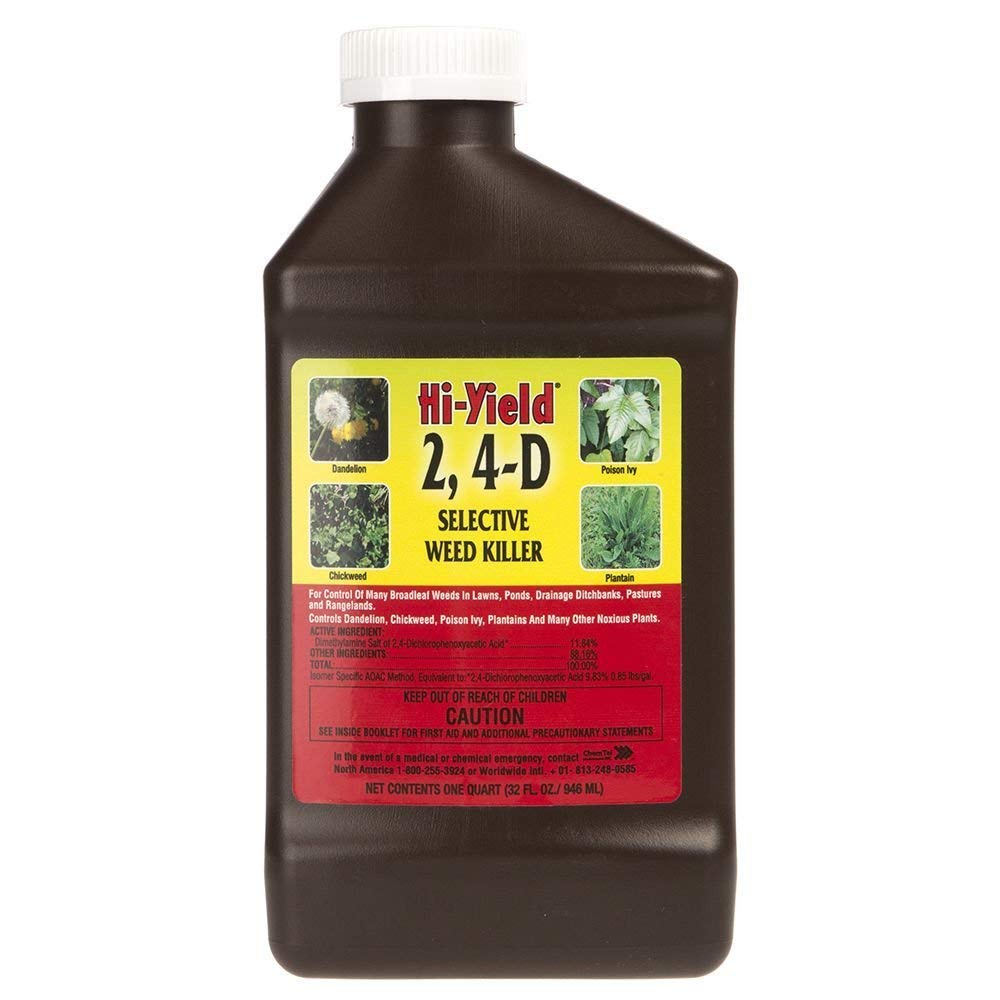
Hi-Yield’s 2,4-D Selective Weed Killer is a straightforward, single-active-ingredient concentrate that does one thing well: kill common broadleaf weeds without damaging lawn grass. The 32-ounce bottle is labeled for use on lawns, ponds, drainage ditches, pastures, and rangelands, making it a versatile backup for properties with mixed terrain. Owner reviews consistently rate it as effective for the price, though tougher weeds like Virginia buttonweed may require a second application.
The simple formulation makes it a safe choice for homeowners new to chemical weed control — there are fewer active ingredients to worry about overdosing, and the mixing instructions are straightforward. For basic dandelion, clover, and chickweed infestations, a single application shows clear results within a week. The 32-ounce size is easy to store and handle compared to gallon jugs, and the low cost makes it a low-risk trial product.
The limitation is that straight 2,4-D struggles against perennial weeds with extensive root systems, including ground ivy, wild violet, and established thistle. Multiple applications spaced 2 to 3 weeks apart are often necessary, and some owners report needing three or four passes before stubborn weeds fully disappear. The lack of Dicamba or Triclopyr means the weed control spectrum is narrower than multi-active competitors.
What works
- Extremely affordable entry point for basic broadleaf control
- Versatile labeling for lawns, pastures, and aquatic areas
- Simple mixing with low risk of grass injury on most turf types
What doesn’t
- Straight 2,4-D requires multiple applications on tough perennials
- Narrow weed control spectrum compared to multi-active blends
Hardware & Specs Guide
Active Ingredient Percentage
The concentration of 2,4-D in the bottle dictates how much product you need to mix per gallon of water. Standard amine formulations range from roughly 30% to 47% active ingredient. Higher percentages mean fewer ounces per gallon of water, which stretches the bottle further. Products listing “dimethylamine salt” as the carrier are standard amine formulations that mix readily with water and are safe on most cool-season turf when label rates are followed.
Surfactant Compatibility
Most 2,4-D concentrates perform better when mixed with a non-ionic surfactant at 0.25% to 0.5% of the spray volume. Surfactants reduce water surface tension, allowing herbicide droplets to spread evenly across waxy weed leaves instead of beading and rolling off. This is especially important for weeds like thistle, ground ivy, and wild violet, which have thick cuticles that resist liquid penetration. Some premium formulas include built-in surfactants; budget options typically do not.
Rainfast Window
The rainfast period — the time required after spraying before rain will not wash the chemical off — varies significantly between formulations. Standard amine formulations typically require 6 to 8 hours of dry weather. Ester-based formulations and products containing Carfentrazone can be rainfast in as little as 3 hours. Applying before a forecasted rain event wastes product and can cause chemical runoff into unintended areas.
Application Temperature Range
2,4-D efficacy drops sharply when applied below 50°F or above 85°F. Cool temperatures slow herbicide absorption into weed tissue, while high heat combined with bright sun increases the risk of “vapor drift” — where the chemical evaporates and moves off-target. Early morning applications when temperatures are between 55°F and 75°F, winds are below 10 mph, and no rain is forecast for 24 hours produce the most reliable results.
FAQ
How long does 2,4-D take to kill weeds visibly?
Can I reseed after applying 2,4-D to my lawn?
Why does my grass turn yellow after using 2,4-D?
Is straight 2,4-D better than a three-way or four-way blend?
Final Thoughts: The Verdict
For most gardeners, the 2 4 d weed killer winner is the Select Source Triad TZ because its four-active-ingredient formula delivers the widest weed control spectrum while remaining safe on cool-season turf when mixed correctly. If you want SpeedZone EW for fast visible results within hours and minimal rain delay. And for large properties where cost per square foot matters most, the Southern Ag Trimec or Liquid Harvest gallon jugs provide the best coverage for the investment.