
A tree stump left in the ground is a stubborn tripping hazard, a lawnmower-wrecking obstacle, and an open invitation for termites and fungus. Every passing season it refuses to rot, you are stuck looking at a woody eyesore that steals yard space and keeps sprouting shoots from the root system. Getting rid of it by physical removal usually means renting a heavy grinder or paying for professional excavation. The alternative is a chemical approach that accelerates decomposition and kills the root system for good.
I’m Rikta — the co-founder and writer behind Lawn Gear Lab. I spend my time digging through label data, comparing active ingredient concentrations, and cross-referencing hundreds of verified owner reports to find which formulations actually deliver the knockout punch to woody root systems without wasting your afternoon.
Whether you’re clearing fence lines, reclaiming a garden bed, or just tired of stepping around the same dead hulk, the intelligence you need is right here in this guide to the best tree stump killer for every kind of stubborn wood and persistent brush.
How To Choose The Best Tree Stump Killer
Picking the right chemical stump remover is not complicated, but choosing the wrong type will leave you with a half-dead stump that keeps sprouting. The decision boils down to whether you want a fast systemic kill on green wood or an accelerated rot on seasoned dry stumps. Your timeline and tolerance for follow-up work matter just as much as the brand on the label.
Active Ingredient: Systemic Herbicide vs. Accelerator
Systemic herbicides like triclopyr and glyphosate are the workhorses for live stumps. You apply them to the freshly cut cambium layer — the ring of inner bark — and they travel down into the roots. This stops resprouting in weeks. Potassium nitrate, by contrast, does not kill tissue. It feeds wood-decaying fungi and bacteria, speeding natural rot over months. Use systemic killers for green, recently felled trees. Use the nitrate accelerators for dry stumps you don’t mind waiting on.
Application Method: Ready-to-Use vs. Concentrate vs. Powder
Ready-to-use squirt bottles are the easiest starting point for small properties. Concentrates require mixing and sprayer equipment but give you far more coverage per dollar. Powders, typically potassium nitrate, get poured into drilled holes drilled into the stump top. The right choice depends on the scale of your project and how comfortable you are handling and measuring chemicals.
Coverage and Residual Control
Every product label specifies the number of stumps a single container treats. A 32-ounce ready-to-use bottle usually covers 50 to 100 small-to-medium stumps if you apply sparingly to the cambium ring. Concentrates stretch further. Premium formulas often include a surfactant or a marker dye, which helps you track coverage and reduces waste. Some formulations also provide residual soil action that prevents nearby seeds of the same species from sprouting.
Quick Comparison
On smaller screens, swipe sideways to see the full table.
| Model | Category | Best For | Key Spec | Amazon |
|---|---|---|---|---|
| ALLIGARE Triumph RTU | Ready-to-Use Liquid | Cut-stump prevention on live trees | 32 fl oz, blue dye included | Amazon |
| Bonide Vine & Stump Killer | Concentrate Liquid | Invasive vines and woody brush | 16 fl oz total (2 x 8 oz) | Amazon |
| Dow AgroSciences Tordon RTU | Ready-to-Use Liquid | Fence rows and roadsides | 32 fl oz, ~100 stumps per bottle | Amazon |
| Outlaw X Potassium Nitrate | Powder Accelerator | Accelerating rot on dry stumps | 5 lbs, 99%+ purity | Amazon |
| Hi-Yield Killzall 365 | Liquid Concentrate | Large area bare-ground control | 32 fl oz, treats 4,300 sq ft | Amazon |
| Ecoxall Potassium Nitrate Pellets | Pellet Accelerator | Fertilizer and stump rot combo | 5 lbs, 99% pure prilled | Amazon |
| Omni Depot Stump Stop | Ready-to-Use Liquid | Livestock-safe pasture stumps | 32 fl oz, includes gloves | Amazon |
In‑Depth Reviews
1. ALLIGARE Triumph RTU Herbicide
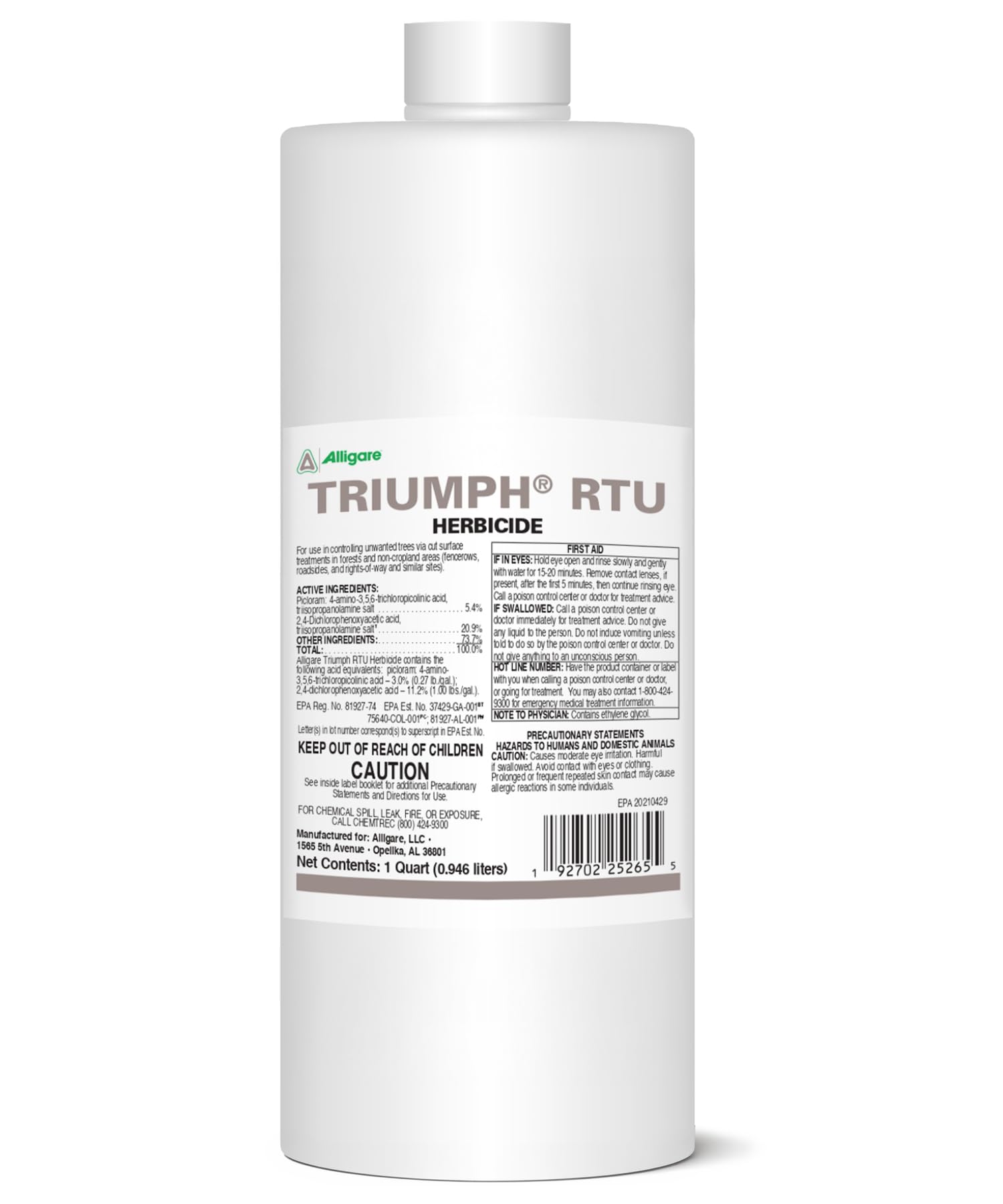
ALLIGARE Triumph RTU positions itself as a direct alternative to Tordon RTU, and the formula matches up well on paper. The dual active ingredients target woody plants through the cambium and translocate into the root system to prevent resprouting. The built-in blue dye is a genuine workflow upgrade — you see exactly where the liquid goes, which prevents skipping the critical cambium ring on the cut surface.
At 32 ounces in a ready-to-use squirt bottle, the coverage is generous for a small-to-medium property. Verified owners report that stumps treated in early spring disintegrate within twelve months, and the lack of seasonal restrictions means you can apply it any month of the year. The product holds up well on aggressive species like honeysuckle and blackberry thickets along fence lines.
The single downside from user reports is shipping reliability. Several buyers note that the cap arrived loose or the seal was compromised during transit, which is a legitimate concern given the chemical nature. If the packaging holds, this is the most balanced overall performer for the price.
What works
- Blue dye provides visual confirmation of coverage on the cambium layer
- No seasonal restrictions — apply year-round on live stumps
- Ready-to-use format eliminates mixing errors
What doesn’t
- Cap and seal occasionally loosen during shipping, risking leaks
- Not formulated for accelerating rot on dry/dead stumps
2. Dow AgroSciences Tordon RTU

Dow AgroSciences Tordon RTU is the benchmark that other cut-stump herbicides are measured against. The triclopyr-based formula provides permanent root kill on species notorious for resprouting, including Bradford pear, crepe myrtle, and Japanese elm. A single 32-ounce bottle handles roughly 50 to 100 stumps depending on diameter, making it a reasonable buy for moderate-scale fence row and roadside work.
Owner feedback consistently highlights that stumps show no regrowth after treatment, even on invasive species that laugh off weaker chemicals. The liquid penetrates quickly into the exposed wood, and the product is labeled for non-crop areas such as fence rows, roadsides, and rights-of-way. It also works on cuts made in live tree trunks when you are trying to kill a standing unwanted tree without felling it first.
On the downside, the fumes are noticeable during application, so a respirator or at least avoiding direct inhalation is wise. It also lacks a marker dye, so you have to track your application carefully to avoid missing a section of the cambium ring. Despite those caveats, the kill rate is as close to guaranteed as this category gets.
What works
- Proven triclopyr formula stops resprouting on aggressive woody species
- Excellent residual control prevents nearby seeds from sprouting
- Fast absorption into cut surfaces — no waiting around
What doesn’t
- Strong fumes require caution during application
- No built-in dye, so coverage tracking is manual
3. Omni Depot Stump Stop

Stump Stop from Omni Depot bundles a ready-to-use triclopyr-based formula with a pair of gloves, which signals the manufacturer’s commitment to safe handling. The herbicide is labeled for use in pastures with grazing livestock, forest lands, and fence rows. Verified owners have successfully used it to kill honeysuckle, wisteria, blackberries, and multiple tree species including maple, oak, and cedar by painting the cut stump surface.
Reports from five-acre brush-clearing projects indicate that a single 32-ounce bottle has enough volume to handle dozens of medium stumps when applied sparingly to the cambium ring. The product begins showing visible wilting on foliage within two to three days of application to connected root systems. The ability to use it around livestock without grazing withdrawal times is a meaningful advantage for rural property owners.
The main caution is drift. Because the liquid is thin, even a light breeze during spray application can carry droplets onto desirable plants. Several users reported losing raspberry bushes and ornamentals from unintended contact. Using the included gloves and a paintbrush for stump application rather than a sprayer eliminates this risk entirely.
What works
- Safe for use in grazed pastures with no livestock withdrawal required
- Includes a pair of gloves for application safety
- Fast wilting visible in days on connected root systems
What doesn’t
- Thin liquid drifts easily in wind when sprayed
- Premium pricing per ounce compared to concentrates
4. Hi-Yield Killzall 365

Hi-Yield Killzall 365 is a liquid concentrate designed for broad vegetation control on non-crop surfaces. The label specifies a mix ratio of 6 ounces per gallon of water for spot spraying brush and vines, and 7.4 ounces per 1 to 10 gallons for bare-ground total vegetation control. A single 32-ounce bottle covers up to 4,300 square feet at the spot-spray rate, which makes it a volume-efficient choice for larger properties.
Owner reports confirm that the formula is rainfast once dried, meaning a shower the next day does not wash away the active ingredient. The glyphosate-based chemistry works well on broadleaf weeds, grasses, and woody brush, though some stubborn species require a second pass. Users switching from retail brands like Ortho note significant cost savings per gallon of mixed spray.
The main functional limitation is that this product is not specifically formulated for cut-stump application — it works best as a foliar spray on actively growing vegetation. For stump kill, you need to apply it immediately after cutting and ensure the freshly exposed cambium absorbs it before drying. It also does not contain a surfactant, so adding a few drops of dish soap improves adhesion on waxy brush leaves.
What works
- Excellent value per square foot of coverage as a concentrate
- Rainfast after drying — holds up in wet climates
- Works on grasses, broadleaf weeds, and woody brush
What doesn’t
- No surfactant included for waxy leaf adhesion
- Requires timely application to fresh cut stumps for best results
5. Bonide Vine & Stump Killer Concentrate
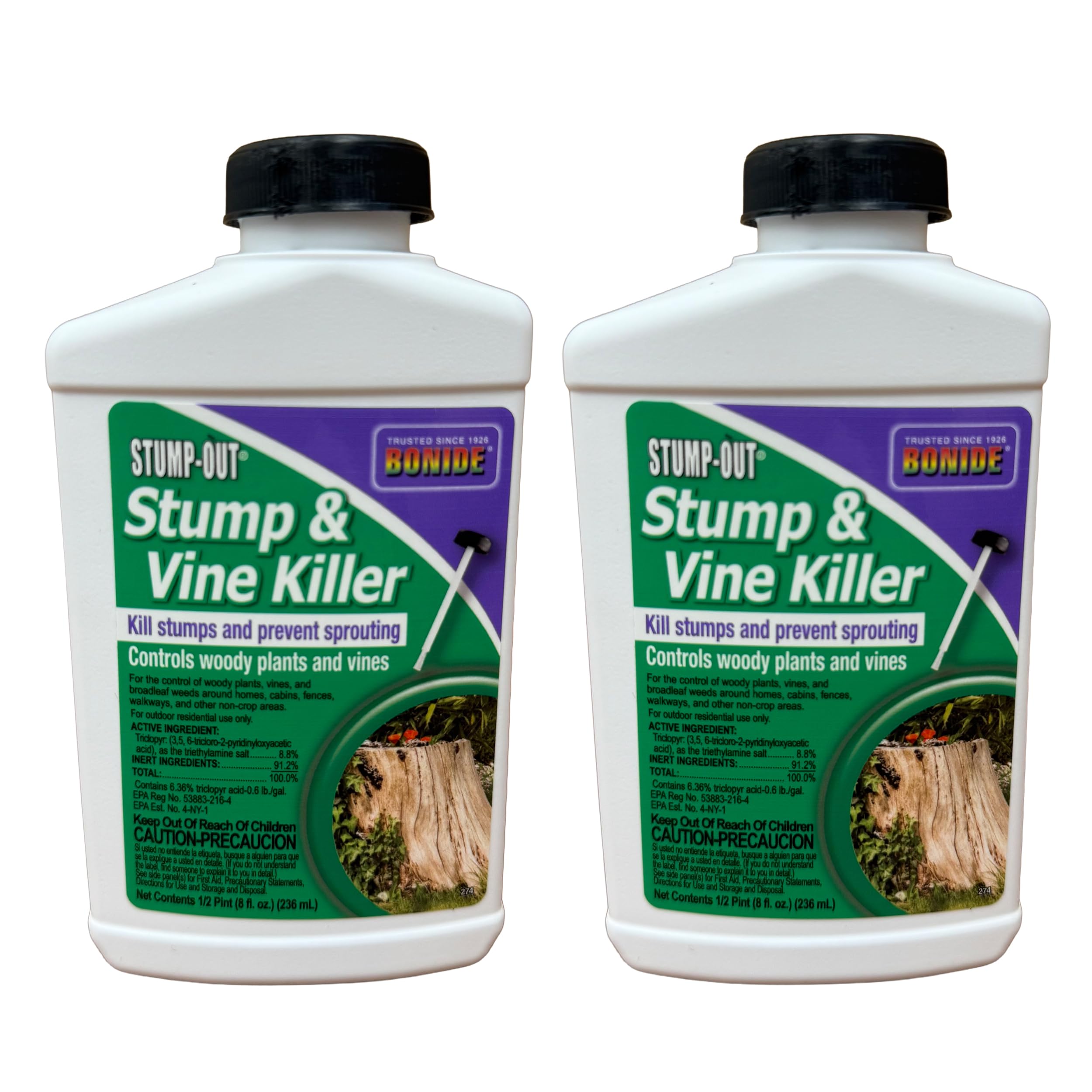
Bonide’s concentrate uses sodium metabisulfite as the active ingredient — a different chemistry than the triclopyr or glyphosate options. This product works by rapidly dehydrating plant tissue, making it particularly effective on aggressive climbing vines that wrap around desirable trees. The two-pack format gives you two 8-ounce bottles, which is enough for dozens of spot treatments on cut brush and stumps.
Verified users have employed it on tough species like blackberry and raspberry bushes by snipping the stem, painting the cut, and waiting a few weeks for the plant to yellow and die at the root. The same approach works on tree stumps, though the mechanism is dehydration rather than systemic translocation. Because the active ingredient is a salt compound, it is less persistent in soil than triclopyr, which some users prefer for areas near vegetable gardens.
The most frequent complaint from buyers is packaging integrity. Multiple reports describe bottles arriving with leaking caps even though they were bagged. The small bottle size also feels expensive compared to larger concentrates. If the product arrives intact, however, the performance on stubborn vines is impressive for such a small volume.
What works
- Dehydrating chemistry works exceptionally well on climbing vines
- Less soil persistence than triclopyr — safer near garden beds
- Small volume is easy to store and use for targeted spot treatments
What doesn’t
- Bottles frequently leak during shipping
- Higher cost per ounce compared to larger concentrate formats
6. Outlaw X Potassium Nitrate Powder
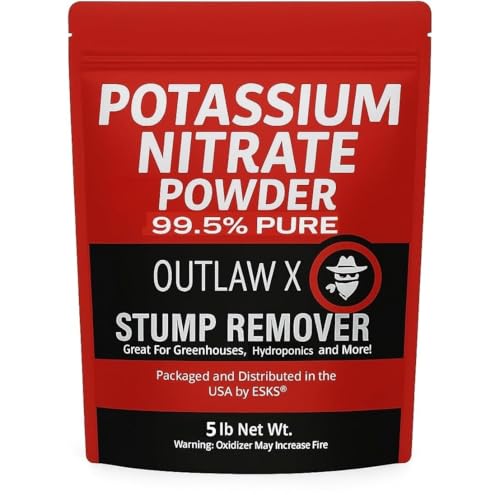
Outlaw X delivers five pounds of high-purity potassium nitrate powder that serves a dual purpose: it accelerates stump decomposition when poured into drilled holes, and it doubles as a nitrogen-potassium fertilizer for lawns and hydroponic setups. The water-soluble powder dissolves completely, which is important for both stump treatment and fertigation applications.
Owner feedback reveals a creative range of uses beyond stump removal. Several buyers use it as a lawn fertilizer to green up grass, and one reported mixing it with sugar for a smoke bomb to control gophers. The large 5-pound bag provides far more product than a typical stump removal project requires, so the leftover material has genuine secondary utility around the yard.
The trade-off is that potassium nitrate does not kill live stumps. It merely speeds up natural wood decay by feeding decomposer organisms. If you apply it to a living stump without first killing the root system, you will still get resprouts while the wood slowly rots. You must pair this with a systemic herbicide or mechanically sever the stump from the roots for best results.
What works
- Generous 5-pound bag provides months of supply for multiple uses
- Dissolves completely in water for easy application in drilled holes
- Works as a fertilizer for lawns and hydroponics when not used on stumps
What doesn’t
- Does not kill living stumps — only accelerates rot on dead wood
- Slower results than systemic herbicides; requires months for full decomposition
7. Ecoxall Potassium Nitrate Pellets
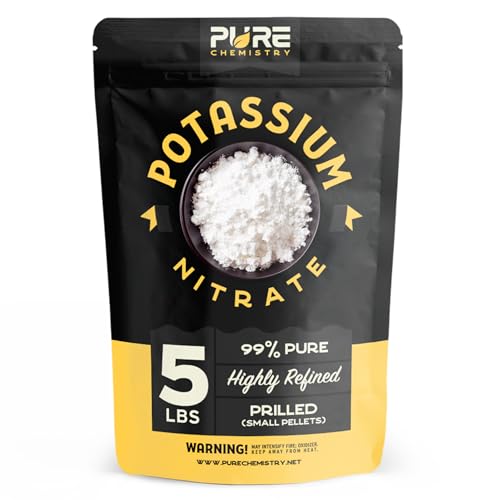
Ecoxall packages its potassium nitrate in a prilled pellet form rather than a fine powder. The small uniform pellets provide controlled distribution when poured into drilled stump holes, reducing dust and making application cleaner. The 99% purity rating matches the Outlaw X product, and the multi-industry-grade designation means this is the same material used in glass manufacturing and food preservation.
Verified users report success using it as a stump remover by drilling deep holes into the stump top, filling them with pellets, and adding water to activate the decomposition process. Several buyers also use it as a root stimulator for indoor plants and as a booster for compost piles in sandy coastal soil. The pellets dissolve more slowly than powder, which can extend the active period in stump holes over several rain cycles.
The downside mirrors the Outlaw X product: potassium nitrate does not kill living tissue. On a green stump, you need to first kill the root system with a systemic herbicide or physically cut all root connections before the pellets can start breaking down the wood. Users expecting a fast kill will be disappointed by the slow, months-long timeline.
What works
- Prilled format minimizes airborne dust during application
- 99% purity suitable for food-grade and industrial uses
- Slow-release pellets extend decomposition activity through multiple rain cycles
What doesn’t
- Requires live stump to be killed first before pellets take effect
- Decomposition timeline is measured in months, not weeks
Hardware & Specs Guide
Active Ingredient: Triclopyr vs. Glyphosate vs. Potassium Nitrate
Triclopyr is the gold standard for cut-stump treatments on woody brush and trees. It translocates through the cambium into the root system and stops resprouting fast. Glyphosate is broad-spectrum but works best on green foliage, so it is better for foliar spray on brush rather than direct stump painting. Potassium nitrate does not kill — it feeds wood-decay microbes and is only appropriate for dry, already-dead stumps when your only goal is to speed up natural rotting.
Coverage Rate and Concentration
The most important number on the label is the unit count and the recommended dilution rate. A 32-ounce ready-to-use bottle typically covers 50 to 100 stumps. Concentrates extend that dramatically — a 32-ounce concentrate bottle can produce multiple gallons of mixed spray. Potassium nitrate powders in 5-pound bags handle multiple large stumps or can be used across the lawn as fertilizer. Always match the product size to your project scale to avoid waste.
FAQ
Can I use a tree stump killer on a stump that has been sitting for years?
How long does it take for a stump killer to fully break down the wood?
Final Thoughts: The Verdict
For most gardeners, the best tree stump killer winner is the ALLIGARE Triumph RTU because the triclopyr formula, built-in blue dye, and year-round application window make cut-stump treatment nearly foolproof. If you want the no-regrowth industry standard trusted by professionals, grab the Dow AgroSciences Tordon RTU. And for a dual-purpose product that fertilizes your lawn while slowly eroding a dead stump, nothing beats the Outlaw X Potassium Nitrate powder.