
Nothing sinks a tomato season faster than leggy, pale seedlings that stretch for light on a cloudy windowsill. The difference between a bushel of sweet, sun-warmed fruit and a stringy, underperforming plant often comes down to the quality of artificial light you provide in those first critical weeks — and that means choosing a fixture that delivers the right wavelength intensity and coverage for a nightshade crop that demands more energy than your average basil or succulent.
I’m Rikta — the co-founder and writer behind Lawn Gear Lab. Over the past weeks I’ve pored over spectral output charts, compared PPFD maps, and cross-referenced thousands of verified owner experiences to determine which fixtures actually move the needle for Solanum lycopersicum growers working in tents, on shelves, or in greenhouse starter trays.
Whether you are hardening off a single determinate variety or managing a multi-shelf nursery operation, this guide breaks down the real performance metrics that separate a productive harvest from a disappointing one, so you can find the best grow lights for tomatoes without wasting money on fixtures that the industry overrates.
How To Choose The Best Grow Lights For Tomatoes
Tomatoes are heavy feeders of light energy — a fruiting vine requires a daily light integral (DLI) considerably higher than leafy greens or herbs. Choosing a fixture without understanding spectrum, coverage, and thermal output is the fastest way to waste money on a light that will produce thin stems instead of thick trusses.
Spectrum and Color Temperature
Full-spectrum white lights (3000K–5000K blend with 660nm deep red) deliver the balanced energy tomatoes need from seedling stretch suppression to fruit ripening. Pure red/blue blurple panels make it impossible to spot pest damage or nutrient deficiencies, and they often lack the far-red photons that drive the shade-avoidance response in indeterminate varieties.
Coverage Area and PPFD Uniformity
A single tomato plant in a 5-gallon pot needs a roughly 2×2 ft footprint of 400–600 µmol/m²/s to fruit well. Fixtures with lens optics or dense center layouts (like the VIPARSPECTRA XS1500 Pro) spread photons evenly from edge to edge, while cheap reflector designs create a hot spot directly below and dark corners where lower trusses fail to set fruit.
Dimmability and Heat Management
Seedlings require around 200–300 µmol/m²/s; flowering tomatoes can handle 600+. A dimmable driver lets you adjust intensity without raising or lowering the fixture. Passive heat sinks (fanless) are silent and last longer than units with fans that can fail mid-season, so consider ambient tent temperature when deciding between the GroCruiser (fans) and the FARMLITE (fanless bars).
Quick Comparison
On smaller screens, swipe sideways to see the full table.
| Model | Category | Best For | Key Spec | Amazon |
|---|---|---|---|---|
| VIPARSPECTRA XS1500 Pro | Panel | Single-plant fruiting in 2×2 | Optical lens for uniform PPFD | Amazon |
| MARS HYDRO SP3000 | Bar | Max yield in 2×4 tent | WiFi control + 727 PPF | Amazon |
| FARMLITE 260W Bar | Bar | Quiet, large-coverage greenhouse | IP65 waterproof + fanless | Amazon |
| VIVOSUN LumaLight 200W | Panel | Smart-app automation in 3×3 | 4-level dimming + IP65 | Amazon |
| MARS HYDRO TS1000 | Panel | Budget entry for 2×2 veg | Patented reflector + 150W | Amazon |
| GroCruiser 2000W | Panel | Budget coverage for seedlings | Dual fan + 1176 LEDs | Amazon |
| SANSI 4-Gooseneck Clip | Clip | Small shelf or desk seedlings | Replaceable bulb + 4000LM | Amazon |
In‑Depth Reviews
1. VIPARSPECTRA XS1500 Pro

The XS1500 Pro is the goldilocks fixture for a single determinate or compact indeterminate tomato in a 2×2 ft tent. Its optical lens design delivers one of the most uniform PPFD footprints in this price tier — verified owner reports show 747 µmol/m²/s at 50% intensity and 13-inch hang height, which is exactly the range where tomato fruit set thrives without tip burn. The 660nm deep red and 730nm far-red channels push photomorphogenic responses that encourage branching and flower cluster initiation.
At 150W actual draw, this light runs cool enough on an aluminum heatsink that you can keep canopy distance at 12–14 inches during flower without heat stress. The dimmer cable allows smooth 0–100% scaling, and daisy-chaining up to 20 units makes it scalable for a multi-tent setup without buying extra controllers. It lacks a physical off switch on the driver, which means you must use a wall timer or smart plug to cut power completely.
Owners growing super-hot peppers and beets alongside their tomatoes confirm that the even edge lighting eliminates the weak side-bud development common with reflector-based panels. The 6-pound weight requires sturdy support, but the included stainless steel hooks and ratchet hangers hold the unit securely at any angle. For a single-fruit grower who wants pro-level uniformity without pro-level complexity, this is the logical choice.
What works
- Exceptionally even PPFD across the 2×2 footprint
- Adjustable intensity dial for seed-to-harvest scaling
- Strong canopy penetration with optical lenses
What doesn’t
- No on/off switch — must rely on external timer
- Heavy at 6 lbs for some wire-shelf rigs
2. MARS HYDRO SP3000
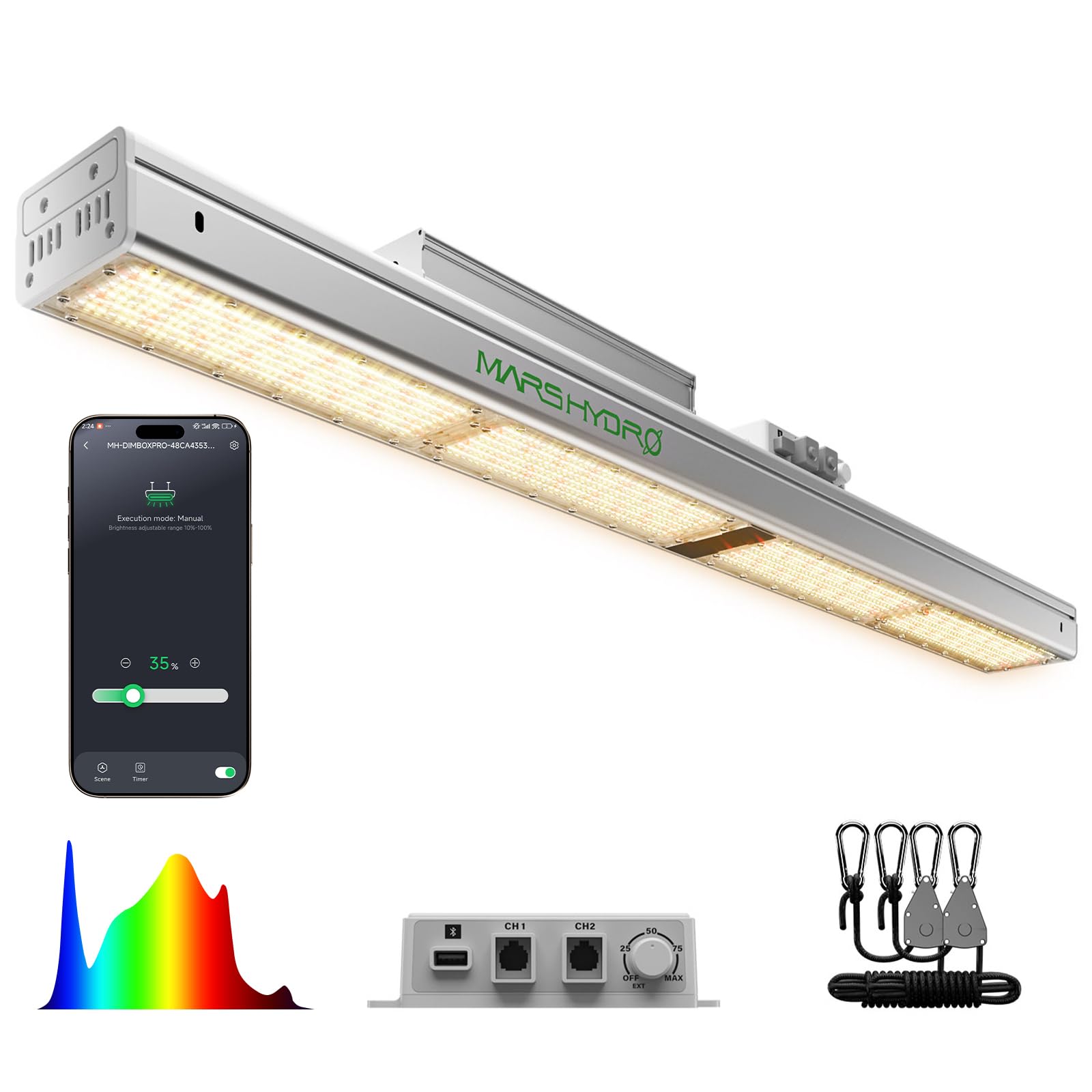
The SP3000 is the bar-style workhorse for a 2×4 ft tent that needs to push multiple indeterminates to full production. With a 727 µmol/s PPF and 2.8 µmol/J efficiency, it beats many older 600W HPS fixtures on electrical cost while running cool enough to keep ambient temps under control. The 3000K/5000K/660nm combo provides the blue light for stocky seedlings and the red spike that drives sugar accumulation into fruit — critical for flavor development in beefsteak and Roma varieties.
WiFi control via the optional Iconconnect USB hub unlocks sunrise/sunset ramping and up to five timed auto-dimming schedules, which is convenient for mimicking outdoor photoperiod shifts. The aluminum heatsink and waterproof sealing make it safe for the high-humidity environment that mature tomato canopies create, and the 50,000-hour lifespan means this fixture will outlast a dozen consecutive growing seasons. The small oval hanging openings received criticism for being fiddly, and the lack of an included dimmer knob on some units has frustrated buyers who had to request one separately.
Owners report that daisy-chaining three units in a 5×5 ft tent produced PAR distribution superior to a single large square panel, with no center hot spot and consistent performance at the edges. The 9.9-pound weight and 42.8-inch length demand solid tent crossbars, but once mounted the even spread eliminates the need to rotate plants. For the high-yield indoor tomato grower who values automated spectrum control and long fixture life, this is the serious upgrade.
What works
- WiFi scheduling for hands-off photoperiod control
- Excellent PPF efficiency at 2.8 µmol/J
- Waterproof build handles humid canopy conditions
What doesn’t
- Hanging hardware uses small oval openings
- Dimmer knob not included in the box
3. FARMLITE 260W Bar

The FARMLITE 260W bar is designed for growers who prioritize dead-silent operation and broad-coverage efficiency in a greenhouse or open room. With no fan, heat dissipation relies entirely on lightweight aluminum bars that stay cool even after 18-hour daily runs — owners running autoflowers report tent temperatures of 73°F with a 68°F basement ambient, which is exceptional thermal performance for a 240W actual draw. The 26000 lumen output at 260W peak gives you the raw photon density needed to support fruiting tomato plants up to 9 feet tall.
Master/slave daisy-chaining allows you to control over 100 units from a single dimmer, making this a legitimate option for a multi-shelf propagation setup or a small commercial greenhouse. The IP65 rating means splashes from overhead watering or high humidity during the flowering stretch won’t compromise the diodes or driver. Some units arrived with compatibility issues that prevented daisy-chaining despite the advertised capability, and the 3-meter power cord is shorter than ideal for tall tents, but customer service resolved most concerns promptly.
Tomato growers specifically praise the wide reach of the bar layout — one owner reported healthy cherry tomato production even from plants placed at the outer edges of the coverage area, where narrow panels would have left them in shadow. The slightly higher retail price compared to equivalently wattage panels is offset by the build quality and the lack of fan noise, which matters if the light is in a living space or bedroom grow area.
What works
- Completely silent fanless operation
- IP65 waterproof for humid environments
- Master/slave dimming for large-scale setups
What doesn’t
- Daisy-chain function inconsistent on some units
- Power cord could be longer for tall tents
4. VIVOSUN LumaLight 200W
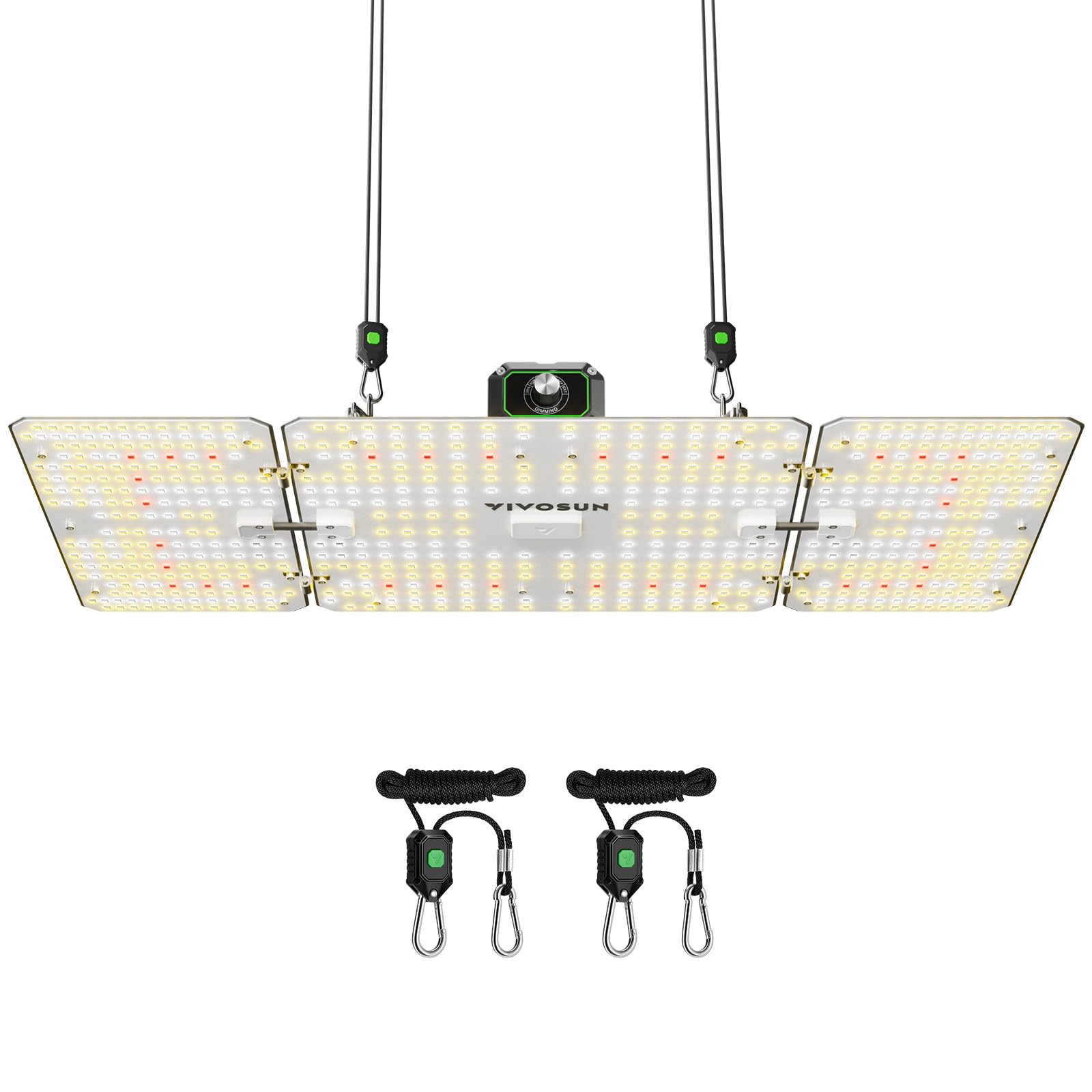
The VIVOSUN LumaLight 200W targets the grower who wants app-enabled control without jumping to the + tier. When paired with the Vivosun GrowHub (sold separately), you can set automated dimming schedules, monitor temperature and humidity, and switch between pre-programmed seedling/veg/bloom modes from your phone. For tomato growers managing photoperiod-sensitive varieties, the ability to gradually ramp light intensity rather than switching on at full power reduces plant shock and promotes consistent internode spacing.
The 4-level manual dimmer (0%, 25%, 50%, 100%) gives you basic control even without the smart hub, and the IP65 waterproofing protects against condensation buildup common in densely planted 3×3 ft tents. With 660nm and 730nm plus 3000K/5000K white diodes, the spectrum closely mimics the VIPARSPECTRA’s, though the PPFD uniformity is slightly less even at extreme edges due to the panel form factor. The power connection to the external driver has been flagged as finicky — slight movement can cut light entirely, which is a reliability concern for a unattended week-long stretch.
Several owners note that 25% brightness was already too intense for tomato seedlings at the standard 24-inch hang height, causing leaf curl until they raised the light to the top of a 5-foot tent. This emphasizes that the LumaLight is best used with the dimmer actively dialed down during the early weeks. The 9-pound weight and 23.5-inch length make it a solid fit for a 3×3 tent with adequate crossbars, but it does add noticeable warmth — expect a 10°F rise inside a closed tent.
What works
- App-based scheduling with GrowHub optional kit
- Strong 660nm red for flower initiation
- IP65 rated for high-humidity environments
What doesn’t
- Power connector to driver feels fragile
- Generates noticeable heat inside enclosed tents
5. MARS HYDRO TS1000

The TS1000 is the entry-level quantum board that changed the game for budget-minded tomato growers. At 150W actual draw with a patented highly-reflective white hood, it increases light utilization by 25% over previous designs and produces a footprint that comfortably covers a 2.5×2.5 ft area. The 354 SMD LEDs are arranged densest in the center and sparse at the edges to compensate for the natural falloff, resulting in more uniform PAR than many budget boards from smaller brands.
A documented tomato grow using this light in a 3×3 tent yielded 9.6 ounces of dense, potent fruit from four plants — a strong return for a sub-premium investment. Owners report that branches on tomato plants rose noticeably overnight after switching from a generic blurple panel, a sign that the 660nm red spectrum is triggering proper photomorphogenic responses. The 0–100% dimming is controlled by a knob on the external driver, though some users experienced driver failures after 6–12 months of continuous use. MARS HYDRO’s warranty support has been responsive to replacements, but it’s a known single-point failure.
At 3.7 pounds, the TS1000 is light enough for wire shelving, and the inclusion of a timer and temperature/humidity sensor in the box adds value for first-time indoor growers. The heat output is higher than fanless panels — the driver and heatsink run warm to the touch — so adequate ventilation is necessary during summer growing cycles. For the grower who wants to test indoor tomato production without committing to a premium fixture, the TS1000 delivers reliable results at a low entry cost.
What works
- Proven yield gains over generic blurple panels
- Lightweight and easy to hang on shelves
- Includes timer and temp/humidity sensor
What doesn’t
- Driver failures reported after 6–12 months
- Heatsink runs warm; needs active airflow
6. GroCruiser 2000W (260W Actual)

The GroCruiser 2000W is a budget panel that makes sense for the tomato grower focused on seed starting and early vegetative growth rather than full-cycle flowering. With 1176 LEDs spanning 3000K, 4500K, 6000K, plus UV and IR diodes, the 380–780nm spectrum delivers a reasonable approximation of sunlight for stocky, healthy seedlings. The 260W actual draw at 15000 lumens is sufficient to cover a 2×4 ft tray for the first 4–6 weeks, at which point most growers will want more intensity for fruit set.
The dual silent cooling fans are the defining feature here — they keep the panel cool enough to touch even after 14-hour runs, which is rare at this price level. The dimmer knob controls both light output and fan speed simultaneously, so lowering brightness also reduces noise. A 4-tier mini greenhouse owner reported excellent results with tomato and pepper seedlings using the dimmer at 30% for the first two weeks, then 60% through transplant stage. Some units had fans that produced a noticeable whine at power levels above 25%, but the manufacturer replaced those quickly.
The main frustration is that the panel does not shut off completely without being unplugged — the LEDs stay dimly lit even with the dimmer at zero, which can confuse photoperiod-sensitive tomato starts. The daisy-chain cap is limited to two units, so scaling beyond a 3×3 tent is cumbersome. For the budget-conscious seed starter who will transplant outdoors or upgrade before flower, this is a functional tool.
What works
- Excellent heat management with dual cooling fans
- Broad spectrum for healthy seedling growth
- Dimmable from 0–100% with easy knob
What doesn’t
- LEDs do not fully shut off at zero dimmer level
- Fans can produce noise above 25% power
7. SANSI 4-Gooseneck Clip

The SANSI 4-Gooseneck Clip is a specialized tool for the grower who needs targeted supplemental light for a few tomato plants on a desk, wire shelf, or windowsill where space is at a premium. Each of the four heads contains a 10W PAR20 bulb that emits 380–800nm spectrum at 4000K color temperature, producing 4000 lumens total — enough to keep one determinate tomato in early veg or to start a six-pack of seedlings before final transplant. The lifetime free bulb replacement program is genuinely unique: if a bulb fails, SANSI sends a replacement at no cost, eliminating the need to bin the entire fixture.
The auto-timer offers 4/8/12-hour cycles based on a 24-hour reset, which simplifies the photoperiod for forgetful growers. However, the timer only works when power is supplied through the inline controller — if you unplug the unit, the timer resets and must be manually set again. The clip strength received mixed feedback: early reviews noted weak clips that slipped, while later production runs appear to have corrected this. The bulbs get hot enough to scorch tomato leaves if placed closer than four inches, so spacing must be managed carefully with young seedlings.
For the home grower raising a single patio tomato on a kitchen counter, this fixture provides adequate light intensity and the adjustability of four independent goosenecks. The E26 bulb base means you can swap in any standard PAR20 grow bulb if you want different color temperatures. But for anyone expecting to flower more than one tomato plant, the 40W total draw will fall short — this is a propagation and early-veg tool, not a fruiting rig.
What works
- Lifetime free bulb replacement from SANSI
- Four adjustable goosenecks for targeted coverage
- Decent 4000 lumen output for small shelves
What doesn’t
- Bulbs run hot; risk of leaf scorch below 4 inches
- Timer resets when unplugged
Hardware & Specs Guide
Daily Light Integral (DLI) Requirements
Tomatoes need a DLI of 20–30 mol/m²/day during vegetative growth and 30–45 mol/m²/day during fruiting. You can estimate your fixture’s capability by multiplying its PPFD (µmol/m²/s) by the number of daily light hours and dividing by 1,000,000. For example, a fixture delivering 500 µmol/m²/s for 16 hours provides a DLI of 28.8 mol/m²/day — adequate for strong fruit development.
Hanging Height and Canopy Distance
Keep LED panels 12–24 inches from the top of the tomato canopy depending on intensity. Higher intensity (600+ µmol/m²/s) at 12 inches requires dimming back for seedlings. Use a PAR meter or smartphone app to measure actual PPFD at canopy level rather than trusting manufacturer charts, which often overstate performance at the edges.
FAQ
Can I use a standard white LED bulb for tomato seedlings?
How many hours a day should my grow light run for tomatoes?
What is the ideal PPFD range for fruiting tomatoes indoors?
Final Thoughts: The Verdict
For most gardeners, the grow lights for tomatoes winner is the VIPARSPECTRA XS1500 Pro because its optical lens delivers the most uniform light spread per dollar for a single-plant tent. If you want automated WiFi control and the highest PPF for a 2×4 canopy, grab the MARS HYDRO SP3000. And for a budget entry into indoor tomato growing, nothing beats the reliable value of the MARS HYDRO TS1000.