
That sudden, searing sting from a disturbed fire ant mound turns a peaceful afternoon in the yard into a frantic retreat. These aggressive invaders don’t just hurt—they multiply rapidly, building hard-packed mounds that ruin the aesthetics of a manicured lawn and pose a real risk to children and pets. The challenge is that many treatments miss the mark, killing only the workers you see while leaving the queen alive underground to rebuild the colony stronger than before.
I’m Rikta — the co-founder and writer behind Lawn Gear Lab. My goal is to cut through the marketing noise by comparing the active chemical formulations, application methods, and colony-kill timelines reported by thousands of verified users, ensuring you invest in a product that actually solves the problem.
Whether you need a ready-to-use dust for spot treatments or a powerful concentrate for widespread infestations, this guide breaks down the chemistry, speed, and coverage of the top contenders to help you find the most effective fire ant mound killer for your property.
How To Choose The Best Fire Ant Mound Killer
Selecting the right product requires understanding the difference between a quick surface kill and a true colony eradication. Here are the four crucial factors to weigh before you buy.
Active Ingredient: Acephate vs. Bait vs. Contact Kill
Acephate is a professional-grade organophosphate that provides immediate contact kill and residual control—it’s the gold standard for fast mound knockdown. Baits like spinosad or the active in Spectracide work by attracting worker ants, which then carry the poison back to the queen for delayed colony collapse. Contact killers are best for visible pests, but if the queen isn’t fed, the mound survives.
Application Method: Dust, Granules, or Drench
Dusts (like Bengal UltraDust) stick well to ant bodies and are effective in dry or dewy conditions, requiring no watering-in. Granules (most common) need to be sprinkled around the mound, not on top, or the ants treat it as debris and avoid it. Pre-measured packets offer convenience but can be pricier per treatment. Drenches (concentrates mixed with water) ensure deep penetration into the colony.
Speed of Colony Elimination
Contact-kill formulas can show dead worker ants within hours, but full colony eradication (queen dead) takes 24–72 hours. Slow-acting baits require 3–7 days because the poison must be shared through the colony’s food chain. If you need immediate relief for high-traffic areas, a fast-acting dust or acephate-based product is the better call.
Residual Protection and Coverage Area
Check how many mounds a single unit treats. A 12-ounce dust can handle upwards of 75 mounds, while a 1.5-pound bag of granules might cover far fewer. Products with residual action (up to 8 months, like Bengal) help prevent new queens from establishing in the same area. For large properties with multiple active mounds, the total treatment capacity per purchase is a key spec.
Quick Comparison
On smaller screens, swipe sideways to see the full table.
| Model | Category | Best For | Key Spec | Amazon |
|---|---|---|---|---|
| Hi-Yield Fire Ant Control | Acephate Granules | Season-long professional control | 1.1 lbs, full season claim | Amazon |
| Ortho Orthene Fire Ant Killer | Acephate Powder | Large properties value pack | 4 x 12 oz bottles | Amazon |
| Surrender Fire Ant | Acephate Spray | Florida tough ants | 1 lb spray formula | Amazon |
| Bengal UltraDust 2X | Contact Dust | Big mound volume with residual | 12 oz, treats 75 mounds | Amazon |
| Acephate 97UP | Concentrate Granules | Multi-pest users needing bulk | 97% acephate, 1 lb | Amazon |
| Ortho Mound Blitz | Pre-Measured Packets | No-mess no-measure treatment | 8 pre-measured packs | Amazon |
| Spectracide One Shot | Bait Granules | Broadcast lawn treatment | 1.5 lb, 3 month control | Amazon |
In‑Depth Reviews
1. Hi-Yield Fire Ant Control with Acephate
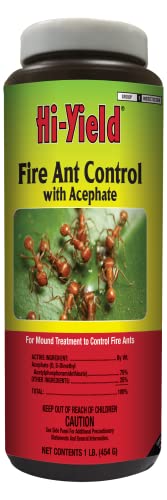
The Hi-Yield Fire Ant Control leads this list because it strikes the ideal balance between professional-grade performance and practical homeowner application. Each 1.1-pound container is packed with acephate in a granular format, which delivers immediate contact kill on workers while ensuring enough poison is transferred into the colony to take down the queen. Users consistently report mounds going silent within 24 to 48 hours of a single application, and the manufacturer claims this single treatment provides full-season suppression when applied correctly in the early morning or late afternoon.
This formulation is EPA-labeled for residential turf, recreational turfgrass, and commercial non-crop areas, making it versatile enough for the average yard or a larger property with multiple active mounds. The application is straightforward: evenly distribute one to two teaspoons directly over the mound. The granules do not require watering in, which saves time and avoids the risk of washing the chemical away before it can work. It also gives the ants time to track the poison through the colony before they seal the mound.
The only significant trade-off is the smell. Like most acephate-based products, this granular formula has a pungent odor that some users describe as reminiscent of rotten cabbage or spoiled food. While this odor dissipates after a few hours outdoors, it is strong enough during application to recommend wearing gloves and a dust mask. For homeowners who prioritize effectiveness over aesthetics, however, this remains the top-tier choice for long-term fire ant management.
What works
- Full-season control from a single application
- Fast queen and colony knockdown within 2 days
- No watering-in required
What doesn’t
- Extremely strong, lingering rotten-cabbage odor
- Cannot be used in areas where livestock graze
2. Ortho Orthene Fire Ant Killer
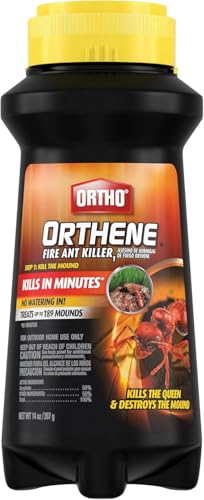
The Ortho Orthene Fire Ant Killer is the 12-ounce shaker bottle version of the same acephate technology that professional exterminators rely on, but sold in a four-pack for comprehensive property coverage. Each bottle features a built-in shaker top that makes spot-treating individual mounds extremely precise—no measuring cups, no filling bulb dusters. Because the active ingredient is acephate, this powder kills fire ants on contact while also providing residual activity that stops new queens from colonizing nearby.
Users specifically praise this product for its rain-resistant performance. Once applied, the powder does not require watering-in and holds up well even if a light shower occurs a few hours after treatment. The 48-ounce total quantity in this pack makes it ideal for homeowners who manage two or three acres with scattered mounds, especially in the southern states where fire ants are a persistent, year-round battle. The product is also officially compatible with Ortho’s two-step system, where broadcast granules prevent new mounds for up to six months.
The powder is fine and can become airborne during application if the shaker is held too high above the mound. Users recommend a gentle, low sprinkle to avoid inhaling the dust cloud. The odor is present but less overwhelming than the straight Hi-Yield granules. A few reviewers also noted that the bottle caps can be difficult to reseal tightly, so storing the bottles in a sealed plastic bag is a sensible precaution to contain the smell and moisture.
What works
- Four bottles provide excellent value for large properties
- Rain-resistant and does not require watering-in
- Precise shaker top minimizes waste
What doesn’t
- Fine dust can become airborne and require a mask
- Caps can be difficult to reseal tightly
3. Surrender Fire Ant
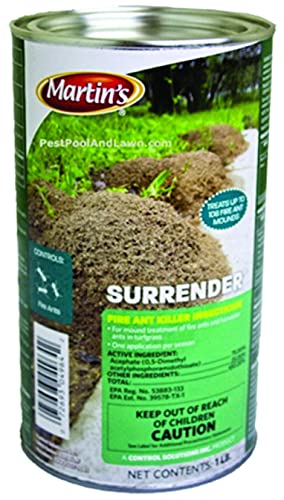
Surrender Fire Ant has earned a fierce reputation among those battling the notoriously aggressive fire ants of Florida and the Gulf Coast. Unlike the dry granular or dust formats, Surrender is a spray formula that mixes with water to create a drench that penetrates deep into the mound structure, hitting the queen where she hides. Users report that a single application is often sufficient, with mounds showing no activity within 24 hours.
This product is particularly effective for homeowners who have tried bait granules without success and need a more aggressive chemical approach. The liquid formulation ensures that the acephate reaches lower chamber levels where granules might not travel. It also works against a broad spectrum of insects, giving it utility beyond just fire ants. Experienced users recommend using it in the evening when ants are inside the mound and the sun won’t degrade the solution too quickly.
The smell is the biggest hurdle. Users consistently describe the odor as a strong rotten-egg scent that lingers for a few days. This is a chemical odor that signals high efficacy, but it means the product is best reserved for outdoor use away from open windows and play areas. The packaging is a simple 1-pound bottle, which feels smaller than the granular competitors, but the concentrate goes a long way when mixed properly.
What works
- Deep mound penetration with liquid drench
- One application provides total colony kill
- Effective against Florida’s toughest strains
What doesn’t
- Very strong rotten-egg odor during and after use
- Requires mixing with water, not ready-to-use
4. Bengal UltraDust 2X Fire Ant Killer
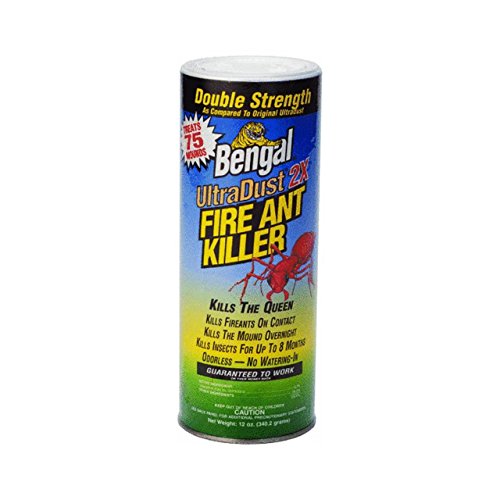
Bengal UltraDust 2X is a dedicated dust formulation that stands out for its sheer coverage capacity. A single 12-ounce container treats up to 75 mounds at a teaspoon per mound, making it the highest volume-to-mound ratio on this list. The dust formula is engineered to resist clumping in humid or dewy environments, a common failure point for granular baits that turn into a paste when they hit morning moisture.
The key advantage here is the prolonged residual action—the manufacturer claims it continues killing insects for up to eight months after application. This is significantly longer than most bait-based products that fade after a few weeks. Because it is a contact killer that also works via ingestion, the ants die quickly, and the dust gets tracked deep into the colony. The product is also labeled for use on roses and ornamental plants, adding perimeter protection around the home.
Application requires a careful hand to avoid creating a visible dust cloud. The fine powder can drift in a breeze, so applying it close to the mound on a calm day is essential. While the odor is much milder than acephate-based granules, the dust is still a chemical that warrants gloves and avoidance of inhalation. Some users report that very large or deeply settled mounds may require a second treatment because the dust doesn’t always penetrate the entire structure in one go.
What works
- Treats 75 mounds per container—exceptional value
- Dust resists clumping in humid and dewy conditions
- Residual action lasts up to 8 months
What doesn’t
- Fine powder drifts easily in wind
- Very large mounds may need a second application
5. Acephate 97UP 1lb Bag
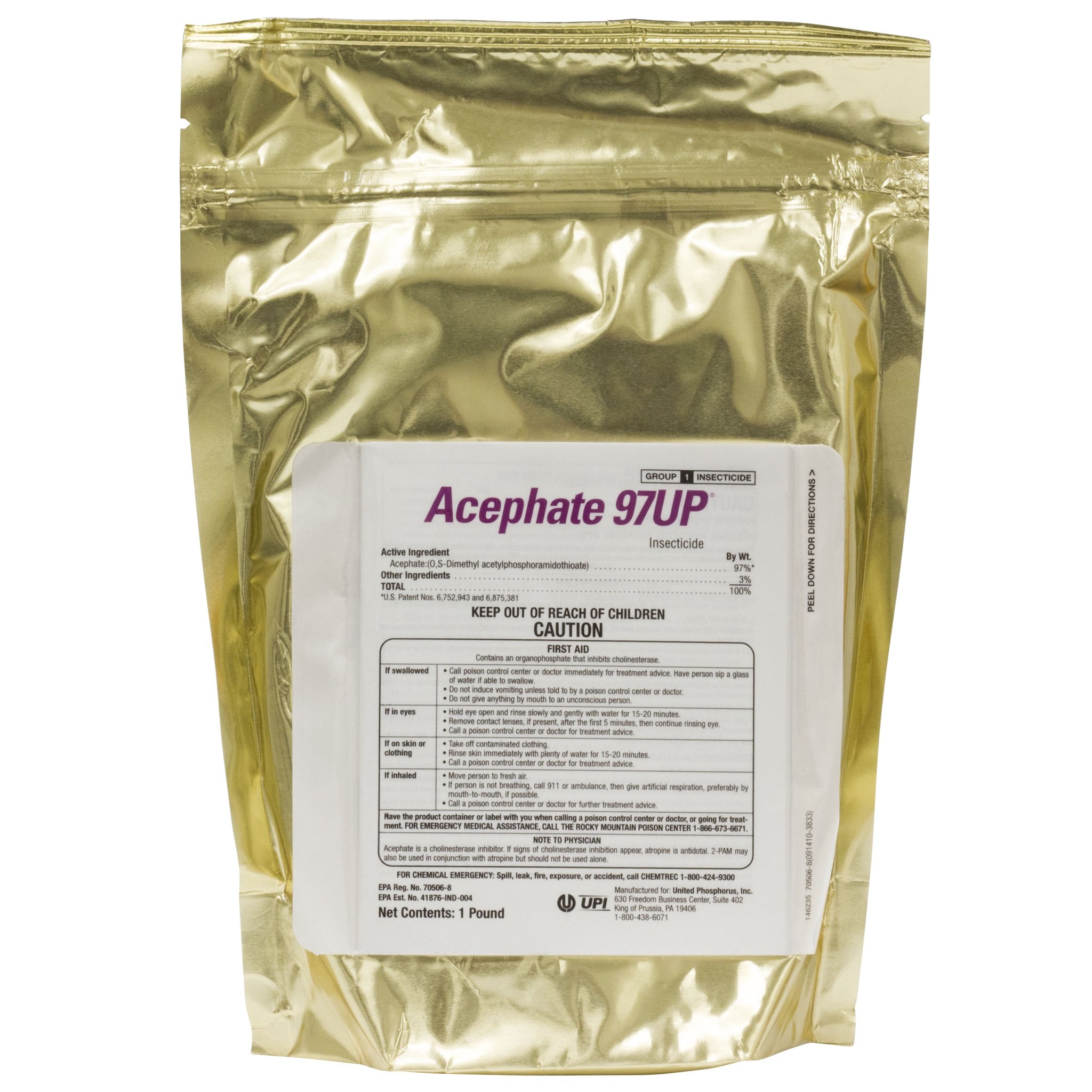
Acephate 97UP isn’t a consumer-ready shaker bottle; it’s a professional-grade concentrate containing 97% pure acephate powder. This is the same technical material that pest control companies mix into their own formulations. The granular form can be applied dry directly to mounds or mixed with water at a rate of ½ cup per gallon to create a powerful drench. This flexibility makes it the most potent option for those comfortable handling highly concentrated chemicals.
The list of controlled insects is staggering—fire ants, aphids, grasshoppers, beetles, loopers, cutworms, thrips, whiteflies, borers, armyworms, and over 125 other species. This makes the bag a multi-purpose weapon for a household with diverse pest problems, from the lawn to the greenhouse. Users report that dry application kills hills within one to two days, while a wet drench ensures the poison reaches every level of a deep mound. The cost per treatment is remarkably low compared to branded products.
The trade-off is extreme. The smell has been described as “spoiled kimchi” or “strong bad cabbage” that permeates sealed containers and lingers for weeks. Users strongly recommend repackaging the powder in a glass jar immediately and storing it in a detached garage or shed. A proper respirator, rubber gloves, and full-length clothing are mandatory for safe handling. This is not a product for casual users; it is for the dedicated gardener who values raw chemical power above all else.
What works
- 97% acephate concentration for maximum strength
- Extremely cost-effective on a per-treatment basis
- Controls over 125 insect species
What doesn’t
- Overwhelming, persistent chemical odor
- Requires a respirator and full protective gear
- Not a ready-to-use product; requires mixing or careful dry application
6. Ortho Fire Ant Mound Blitz

Ortho Fire Ant Mound Blitz is designed for homeowners who want zero measuring, zero mixing, and zero fuss. Each of the eight packets contains a precisely measured dose of contact-kill powder. You simply tear open a pack, pour the contents over the visible mound, and the product works immediately—killing ants on contact while the colony destroys itself from within as workers track the poison to the queen. Users report seeing no ant activity within the same day.
The formula is a fine powder that doesn’t require watering-in and works in both lawns and around ornamental plants, including flowers, shrubs, and trees. The disposable packaging means you don’t have to store half-used bottles of chemicals, which is a significant advantage for occasional users who only see a few mounds each season. The powder itself has a very mild odor compared to acephate-based products, making it more pleasant to apply in the immediate vicinity of the house or patio.
The primary limitation is the coverage versus cost ratio. At eight pre-measured packets per bag, this product is priced similarly to products that treat 75 mounds. For a property with only one or two mounds, this is perfect; for an acre with dozens of colonies, it becomes an expensive solution quickly. Additionally, the very fine dust can drift in even a light breeze, so applying it on a still day is crucial. Users have also noted it can leave a light white residue on grass for a few days after treatment.
What works
- No measuring required—just rip and pour
- Mild odor suitable for use near patios
- Kills the entire colony overnight
What doesn’t
- Low total coverage for the price point
- Fine dust drifts in wind; can leave residue on grass
7. Spectracide One Shot Fire Ant Killer

Spectracide One Shot Fire Ant Killer takes a different approach than the acephate products on this list. It is a bait-based granular formula, not a contact killer. The active ingredient is designed to kill slowly—the worker ants carry the bait back to the colony and feed it to the queen, who dies within 48 hours. This bait strategy is effective but requires a behavioral understanding: you must apply the granules around the mound openings in the early morning or late evening when ants are foraging, rather than directly on the mound itself.
The manufacturer claims a single application controls fire ants for three months, and the 1.5-pound canister is large enough for both spot-treating mounds and broadcast treatment across the entire lawn. The granules are large and odorless, which means no chemical smell during application and no airborne dust. It pairs well with a proactive lawn management strategy where you treat before an infestation becomes severe.
The bait nature means results are not instantaneous. Users who apply it directly onto the mound have poor results because the ants treat the granules as a foreign object and avoid them. Correct application around the perimeter of the mound is critical for success. Additionally, bait products are less effective if there are other food sources available in the yard, or if it rains shortly after application and washes the granules away. For immediate, dramatic knockdown of a visible mound, this product is slower than the acephate dusts.
What works
- Odorless, large granules eliminate airborne dust concerns
- Suitable for both spot treatment and broadcast lawn application
- Controls the queen through slow-acting bait mechanism
What doesn’t
- Requires correct application around, not on, the mound
- Slower visible results compared to contact-kill powders
- Effectiveness can be compromised by rain or competing food sources
Hardware & Specs Guide
Acephate (Orthene)
Acephate is a systemic organophosphate insecticide with both contact and stomach action. It is the most common active ingredient in professional and consumer fire ant mound killers. Products with acephate (like Hi-Yield and Ortho Orthene) provide rapid knockdown of worker ants and kill the queen within 24–72 hours. It also offers residual activity, preventing re-infestation for several weeks to months depending on the formulation and weather conditions. It has a distinctive pungent odor that signals its potency.
Bait vs. Contact Kill vs. Dust
Bait granules (like Spectracide One Shot) rely on the ant’s foraging behavior—they must carry the poison back to the queen. This method is effective but slower (3–7 days) and sensitive to weather and application technique. Contact kill powders (like Bengal UltraDust) kill on contact and are faster (24 hours) but require fine-particle application. Dusts resist moisture better in humid climates. Drench formulations (like Surrender) ensure deep penetration into large mounds where granulars might not reach.
FAQ
Will a fire ant mound killer harm my grass or flowers?
Why do I need to apply granules around the mound and not on top?
How soon after treatment can I let my children or pets on the lawn?
Final Thoughts: The Verdict
For most gardeners, the fire ant mound killer winner is the Hi-Yield Fire Ant Control with Acephate because it delivers professional-grade, full-season protection with a single application, making it the most efficient choice for both small yards and larger properties. If you want zero-measure convenience and a milder smell for spot treatments near the house, grab the Ortho Fire Ant Mound Blitz. And for tackling massive infestations with deep, established mounds where liquid penetration is crucial, nothing beats the Surrender Fire Ant.