
Florida’s sandy, alkaline soil drains nutrients rapidly, leaving palms starved for the potassium and magnesium they need to push out deep green fronds instead of the telltale yellow-orange spotting that signals deficiency. A fertilizer matched to this regional soil chemistry makes the difference between a ragged canopy and a landscape centerpiece.
I’m Rikta — the co-founder and writer behind Lawn Gear Lab. I’ve spent hundreds of hours cross-referencing NPK ratios, slow-release technologies, and micronutrient profiles against the specific needs of Florida palms to deliver a guide rooted in agronomic data rather than marketing claims.
After combing through soil science bulletins from the University of Florida IFAS Extension and analyzing thousands of verified owner experiences, I’ve narrowed the field to the seven formulas that actually earn their place in your shed — this is the definitive breakdown of the best palm tree fertilizer for florida conditions.
How To Choose The Best Palm Tree Fertilizer For Florida
Selecting the wrong fertilizer for Florida palms isn’t a minor mistake — it can directly cause frizzle top, bud rot, and increased susceptibility to lethal bronzing. The state’s sandy, alkaline soils (pH 7.0-8.5) lock up phosphorus and iron while leaching potassium and magnesium, creating a unique nutritional minefield. The right formula compensates for these deficits without overfeeding nitrogen, which can trigger excessive growth that attracts pests.
Prioritize Potassium Over Everything Else
University of Florida IFAS research consistently recommends a 2-1-3 or 3-1-5 NPK ratio for palms — roughly twice as much potassium as nitrogen. Potassium strengthens cell walls, improves cold tolerance, and prevents the yellow-orange spotting on older fronds that signals deficiency. Look for potassium (K) numbers above 12%; anything under 10% is unlikely to correct Florida’s endemic potassium shortages in sandy soil.
Controlled-Release Nitrogen Is Non-Negotiable
Quick-release nitrogen forces a sudden flush of tender growth that attracts palm aphids, scale, and the weevils that vector lethal yellowing disease. A slow-release nitrogen source (often listed as polymer-coated, sulfur-coated, or controlled-release) meters nutrients across 3-6 months. This matches the palm’s natural uptake curve and prevents the boom-bust cycle that stresses the tree. Most premium granular products use 50%+ controlled-release nitrogen.
Micronutrients Complete the Picture
Florida’s alkaline soil locks up iron, manganese, and zinc — all essential for chlorophyll production and frond rigidity. Chelated forms of these micronutrients remain plant-available at high pH. Products containing magnesium (Mg) in the 1-2% range help prevent the frizzle top disorder common in Queen and Washington palms. Sulfur (S) in the 5-10% range gradually acidifies the root zone, improving micronutrient uptake.
Quick Comparison
On smaller screens, swipe sideways to see the full table.
| Model | Category | Best For | Key Spec | Amazon |
|---|---|---|---|---|
| Perfect Palm Dual Action | Granules | Complete long-term palm health | 7-14-40 NPK with XCU 64% CR tech | Amazon |
| Jobe’s Palm Spikes 10-5-10 | Spikes | Mess-free, set-and-forget feeding | 10-5-10 with micro-nutrients (3 pack) | Amazon |
| Espoma Palm-tone | Granules | Organic gardening enthusiasts | 4-1-5 with Bio-tone plus 5% Ca | Amazon |
| Farmer’s Secret Booster | Liquid | Rapid green-up of yellow fronds | 4-15-12 concentrate, 32 oz | Amazon |
| Jack’s Classic Tropical Food | Powder | Water-soluble versatility | 16-5-25 with micronutrients | Amazon |
| Pennington Ultra Green | Granules | Budget-friendly maintenance | 9-4-9 with 3 chelated nutrients | Amazon |
| Jobe’s Palm Spikes 1-0-0 | Spikes | Lowest-touch convenience | 1-0-0 slow-release, 2-pk | Amazon |
In‑Depth Reviews
1. Perfect Palm Dual Action Palm Tree Fertilizer

The 7-14-40 ratio is remarkable — a 40-point potassium number that directly addresses Florida’s acute potassium leaching problem. Most competing products top out at 12-15% K, making this formula an outlier in its ability to correct the yellow-orange spotting on older fronds. The 64% controlled-release nitrogen (XCU technology) meters feeding across roughly four months, preventing the soft growth flush that attracts palm weevils.
Developed by actual palm farmers rather than a general lawn-care chemical company, the formula includes dual forms of magnesium and iron to ensure availability across a wider soil pH range. The resealable pail with measuring scoop eliminates the guesswork of application rates — 1 cup per 2-inch trunk diameter works out to 14 palms per pail at typical mature sizes. The spoon-feeding philosophy avoids the salt buildup common with single heavy applications.
Owner reports consistently mention new frond emergence within two weeks on stressed specimens and noticeable greening of yellowing canopies. The only friction point is the premium cost per pail, though the per-palm math works out favorably against many granular competitors when you factor in the higher potassium concentration and controlled-release efficiency.
What works
- Exceptionally high 40-point potassium corrects Florida’s endemic deficiency rapidly
- 64% controlled-release nitrogen prevents pest-attracting growth flush
- Dual-form magnesium and iron ensure uptake in alkaline soil
What doesn’t
- Higher upfront cost per pail than basic granular fertilizers
- Not suitable for organic gardening certification requirements
2. Jobe’s Palm Tree Fertilizer Spikes 10-5-10 (3 Pack)

The 10-5-10 spike formulation hits the 2-1-2 ratio that Florida Extension recommends as a minimum for maintenance, with a potassium percentage high enough to slow the typical yellowing. The spike delivery system bypasses the surface runoff problem that plagues granular fertilizers on Florida’s sandy, fast-draining soils — nutrients release directly at the active root zone depth, where water doesn’t carry them away before uptake.
Each spike contains sulfur, magnesium, iron, and zinc in chelated forms that remain plant-available at the alkaline soil pH common across the state. The three-pack provides 15 total spikes, which covers 3-4 mature palms per application (typically 3-4 spikes per tree depending on trunk diameter). The slow-release mechanism lasts roughly 8 weeks, requiring 3-4 applications per year for consistent nutrition.
Real-world feedback emphasizes the ease of use: drive the spike into moist soil along the drip line and walk away. Users report visible improvement in frond color within three weeks, with new spear leaf emergence accelerating. A small number of users note that very hard, compacted Florida sand can cause the spike to crumble during installation if the soil isn’t pre-moistened.
What works
- Spike delivery eliminates granular runoff on sandy Florida soils
- Contains chelated micronutrients for high-pH availability
- 15 spikes per pack offer cost-effective multi-tree coverage
What doesn’t
- Spikes may crumble in hard, dry, compacted soil
- Potassium at 10% is adequate but not corrective for severe deficiency
3. Espoma Organic Palm-tone 4-1-5 (3 Pack)
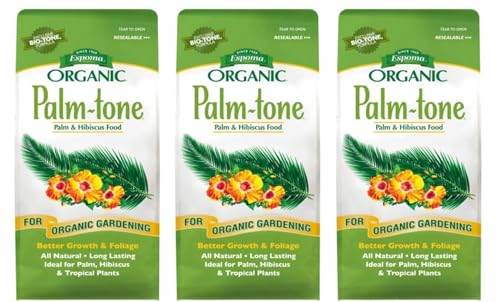
Espoma’s Palm-tone is the only entry in this guide approved for organic production, using a 4-1-5 ratio that delivers a potassium level three times higher than its nitrogen content — critical for Florida palms without relying on synthetic salts. The inclusion of 5% calcium addresses the calcium deficiency common in sandy Florida soils, supporting cell wall strength and reducing the risk of bud rot in hurricane-season downpours.
The Bio-tone microbial inoculant speeds decomposition of the organic matter, making the nutrients available faster than typical organic fertilizers while still feeding soil biology. The granular form requires application every three months for palms, with monthly feeding recommended for hibiscus and tropicals. The 4-pound bag size in this three-pack provides 12 pounds total, sufficient for roughly 6-8 mature palms per year at the recommended rates.
Owner experiences consistently highlight rapid greening and prolific flowering on companion hibiscus plants, with several users reporting recovery of stress-yellowed palms within a month. The barnyard scent during application is noticeable but fades quickly after watering in. The organic nitrogen sources are slower-acting than controlled-release synthetic forms, so visibly deficient palms may need a supplemental liquid feed for faster correction.
What works
- Organic-certified formula safe for edible landscape plants
- 5% calcium corrects common Florida soil deficiency
- Bio-tone microbes improve organic matter breakdown in sandy soil
What doesn’t
- Organic nitrogen is slower to green up severely deficient palms
- Noticeable barnyard odor during and immediately after application
4. Farmer’s Secret Palm Tree Booster Fertilizer
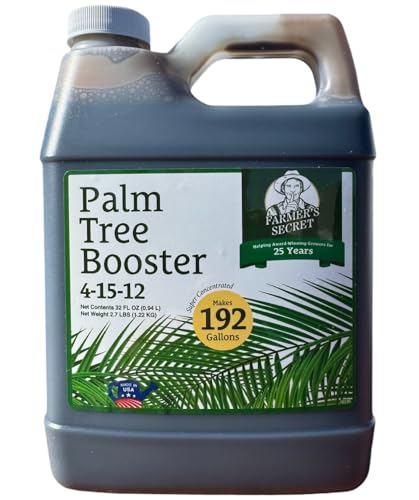
The 4-15-12 ratio is unusual — elevated phosphorus for root and bud development combined with a solid potassium figure for frond health. The liquid form delivers nutrients immediately to the root zone, making it the best choice for rescuing palms that are already showing severe yellowing or winter damage from a North Florida cold snap. The super-concentrated formula requires only one teaspoon per gallon of water, making the 32-ounce bottle yield 192 gallons of feed solution.
Designed for all life stages, the dosage adjusts from 1.5 teaspoons per week for first-season plantings down to half that for container specimens. The inclusion of trace iron and zinc in immediately available liquid form addresses chlorosis faster than granular products that must first dissolve in soil moisture. Application along the drip line targets the feeder root zone rather than the trunk, reducing the risk of bud rot from moisture trapped in the crown.
Owner reviews consistently report dramatic reversal of yellowing — one user described leaves turning from yellow to green after a single dose, a speed unmatched by granular slow-release products. The liquid format is particularly effective for container-grown palms where granular salts can accumulate in the pot. The premium per-ounce cost is offset by the extreme dilution rate; a full growing season requires only a few ounces per mature tree.
What works
- Liquid form reverses severe chlorosis faster than any granular in this guide
- Extreme concentration yields 192 gallons of feed per bottle
- Adjustable dosage suitable for seedlings to mature trees
What doesn’t
- Requires mixing and weekly application schedule
- Not a complete maintenance solution — needs supplemental slow-release nitrogen
5. Jack’s Classic 16-5-25 Tropical Food
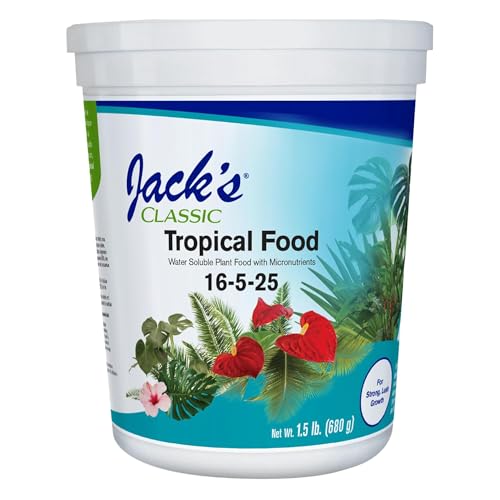
Jack’s Classic delivers a 16-5-25 ratio that mirrors the high-potassium, moderate-nitrogen profile Florida palms require, but in a water-soluble powder form that allows precise control over application strength. The analysis includes multiple nitrogen sources (ammoniacal, nitrate, and urea) for both immediate and sustained uptake — a smart design for sandy soils where urea alone can leach below the root zone before plants access it.
The formula is especially strong for indoor or overwintering container palms in zones 8b and 9a, where limited root volume makes granular buildup dangerous. The 1.5-pound box includes a measuring spoon, and the powder mixes cleanly without the sediment common to some liquid concentrates. Foliar feeding is also an option — diluted at half strength, it supplies micronutrients directly through the leaves when root uptake is compromised by cold soil temperatures.
Long-term users report consistent improvement in cycad and palm specimens over multiple seasons, with particular praise for the way it prevents the weak, stretched growth that can occur with high-nitrogen water-soluble feeds. The packaging change to “Tropical Food” branding has caused minor confusion, but the chemical formula remains unchanged. The 1.5-pound size is compact and best suited for homeowners with fewer than five palms rather than large landscapes.
What works
- Multiple nitrogen sources prevent rapid leaching in sandy Florida soil
- Effective as both root drench and foliar spray
- Dissolves completely without sediment clogging sprayers
What doesn’t
- Small box size requires frequent reordering for multiple trees
- Rebranding has caused temporary package confusion
6. Pennington Ultra Green Palm Tree & Hibiscus 9-4-9

Pennington’s 9-4-9 provides a balanced 1-0.4-1 ratio that serves as a reasonable maintenance feed for established palms not showing severe deficiency symptoms. The 5-pound bag contains iron, magnesium, and three chelated micronutrients — enough to support one to two mature palms for a single application. The granular form includes water-retention polymers that help keep moisture in Florida’s fast-draining sand around the root zone.
The 4-month feeding duration is adequate for a twice-per-year schedule, aligning with the spring and late-summer applications recommended by IFAS. The inclusion of hibiscus in the target species list makes this a convenient single-bag solution for mixed tropical landscapes. The bags are relatively compact and easy to store in a garage or shed without taking up significant floor space.
Consistent users report satisfaction over multiple years, particularly for queen palms and hibiscus in Central Florida landscapes. The potassium level at 9% is lower than ideal for correcting advanced deficiency — palms showing extensive yellow-orange spotting may need a supplemental potassium source. The granular form is surface-applied and requires thorough watering to move nutrients into the root zone, which can be less efficient than spikes or water-soluble options in very sandy soil.
What works
- Affordable entry price for basic palm maintenance feeding
- Includes water-retention polymers for sandy Florida soil
- Works for both palms and hibiscus in mixed beds
What doesn’t
- 9% potassium is too low to correct established deficiency
- Granules require thorough watering to prevent surface runoff on sand
7. Jobe’s Palm Tree Fertilizer Spikes 1-0-0 (2 Pack)

Jobe’s 1-0-0 spike is a simplified, nearly nitrogen-only option that provides micronutrients (sulfur, magnesium, iron, zinc) without significant macronutrient impact. The formula is best understood as a targeted micronutrient delivery system rather than a complete palm fertilizer — and it should be used as a supplement to a balanced palm-specific feed rather than a standalone solution, particularly for Florida palms that need substantial potassium.
The spike form eliminates measuring, mixing, and runoff — simply push the spike into the soil along the dripline. The slow-release design lasts a full season, making it the lowest-maintenance option in this guide. The 1-0-0 ratio means there’s essentially no nitrogen to cause a growth flush, which can be strategically useful for palms that are already oversized for their location or for feeding during the late-fall dormant period.
Owner reviews highlight the convenience and the fact that the spikes stay intact during installation if the soil is pre-softened. The product works best for homeowners who already apply a complete potassium-rich granular in spring and want a mid-season micronutrient boost without the hassle of mixing liquids. Palms with active yellowing or frizzle top will not see correction from these spikes alone — they lack the potassium needed to reverse those conditions.
What works
- Ultra-convenient — no measuring, mixing, or cleanup
- Negligible nitrogen prevents undesirable growth flushes
- Season-long release with a single application
What doesn’t
- 1-0-0 ratio provides no potassium, the most critical nutrient for Florida palms
- Cannot correct advanced deficiency symptoms on its own
Hardware & Specs Guide
NPK Ratio & Potassium Priority
The three numbers on a fertilizer bag represent nitrogen (N), phosphorus (P), and potassium (K). For Florida palms, the K number should be roughly double the N number — a 2-1-3 or 3-1-5 ratio is ideal. Potassium strengthens vascular tissue, improves cold tolerance, and directly prevents the orange-yellow spotting on lower fronds. Products with K below 10% (like many balanced lawn fertilizers at 0-0-7 or 0-0-8) will not correct the endemic deficiency in Florida’s sandy soils.
Controlled-Release vs. Quick-Release Nitrogen
Controlled-release nitrogen (polymer-coated, sulfur-coated, or resin-coated granules) releases nutrients slowly over weeks or months, matching the palm’s natural uptake curve. Quick-release nitrogen (urea, ammonium nitrate) hits the root zone fast but can leach below the root zone in sandy soil within days, wasting product and potentially causing a soft growth flush that attracts weevils and scales. Look for “slow-release” or “controlled-release” on the label, ideally comprising at least 50% of the total nitrogen content.
Micronutrients for Alkaline Soil
Florida’s typical soil pH of 7.0-8.5 locks up iron, manganese, and zinc in forms unavailable to plants. Chelated versions of these micronutrients remain soluble and plant-absorbable at high pH. Products listing “chelated iron” (often as DTPA or EDDHA) or “sulfate” forms of manganese and zinc are more effective on alkaline soils than oxide forms. Magnesium in the 1-2% range helps prevent frizzle top, a disorder common in Queen and Washington palms where new fronds emerge stunted and crinkled.
Granules vs. Spikes vs. Liquids
Granular fertilizers spread over the root zone and require watering-in, making them prone to runoff on slopes or very sandy soil — the water carries the nutrients away before roots can absorb them. Spikes bypass this by releasing nutrients directly at root depth, but coverage is limited to the area immediately around each spike. Liquids and water-soluble powders provide the fastest uptake and allow precise dosage but require regular mixing and application. Spikes and controlled-release granules work well for maintenance; liquids are better for correcting acute deficiency.
FAQ
Why can’t I use a general 10-10-10 fertilizer on my Florida palms?
How often should I fertilize palm trees in Florida?
What causes yellow fronds on my palm, and will fertilizer fix it?
Is liquid fertilizer better than granular for Florida palms?
Final Thoughts: The Verdict
For most Florida homeowners, the best palm tree fertilizer for florida is the Perfect Palm Dual Action because its massively elevated potassium content directly counteracts the state’s most common soil deficiency. If you want a completely mess-free, set-and-forget solution that bypasses runoff on sandy soil, grab the Jobe’s Palm Spikes 10-5-10. And for rapidly reversing yellow fronds or nursing a cold-damaged palm back to health, nothing beats the speed of Farmer’s Secret Booster.