
Few sights are more disheartening than an arborvitae hedge suddenly turning brown from the inside out, its branches draped in silken bags that signal a bagworm infestation. These persistent pests can defoliate and kill entire trees if left unchecked, demanding a targeted spray strategy that reaches deep into the canopy to stop the larvae before they do irreversible damage.
I’m Rikta — the co-founder and writer behind Lawn Gear Lab. My approach to this guide involved weeks of cross-referencing active ingredients, application methods, and residual control data against hundreds of verified owner experiences to determine which formulations actually stop bagworms from ravaging arborvitae stands.
If you need a concentrated solution that penetrates bagworm shelters and halts defoliation, here is my complete breakdown of the best bagworm spray for arborvitae based on formulation chemistry and real-world treatment results.
How To Choose The Best Bagworm Spray For Arborvitae
Selecting the right spray for bagworms on arborvitae hinges on understanding the active ingredient’s mode of action, the treatment timing relative to the bagworm life cycle, and the application method that ensures thorough canopy coverage. The wrong choice can mean wasted effort and a dead tree.
Active Ingredient: Bifenthrin vs. Permethrin vs. B.t. vs. Spinosad
Bifenthrin, a sodium channel modulator, provides immediate knockdown and residual protection lasting several weeks, making it ideal for heavy infestations on mature arborvitae. Permethrin offers similar broad-spectrum control but may require more frequent reapplication. For those seeking an organic approach, Bacillus thuringiensis (B.t. kurstaki) is a stomach poison specific to caterpillars — it works only when ingested by actively feeding larvae, so timing is critical. Spinosad, derived from a soil bacterium, offers a middle ground: effective on contact and ingestion with an OMRI listing for organic gardening.
Application Method and Canopy Penetration
Bagworms build protective silken cases that repel light surface sprays. A sprayer with adequate pressure (at least 40-60 PSI) and a nozzle that produces a fine, penetrating mist is essential for forcing the insecticide inside the bag and through the arborvitae’s dense scale-like foliage. Concentrates mixed with a non-ionic surfactant dramatically improve droplet spread and adhesion to the waxy leaf surface.
Treatment Timing and Residual Duration
Spray when bagworm larvae are small (late June through early July) and actively feeding. B.t. products degrade in sunlight within 3-4 days and require repeat applications every 5-7 days during the hatching window. Synthetic pyrethroids like bifenthrin offer residual control for up to 4-6 weeks, reducing the number of applications needed. Late-season sprays are less effective because mature larvae seal their bags and are impervious to treatment.
Quick Comparison
On smaller screens, swipe sideways to see the full table.
| Model | Category | Best For | Key Spec | Amazon |
|---|---|---|---|---|
| Wisdom Pro L&H 7.9% Bifenthrin | Synthetic Pyrethroid | Heavy infestations, long residual | 7.9% Bifenthrin concentrate | Amazon |
| Valent USA Dipel Pro DF B.t. | Biological | Organic control, early season | 54% B.t. Kurstaki powder | Amazon |
| Fertilome Spinosad | Bio-Synthetic | Organic gardens, broad pest | Spinosad concentrate 32 oz | Amazon |
| Monterey B.t. | Biological | Easy mixing, bee safe | B.t. Kurstaki liquid concentrate | Amazon |
| Hi-Yield Bug Blaster Bifenthrin | Synthetic Pyrethroid | Budget-friendly knockdown | 2.4% Bifenthrin concentrate | Amazon |
| GORDON’S Permethrin 10 | Synthetic Pyrethroid | Multi-pest, farm use | 10% Permethrin concentrate | Amazon |
| Martin’s Permethrin 13.3% | Synthetic Pyrethroid | High concentration, ticks | 13.3% Permethrin concentrate | Amazon |
In‑Depth Reviews
1. Wisdom Pro L&H 7.9% Bifenthrin Insecticide Concentrate (Quart)

The Wisdom Pro L&H Bifenthrin concentrate delivers a potent 7.9% active ingredient load that directly targets bagworms and other lepidopteran pests on ornamentals. Owner reports note seeing dead caterpillars within hours of application and a residual barrier that holds for several weeks, reducing the need for constant re-spraying on large arborvitae hedges.
The quart bottle mixes economically — users commonly dilute 1 to 2 ounces per gallon of water, making this a cost-effective solution for properties with multiple or tall trees. The label explicitly lists bagworms and tent caterpillars, so you are using a formulation designed for this exact pest scenario rather than guessing at off-label usage.
One practical drawback reported is the milky appearance when mixed, which can leave a temporary visible residue on darker foliage until dry. Still, for knockdown power and extended residual protection on established arborvitae, this bifenthrin concentrate stands out as the most complete package in this lineup.
What works
- High 7.9% concentration provides fast knockdown of bagworm larvae
- Residual activity lasts several weeks, reducing application frequency
- Excellent value per gallon mixed — one quart treats a large property
What doesn’t
- Can leave a visible white residue on foliage until dry
- Synthetic pyrethroid is not suitable for organic production systems
2. Valent USA Dipel Pro DF Biological Insecticide BT 54% (1lb Bag)

Valent’s Dipel Pro DF is a concentrated dry flowable formulation of Bacillus thuringiensis kurstaki at 54% potency, making it the most target-specific bagworm option in this guide. One reviewer with hundreds of cedar trees confirmed it stopped bagworms completely each summer, and the OMRI listing assures organic growers that no synthetic residues reach their soil or nearby edibles.
The powder mixes cleanly with water and works via ingestion — the larvae must eat treated foliage to die. This means thorough coverage of the arborvitae’s interior scales is non-negotiable. Users report that the product degrades in sunlight within 3-4 days, requiring reapplication every 5-7 days during the peak hatching window to catch newly emerged larvae.
On the downside, the 1-pound bag is oversized for a homeowner with a single tree but economical for those managing multiple arborvitae or a full landscape. The biological mode of action is slower than synthetic pyrethroids — expect 2-4 days for visible die-off rather than hours.
What works
- Highly specific to caterpillars with zero impact on bees, earthworms, birds
- 54% B.t. concentration means a little powder goes a long way
- OMRI listed for certified organic vegetable and ornamental production
What doesn’t
- UV breakdown in 3-4 days demands frequent reapplication
- Slower kill time compared to synthetic pyrethroids
3. Fertilome Spinosad Insecticide (32 oz)

Fertilome’s Spinosad concentrate occupies a smart middle ground between biological and synthetic chemistry. Derived from a naturally occurring soil bacterium, spinosad kills bagworms on contact and through ingestion, and the OMRI listing makes it suitable for organic gardening programs — a reviewer with an apple orchard confirmed it kept worms from proliferating and improved crop yield without synthetic residue concerns.
The 32-ounce bottle mixes at a rate of 4 tablespoons per gallon of water, making one bottle sufficient for multiple full-coverage sprays on a row of arborvitae. Users report that it handles bagworms, tent caterpillars, and webworms equally well, with residual activity lasting roughly 7-10 days before degradation. The product is rainfast after about 2 hours, which is a practical advantage during unpredictable summer weather.
The primary limitation is that spinosad can be highly toxic to bees while the spray is wet, so applying at dawn or dusk when pollinators are less active is essential. Some users also note the concentrate has a mild but noticeable odor during mixing.
What works
- Dual-action contact and ingestion for fast knockdown of bagworms
- OMRI listed with good residual length for an organic-class product
- Excellent leaf coverage from the 4 Tbsp/gallon mix rate
What doesn’t
- Wet spray is highly toxic to bees — must time applications carefully
- Noticeable odor during mixing and application
4. Monterey B.t. Caterpillar & Worm Killer (32 oz with Spoon)
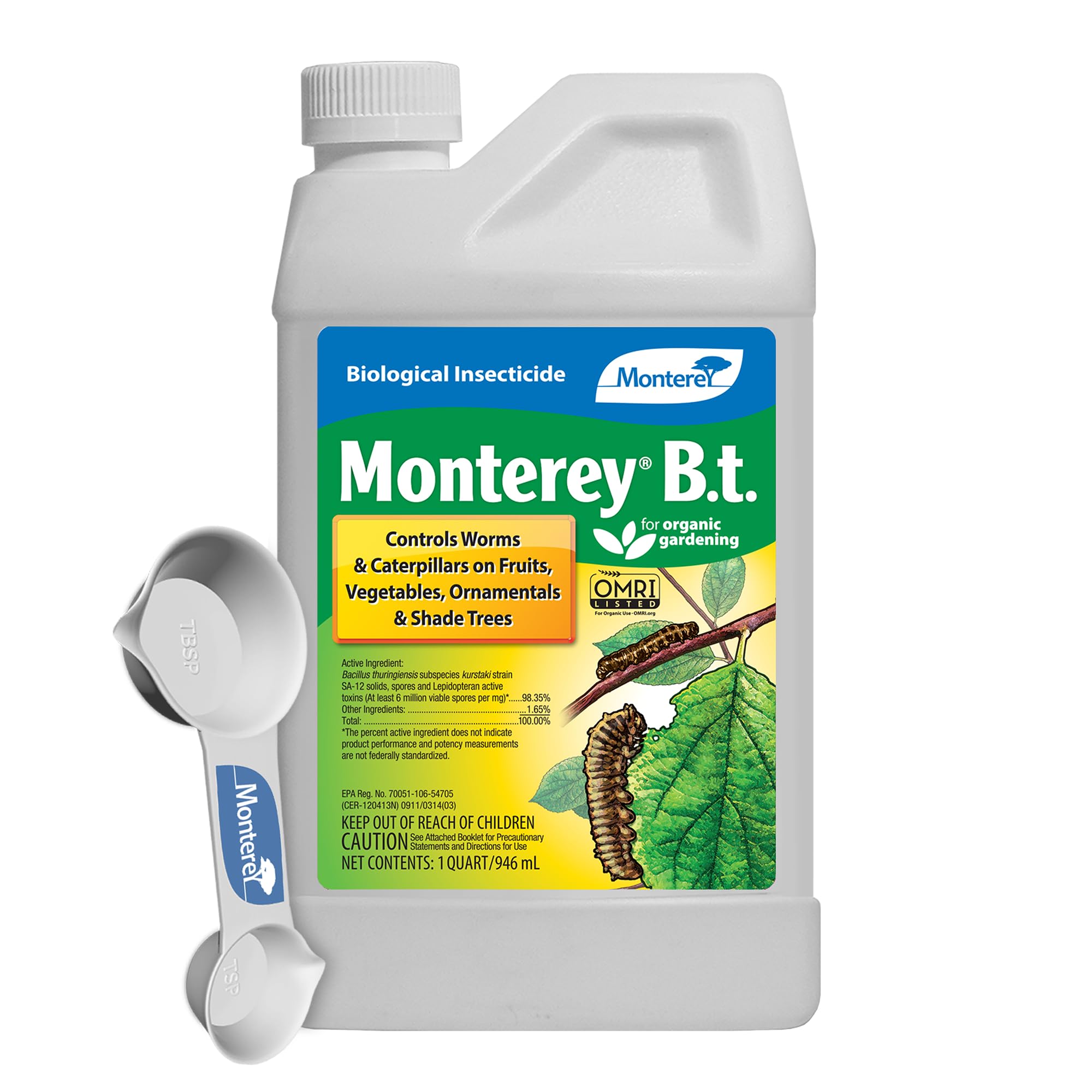
Monterey’s B.t. concentrate bundles a measuring spoon for convenient dosage and targets the exact caterpillar species that attack arborvitae — bagworms, gypsy moths, fall cankerworms, and elm spanworms. The label states it has no effect on honeybees or earthworms when used as directed, making this the safest choice for properties with active pollinator gardens or vegetable beds near the arborvitae.
Users reported seeing dead caterpillars within two days of application on tomato plants, and the same bacillus strain works effectively on bagworms when sprayed during the early larval feeding stage. The liquid concentrate mixes instantly with water and works best in a pressurized sprayer that can deliver a fine mist deep into the arborvitae canopy.
The primary complaint involves the bottle design — several users struggled to open the container and resorted to cutting it open. Additionally, like all B.t. formulations, UV degradation means reapplication every 5-7 days is necessary during the egg-hatch period.
What works
- Completely safe for bees and beneficial insects when dry
- Comes with a measuring spoon for accurate mixing
- Listed for use on ornamentals as well as edible crops
What doesn’t
- Bottle cap is notoriously difficult to open — plan to use pliers
- Short 3-4 day UV lifespan requires frequent weekly reapplication
5. Hi-Yield Bug Blaster Bifenthrin 2.4 Concentrate (16 oz)

Hi-Yield’s Bug Blaster uses bifenthrin at a 2.4% concentration — lower than the Wisdom Pro but still effective against larval insects when mixed at the correct rate. The 16-ounce bottle treats up to 5,300 square feet of lawn according to the label, and the water-based formula is virtually odor-free and non-staining on treated surfaces, which is a practical advantage when spraying near a house or patio.
Owner reviews are overwhelmingly positive for grasshopper and ant control, but the bifenthrin active ingredient is also labeled for use on trees and shrubs, including ornamentals like arborvitae. The 4-month residual claim applies to lawn applications on non-porous surfaces; on foliage, expect protection closer to 3-4 weeks depending on rain and sun exposure.
At this entry-level price point, the lower bifenthrin percentage means you will use more concentrate per gallon compared to the 7.9% options. For a single small arborvitae or occasional spot treatment, it works fine, but for a large hedge the higher-concentration products deliver better economic value per treatment.
What works
- Low odor and non-staining formula suitable for near-house use
- Very affordable entry point for small gardens
- One 16-oz bottle covers a large area at the lawn treatment rate
What doesn’t
- Lower 2.4% bifenthrin requires more concentrate per gallon for trees
- Coverage on tall arborvitae may require a high-pressure sprayer
6. GORDON’S Permethrin 10 Livestock & Premise Spray (1 Quart)

GORDON’S Permethrin 10 is a 10% permethrin concentrate primarily marketed for livestock and premise use, but its broad-spectrum activity includes caterpillar pests found on ornamentals. Users successfully deploy it around barns and chicken coops for flies and mites, and the 2-ounce-per-gallon mixing rate provides generous coverage for the 32-ounce bottle.
This product is a practical choice for homesteaders who already keep permethrin on hand for tick prevention on clothing and livestock facilities. When spraying arborvitae, the permethrin provides fast knockdown of exposed bagworm larvae and residual protection that holds for 1-2 weeks under normal weather conditions. The mix produces a milky solution that coats foliage evenly through a pump or backpack sprayer.
The primary limitation is the livestock label — GORDON’S does not prominently feature ornamental or bagworm use on the front label, so some buyers might prefer a product explicitly marked for tree and shrub application. The permethrin odor, while less aggressive than some concentrates, is more noticeable than the bifenthrin-based alternatives.
What works
- High 10% permethrin content mixes economically for large areas
- Excellent for homesteaders needing a multi-purpose premise spray
- Fast knockdown of larvae on contact
What doesn’t
- Label focuses on livestock, not ornamentals or bagworms
- More noticeable chemical odor during application than bifenthrin
7. Martin’s 32 oz Permethrin 13.3% Concentrate
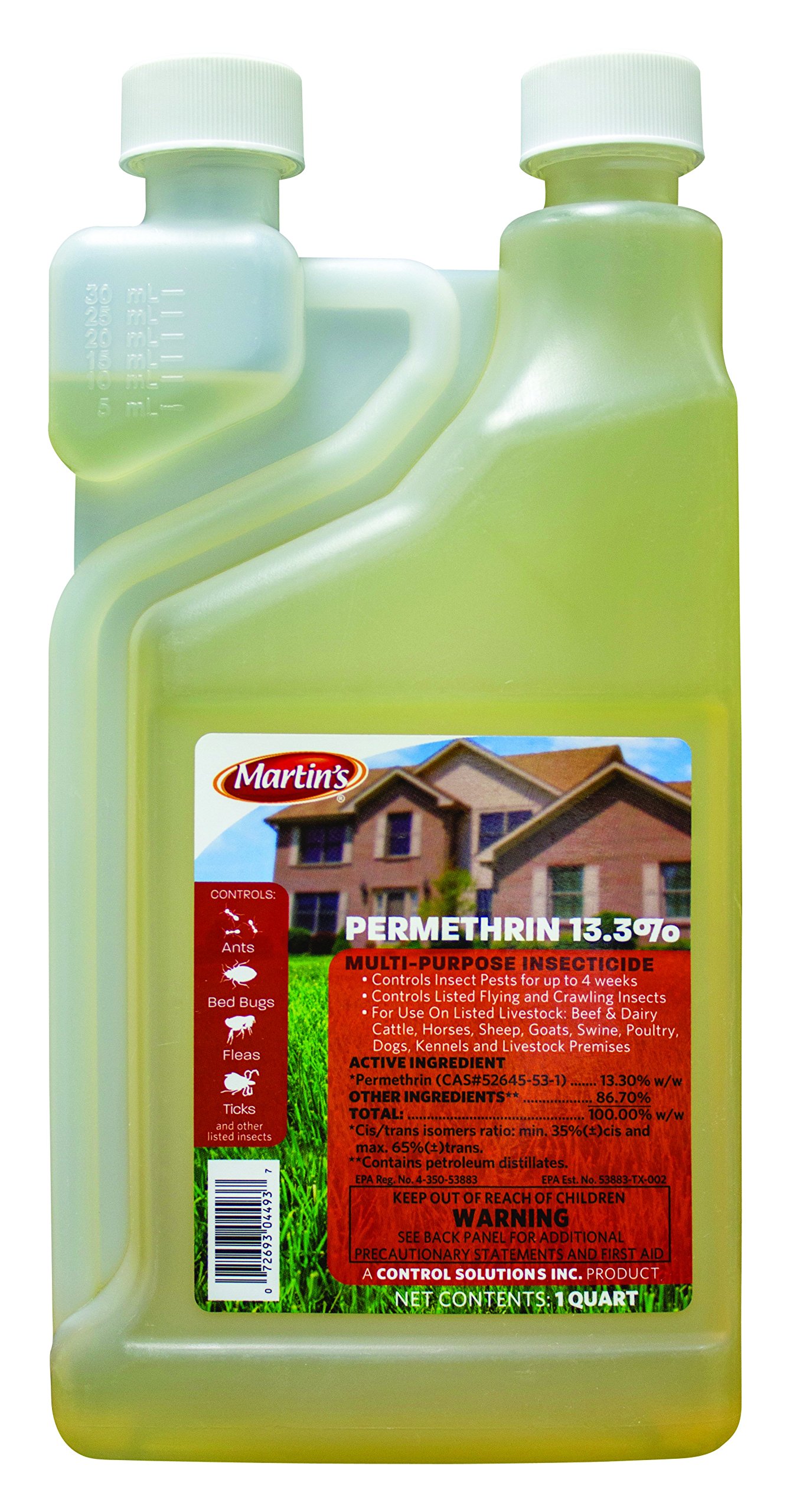
Martin’s Permethrin at 13.3% is the highest-concentration synthetic pyrethroid in this roundup, delivering a potent dose that many users rely on for tick control around property perimeters. A 4-ounce dose per gallon of water yields a solution that kills bagworm larvae quickly and maintains residual efficacy for 4-6 weeks according to owner reports, making it ideal for property owners who want a single-spray season-long approach.
The high concentration means the 32-ounce bottle goes very far — one gallon of mixed solution treats roughly 800 to 1,000 square feet. Reviewers mention using it in a chemical mister for yard perimeters and tree canopies, reporting excellent results on ticks and mosquitoes at the same mixing rates that would handle bagworms on arborvitae.
The strongest drawback is the intense chemical odor, described as paint thinner or solvent-like. This product is not suitable for indoor or enclosed-space use, and even outdoor applications require good ventilation and a respirator for comfort. The strong smell lingers for several hours after drying, which may be off-putting for homeowners with nearby patios or outdoor living areas.
What works
- Highest 13.3% permethrin concentration delivers maximum potency per drop
- Excellent residual control lasting 4-6 weeks on foliage
- Very economical — one bottle treats a large property multiple times
What doesn’t
- Intense solvent-like smell that lingers after application
- Overkill for small yards with only a single arborvitae tree
Hardware & Specs Guide
Bifenthrin vs. Permethrin vs. B.t.
Bifenthrin and permethrin are both synthetic pyrethroids that attack the insect nervous system on contact. Bifenthrin typically offers slightly longer residual activity (up to 4 weeks on foliage), while permethrin provides faster knockdown. Bacillus thuringiensis (B.t.) is a biological stomach poison that only works when ingested by feeding caterpillars — it degrades in sunlight within 3-4 days but is completely safe for non-target organisms once dry. Spinosad bridges both worlds with contact and ingestion activity and an OMRI listing.
Concentrate Percentage Math
A 7.9% bifenthrin concentrate requires roughly 1-2 ounces per gallon of water, while a 2.4% product needs 4-5 ounces per gallon to achieve the same active ingredient load. Higher percentage concentrates cost more per bottle but deliver more mixed gallons per ounce, making them more economical for large properties with multiple arborvitae or tall hedges requiring gallons of spray solution per treatment.
FAQ
When is the best time to spray bagworms on arborvitae?
Does B.t. kill bagworms already inside their bags?
Should I use a surfactant with bagworm sprays?
Final Thoughts: The Verdict
For most gardeners, the bagworm spray for arborvitae winner is the Wisdom Pro L&H 7.9% Bifenthrin because its high concentration delivers immediate knockdown and weeks of residual protection from a single thorough application. If you need an organic option that protects pollinator populations, grab the Valent Dipel Pro DF B.t. and commit to the weekly re-spray schedule. And for a mid-range bio-synthetic that works on both contact and ingestion with an OMRI listing, nothing beats the Fertilome Spinosad.