
The chemistry between the active ingredient, the application method, and the specific plant species dictates whether you see shriveled leaves in a week or full regrowth in a month — and that difference starts with choosing the right concentrated herbicide.
I’m Rikta — the co-founder and writer behind Lawn Gear Lab. I’ve spent countless hours dissecting the chemical compositions, application coverage rates, and real-world owner feedback across the herbicide market to identify which formulas actually penetrate woody tissue and stop root systems from regenerating.
A focused herbicide with the right active ingredient is essential for reclaiming overgrown property, and this guide breaks down the top performing concentrates to help you find the best shrub killer for your specific infestation level and lot size.
How To Choose The Best Shrub Killer
Selecting effective brush control starts with understanding the active ingredient chemistry rather than brand reputation. Shrubs and woody vines have a different physiology than annual weeds, requiring systemic herbicides that translocate through bark and cambium layers down to the root mass.
Active Ingredient Selection
Triclopyr is the gold standard for woody brush and vines because it mimics a natural plant hormone and causes uncontrolled growth that kills the entire root system. Glyphosate works well on broadleaf weeds and grasses but is slower and less effective on mature, thick-barked shrubs. Products with 2,4-D are best combined with triclopyr for broad-spectrum pasture and fence line control.
Application Method and Mixing Ratios
Foliar spraying requires the plant to have active leaves for translocation, while basal bark or cut-stump treatments penetrate directly through the bark during dormant months. Concentrates with higher active ingredient percentages allow you to adjust mixing ratios — a standard 1:4 mix for light brush can be bumped to 1:2 for multi-stemmed thickets. Coverage area specifications let you calculate whether a quart, gallon, or multiple gallons fit your infestation size.
Rainfastness and Soil Activity
Rainfastness determines how long the herbicide needs to bond to leaves before rain can wash it off — 15 minutes to a few hours depending on formulation. Residual soil activity matters if you plan to replant in the same area; glyphosate binds quickly to soil particles and breaks down rapidly, while triclopyr persists longer in heavy organic matter and may delay replanting.
Quick Comparison
On smaller screens, swipe sideways to see the full table.
| Model | Category | Best For | Key Spec | Amazon |
|---|---|---|---|---|
| Roundup Poison Ivy Plus Tough Brush Killer₂ Concentrate | Premium | Poison ivy, kudzu & woody brush | 32 fl. oz. // Triclopyr + Fluazifop | Amazon |
| Southern Ag Crossbow Specialty Herbicide | Premium | Large acre pasture & fence lines | 128 fl. oz. // Garlon + 2,4-D | Amazon |
| Remedy Specialty Herbicide | Premium | Rangeland & encroaching brush | 1 Gallon // Triclopyr concentrate | Amazon |
| Ortho GroundClear Weed and Grass Killer Super Concentrate | Mid-Range | Patios, driveways & fence lines | 32 fl. oz. // Treats 1,120 sq. ft. | Amazon |
| Spectracide Weed and Grass Killer Concentrate | Mid-Range | Fast visible kill on annual weeds | 32 fl. oz. // Diquat Dibromide | Amazon |
| Southern AG 01113 Brush Weed Killer | Budget | Small property brush & stumps | 1 Quart // Triclopyr concentrate | Amazon |
| Control Solutions Eraser Grass Killer Concentrate | Budget | General weed & grass eradication | 32 fl. oz. // 41% Glyphosate | Amazon |
In‑Depth Reviews
1. Roundup Poison Ivy Plus Tough Brush Killer₂ Concentrate

Roundup’s triple-active formula combines triclopyr, fluazifop-P-butyl, and diquat dibromide — a mix engineered specifically for the toughest woody species that ignore standard glyphosate-only products. The diquat dibromide provides the rapid visible burn-down within hours, while the triclopyr and fluazifop work systemically to destroy the root structure of poison ivy, blackberry, kudzu, and woody brush over the following days. The concentrate makes up to 10 gallons of spray solution, treating up to 1,500 square feet per mixed gallon.
Users consistently report complete die-off of multi-year poison ivy stands and thick blackberry brambles within one to two weeks, with no regrowth from the root crown. The 30-minute rainfast window is unusually tight for a triclopyr-based product, giving you confidence even in uncertain weather. A few experienced applicators note that the product works best when applied to actively growing foliage in mid-spring through early summer, and that dense, tall brush may require a follow-up application after two weeks.
The 32-ounce bottle is the sweet spot for homeowners tackling a quarter-acre or less of dense brush. Larger properties will wish for a gallon-size option, but the concentrated potency means this bottle goes further than most quart competitors when mixed at the standard 4-ounce-per-gallon rate for heavy brush.
What works
- Triple-active formula hits poison ivy, kudzu, and woody brush from multiple angles
- Visible wilting in just a few hours, full root kill in 7-14 days
- 30-minute rainfast window beats most competitors by hours
What doesn’t
- Only available in 32 oz. size — large-acre owners need multiple bottles
- May need reapplication on extremely dense, tall multiflora rose
2. Southern Ag Crossbow Specialty Herbicide

Crossbow combines two powerhouse active ingredients — triclopyr (Garlon) and 2,4-D — into a single gallon that treats up to 2.23 acres of brush and broadleaf weeds. The 2,4-D component broadens the spectrum to include common pasture weeds like thistle and ragweed while the triclopyr tackles the woody invaders. This is a low-volatile formulation, which means less drift onto desirable trees and ornamentals compared to ester-based herbicides.
Owner feedback from farmers and rural homeowners highlights its effectiveness along fence lines where blackberry, locust thorns, and invasive pears form impenetrable walls. Users report total die-off within a week on small trees and shrubs when applied as a foliar spray, and even better results when used as a basal bark treatment mixed with diesel during dormant months. The 3-day soil half-life is significantly shorter than many triclopyr-only products, allowing for faster pasture regrowth if you decide to reseed.
One trade-off is the strong chemical odor during mixing and application, which requires a respirator for any extended spraying session. The effectiveness also varies with soil type — heavy clay and high organic matter can reduce translocation speed, requiring a slightly higher mixing ratio for consistent results.
What works
- Covers 2.23 acres per gallon, making it the most economical option for large properties
- 2,4-D + triclopyr combo kills both woody brush and pasture broadleaf weeds
- Low-volatile formula reduces drift risk around desirable trees
What doesn’t
- Strong odor requires a respirator for comfortable application
- Performance drops noticeably in high organic matter soils
3. Remedy Specialty Herbicide
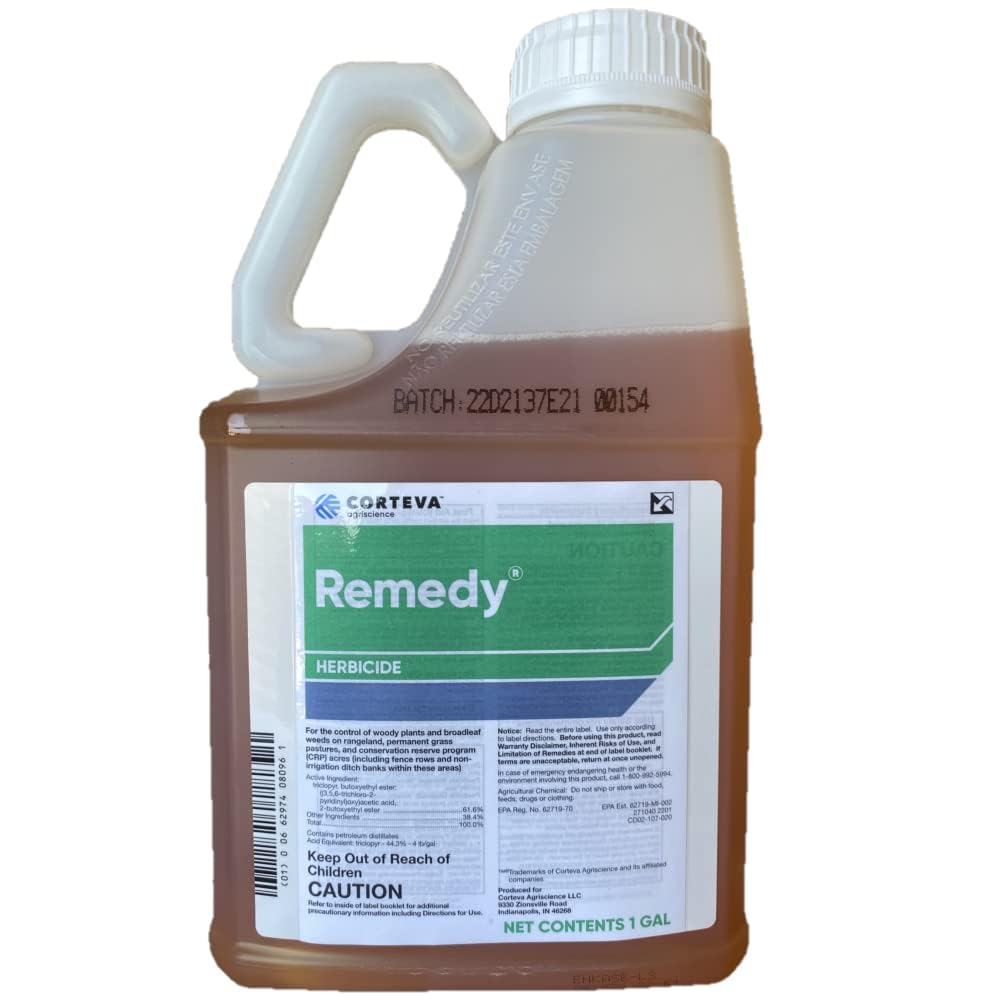
Remedy Ultra is a straight triclopyr concentrate with no secondary actives, giving the applicator total control over mixing ratios for specific brush species. At full strength it is designed for rangeland, pasture restoration, and fence row maintenance where dense woody encroachment threatens grazing land. The low-odor formula is a welcome relief compared to the harsh fumes of 2,4-D mixes, though it still requires standard PPE for safe handling.
Real-world reports from ranchers in Texas and the Midwest describe Remedy as the definitive solution for honey locust, multiflora rose, and cogon grass. The basal bark method at a 1:3 mix with diesel is singled out as the most effective way to kill multi-stemmed invasive trees without having to cut them first. Users note that a single application to freshly cut stumps virtually eliminates resprouting — an advantage over glyphosate-based stump treatments that often require multiple retreatments.
The main downside is the price per gallon, which sits at the premium end of the market. For a small suburban yard with a few brush patches, a quart-sized product would be more practical. However, for anyone managing five acres or more of woody invasion, Remedy delivers the concentration and coverage that cheaper products cannot match.
What works
- Pure triclopyr concentrate allows precise custom mixing for different brush species
- Best-in-class basal bark results on honey locust, multiflora rose, and invasive pears
- Low-odor formulation makes extended spraying sessions more tolerable
What doesn’t
- Premium price point makes sense only for large-acreage operations
- No secondary active ingredients means it is less effective on broadleaf pasture weeds
4. Ortho GroundClear Weed and Grass Killer Super Concentrate
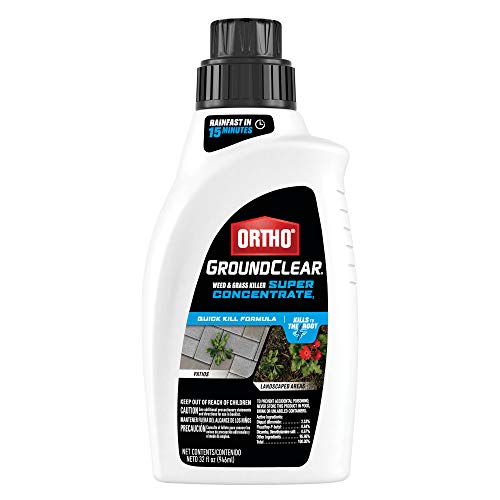
Ortho GroundClear Super Concentrate is built around a fast-acting non-selective formula that starts working immediately upon contact, with visible results within hours on annual weeds and grasses. The 32-ounce bottle treats up to 1,120 square feet when mixed according to label directions, making it a solid mid-range option for clearing fence lines, walkways, and patio cracks where shrubs have begun to encroach. The 15-minute rainfast window is the fastest of any product on this list, giving you flexibility for morning application before unpredictable afternoon showers.
User reviews consistently highlight its speed — vegetation visibly wilts within 4-6 hours on warm, sunny days, and complete die-off occurs within three to four days. For thick woody shrubs that have already established significant root mass, the formula kills the top growth quickly, but some users report that the toughest multi-year shrubs may need a second application for full root kill. This product works best when applied to actively growing green foliage rather than dormant bark.
The concentrate is easy to mix with no strong odor, making it a more pleasant option for homeowners who are sensitive to chemical smells. A common tip from experienced users is to increase the mixing ratio slightly for heavy woody brush — the standard rate works well on grasses and annual weeds, but woody stems require a higher concentration to penetrate through bark.
What works
- Visible results in just hours on annual weeds and grasses
- 15-minute rainfast window allows quick application even in unpredictable weather
- Low odor formula is comfortable for home use near living areas
What doesn’t
- Less effective on mature woody shrubs at standard mixing rates
- 32 oz. bottle covers less area than gallon-sized competitors
5. Spectracide Weed and Grass Killer Concentrate
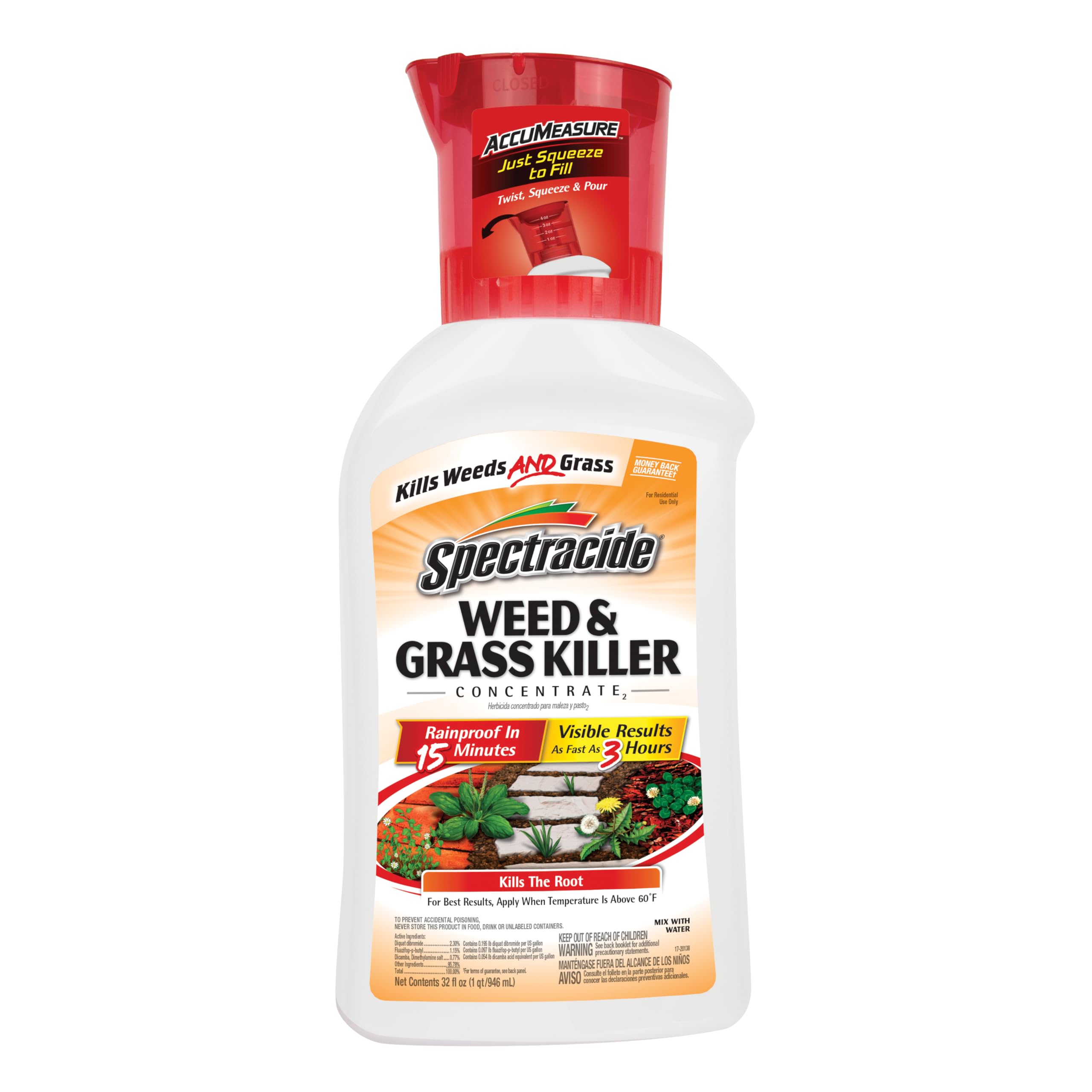
Spectracide Weed and Grass Killer Concentrate is a diquat dibromide-based formula designed for rapid burn-down of emerged weeds and grasses. Diquat dibromide is a contact herbicide that destroys cell membranes on contact, leading to visible browning within three hours under ideal conditions. This makes it a strong choice for quick cleanup of annual weeds around shrubs, flower beds, and hardscapes — but it does not translocate to the roots of woody shrubs, so established brush will regrow from the root crown within weeks.
The Accumeasure cap system is a practical design detail that makes mixing simple and mess-free. The formula is rainfast in 15 minutes, matching Ortho GroundClear for the fastest protection against wash-off. Spectracide promotes that you can replant in treated areas the same weekend, which is accurate because diquat dibromide has no residual soil activity — it is inactivated immediately upon contact with soil particles.
This product is best suited to homeowners who want a fast, visible kill on weeds and grasses and are willing to reapply periodically rather than seeking a single-application root kill.
What works
- Visible browning in as fast as 3 hours on annual weeds and grasses
- Accumeasure cap eliminates messy measuring and spills
- No soil activity allows same-weekend replanting in treated areas
What doesn’t
- Contact-only formula does not kill roots of established woody shrubs
- Requires frequent reapplication for brush and perennial weed control
6. Southern AG 01113 Brush Weed Killer

The Southern AG 01113 is a triclopyr concentrate in a 32-ounce quart format that punches well above its budget-tier price point. Unlike many value-oriented herbicides that rely on a diluted glyphosate base, this is a genuine triclopyr formula equal to the chemistry found in much more expensive premium brands. It covers 512 to 1,024 square feet per mixed gallon — concentrated enough for serious brush work but small enough for a homeowner with a few problem areas to use without waste.
Users report excellent results on poison ivy, wild blackberry, multi-flora rose, and even small trees when applied as a foliar spray or directly to freshly cut stumps to prevent sprouting. The concentrate works especially well on fence lines and along roadsides where you want complete vegetation removal without harming adjacent pasture grass. One reviewer noted it outperformed their local big box store brand on tough weeds growing through weed block and rock, with no regrowth after the initial die-off.
The main limitation is that it struggles with extremely aggressive species like strangler fig and may require multiple applications for deeply established root systems of certain invasive trees.
What works
- Genuine triclopyr concentrate at a budget-friendly price point
- Excellent on poison ivy, blackberry, and multiflora rose in fence lines
- Effective stump treatment that prevents root sprouting
What doesn’t
- Not effective on strangler fig or some aggressive invasive trees
- Small quart size runs out fast on larger properties
7. Control Solutions Eraser Grass Killer Concentrate
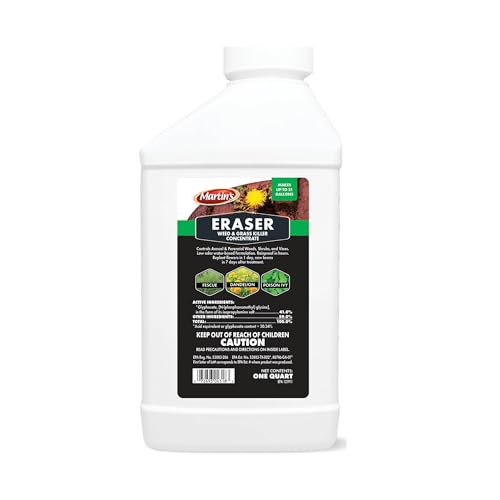
Control Solutions Eraser is a 41% glyphosate concentrate that matches the active ingredient concentration of the original Roundup concentrate at a significantly lower cost. Glyphosate is a non-selective systemic herbicide that works slowly — translocation through the plant tissue takes four to seven days for visible yellowing, and complete die-off typically occurs at the two-week mark. This slow but thorough action makes it a reliable option for clearing mixed vegetation where you need bare ground, including shrubs, vines, and grasses.
Owner reports spanning nearly two decades of use confirm that Eraser kills everything green when mixed at 8 ounces per gallon. Users note that poison ivy and woody brush may need a higher concentration or a second application after three weeks, but the product is far more affordable than comparable consumer Roundup bottles. The low-odor, water-based formula is easy to work with, and the lack of residual soil activity means you can transplant into treated areas after the weeds have fully decomposed.
The primary downside is speed — impatient users expecting overnight results will be frustrated. The herbicide shows no effect for the first two days, begin yellowing around day four to seven, and achieves full kill around day 14. For woody shrubs with established root systems, the slow action gives the plant more time to recover if you miss a spot or apply on a cloudy day when translocation is slower.
What works
- 41% glyphosate concentration matches premium brands at a budget price
- Low-odor formula is comfortable for long spraying sessions
- No residual soil activity allows quick replanting after die-off
What doesn’t
- Very slow acting — 7-14 days for full die-off compared to diquat products
- Less effective on woody brush at standard mixing ratios without higher concentration
Hardware & Specs Guide
Triclopyr Concentration
Triclopyr is a selective auxin-mimicking herbicide that targets woody plants and broadleaf weeds while sparing most grasses. Higher concentrations (as found in Remedy and Southern AG 01113) allow for more aggressive mixing ratios on multi-stemmed brush. Triclopyr works best when applied to actively growing foliage between 60°F and 85°F, with full translocation to roots taking approximately 7-14 days. It binds moderately to soil organic matter and has a half-life of 30 to 90 days in high organic soils, which can delay overseeding.
Application Volume and Coverage
Coverage area is the primary determinant of which product size to buy. A quart product like Southern AG 01113 or Roundup Tough Brush Killer treats roughly 1,500 to 2,000 square feet per mixed gallon at a standard brush rate. The gallon-sized Crossbow and Remedy products treat up to 2 acres at equivalent ratios, making them dramatically more cost-effective for large infestations. Always calculate your target area before purchasing — buying a quart for a half-acre of brush will leave you scrambling for a second bottle mid-project.
Rainfast Window
The rainfast window is the time a herbicide requires to bond to leaf surfaces before rain can wash it off. Diquat-dibromide products (Spectracide, Ortho GroundClear Super) need only 15 minutes of dry weather. Triclopyr-based concentrates require 30 minutes to an hour depending on the surfactant package. Glyphosate products like Control Solutions Eraser need 4 to 6 hours for adequate absorption — spraying when rain is forecast within the same day is a gamble that often results in wasted product.
Soil Activity and Replanting Interval
Non-residual herbicides like glyphosate and diquat dibromide are inactivated upon contact with soil particles, which means you can replant ornamentals or grass seed immediately after the targeted vegetation has died. Triclopyr products have longer soil persistence, particularly in heavy clay and high organic matter. The typical replanting interval for triclopyr-treated soil is 30 days for most ornamental species, though some label instructions recommend waiting up to 120 days for sensitive plants like legumes.
FAQ
Can I spray shrub killer on poison ivy without killing nearby trees?
How long should I wait before letting my dog on treated grass after applying shrub killer?
What mixing ratio should I use for thick, multi-year brush compared to light weeds?
Final Thoughts: The Verdict
For most gardeners tackling poison ivy, blackberry, or woody brush around the yard, the best shrub killer winner is the Roundup Poison Ivy Plus Tough Brush Killer₂ Concentrate because its triple-active formula delivers fast visible burn-down while simultaneously destroying root systems — a combination that cheaper single-active products cannot match. If you need to cover large acreage pasture and fence lines, grab the Southern Ag Crossbow Specialty Herbicide for its 2.23-acre coverage and low-volatile profile. And for a budget-friendly triclopyr option that handles smaller brush patches without breaking the bank, nothing beats the Southern AG 01113 Brush Weed Killer.