
Broadleaf weeds like dandelions are among the most persistent invaders in a manicured lawn, pushing deep taproots that make hand-pulling a futile cycle. An effective herbicide doesn’t just scorch the leaves; it translocates into the root system to prevent regrowth and restore turf density. With dozens of formulas on the shelf, the difference between temporary wilting and complete eradication comes down to active ingredients, application timing, and coverage strategy.
I’m Rikta — the co-founder and writer behind Lawn Gear Lab. My research for this guide involved cross-referencing herbicide active ingredients against hundreds of verified owner experiences to isolate which formulas deliver true root-kill without torching desirable turf grasses.
After comparing concentrated solutions, ready-to-use triggers, and specialty actives like Quinclorac and Mesotrione, the best dandelion weed killer for most lawns balances selective broadleaf control with a wide application window.
How To Choose The Best Dandelion Weed Killer
Dandelions require a systemic herbicide that mimics natural plant hormones to force uncontrolled growth and eventual death. The wrong formula simply burns foliage while leaving the taproot intact, leading to rapid regrowth.
Active Ingredient Strategy: 2,4-D vs. Dicamba vs. Quinclorac
2,4-D is a synthetic auxin that disrupts cell division in broadleaf weeds and remains the most common ingredient in lawn-safe herbicides. Dicamba expands the weed spectrum and works synergistically with 2,4-D for tougher perennials like dandelions. Quinclorac, typically reserved for crabgrass, also controls dandelions but requires a surfactant for leaf adhesion. Products with three-way blends (Trimec) offer the widest dandelion control window.
Concentrate vs. Ready-to-Use
Concentrates deliver better value per square foot and allow you to adjust mix strength for heavy infestations. A 32-ounce concentrate covering up to 16,000 square feet costs less than three RTU bottles covering the same area. Ready-to-use triggers suit small patches and spot treatments under 500 square feet where precision is needed.
Turf Grass Compatibility
Not all dandelion killers are safe on every lawn. St. Augustine grass, centipede grass, and bentgrass are sensitive to certain active ingredients. Always cross-reference the product label with your dominant turf species before application, and avoid applying when temperatures exceed 85°F to prevent turf injury.
Quick Comparison
On smaller screens, swipe sideways to see the full table.
| Model | Category | Best For | Key Spec | Amazon |
|---|---|---|---|---|
| Primesource Quinclorac 1.5L Select | Liquid Concentrate | Professional dandelion + crabgrass control | 18.92% Quinclorac | Amazon |
| Liquid Harvest Mesotrione | Liquid Concentrate | Pre-emergent plus post-emergent action | 8 oz concentrate | Amazon |
| Ortho GroundClear Super Concentrate | Super Concentrate | Hardscape and fence line dandelion control | 32 oz treats 1,120 sq ft | Amazon |
| Southern Ag Lawn Weed Killer | Liquid Concentrate | Value-priced dandelion knockdown on 9 turf types | 32 oz covers 5,000 sq ft | Amazon |
| Ortho Weed B Gon RTU | RTU Trigger | Spot treatment without mixing | 24 oz ready-to-use | Amazon |
| BioAdvanced Weed Killer Concentrate | Liquid Concentrate | Large-area dandelion coverage | 32 oz covers 16,000 sq ft | Amazon |
| Spectracide Weed & Grass Killer | Liquid Concentrate | Fast-acting non-selective spot kill | 32 oz covers 1,350 sq ft | Amazon |
In‑Depth Reviews
1. Primesource Quinclorac 1.5L Select Liquid Crabgrass Killer
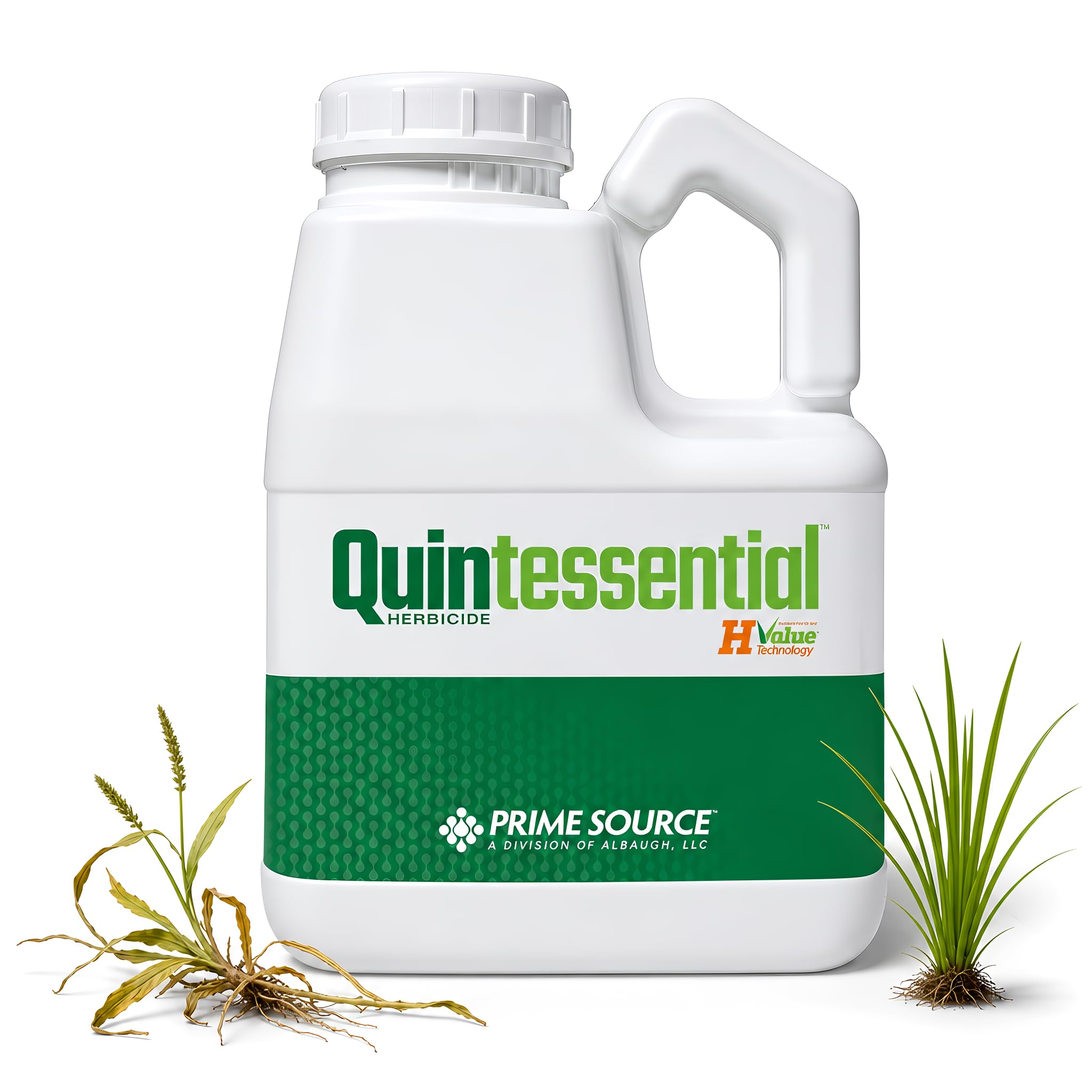
This is a heavy-duty professional concentrate formulated with 18.92% Quinclorac, an active ingredient that targets both broadleaf weeds like dandelions and grassy weeds like crabgrass. The 64-ounce container offers exceptional value for large properties, and the selective chemistry spares desirable turf when applied at label rates. Multiple verified users reported visible wilting within 24 to 48 hours after mixing with a non-ionic surfactant and spray dye.
The spectrum of control extends beyond dandelions to include field bindweed, dollarweed, and English daisy, making this a versatile tool for mixed weed infestations. Label recommendations suggest adding a methylated seed oil (MSO) surfactant to prevent beading on waxy dandelion leaves, which is critical for translocation. Users treating half-acre lots noted that a single concentrated bottle provided multiple full-yard applications.
While the price point is higher than retail herbicide blends, the kill rate consistency and breadth of weed coverage justify the investment for homeowners managing chronic dandelion pressure. The concentrate requires a pump or backpack sprayer — hose-end applicators are not recommended due to dilution control issues.
What works
- Professional-grade Quinclorac concentration for deep root kill
- Controls dandelions plus crabgrass and tough perennials
- One bottle covers very large turf areas
What doesn’t
- Requires separate surfactant purchase for best results
- Not suitable for hose-end sprayers
2. Liquid Harvest Mesotrione Concentrate

Mesotrione is a unique active that inhibits photosynthesis in susceptible weeds, causing a distinct bleaching effect before death. This 8-ounce concentrate competes directly with the branded Tenacity product at a lower cost per ounce, and it works both pre-emergently on germinating seeds and post-emergently on emerged dandelions. Users reported seeing white or yellow foliage within 10 days of application, confirming systemic activity.
The label lists 46 target species including dandelion, clover, chickweed, and crabgrass. Activation requires rainfall or irrigation within 10 days — ideally 0.15 inches — which makes timing weather-dependent. Reviewers noted excellent safety on centipede grass, Kentucky bluegrass, and tall fescue, though St. Augustine should only be treated when established from sod, not seed.
One trade-off is the slower visual kill compared to 2,4-D-based formulas; full necrosis takes two to three weeks. The concentrated nature means a little goes a long way — one teaspoon per two gallons of water for spot spraying. Users recommend adding a spray dye to avoid overlapping and injuring turf.
What works
- Dual pre-emergent and post-emergent dandelion control
- Highly concentrated — minimal product per application
- Safe on centipede, fescue, and bluegrass
What doesn’t
- Requires water activation within 10 days
- Slower visible results compared to synthetic auxin blends
3. Ortho GroundClear Weed and Grass Killer Super Concentrate
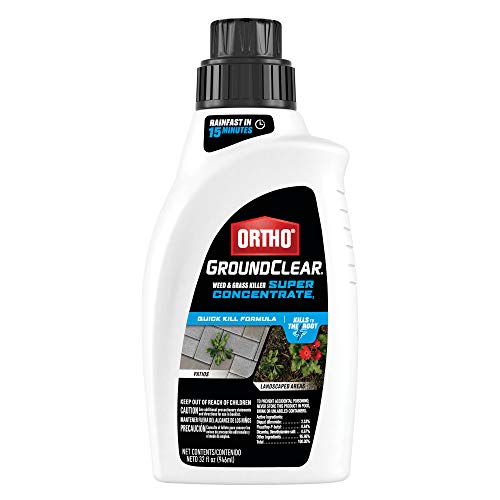
Ortho GroundClear Super Concentrate is a fast-acting non-selective formula designed for areas where you want no vegetation at all — driveways, patios, fence lines, and sidewalk cracks. It contains a blend of active ingredients that begin working immediately upon contact and remain rainfast after just 15 minutes, which is critical for unpredictable weather. Verified users noted complete dandelion kill on hardscape within 72 hours.
This 32-ounce bottle treats up to 1,120 square feet when mixed at the standard rate, making it a mid-range option for targeted hardscape maintenance. The super-concentrate format allows you to mix stronger for tough perennial weeds like dandelions growing through gravel or cracks. Reviewers consistently praised its speed, with some observing visible wilting by the next morning.
Because it kills grass along with weeds, this product is not intended for lawn application. It excels in perimeter and non-turf areas where dandelions establish between pavers or along curb edges. The bottle includes dilution guidelines for both pump sprayers and hose-end applicators.
What works
- Visible results within hours on dandelions
- Rainfast in 15 minutes for flexible scheduling
- Versatile for hardscapes and perimeter use
What doesn’t
- Non-selective — kills any vegetation it contacts
- Smaller coverage area per bottle than lawn-safe concentrates
4. Southern Ag Lawn Weed Killer with Trimec

Southern Ag’s Trimec formulation combines 2,4-D, MCPP, and Dicamba into a single selective herbicide that targets dandelions, clover, chickweed, and spurge without harming most warm- and cool-season turf grasses. At a 32-ounce concentrate covering 5,000 square feet, it represents the best cost-to-coverage ratio for homeowners with standard suburban lots. Verified reviews confirmed dandelion death in roughly two weeks with a single application.
The product is labeled for use on nine turf types, including Bermuda, fescue, and zoysia. Directions recommend mixing two ounces per gallon of water for spot treatments. Some users noted that reapplication every three to four weeks was necessary for complete eradication of heavy infestations. A surfactant additive is recommended by the manufacturer to improve leaf adherence and translocation.
While the Trimec blend is effective, it is not as fast as non-selective formulas. Weed regrowth within a month suggests that some seeds or deep root fragments survive the first pass. Pairing this with a pre-emergent program in early spring reduces the reappearance cycle.
What works
- Selective formula safe on 9 common turf types
- Excellent coverage value at 5,000 sq ft per bottle
- Patented three-way active blend
What doesn’t
- Weeds may return within a month, requiring follow-up
- Surfactant recommended but not included
5. Ortho Weed B Gon Weed Killer RTU Trigger

Ortho Weed B Gon in the ready-to-use trigger bottle is the most convenient entry point for dandelion spot control. No mixing, no measuring, no sprayer cleanup — simply aim and spray. The 2,4-D-based formula kills over 250 listed broadleaf weeds to the root while leaving lawn grass unharmed when used according to the label. Many users reported visible results within hours and complete dandelion death by day seven.
The 24-ounce bottle covers up to 5,000 square feet per the manufacturer, though coverage depends on infestation density. Reviewers praised its ease of use for isolated dandelion clumps in flower beds and lawn edges. The trigger mechanism delivers a targeted stream that reduces drift onto desirable plants. Some users noted the formula has a strong chemical odor during application.
For homeowners who only have a few dozen dandelions scattered across their lawn, the RTU format eliminates the hassle of concentrate mixing and equipment cleanup. The trade-off is higher cost per ounce compared to concentrates, making it less budget-friendly for whole-yard treatments or recurring applications.
What works
- Zero preparation required — spray directly from bottle
- Selective formula won’t kill lawn grass
- Targeted stream minimizes overspray
What doesn’t
- Higher cost per square foot than concentrates
- Strong chemical odor during application
6. BioAdvanced Weed Killer for Lawns Concentrate

BioAdvanced Weed Killer Concentrate covers an impressive 16,000 square feet per 32-ounce bottle, the largest area-to-product ratio in this guide. The active ingredient blend includes Dicamba, MCPP, and 2,4-D specifically formulated to translocate to dandelion roots and prevent regrowth. The label lists over 200 weed species, including dollar weed and nutgrass, which broadens its utility for mixed infestations.
Application requires a tank sprayer, and the concentrate mixes at 1.5 ounces per gallon for spot treatments. Users reported effective dandelion knockdown with one application, though some noted temporary browning on Bermuda grass that recovered within two weeks. The bottle includes a “press the tab” mechanism for measuring that a minority of reviewers found stiff on the first use.
For larger lawns, this concentrate significantly reduces the number of bottles you need to buy per season. The price per square foot of coverage is among the lowest available. However, users with St. Augustine or centipede grass should carefully verify label compatibility, as the Dicamba concentration may cause injury on sensitive turf species.
What works
- Highest coverage area at 16,000 sq ft per bottle
- Translocates to dandelion roots effectively
- Kills over 200 broadleaf weed species
What doesn’t
- May temporarily discolor Bermuda grass
- Measuring tab mechanism can be difficult to operate
7. Spectracide Weed and Grass Killer Concentrate
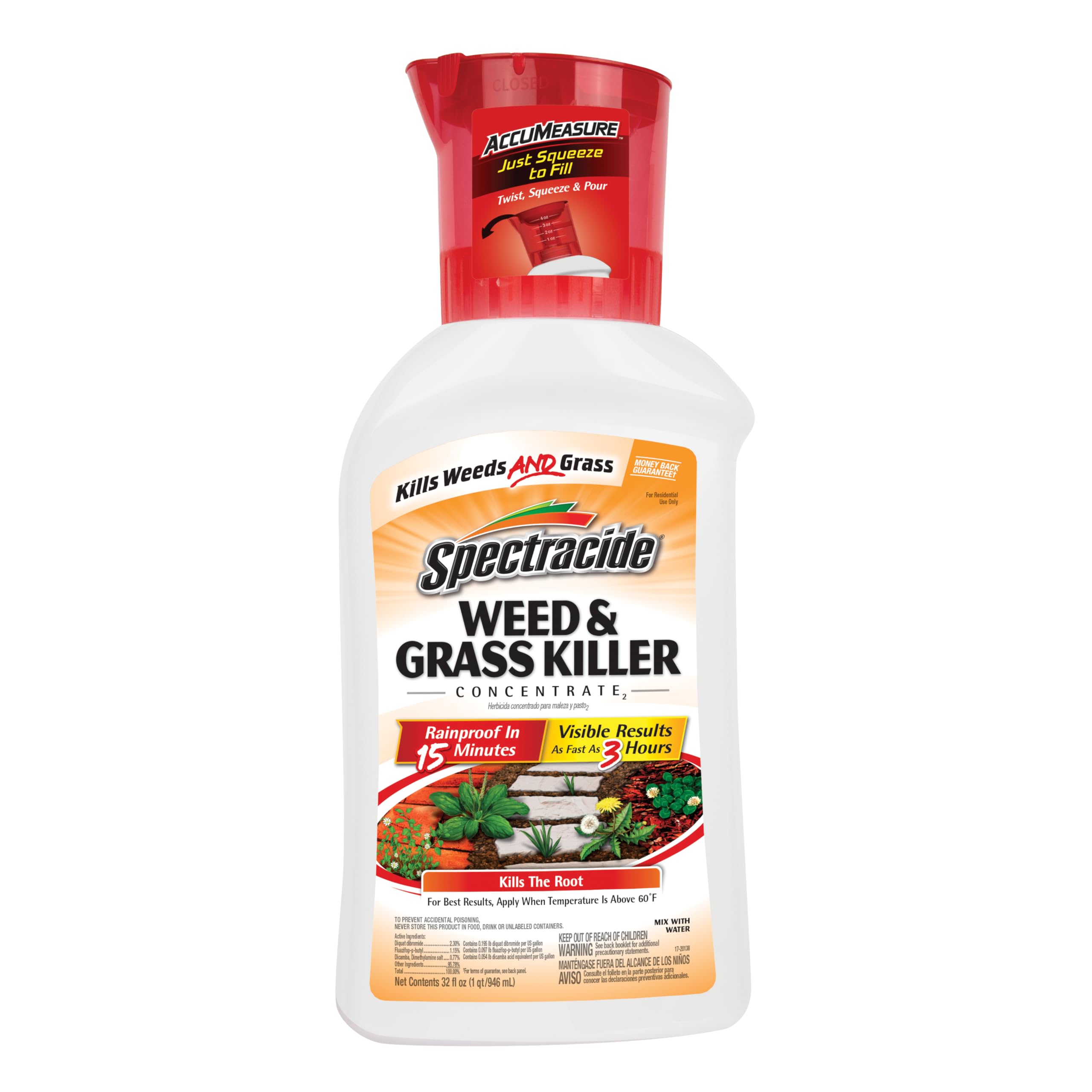
Spectracide Weed and Grass Killer uses Diquat Dibromide, a contact herbicide that desiccates foliage within hours rather than days. This is a non-selective product intended for driveways, walkways, fence lines, and areas where you want all vegetation removed. Verified users reported seeing dandelions turn brown within 24 hours, with full kill inside three days.
The Accumeasure cap system twists and squeezes to dispense the concentrate directly into a tank sprayer, reducing mess compared to traditional bottle tops. One 32-ounce bottle treats approximately 1,350 square feet, which is a smaller coverage footprint than lawn-safe concentrates. The formula is rainfast after 15 minutes, allowing replanting of flowers and shrubs the same weekend.
Because Diquat does not translocate to roots, established dandelions with deep taproots may regrow from below-ground tissue. This makes Spectracide better suited for maintenance spot-kills on visible foliage rather than systemic eradication. Some reviewers noted the Accumeasure cap was finicky and eventually replaced it with a standard lid from an older bottle.
What works
- Extremely fast visible kill in under 24 hours
- Rainfast in 15 minutes for quick scheduling
- Replant-safe the same weekend
What doesn’t
- Non-selective — kills grass and desirable plants
- Contact action may not kill deep dandelion taproots
Hardware & Specs Guide
Active Ingredients Decoded
The three most common actives in dandelion killers are 2,4-D, Dicamba, and Quinclorac. 2,4-D mimics auxin hormones causing uncontrolled growth and stem twisting. Dicamba broadens the weed spectrum and is more soil-active. Quinclorac inhibits cell wall formation and excels against grassy weeds while also controlling dandelions. Trimec is a pre-blended ratio of all three that provides the broadest post-emergent control.
Surfactants and Adjuvants
Dandelion leaves have a waxy cuticle that causes spray droplets to bead and roll off. Adding a non-ionic surfactant (NIS) or methylated seed oil (MSO) at 0.25% to 0.5% of spray volume reduces surface tension and improves coverage. Without a surfactant, many systemic herbicides fail to penetrate dandelion tissue, resulting in incomplete root kill and rapid regrowth within weeks.
FAQ
What is the best time of year to spray dandelion killer?
Will dandelion killer damage my lawn grass?
How long does it take for dandelion killer to work?
Final Thoughts: The Verdict
For most gardeners, the best dandelion weed killer winner is the Ortho GroundClear Super Concentrate because it offers unmatched speed of visible kill with the convenience of a 15-minute rainfast window for perimeter and hardscape infestations. If you want a selective lawn-safe concentrate that won’t damage your turf while wiping out dandelions, grab the Southern Ag Lawn Weed Killer. And for professional-grade, multi-species control on large properties, nothing beats the Primesource Quinclorac 1.5L Select.