
Aloe vera isn’t a heavy feeder, but giving it the wrong fertilizer — or none at all — leaves you with pale, drooping leaves that never thicken. These succulents store water in their leaves, so a nitrogen-rich general-purpose plant food can burn the roots and push out weak, stretched growth that the plant can’t support. The trick is a balanced, low-nitrogen formula designed for the slow metabolism of xerophytes.
I’m Rikta — the co-founder and writer behind Lawn Gear Lab. I’ve spent hundreds of hours cross-referencing technical specifications, studying NPK ratios, analyzing organic certifications, and sifting through owner feedback to find the formulas that actually match an aloe vera plant’s unique nutrient needs without causing root damage.
This guide breaks down the seven most effective options on the market right now, from concentrated liquids to gentle monthly formulas. Whether you are a first-time aloe owner or a seasoned succulent grower, this evaluation of the best fertilizer for aloe vera will help you pick a product that strengthens roots, deepens leaf color, and promotes steady, compact growth without the guesswork.
How To Choose The Best Fertilizer For Aloe Vera
Aloe vera thrives on neglect, but it still requires specific nutrients to maintain its thick, gel-filled leaves. Choosing a fertilizer without understanding three key factors — NPK ratio, form factor, and organic certification — can lead to leaf burn, root rot, or stunted growth.
NPK Ratio — Why Low Nitrogen Wins
Standard houseplant fertilizers often carry a high first number (nitrogen), which pushes rapid green foliage growth. For aloe vera, nitrogen-heavy feeding causes the leaves to stretch thin and become pale, a condition called etiolation. You want a ratio like 2-7-7 or 1-2-2 where phosphorus and potassium are equal to or higher than nitrogen. These support root strength and cell-wall structure without forcing the leaves to grow faster than the plant can handle.
Liquid vs. Granular — Which Form to Use
Liquid fertilizers dilute into water and reach the roots immediately, which is ideal for potted aloe vera. Granular slow-release formulas are harder to control because the nutrients release based on temperature and moisture — and aloe vera’s watering schedule is irregular. Liquid concentrates also let you adjust the dose easily. Look for a pre-mixed pump bottle as a starter or a concentrated liquid that you dilute to half-strength for a gentler feeding.
Organic vs. Synthetic — Safety for Leaves and Pets
Organic fertilizers made from kelp meal, worm castings, or bat guano typically release nutrients slowly and improve soil microbiology. Synthetic formulas deliver immediate energy, often via glucose or added vitamins like B-1, which can help a stressed aloe recover faster. If you plan to use the aloe gel for skin care, steer toward organic or OMRI-listed products to avoid synthetic residue in the leaves.
Quick Comparison
On smaller screens, swipe sideways to see the full table.
| Model | Category | Best For | Key Spec | Amazon |
|---|---|---|---|---|
| Growth Technology GT Succulent Focus | Premium | Serious collectors & semi-hydro aloe | pH buffered; 12 essential minerals | Amazon |
| Miracle-Gro Succulent Plant Food | Mid-Range | Quick, mess-free feeding | Pump-to-soil; feeds in seconds | Amazon |
| Espoma Organic Cactus! Plant Food | Premium | Organic indoor aloe care | OMRI organic; 1-2-2 NPK | Amazon |
| Gardenera Plant Growth Superfood for Aloe Vera | Mid-Range | All-natural, long-lasting nutrition | Zymology process; 18 nutrients | Amazon |
| Schultz Cactus Plus 2-7-7 | Budget-Friendly | Root-focused growth for compact plants | NPK 2-7-7; concentrated liquid | Amazon |
| Gardenera Plant Superfood Spray for Aloe Vera | Mid-Range | Leaf-spray recovery for stressed aloe | Vitamin B-1 + glucose spray | Amazon |
| Cute Farms Succulent, Cacti, & Aloe Fertilizer | Budget-Friendly | Monthly starter feeding | Gentle 0.02-0.02; pre-mixed pump | Amazon |
In‑Depth Reviews
1. Growth Technology GT Succulent Focus
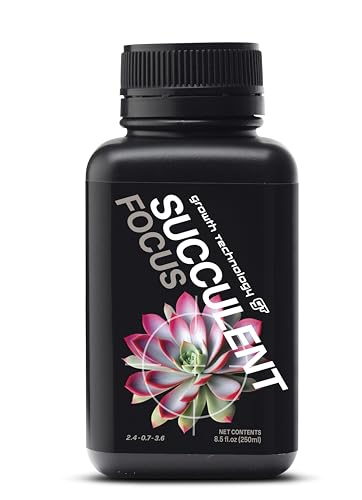
The Growth Technology GT Succulent Focus is a scientific-grade liquid concentrate formulated with all 12 essential minerals, including calcium, in a pH-buffered solution that prevents nutrient lockout. For aloe vera growers using semi-hydro, LECA, or traditional potting mix, the 3–5 ml per liter dilution rate gives precise control over feeding intensity. Unlike many succulent formulas, this one excludes sodium, chlorides, and urea — additives that can damage aloe’s sensitive root zone.
Owner feedback consistently highlights significantly larger leaf size and deeper green coloration within two to three weeks of regular use. The pH buffering is a standout feature because aloe vera prefers a slightly acidic to neutral soil environment (pH 6.0–7.0), and this product maintains mineral availability across that range. Even users with picky species like Alocasia and Monstera report vigorous results, confirming the formula’s broad-spectrum effectiveness for slow-growing succulents.
The main complaint is the squeeze-cap bottle, which can drip or leak if stored on its side. Some users recommend transferring the concentrate to a dedicated measuring cup to avoid mess. At this price point, it is the most technically advanced option on this list, but the bottle size is smaller than standard 8 oz containers, so plan your dilution schedule accordingly.
What works
- pH-buffered formula prevents root burn
- Contains calcium and all 12 essential minerals
- Safe for semi-hydro and LECA setups
What doesn’t
- Small 250 ml bottle for the price point
- Cap can leak if stored improperly
2. Miracle-Gro Succulent Plant Food

Miracle-Gro’s Succulent Plant Food is a pump-action liquid fertilizer that eliminates measuring and mixing. One pump for small pots, two for larger pots — applied directly to the soil surface every two weeks. The formula is specially calibrated for succulents and cacti, including aloe vera, jade, and Christmas cactus. Users report visible new growth within a week of the first application, especially in plants that had stalled during winter dormancy.
The two-pack bundle provides roughly 1.5 years of feeding for a typical household aloe collection, making it one of the most cost-efficient options on this list. The convenience factor is significant for anyone who owns multiple succulents and wants a consistent, low-effort feeding schedule. Several reviews highlight dramatically improved blooming in Thanksgiving and Christmas cacti, which share aloe’s preference for low-nitrogen feeding during the growing season.
Because this is a synthetic liquid fertilizer, it works fast, but it also requires careful adherence to the recommended schedule. Over-application can push weak growth, especially if the aloe is in low-light conditions. The pump mechanism is generally reliable, though a small percentage of users report that the nozzle can clog if not rinsed after each use.
What works
- No mixing required — pump and go
- Two-pack lasts 1.5 years for most collections
- Feeds instantly and shows results in days
What doesn’t
- Pump nozzle may clog without rinsing
- Synthetic formula; not organic-certified
3. Espoma Organic Cactus! Plant Food

Espoma’s Cactus! Plant Food is an OMRI-listed organic liquid concentrate with an NPK of 1-2-2, making it one of the safest choices for aloe vera. The low nitrogen content prevents leaf stretching, while the higher phosphorus and potassium encourage root development and cell-wall density. Users dilute half a cap per quart of water and apply every two to four weeks during the active growing season. Because it is organic, the nutrients release more slowly than synthetic formulas, reducing the risk of root burn.
This formula is specifically marketed for cactus, succulents, palms, and citrus, but aloe vera owners report exceptional results — especially with plants that were previously in poor soil. The manure base causes a noticeable earthy smell during mixing, but the odor disappears completely after dilution. Overwhelmingly, reviewers highlight that their aloe plants produce thicker, more upright leaves after switching from a generic houseplant fertilizer to this organic blend.
Some users note that the organic ingredients can encourage fungus gnats if the soil stays damp after watering, though this is true for any organic fertilizer. The two-pack offers solid value for the price, and the formula is gentle enough for consecutive monthly feedings without salt buildup.
What works
- OMRI organic — safe for edible aloe gel use
- Low 1-2-2 NPK prevents leaf stretching
- Two-pack provides months of feeding
What doesn’t
- Manure smell during mixing
- Organic content can attract fungus gnats
4. Gardenera Plant Growth Superfood for Aloe Vera
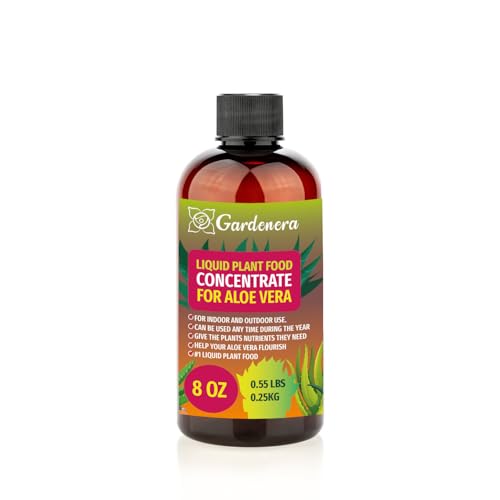
This concentrated liquid superfood from Gardenera packs 18 essential nutrients sourced from poultry litter, bat guano, worm castings, kelp meal, and humic shale, processed through a proprietary Zymology method that breaks ingredients into readily absorbable elements. The aloe-specific label makes formulation targeting straightforward, and the 1:128 dilution ratio means each 8 oz bottle goes a long way. Users report noticeable leaf plumping and color improvement within two weeks of starting regular use.
The all-natural ingredient list is attractive for growers who use aloe gel for skin care or culinary purposes, as the formula contains no synthetic chemicals. The product is also fish- and reptile-safe, making it safe for vivarium and terrarium setups that include aloe vera. Because it never expires in any dilution, you can safely mix larger batches and store them for later use.
The main downside is that the bottle requires a relatively high dilution rate — 2 tablespoons per gallon — meaning it disappears faster than expected if you have a large plant collection. Some users wish the label had clearer instructions for direct-soil application versus mixing. Nonetheless, for an organic concentrate with this many nutrient sources, the value is strong.
What works
- 18 organic nutrient sources for broad nutrition
- Safe for terrariums and vivariums
- Never expires — stable in storage
What doesn’t
- Small bottle consumed quickly with many plants
- Label instructions could be more precise
5. Schultz Cactus Plus 2-7-7
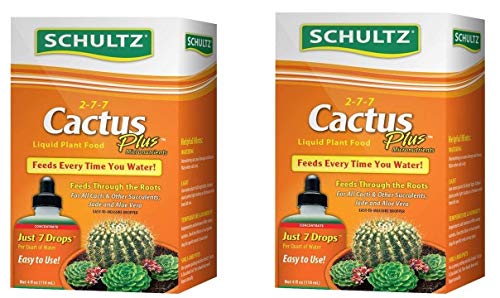
The Schultz Cactus Plus 2-7-7 is a synthetic liquid concentrate built around a high-phosphorus, high-potassium ratio that prioritizes root health over leaf expansion. The 2-7-7 analysis is one of the most aggressive phosphorus levels available for succulents, making this a top-tier choice for aloe owners who want to promote deep root anchoring and compact leaf rosettes. The concentrate dilutes at 1 teaspoon per gallon of water — a tiny amount for each feeding, so the two-pack lasts a very long time.
Multiple long-term users report that switching to this fertilizer turned their aloe plants from “surviving” to “thriving,” with visibly thicker leaves and more pups. The low nitrogen content is ideal for aloe vera grown indoors under moderate light, where excessive nitrogen would cause weak, elongated growth. Reviewers with Christmas cactus also highlight spectacular blooming, confirming the 7 phosphorus value encourages flower production for succulent species.
The biggest caveat is that the high phosphorus concentration makes it unsuitable for every watering — over-application can lead to nutrient lockout. It is best used twice a year for slow-growing cacti, or monthly during the spring and summer growing season for fast-growing aloe. Some users also note that the 4 oz bottle is small, but the high concentration compensates by stretching far past standard liquid fertilizers.
What works
- 2-7-7 NPK builds dense root systems
- Highly concentrated — small dose per gallon
- Long-lasting — two-pack covers many plants
What doesn’t
- Easy to over-fertilize if not diluted carefully
- Not organic — synthetic formula
6. Gardenera Plant Superfood Spray for Aloe Vera
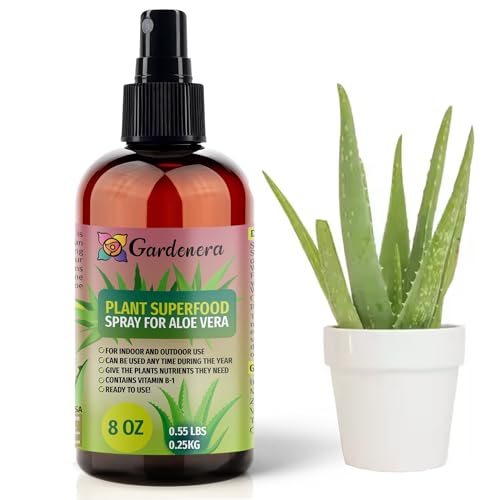
This spray-on formula from Gardenera is designed for foliar feeding and direct root-zone application, featuring Vitamin B-1 to stimulate root development and glucose for an immediate energy boost. It works as a rescue treatment for aloe vera plants suffering from transplant shock, sunburn, or general weakness. The spray format makes it easy to target the leaves and base of the plant without disturbing the soil structure.
Users report that aloe plants that looked pale and droopy perked up within days of the first application. The inclusion of iron, manganese, and zinc addresses micronutrient deficiencies that often appear as yellowing leaf tips or stunted growth. It is also effective year-round, making it a good option for indoor aloe owners who want a quick, no-mix solution during winter months when the plant is semi-dormant.
The spray bottle design has received mixed feedback — some users find the trigger mechanism inconsistent compared to the original handle-grip version. The bottle is also relatively small for the price, and because it is a ready-to-use spray, it is consumed faster than concentrated liquids. But for targeted recovery treatment, the formula itself works as advertised.
What works
- Vitamin B-1 reduces transplant shock
- Glucose provides quick energy for recovery
- Foliar spray reaches leaves and roots
What doesn’t
- Spray bottle quality is inconsistent
- Small bottle consumed quickly with frequent use
7. Cute Farms Succulent, Cacti, & Aloe Fertilizer
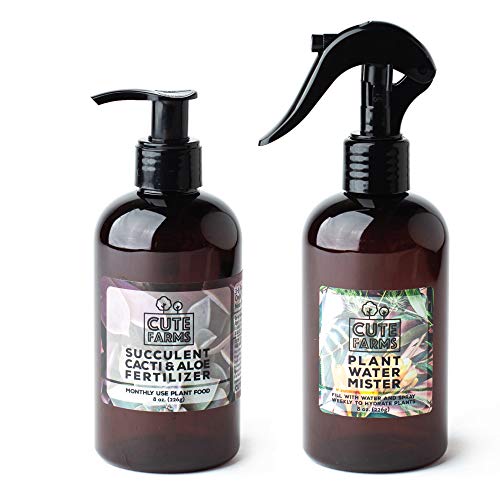
The Cute Farms Succulent Fertilizer is a low-strength, pre-mixed liquid with an NPK of 0.02-0.02 — essentially a maintenance dose that is almost impossible to overdo. It comes with a dispensing pump that measures out a perfect amount (3-5 pumps per plant), plus a free fine-mist spray bottle for watering. This is the option for beginners who are nervous about mixing concentrates or burning their first aloe vera plant. The formula is designed for all xerophytes, from aeonium to zebra plants, so it is one-size-fits-all for succulent collections.
Customer reviews consistently describe the product as “easy to use” and note that aloe plants start producing new growth after a single monthly feeding. The inclusion of a care guide helps new owners understand the plant’s light and watering needs. Many buyers mention that the pump lock system prevents leaks during storage, a nice detail for a budget-friendly product.
The extreme dilution means this fertilizer will not correct severe nutrient deficiencies — it is a maintenance food, not a rescue formula. Some experienced growers find it too weak to produce noticeable changes in established aloe plants. For those with a large aloe collection, this may require buying more bottles throughout the year. Still, as a starter fertilizer for small houseplants, it covers the basics without risk.
What works
- Ultra-gentle formula — no risk of root burn
- Pre-mixed — no measuring or diluting
- Includes a fine-mist spray bottle for watering
What doesn’t
- Too weak for nutrient-deficient plants
- Requires multiple bottles for larger collections
Hardware & Specs Guide
NPK Ratio — The Only Number That Matters
Aloe vera requires an NPK ratio where phosphorus and potassium are equal to or higher than nitrogen. Ratios like 2-7-7 or 1-2-2 are ideal. A high first number (nitrogen) forces leaves to stretch thin and turn pale. Always check the three-digit code on the label before buying. If the nitrogen number exceeds the other two, the formula is wrong for aloe.
Dilution Safety — Half-Strength Rule
When using a concentrated liquid fertilizer, dilute it to half the manufacturer’s recommended dose for the first two feedings. Aloe roots are sensitive to salt buildup. If the label says 1 teaspoon per gallon, start with ½ teaspoon. Once you see healthy leaf color and firmness, you can increase to the full dose. Over-fertilization shows as brown leaf tips and mushy lower leaves.
FAQ
How often should I fertilize my aloe vera plant?
Can I use a general houseplant fertilizer on aloe vera?
Is organic or synthetic fertilizer better for aloe vera?
What happens if I over-fertilize my aloe vera?
Final Thoughts: The Verdict
For most gardeners, the fertilizer for aloe vera winner is the Growth Technology GT Succulent Focus because it provides a pH-buffered solution with all 12 essential minerals, giving aloe owners scientific-grade control over feeding without the risk of nutrient lockout. If you want a convenient pump-and-go option, grab the Miracle-Gro Succulent Plant Food. And for organic, skin-safe feeding, nothing beats the Espoma Organic Cactus! Plant Food.