
Weeds are the biggest thief of curb appeal, stealing water and nutrients meant for your grass. A dual-action fertilizer that targets broadleaf weeds while feeding the turf is the most efficient weapon for the average homeowner — one pass, two jobs, a healthier lawn.
I’m Rikta — the co-founder and writer behind Lawn Gear Lab. I spend my time dissecting NPK ratios, comparing herbicide active ingredients, and cross-referencing thousands of owner reports to separate marketing claims from real results in the lawn care aisle.
This guide ranks the top performers based on weed-kill spectrum, nitrogen-release profiles, and coverage value to help you find the best fertilizer to kill weeds and grow grass for your lawn’s specific condition.
How To Choose The Best Fertilizer To Kill Weeds And Grow Grass
Selecting a weed-and-feed product is not as simple as grabbing the cheapest bag. The active herbicide, the nitrogen source, and the particle size all determine whether your lawn gets greener or stays patchy.
Herbicide Type: Pre-Emergent vs. Post-Emergent
Pre-emergent weed-and-feed formulas (like those containing Dimension or Prodiamine) stop weed seeds from germinating — they are ideal for early spring crabgrass prevention but will not kill existing weeds. Post-emergent formulas (with 2,4-D, Mecoprop, or Dicamba) attack broadleaf weeds that are already visible. Some products combine both approaches, but you must match the timing to your weed pressure.
Nitrogen Profile: Quick-Release vs. Slow-Release
Nitrogen is the primary driver of green growth, but too much fast-release nitrogen burns leaf tips and causes a surge that attracts disease. Look for at least 30% slow-release nitrogen (often listed as WIN or polymer-coated sulfur-coated urea) in the NPK mix. This keeps grass fed steadily for 8 to 12 weeks without the boom-and-bust cycle.
Particle Size and Coverage
Fine particle products (like Jonathan Green and The Andersons lines) distribute more particles per square inch, reducing the chance of striping or missed spots. Standard granular products (like Scotts) rely on larger prills that require precise spreader calibration. Check the sq-ft coverage per bag to align with your lawn size — buying a 10,000-sq-ft bag for a 4,000-sq-ft yard wastes money and risks over-application.
Quick Comparison
On smaller screens, swipe sideways to see the full table.
| Model | Category | Best For | Key Spec | Amazon |
|---|---|---|---|---|
| GreenView Fairway Formula | Post-Emergent | Large lawns needing long feeding | 27-0-5 with 63% slow-release N | Amazon |
| The Andersons Surge 16-0-9 | Post-Emergent | Large properties / pro-grade results | 16-0-9, covers 16,000 sq ft | Amazon |
| Scotts Turf Builder Weed and Feed | Post-Emergent | Targeting dandelions and clover | 2,4-D 1.22%, Mecoprop 0.081% | Amazon |
| Jonathan Green Green-Up 21-0-3 | Post-Emergent | Controlling 250+ weed species | 21-0-3, covers 5,000 sq ft | Amazon |
| The Andersons Dimension 26-0-6 | Pre-Emergent | Crabgrass prevention (spring) | 26-0-6 with Dimension herbicide | Amazon |
| Scotts Turf Builder Healthy Plus | Fungicide+Fertilizer | Disease-prone / stressed lawns | Systemic fungicide + lawn food | Amazon |
| Jonathan Green Corn Gluten 10-0-2 | Pre-Emergent Organic | Pet/kid-safe weed prevention | 10-0-2, 100% corn gluten meal | Amazon |
In‑Depth Reviews
1. GreenView Fairway Formula 27-0-5

The GreenView Fairway Formula hits the sweet spot between price-per-pound and nitrogen performance. With a 27-0-5 NPK ratio and a remarkable 63% of that nitrogen in slow-release form, it feeds your lawn for up to 12 weeks without the sharp growth surge that invites disease. The 33-pound bag covers 10,000 square feet — enough for a typical half-acre lot without needing a second purchase.
Owner reports consistently describe a deep, dark green color within days of the first rain, and the 27% nitrogen level provides the kind of vegetative push that helps turf outcompete annual weeds over time. The zero-phosphate formulation also makes it a responsible choice for properties near waterways or areas with phosphorus restrictions.
Where this product falls short is its lack of a built-in herbicide — it is strictly a nitrogen feeder. To kill existing broadleaf weeds, you will need to pair it with a separate post-emergent spray. For straight nutrition with long residual feeding, though, this is the most cost-effective premium option on the market.
What works
- 63% slow-release nitrogen for steady 12-week feeding
- Zero phosphate protects local waterways
- Large 10,000-sq-ft coverage bag saves trips
What doesn’t
- Contains no herbicide — only fertilizer function
- High nitrogen content can burn if spreader is miscalibrated
2. The Andersons Surge 16-0-9
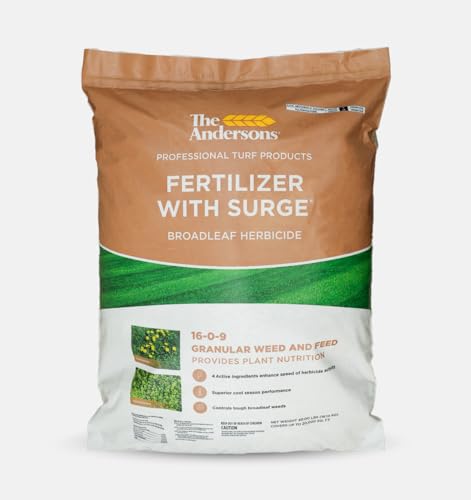
The Andersons Professional Surge is a four-way post-emergent weed-and-feed designed for serious acreage. The 16-0-9 analysis provides a solid potassium boost for root strength while the herbicide cocktail eliminates over 250 broadleaf weeds, including dandelions, clover, chickweed, and plantain. The tiny granule size ensures thousands of particles per square foot, which virtually eliminates striping and missed patches.
Owners report that this product works remarkably well even in the cooler temperatures of spring and fall — a period when many weed-and-feed products lose efficacy. The 40-pound bag covers an impressive 16,000 square feet, making it the most coverage-efficient option in this review for anyone with a large property. Several users noted it killed creeping charlie after other products failed.
The biggest limitation is the restricted species list — it is not safe for Floratam St. Augustine, dichondra, carpetgrass, or creeping bentgrass. It also carries a premium price tag, though the per-square-foot cost is actually competitive given the coverage. Not sold in New Hampshire or Washington state.
What works
- Eliminates 250+ broadleaf weeds including creeping charlie
- Fine granule size for even, streak-free coverage
- Massive 16,000-sq-ft coverage per bag
What doesn’t
- Not safe for several warm-season grass types
- Higher upfront cost despite good per-sq-ft value
3. Scotts Turf Builder Weed and Feed
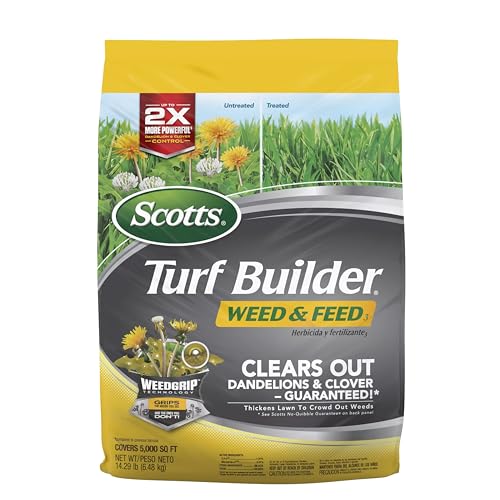
Scotts Turf Builder Weed and Feed is the most recognized name in the category for a reason — it delivers consistent, predictable results on dandelions and clover. The active ingredients (2,4-D at 1.22% and Mecoprop at 0.081%) target broadleaf weeds aggressively while the fertilizer component thickens the turf to crowd out future invaders. The hose-end spray version (available separately) is equally effective and easier for small lawns.
User feedback highlights the importance of proper application timing: the granular version requires damp weeds for the prills to stick, followed by a 48-hour dry period without watering. Owners who follow the directions see dramatic weed clearance and a noticeably greener lawn within two weeks. Many users compare it favorably against professional lawn service results at a fraction of the cost.
The primary drawback is that it struggles against crabgrass and clover — several owners noted those species survived the treatment. The 14.3-pound bag covers only 5,000 square feet, so larger properties will need multiple bags. It is also not suitable for all grass types, so always check the label before broadcast spreading.
What works
- Strong post-emergent control of dandelions and clover
- Easy to find and apply with standard spreaders
- Noticeable greening within two weeks of application
What doesn’t
- Weak against crabgrass and some clover species
- Smaller bag size requires multiple units for larger lawns
4. Jonathan Green Green-Up 21-0-3

Jonathan Green’s Green-Up Weed & Feed boasts one of the most comprehensive weed-kill profiles in the consumer market, listing control over more than 250 broadleaf weeds including thistle, poison ivy, and wild onions. The 21-0-3 analysis delivers steady nitrogen feeding for up to three months, and the fine particle size ensures that every square inch of the lawn receives both herbicide and nutrition.
Many owners who switched from big-box brands reported that this formula was the first product to actually clear stubborn weeds like thistle and wild violet. The 15-pound bag covers 5,000 square feet, and the best application window is late spring or early fall when weeds are actively growing. Users with centipede or carpet grass were especially pleased with the color response.
The trade-off is that the bag is relatively small for the price — some owners felt the per-pound cost was high. A few also noted that the product did not kill every weed species as claimed, particularly mature weeds with deep taproots. It cannot be used at the same time as overseeding, so plan your lawn renovation schedule around it.
What works
- Controls over 250 weed species including thistle and poison ivy
- Fine-granule design eliminates streaking
- Slow-release nitrogen feeds up to three months
What doesn’t
- Small bag size for the price point
- Not compatible with new seeding applications
5. The Andersons Dimension 26-0-6
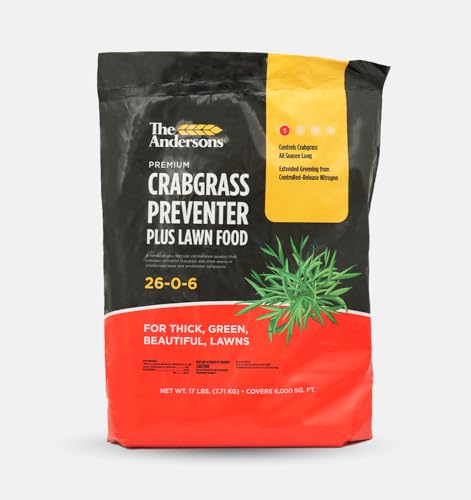
The Andersons Premium Crabgrass Preventer Plus Fertilizer is the pre-emergent king of this lineup. The 26-0-6 NPK ratio is paired with Dimension (dithiopyr) as the active ingredient, providing up to four months of protection against 24 grass and broadleaf weeds. The quick-release nitrogen gives an immediate spring green-up, while the slow-release component sustains feeding through the early growing season.
Owner feedback shows strong results against crabgrass when applied before soil temperatures reach 55°F. The 17-pound bag covers 6,000 square feet, and users praised the easy spreader calibration. Several homeowners noted that combining this with a later post-emergent application gave them the cleanest lawn they had ever had.
The major downside is that this is a pre-emergent only — it will not kill existing weeds. It also carries a burn risk if applied too heavily, and it is restricted in several states (NY, FL, CA, IN) due to the Dimension concentration. Not suitable for dichondra or bentgrass lawns.
What works
- Up to four months of crabgrass prevention
- Dual quick- and slow-release nitrogen for steady feeding
- Easy spreader calibration and consistent coverage
What doesn’t
- Will not kill existing weeds (pre-emergent only)
- Not sold in NY, FL, CA, IN
6. Scotts Turf Builder Healthy Plus

Scotts Turf Builder Healthy Plus Lawn Food is a unique 2-in-1 product that combines a broad-spectrum systemic fungicide with lawn food. It targets 27 types of lawn diseases, including brown patch, leaf spot, powdery mildew, and red thread, while simultaneously feeding the turf to help it recover from summer stress. This is not a traditional weed killer, but it excels at preventing the conditions that allow weeds to invade weak, diseased turf.
Users report that this product dramatically reduced clover infestations and eliminated visible fungus within a single application cycle. The grass response is rapid — owners noted a deep green color and denser growth within two weeks. The 13.7-pound bag covers 4,000 square feet, making it ideal for smaller lawns or targeted spot treatment of problem areas.
The main limitation is that it does not contain a traditional broadleaf herbicide — it is a fungicide plus fertilizer, not a weed killer. Over-application can burn the grass, so precise spreader calibration is essential. The coverage is also smaller than most other products in this guide, so larger properties will need multiple bags.
What works
- Controls 27 types of lawn diseases with systemic fungicide
- Fertilizer helps grass recover from heat and stress
- Visible green-up and thickening within two weeks
What doesn’t
- No broadleaf herbicide — not a true weed killer
- Small coverage area per bag
7. Jonathan Green Corn Gluten 10-0-2

Jonathan Green Corn Gluten Lawn Fertilizer is the only organic pre-emergent option in this list. With a 10-0-2 NPK ratio derived from 100% corn gluten meal, it provides gentle feeding and deep greening while preventing crabgrass and other weed seeds from germinating. The biggest advantage is safety — it is safe to use around children and pets immediately after application, and it can be used in flower gardens and planting beds without damaging ornamentals.
Homeowners who prioritize organic lawn care consistently praise this product for its lack of synthetic chemicals. Timing is everything with corn gluten: it must be applied before weed seeds germinate, typically in early spring when soil temperatures hit 50-55°F. Users who time it correctly report minimal crabgrass and a lush, green lawn without worrying about toxic runoff.
However, corn gluten is a pre-emergent only — it will not kill existing weeds. Some users found that spurweed and other tough broadleaf species emerged despite treatment. The fertilizer analysis is also much lower than synthetic options, so grass may not green up as dramatically. It is also more expensive per square foot than conventional weed-and-feed products.
What works
- 100% organic corn gluten — safe for kids and pets
- Prevents crabgrass germination when timed correctly
- Can be used in flower beds without burning plants
What doesn’t
- Will not kill existing weeds (pre-emergent only)
- Lower nitrogen content provides less dramatic greening
Hardware & Specs Guide
NPK Ratio
The three-number sequence on a fertilizer bag represents Nitrogen (N) for leaf growth, Phosphorus (P) for root development, and Potassium (K) for overall plant health. For a weed-and-feed product, a high first number (20-30) indicates strong greening power, while a zero in the middle (like 27-0-5) means no phosphorus — common in phosphorus-restricted areas. Products like Jonathan Green Green-Up use 21-0-3 for a balanced feed, while The Andersons Surge uses 16-0-9 with higher potassium for root and stress tolerance.
Slow-Release Nitrogen Percentage
This spec tells you how much of the total nitrogen is coated or formulated to break down gradually over weeks. GreenView Fairway Formula leads with 63% slow-release, feeding for up to 12 weeks. Products with higher slow-release percentages reduce the risk of leaf burn and provide consistent color without mowing surges. Quick-release nitrogen gives an immediate green flush but fades quickly and can cause thatch buildup if overused.
Active Herbicide Ingredients
Post-emergent weed-and-feed products rely on broadleaf herbicides like 2,4-D, Mecoprop, Dicamba, or Dimension (dithiopyr) for pre-emergent action. The concentration percentage on the label determines potency — Scotts uses 1.22% 2,4-D, while professional-grade products may use multiple active ingredients for broader weed control. Always match the herbicide spectrum to your specific weed pressure (dandelions, clover, crabgrass, wild onion, etc.).
Particle Size and Coverage Density
Fine-granule products (The Andersons Surge, Jonathan Green) deliver 3-5 times more particles per square foot than standard prill-based fertilizers. This reduces the chance of striping and ensures each weed receives a direct herbicide hit. Coverage is measured in square feet per bag — 5,000 sq ft is standard for consumer bags, while professional bags like The Andersons Surge cover up to 16,000 sq ft. Always measure your lawn before buying.
FAQ
Can I use a weed-and-feed fertilizer on a newly seeded lawn?
How long does it take for a weed-and-feed to show results?
What does the NPK ratio mean on a weed-and-feed bag?
Final Thoughts: The Verdict
For most gardeners, the fertilizer to kill weeds and grow grass winner is the The Andersons Surge 16-0-9 because it combines professional-grade broadleaf control with massive 16,000-sq-ft coverage at a competitive per-square-foot price. If you want a simpler, budget-friendly option that targets common weeds like dandelions and clover, grab the Scotts Turf Builder Weed and Feed. And for organic-focused homeowners who need safe pre-emergent prevention around kids and pets, nothing beats the Jonathan Green Corn Gluten 10-0-2.