
Watching a beloved tree succumb to borers, scale, or aphids is frustrating, especially when foliar sprays fail to reach the pests hidden inside the bark or canopy. Systemic insecticides solve this by traveling through the tree’s vascular system, delivering protection from the roots up to the newest leaves. The challenge is choosing the right formulation—soil drench, granule, or trunk implant—and the correct active ingredient for your specific pest and tree species.
I’m Rikta — the co-founder and writer behind Lawn Gear Lab. After weeks of cross-referencing technical labels, comparing active ingredient concentrations, reading hundreds of verified owner experiences, and studying university extension recommendations, I put together this guide to help you pick the most effective systemic treatment for your trees.
Whether you are battling emerald ash borers, Japanese beetles, or tent caterpillars, the right systemic insecticide for trees depends on matching the delivery method and active ingredient to your specific pest, tree size, and growing conditions.
How To Choose The Best Systemic Insecticide For Trees
Selecting a systemic tree insecticide is not a one-size-fits-all decision. The effectiveness of the treatment depends on the active ingredient, the application method, the tree species, and the life cycle of the target pest. Understanding these factors will save you time, money, and repeated treatments.
Active Ingredient Selection
Three main active ingredients dominate the consumer market: imidacloprid, acephate, and dinotefuran. Imidacloprid is the most common and offers broad-spectrum control of sap-feeding insects like aphids, scale, and lace bugs. Acephate is an organophosphate often delivered via trunk implants for rapid control of caterpillars and borers. Dinotefuran moves through the tree faster but has a shorter residual. Match the ingredient to the pest—not all actives kill every insect.
Application Method: Drench vs. Implant vs. Granule
Soil drenches are poured around the root zone and rely on root uptake, making them ideal for trees with accessible root areas and healthy soil. Trunk implants bypass soil conditions and deliver insecticide directly into the xylem, which is faster and works well in clay-heavy or dry soils. Granules are sprinkled on the soil surface and watered in, offering a slow-release option for turf-adjacent trees. Factors like soil moisture, tree diameter, and slope influence which method works best.
Application Timing
Systemic insecticides must be applied before or at the start of pest activity. For soil drenches, apply in early spring when roots are actively taking up water. For trunk implants, treat in late spring or early summer after full leaf expansion. Late applications often fail because the pest has already caused irreversible damage. Always check the product label for timing recommendations specific to your target pest and region.
Pollinator and Environmental Impact
Many systemic insecticides are highly toxic to bees, butterflies, and other beneficial insects that forage on flowers or tree sap. Avoid applying to trees that are actively blooming, and never treat flowering plants underneath the canopy. Trunk implants significantly reduce environmental drift compared to drenches, making them a safer choice near water sources or pollinator habitats. Always follow local regulations regarding neonicotinoid use.
Quick Comparison
On smaller screens, swipe sideways to see the full table.
| Model | Category | Best For | Key Spec | Amazon |
|---|---|---|---|---|
| Quali-Pro Imidacloprid T&O 2F | Liquid Concentrate | Large-scale turf & ornamental | 21.8% Imidacloprid | Amazon |
| Monterey Once A Year Insect Control II | Soil Drench | Year-long tree & shrub protection | 1 Gallon, 128 fl oz | Amazon |
| Acecap AC4X75 Tree Implant | Trunk Implant | Rapid control in large trees | 75 Capsules, Acephate | Amazon |
| Acecap 25-Pack Systemic Insecticide Tree Implants | Trunk Implant | DIY borer & caterpillar control | 25 Capsules, 3/8-inch | Amazon |
| Bayer Merit 0.5 Granular Systemic Insect Control | Granular | Turf & root-zone management | 0.5% Imidacloprid, 30 lb | Amazon |
| Vpg Fertilome Gallon Tree & Shrub Systemic Insect Drench | Soil Drench | Budget-friendly tree & shrub care | 1 Gallon, 128 fl oz | Amazon |
| Monterey Fruit Tree & Vegetable Systemic Soil Drench | Soil Drench | Edibles & fruit tree protection | 1 Gallon, 128 fl oz | Amazon |
In‑Depth Reviews
1. Quali-Pro Imidacloprid T&O 2F Insecticide (Generic Merit)

Quali-Pro’s Imidacloprid T&O 2F is the concentrated formulation that landscape professionals reach for when they need reliable systemic control across a wide range of trees, shrubs, and turf. At 21.8% imidacloprid, this is a higher concentration than most consumer retail products, which means lower application rates per tree and more treatments per bottle. It is labeled for soil-drench application around ornamentals and non-bearing fruit trees, making it a versatile weapon against Japanese beetles, aphids, scale, leafhoppers, and whiteflies.
Homeowners report rapid results on severe infestations—one saved 13 dying laurels after other treatments failed. The liquid mixes easily with water and stays stable when stored properly. The product is certified by the EPA and comes in a 1-gallon jug that, at the recommended dilution rates, can treat multiple mature trees or an entire shrub border. It is not approved for use on edible vegetable crops, so restrict it to ornamentals, lawns, and non-food trees.
For the price per ounce of active ingredient, this is the most cost-effective option for anyone managing a larger property or multiple trees. The trade-off is the smell—some users describe it as strong and unpleasant—and the need for careful measuring to avoid over-application. If you want professional-grade results without the professional price tag, this is the clear frontrunner.
What works
- Highest imidacloprid concentration in this tier for maximum coverage
- Effective against borers, scale, aphids, and whiteflies from a single drench
- Excellent value per square footage treated
What doesn’t
- Not labeled for use on edible fruit or vegetable trees
- Strong chemical odor during mixing and application
- Requires precise measurement to avoid runoff waste
2. Acecap AC4X75 Tree Implant

The Acecap AC4X75 is a bulk-pack of 75 acephate-loaded trunk implants designed for large trees with trunk diameters over 14 inches. Unlike soil drenches that depend on root uptake and soil moisture, these capsules are drilled directly into the trunk’s vascular tissue, bypassing environmental factors and delivering insecticide straight into the sap stream. This method is particularly effective against wood-boring pests like emerald ash borer, pine beetles, and caterpillars that foliar sprays cannot reach.
Verified owners report dramatic results—one treated 40 oaks and eliminated brown tail moth caterpillars that had defoliated trees for years. Another user applied them to a 80-foot pine tree threatened by beetle kill and watched it recover. The capsules provide season-long control and can last up to two seasons in evergreens. Application requires a cordless drill with a 3/8-inch bit, a hammer, and a bolt to tap the capsules flush with the bark.
At this price point, the AC4X75 pack is a premium investment, but it often replaces hundreds of dollars in professional tree injection services. The downsides are that it is not suitable for trees under 8 inches in diameter, and the acephate active is toxic to beneficial insects if the capsule is improperly placed. For homeowners with multiple large specimen trees facing aggressive borers, this is the most targeted and long-lasting solution available.
What works
- No soil or runoff contamination—direct trunk delivery
- Two-season residual in evergreens
- Proven against emerald ash borer and pine beetles
What doesn’t
- Not suitable for trees under 8-inch trunk diameter
- Requires a drill and hammer for installation
- Unclear instructions on hole depth and spacing
3. Monterey Once A Year Insect Control II
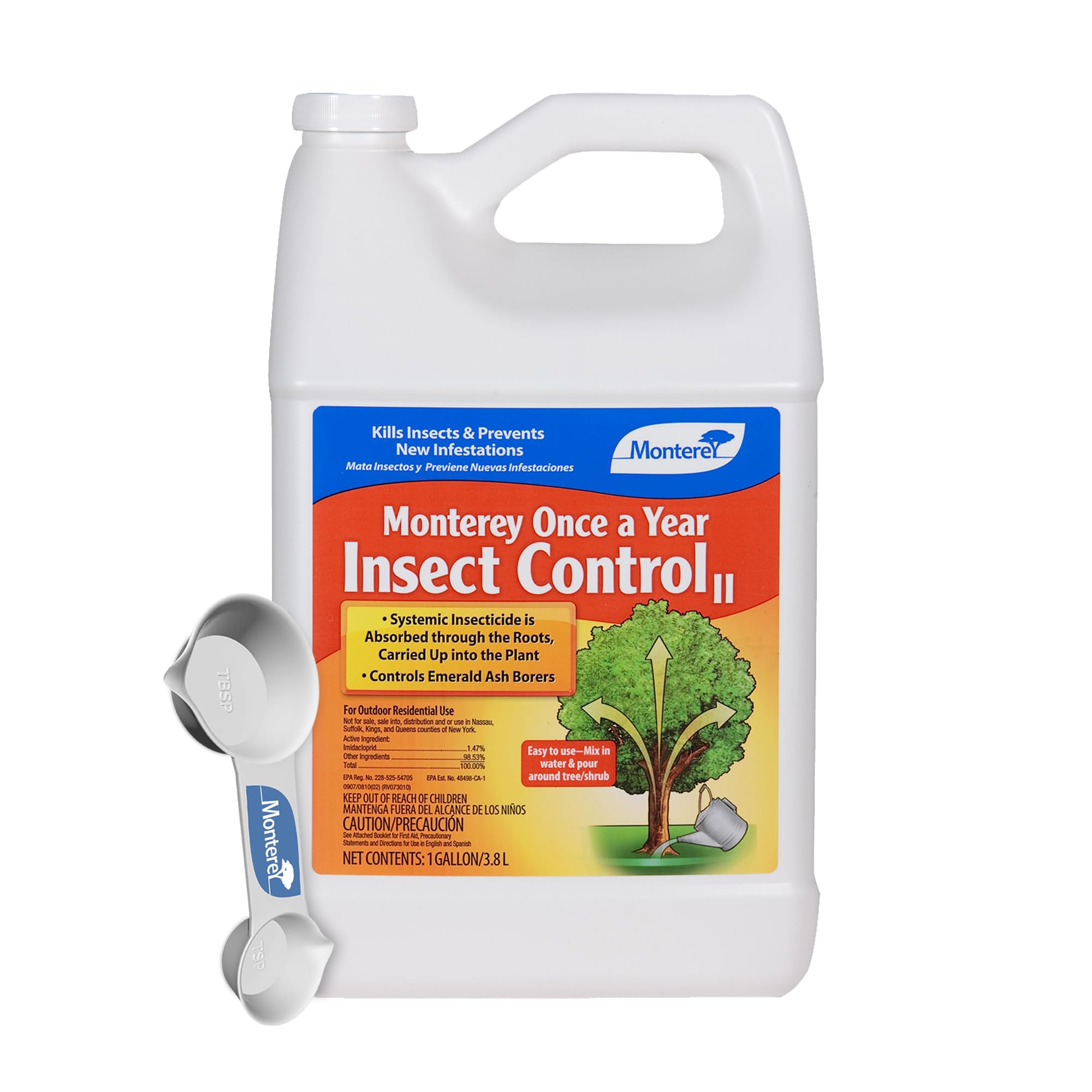
Monterey Once A Year Insect Control II is a soil-drench formulation that lives up to its name—a single application provides season-long protection against a broad spectrum of tree and shrub pests. The active ingredient, imidacloprid, moves through the soil into the root system and then distributes upward to all parts of the tree, including new growth. It is labeled for use on ornamental trees, shrubs, and select fruit trees including apple, pear, pecan, and loquat.
Reviews from verified buyers highlight its effectiveness on locust trees, azaleas, rhododendrons, and hydrangeas. One user eliminated borers and scale within days and reported no reinfestation nine months later. The bottle comes with a measuring spoon for accurate dosing, which helps avoid the common mistake of under-applying. The only significant quality-control concern is a known freeze-thaw issue—if the bottle freezes during shipping, the emulsion can curdle and become unusable, so inspect the consistency before mixing.
For homeowners who want a straightforward annual treatment without the need for drilling or special tools, this is the most convenient option. The 1-gallon jug treats multiple trees, and the measuring spoon ensures accuracy. If you live in a cold climate, buy when temperatures are above freezing or check the bottle immediately upon delivery to avoid a wasted application.
What works
- True 12-month residual with a single spring application
- Labeled for several fruit and nut tree species
- Comes with a measuring spoon for accurate mixing
What doesn’t
- Emulsion can break if exposed to freezing temperatures
- Requires careful application to avoid soil runoff
- Not for use on all edible crops—check label
4. Bayer Merit 0.5 Granular Systemic Insect Control

Bayer’s Merit 0.5 Granular is a slow-release formulation that delivers imidacloprid directly to the root zone of trees, shrubs, and turfgrass. The granules are applied with a push spreader or by hand, then watered in to activate the active ingredient. This method is ideal for treating multiple trees around a lawn because the granules also control soil-inhabiting pests like grubs and chinch bugs that damage turf roots. The 30-pound bag covers a significant area and provides season-long suppression.
Users have praised it for stopping emerald ash borers, elm leaf beetles, and pine borers. One reviewer with an ash tree infestation saw complete cessation of damage after two weeks. The granules also eliminated grubs that were causing brown patches in the lawn, and the mole activity disappeared once the grub food source was removed. The product is EPA-registered and can be used around established trees, shrubs, and flower beds as long as the granules are kept off foliage.
On the downside, the 0.5% concentration means you need a larger volume of product per treatment compared to liquid concentrates. The price per bag is elevated, but for those managing both tree and turf pests, the dual-purpose value is hard to beat. Apply before a steady rain for optimal soil incorporation, and avoid heavy downpours that cause runoff.
What works
- Controls tree pests and lawn grubs simultaneously
- Easy broadcast application with a spreader
- Long residual in the root zone for season-long protection
What doesn’t
- Lower concentration means larger volume needed per tree
- Not suitable for small shrubs or container plants
- Must be watered in immediately after application
5. Acecap 25-Pack Systemic Insecticide Tree Implants

This 25-pack of Acecap trunk implants offers the same acephate active ingredient as the larger AC4X75 pack, but in a smaller quantity designed for homeowners with one or two medium-sized trees. Ten implants treat a 14-inch diameter trunk, making this pack sufficient for a single large tree or two smaller ones. The capsules are ready to install with no measuring or mixing, which eliminates the risk of dosing errors and chemical spills.
Reviews confirm their effectiveness against a wide range of pests. One user treated a 50-foot tulip tree infested with aphids and saw the insects disappear within four days. Another longtime customer living in a high-desert region with heavy clay soil reports that Acecaps have consistently kept his trees the healthiest on the block. The capsules are also effective against elm beetles and pine beetles, with users noting the method’s superiority over soil drenches in dry or compacted soils.
The primary limitation is the installation process—you need a cordless drill with a 3/8-inch bit, a hammer, and a bolt to tap them flush. The depth is tricky on trees with thick bark, and the instructions could be clearer on spacing. However, for the DIYer who wants professional-grade trunk injection without the cost of a commercial service, this is the ideal entry point.
What works
- No mixing, measuring, or chemical handling
- Effective in clay and dry soils where drenches fail
- Results visible within days for sap-feeding insects
What doesn’t
- Not enough capsules for multiple large trees
- Installation depth can be inconsistent with thick bark
- Inadequate for trees under 8-inch diameter
6. Vpg Fertilome Gallon Tree & Shrub Systemic Insect Drench

Fertilome’s Tree & Shrub Systemic Insect Drench is a straightforward liquid formulation designed for homeowners who need reliable pest suppression without paying for professional-grade concentrations. The active ingredient is imidacloprid, mixed at 1 ounce per gallon of water and applied as a soil drench around the base of trees and shrubs. It covers the same pest spectrum as the more expensive concentrates—aphids, scale, borers, and leafminers—at a price that is often half of what local nurseries charge.
Customer experiences are consistently positive. A reviewer treating 45 hemlocks for adelgids found it highly effective, and another eliminated bagworms from a large tree with a single application. The product is backed by recommendations from nurseries and arborists. The clear instructions and fast delivery are frequently mentioned, along with the fact that it outperformed more expensive sprays and soaps in side-by-side tests.
The main caution is toxicity to pollinators—use it before flowering or after blooms have faded. The mixing ratio is easy to remember, and the gallon bottle provides multiple treatments for a typical suburban yard. If you want the same active ingredient as the premium options but need to stay within a tighter budget, this is the smart pick.
What works
- Half the cost of equivalent local nursery products
- Effective against adelgids, bagworms, and borers
- Simple 1 oz per gallon mixing ratio
What doesn’t
- Toxic to bees and other beneficial insects
- Not labeled for edible fruit or vegetable trees
- May require two applications for heavy infestations
7. Monterey Fruit Tree & Vegetable Systemic Soil Drench 1gal
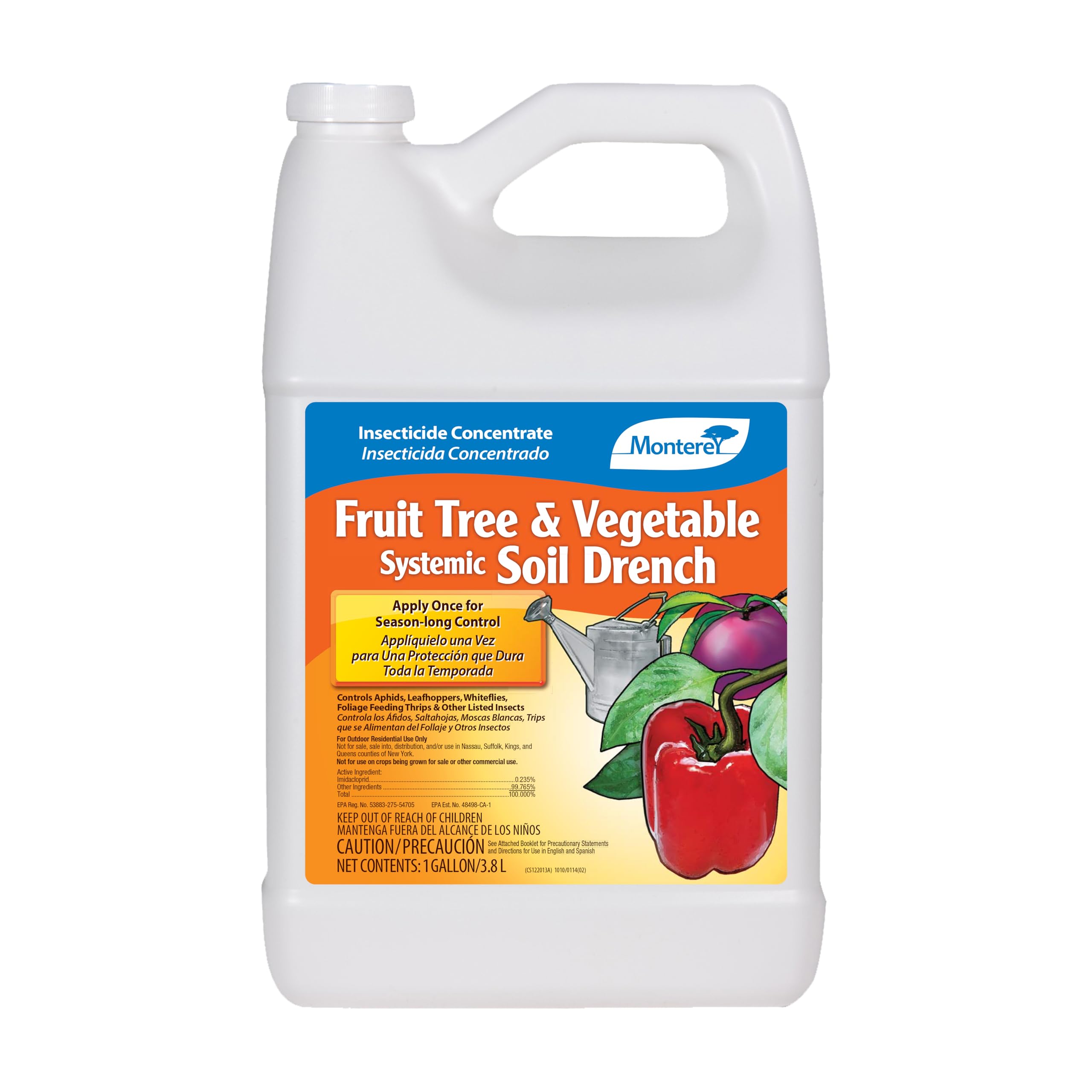
Monterey’s Fruit Tree & Vegetable Systemic Soil Drench is one of the few systemic insecticides labeled for use on edible crops. While it still contains imidacloprid, the label allows application on a wide range of fruit and nut trees—citrus, stone fruits, avocados, mangos, berries, and many more—plus vegetables and herbs. This makes it the only option in the roundup that can be used around the home orchard and vegetable garden, provided the user follows pre-harvest intervals.
Real-world results are impressive. A verified reviewer saved a 7-foot avocado tree suffering from severe lace bug infestation (70% leaf loss) and watched it bounce back with massive new leaf growth. Another user stopped moth worms on squash and saved their fruit trees at the same time. The product is mixed with water and poured over the soil at the base, requiring no spraying equipment or special PPE.
The biggest concern is the presence of imidacloprid on edible plants. While the product is EPA-approved for these uses, some consumers are uncomfortable with neonicotinoid residue. The low mammalian toxicity profile is reassuring, but if you are growing strictly organic produce, this is not a fit. For everyone else with pest-ravaged fruit trees and vegetables, this is the most versatile systemic available.
What works
- Labeled for fruit, nut, vegetable, and herb crops
- Restored heavily infested avocado and citrus trees
- No spraying—simple soil drench application
What doesn’t
- Imidacloprid is not approved for organic growing
- Some users report inconsistent results
- Pre-harvest intervals must be strictly followed
Hardware & Specs Guide
Understanding Active Ingredients
Imidacloprid is the most widely used neonicotinoid for tree systemic control. It targets the insect nervous system and is absorbed through roots, making it effective against sap-feeders and leaf-chewers. Acephate, an organophosphate, is used primarily in trunk implants for fast knockdown of caterpillars, borers, and beetles. Dinotefuran offers faster uptake but shorter residual, useful for acute infestations where immediate results are needed.
Soil Drench vs. Trunk Implant
Soil drenches require moist soil for root uptake and are best applied in early spring or fall. They are effective on trees with accessible root zones and work well in loamy soils. Trunk implants deliver insecticide directly into the xylem and are unaffected by soil conditions, making them ideal for clay soils, slopes, or trees surrounded by pavement. Implants also reduce environmental drift and pollinator exposure.
Application Rate Calculation
The correct dosage depends on trunk diameter and product concentration. For soil drenches, measure the trunk diameter at chest height (DBH) and calculate the volume of mixed solution needed—typically 1 ounce of concentrate per inch of DBH for a 21.8% formulation. For implants, 10 capsules treat a 14-inch diameter trunk. Over-application wastes product and risks environmental harm; under-application leads to pest resurgence.
Pollinator Safety Timeline
Systemic insecticides persist in tree tissues for weeks to months. To protect bees and butterflies, apply drenches before bud break in early spring or after all flowers have dropped. For implants, avoid treatment when trees are in active bloom. Neonicotinoid residues can appear in pollen and nectar, so even trees that are not directly sprayed can pose risks to foraging insects if applied during the wrong window.
FAQ
How long does a systemic insecticide take to work on trees?
Can I use a systemic insecticide on a tree that is currently flowering?
What is the difference between soil drench and trunk injection application?
Final Thoughts: The Verdict
For most gardeners, the systemic insecticide for trees winner is the Quali-Pro Imidacloprid T&O 2F because it delivers the highest concentration of active ingredient per dollar and handles the widest range of common tree pests with a single soil drench. If you want rapid, drift-free control of borers and caterpillars in large specimen trees, grab the Acecap AC4X75 Tree Implant. And for protecting fruit trees and edible crops without spraying, nothing beats the Monterey Fruit Tree & Vegetable Systemic Soil Drench.