
Compacted soil strangles your lawn’s root system, turning a lush yard into a hardpan that rejects water and nutrients. A pull-behind aerator solves this by mechanically coring the ground, allowing air, moisture, and fertilizer to reach the root zone where they matter most. The difference between a spike that punches a hole and a plug aerator that actually removes a core of soil defines whether your aeration effort pays off or just looks busy.
I’m Rikta — the co-founder and writer behind Lawn Gear Lab. I’ve spent hundreds of hours studying plug aerator designs, comparing tine metallurgy, weight-tray capacities, and hitch compatibility across dozens of models to understand which units deliver genuine soil relief versus which ones just roll over hard ground.
This guide breaks down the core specs, build quality, and real-world performance distinctions you need to confidently choose the right pull behind aerator for your property size, soil type, and tractor setup.
How To Choose The Best Pull Behind Aerator
Choosing a pull-behind aerator isn’t about grabbing the cheapest or the widest model. You need to match the machine to your soil’s resistance, your tractor’s tow capacity, and the acreage you plan to cover each season. Four factors separate an effective aeration tool from a frustrating lawn ornament.
Tine Type and Number
Plug aerators use hollow or spoon-shaped tines that extract a soil core, while spike aerators simply puncture. For compacted lawns, plugging is non-negotiable. More tines per pass mean faster coverage, but the tine material matters equally — galvanized steel resists rust and holds an edge longer than plain steel. Look for heat-treated or galvanized tines rated to penetrate at least 2 to 3 inches deep in the soil type you have.
Weight Tray Capacity
Tines only go as deep as the downward force pushing them. A weight tray lets you add ballast — concrete blocks, sand bags, or water-filled containers — to drive those tines into hard clay. Entry-level trays hold around 125 pounds; heavy-duty models support 175 to 200 pounds. If your ground is rock-hard in summer, lean toward a tray that can accept substantial weight without flexing or bowing.
Hitch and Transport Design
A universal hitch pin should fit your tractor’s drawbar without requiring adapters. Look for a cantilever or foot-operated lift mechanism that raises the tine bank off the ground for crossing paved surfaces. Flat-free tires reduce maintenance, while semi-pneumatic tires offer a smoother ride over uneven terrain. The transport lever should engage from the tractor seat to avoid dismounting every time you hit a driveway.
Deck Width and Maneuverability
Wider aerators cover more ground per pass, but they also create wider turning radiuses and heavier overall weight. A 40-inch model balances coverage and maneuverability for most residential lawns up to two acres. For larger properties, 48-inch units cut down on pass counts but require stronger tractors and more storage space. Independently rotating tine sections reduce turf tear-out during turns.
Quick Comparison
On smaller screens, swipe sideways to see the full table.
| Model | Category | Best For | Key Spec | Amazon |
|---|---|---|---|---|
| Field Tuff 48″ 3-Point | 3-Point Hitch | Large acreage | 54 coring plugs | Amazon |
| Brinly PA-403BH-A3 | Plug Aerator | Hard clay soil | 24 heat-treated spoons | Amazon |
| Agri-Fab 45-0299 | Plug Aerator | Professional turf care | 32 galvanized knives | Amazon |
| Brinly AS2-40BH-P | Combination | Overseeding + aeration | 132 tine tips | Amazon |
| Craftsman CMXGZBF7124213 | Plug Aerator | Mid-size yards | 24 galvanized points | Amazon |
| Suchtale LTA-005A | Plug Aerator | Value-focused buyers | 24 heat-treated plugs | Amazon |
| Suchtale B0F4XNZD38 | Spiker/Spreader | Multi-function use | 9 star-shaped tines | Amazon |
| AVVA Rolling Aerator | Push/Rolling | Small lawns, no tractor | 2-3″ core depth | Amazon |
| Agri-Fab 45-0606 | Lawn Roller | Leveling + rolling | 400 lb water capacity | Amazon |
In‑Depth Reviews
1. Field Tuff 48″ 3-Point Plug Aerator
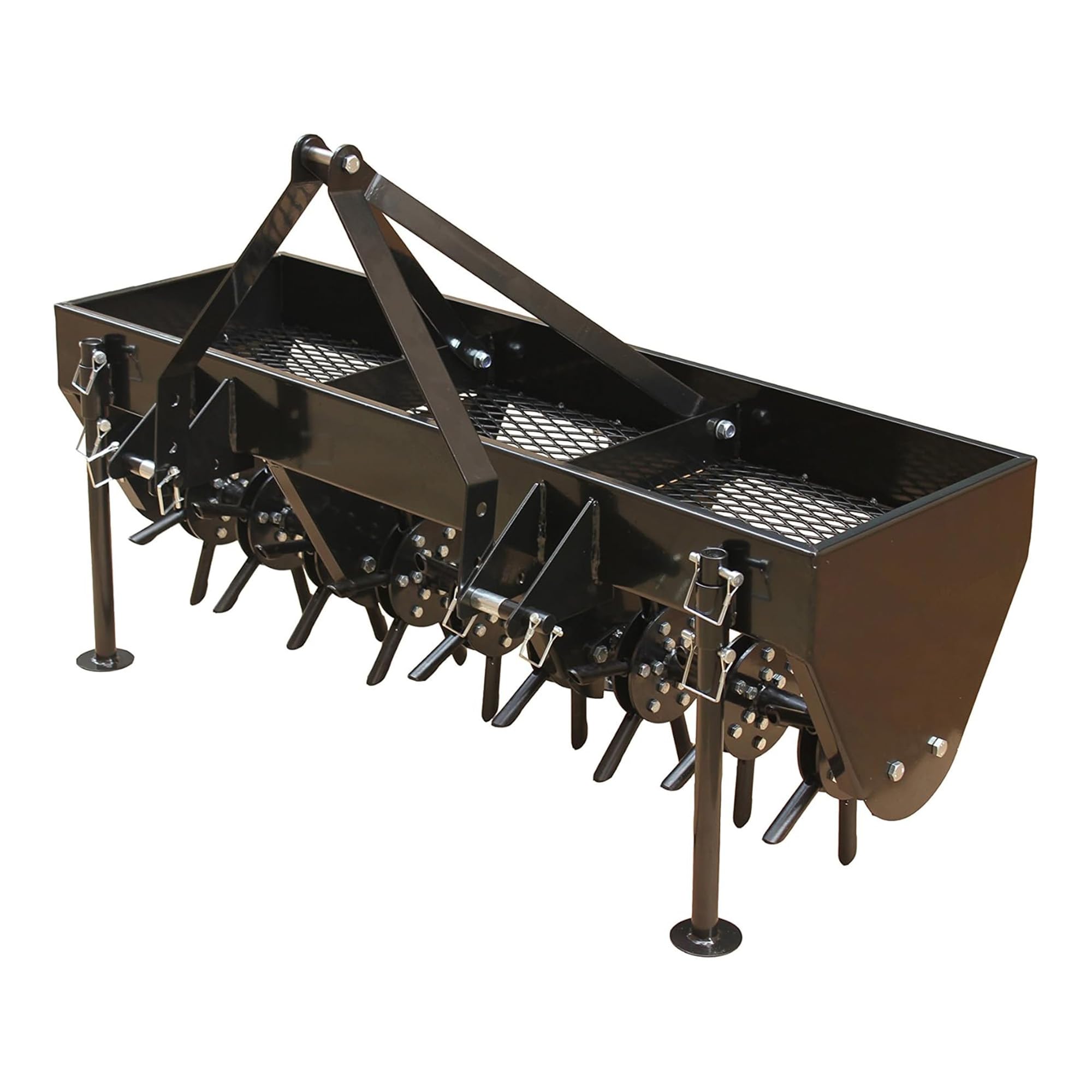
The Field Tuff 48-inch aerator is built for serious acreage, featuring 54 replaceable coring plugs that penetrate up to 3 inches deep across a wide swath. Its heavy-duty steel frame with a corrosion-resistant powder-coat finish handles repeated use on fields and compacted ground without flexing. The integrated weight tray accepts up to 200 pounds of cement blocks or sand bags, giving you the downward force needed for dense clay soils.
Unlike tow-behind units, this model uses a Category 0 or 1 three-point hitch, which provides superior lift and depth control from your tractor. Retractable feet allow you to raise the tines off the ground for transport or storage without damaging the plugs. Independent tine wheels rotate separately, minimizing turf tear-out during sharp turns.
Assembly is straightforward with clearly labeled parts, though some units may arrive with poorly welded grease zerks that require attention before use. The 48-inch width demands a tractor with adequate lift capacity, but for anyone managing several acres, the coverage speed and plug quality justify the investment.
What works
- 54 coring plugs deliver exceptional coverage per pass
- 200-pound weight tray handles deep clay penetration
- Independent tine sections reduce turf tearing on turns
What doesn’t
- Requires a tractor with 3-point hitch, not universal tow
- Weight tray can bow under heavy load without plywood reinforcement
- Some welds and grease fittings need inspection before first use
2. Brinly PA-403BH-A3 40″ Plug Aerator

Brinly’s PA-403BH-A3 uses 24 heat-treated, 16-gauge steel spoons designed with a narrower profile and sharpened ends for easier soil entry. This shape requires less ballast to achieve 3-inch plugs compared to broader spoon designs — a real advantage when you’re dealing with hard, compacted clay. The all-steel frame supports a fully enclosed weight tray rated for 150 pounds of any ballast type.
Transport is handled by a single lever that engages 10-inch semi-pneumatic rubber tires, allowing you to cross driveways and walkways without dragging the tines. Three independently rotating welded tine sections help maintain consistent penetration on uneven ground and reduce turf damage during turns. The universal hitch pin fits most lawn tractors, ZTRs, and ATVs.
Assembly takes around 1 to 2.5 hours depending on mechanical experience; the instructions cover multiple frame sizes, which can cause momentary confusion. Owners report pulling clean 2.5-inch plugs with minimal weight added, making this a strong choice for homeowners with tough soil who don’t want to max out the weight tray every pass.
What works
- Sharpened spoons penetrate hard clay with less added weight
- Enclosed 150-pound tray accepts blocks, sand, or water
- Transport lever works from tractor seat for easy driveways
What doesn’t
- Instructions can be confusing due to multi-size diagrams
- Attaching 24 individual spoons is tedious work
- Some hardware fitment quibbles reported in early units
3. Agri-Fab 45-0299 48″ Plug Aerator

The Agri-Fab 45-0299 is a 48-inch plug aerator equipped with 32 galvanized self-sharpening knives that pull cores up to 3 inches deep. Its weight tray supports up to 175 pounds of ballast, giving you substantial downward force for breaking through tough soil layers. Flat-free tires eliminate flats, and the cantilever transport handle lets you raise and lower the tine bank without dismounting.
Built in the USA by Agri-Fab, this unit uses galvanized knife construction that resists rust and maintains sharpness over many seasons. The universal hitch connects to most lawn and garden tractors, though the 48-inch width is best matched with a mid-to-large frame tractor that can handle the turning radius. Owners report that the machine requires added ballast — four bags of tube sand — to achieve full 3-inch penetration in dry conditions.
Assembly is manageable in about an hour, though the stamped steel edges may have sharp burrs that require deburring with a file before handling. The unit stores vertically to save garage space. Its primary trade-off is the cantilever lift: on some tractors, the handle may be difficult to engage from the seat, requiring a brief dismount to raise or lower the tines.
What works
- 32 self-sharpening galvanized knives for long tine life
- 175-pound weight tray handles heavy clay soils effectively
- Vertical storage saves garage floor space
What doesn’t
- Stamped parts have sharp burrs that require filing
- Lift handle may require dismounting on some tractors
- Needs substantial added weight for full depth in dry ground
4. Brinly AS2-40BH-P Combination Aerator Spreader

The Brinly AS2-40BH-P merges spike aeration with a broadcast spreader, allowing you to drop seed, fertilizer, or lime while the 3-D star tines perforate the soil. The patent-pending galvanized tines feature 132 individual tips that punch holes up to 2 inches deep, creating channels for the material to enter the root zone. The all-steel hopper holds 100 pounds of material with a calibrated flow control that minimizes waste.
An included rigid steel weight tray supports up to 75 pounds of extra ballast for increased penetration in harder ground. The single-lever transport engages 10-inch pneumatic tires for crossing pavement without damaging the tines. Assembly claims 30 minutes, but realistic build time runs closer to 45 minutes with two people to align the holes.
A small number of owners report gear drive failures shortly after first use, though the majority find the unit works well for overseeding and fertilizing in a single pass. The flow control adjustment notch feels a bit light-duty, and some users replace the plastic wing nut with a c-clamp for reliable lockup. If you want to combine aeration and seeding into one operation, this unit reduces field time significantly.
What works
- Combines spreading and aeration for time savings
- 132 tine tips create good soil perforation coverage
- Pneumatic transport wheels handle pavement transitions well
What doesn’t
- Gear drive durability concerns reported by some users
- Flow control adjustment is finicky and may loosen
- Requires two people for easier assembly
5. Craftsman CMXGZBF7124213 40″ Plug Aerator

The Craftsman 40-inch plug aerator, built by Agri-Fab in the USA, uses 24 galvanized steel coring points that extract soil plugs up to 3 inches deep. Its wide 140-pound weight tray provides ample ballast for tackling compacted lawns, and the flat-free tires eliminate puncture worries across the season. The lift handle release system lets you raise the tines for crossing paved areas without scraping.
This unit stores vertically to fit neatly against a wall, a practical detail for garages where floor space is tight. The universal hitch attaches to most lawn and garden tractors, and the steel frame feels robust enough to handle rocky or root-heavy soil without flexing. Owners consistently note the build quality outlasts cheaper plastic-laden competitors, especially when hitting subsurface obstacles.
Assembly is the biggest hurdle — expect 2 to 3 hours of work with detailed attention to bolt bags and diagrams. Several owners recommend watching a YouTube build video and using a set of wrenches rather than relying on the included tools. Once assembled, the machine pulls clean cores even on steep inclines, making it a solid workhorse for properties up to 1.5 acres.
What works
- Galvanized coring points resist rust and stay sharp
- 140-pound tray provides good weight capacity for clay soil
- Vertical storage saves garage space when not in use
What doesn’t
- Assembly requires several hours and mechanical patience
- Knives arrive uninstalled for safety, adding build time
- Directional diagrams in manual could be clearer
6. Suchtale LTA-005A 40″ Plug Aerator

The Suchtale LTA-005A brings 24 heat-treated coring plugs to a 40-inch frame with a 125-pound weight tray, targeting homeowners who want plug aeration without paying for a premium badge. The all-steel construction uses reinforced side plates and a 6-millimeter-thick adjustment handle — thicker than the 4-millimeter handles found on some budget alternatives. The universal two-piece steel draw bar connects to lawn tractors and ATVs via a pin-style hitch.
Each plug penetrates compacted soil up to 2 inches deep, and the weight tray accepts cement blocks or sand bags for increased force. The transport handle raises and lowers the tine bank for crossing walkways. Assembly runs 1 to 2 hours with the included detailed manual, and most parts come bagged by step, reducing sorting frustration.
Some owners report missing bolts in specific bags, though Amazon customer service resolves the issue quickly. The unit performs well on clay soil after a quarter-inch of rain, producing clean plugs that leave room for seed and water. A few users note that the steel could be thicker in the axle bracket area; adding washers to reduce lever play helps extend longevity. For the price, it delivers genuine core aeration capability.
What works
- 24 heat-treated plugs penetrate compacted clay effectively with added weight
- 125-pound tray accepts common ballast like bricks or sand
- Bagged parts and step-by-step manual simplify assembly
What doesn’t
- Some units arrive missing specific bolts in the hardware kit
- Axle bracket play requires washers for snug fit
- Wide frame less maneuverable on hilly terrain
7. Suchtale Upgrade 40″ Spiker Seeder & Spreader
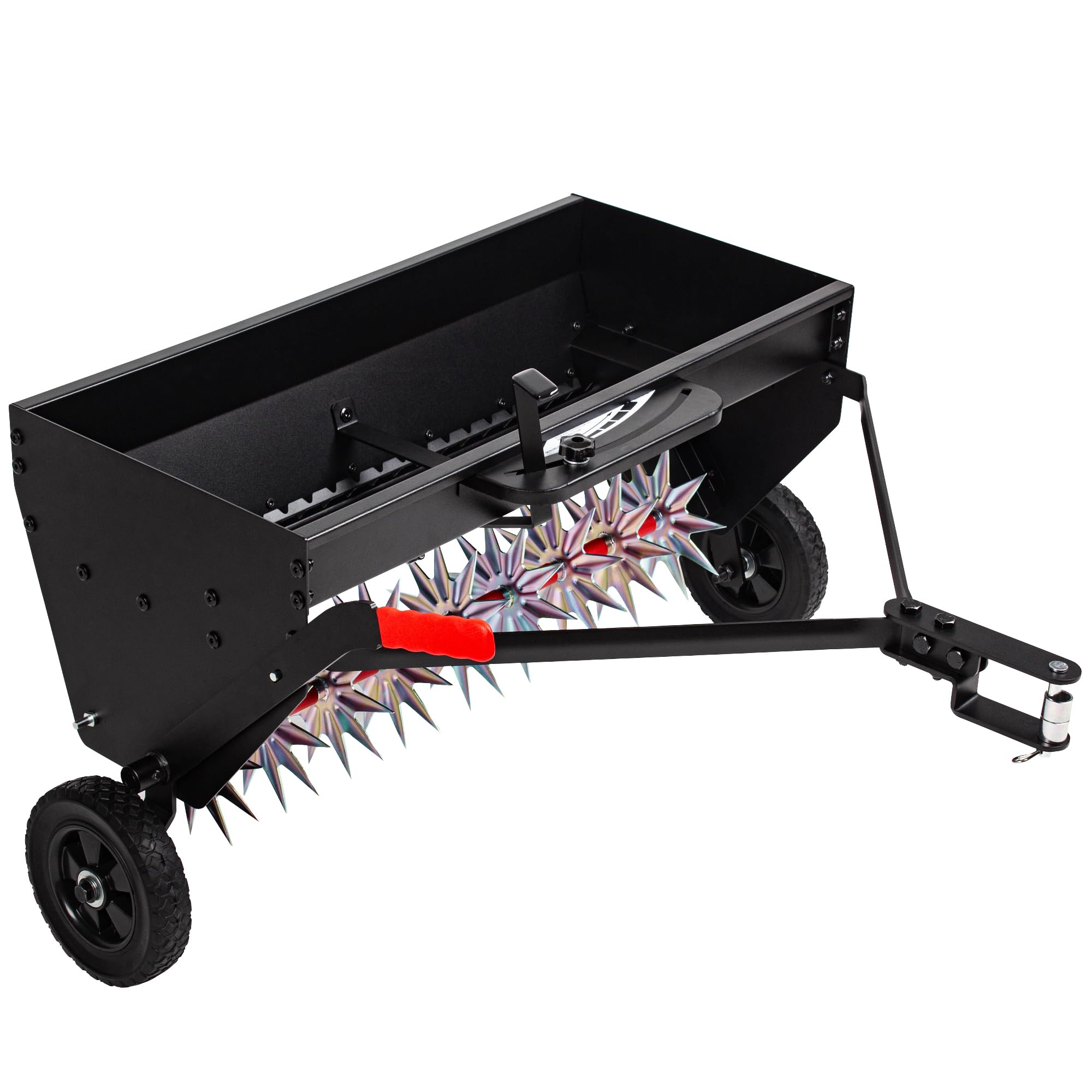
This Suchtale combo unit combines a spike aerator with a broadcast spreader, letting you aerate and distribute seed or fertilizer in one pass. Nine 3D steel star tines, each 8 inches in diameter with 10 curved spikes, penetrate up to 2 inches deep. The high-quality all-steel hopper holds over 100 pounds of material and features an agitator that prevents clumping during operation.
The flow control plate uses an infinitely adjustable stop device for precise spreading, covering a 32-inch width. Assembly, however, is a significant undertaking — owners report 2 to 4 hours of work, with some needing to drill alignment holes or beat parts into place with a mallet. The chain driving the spreader mechanism tends to slip off the sprocket on bumpy terrain, requiring roadside reinstallation.
Once assembled and adjusted, the aerator function works independently even if the spreader chain misbehaves, so you can at least get aeration done. The metal quality and powder-coat finish feel durable for the price tier. This unit makes sense if you prioritize the combination functionality and have the mechanical patience to dial it in, but the assembly friction is real.
What works
- Combines spike aeration and broadcast spreading in one machine
- All-steel hopper resists twisting and holds 100+ pounds
- Star tines create larger ventilation holes than simple spikes
What doesn’t
- Assembly is lengthy and may require drilling or filing parts
- Chain frequently slips off sprocket on rough terrain
- Flow control calibration requires trial-and-error
8. AVVA Rolling Lawn Coring Aerator
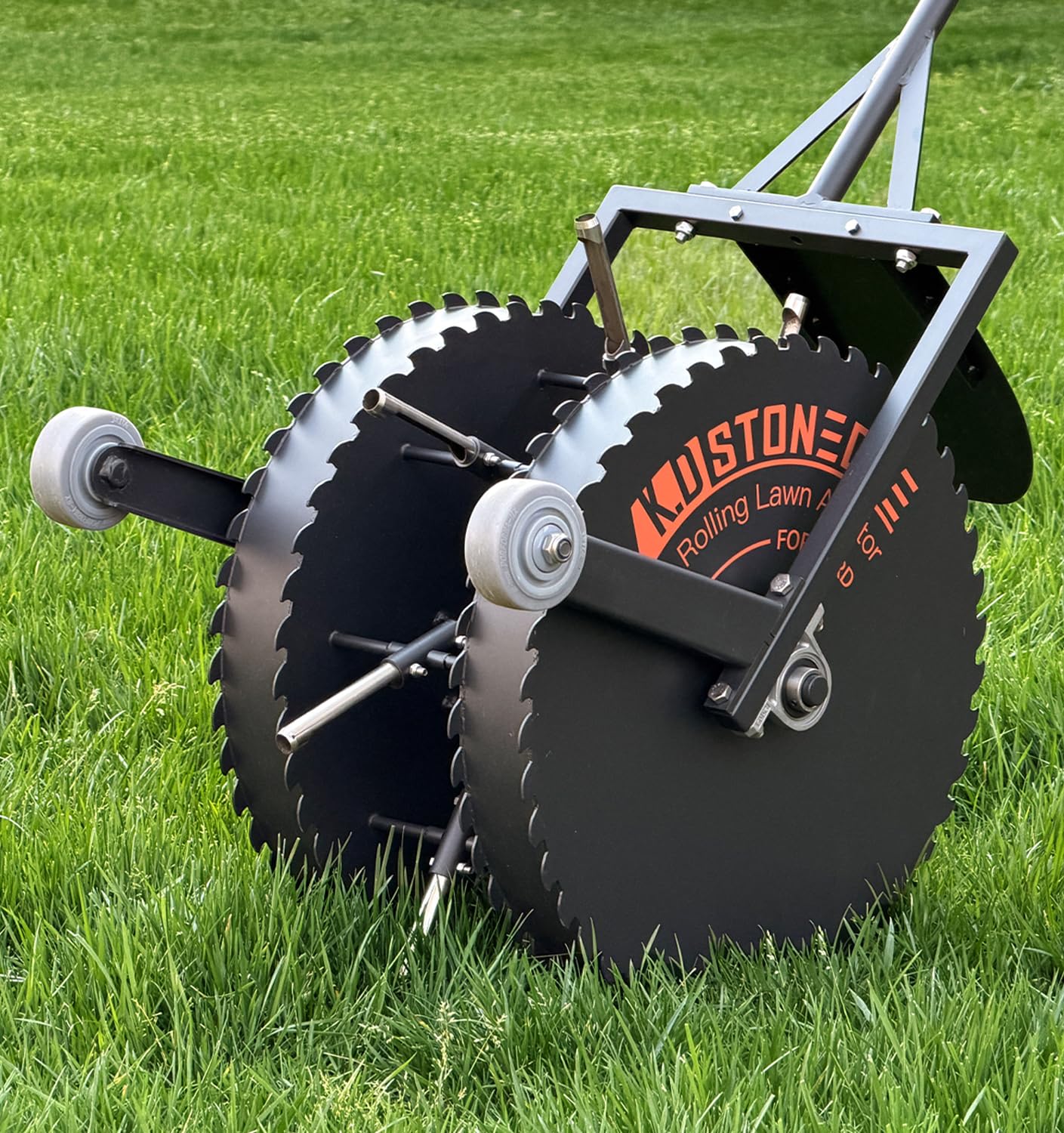
The AVVA rolling coring aerator is a manual push-behind unit that extracts soil plugs without requiring a tractor or tow vehicle. Its rolling mechanism uses spring-loaded tines that engage at a right angle, punching 2- to 3-inch deep holes in moist soil while minimizing turf damage. Sand-fillable wheels add weight for deeper penetration, though the filling process is awkward due to the angled fill holes.
The heavy-duty steel construction handles regular use on small to medium lawns up to a quarter acre. Owners report excellent coring results in wet conditions, with the machine pulling clean plugs that break up on the surface. Turning and carrying the unit over concrete or pavement is awkward — the single-row tine design means you’ll make many passes to cover an area, and the weight climbs to around 80 pounds when wheels are filled.
Assembly is straightforward with basic hand tools; the provided instructions are minimal but the design is intuitive. Some users find the sand-filling step confusing — using a funnel and a small shovel helps. This aerator works best pulled backward rather than pushed forward, letting your body weight drive the tines in. It’s a viable alternative to renting a machine if you have a small lawn and patience for multiple passes.
What works
- Pulls actual soil cores 2-3 inches deep in moist conditions
- No tractor or tow vehicle required
- Metal tines are durable enough for root-heavy soil
What doesn’t
- Sand-filling wheels is messy and time-consuming
- Single row requires many passes for full coverage
- Awkward to move across concrete between lawn sections
9. Agri-Fab 45-0606 Poly Lawn Roller

The Agri-Fab 45-0606 is a poly drum lawn roller, not a plug aerator, designed to flatten uneven ground and set newly seeded areas. The 18-inch diameter by 36-inch wide drum holds up to 400 pounds when filled with water, providing significant compaction force for leveling bumps and settling sod. The poly material resists rust and weighs less than 50 pounds empty for easy transport and storage.
Filling is simple via a garden hose, and the drain plug seals well to prevent leaks during operation. The roller attaches to lawn and garden tractors via a universal hitch, and the 3-year limited warranty covers manufacturing defects. Assembly takes about 15 minutes with basic hand tools, though no printed instructions are included — the design is straightforward enough that most users figure it out quickly.
This tool excels at flattening mole hills, smoothing tilled soil, and pressing seed into contact with the ground. It does not aerate — the solid drum compacts rather than cores the soil. For homeowners who need both leveling and aeration, you’ll want to pair this roller with a separate plug aerator. As a stand-alone leveling tool, it performs reliably at a budget-friendly entry point.
What works
- 400-pound water weight effectively flattens bumps and mole hills
- Poly drum resists corrosion and is lightweight when empty
- Quick 15-minute assembly with a garden hose for filling
What doesn’t
- Does not aerate — compacts soil contrary to aeration goals
- No printed assembly instructions included in the box
- Limited to leveling; not a substitute for plug aeration
Hardware & Specs Guide
Tine Metallurgy and Heat Treatment
Plug aerator tines face constant abrasion from soil, rocks, and roots. Galvanized steel tines resist rust formation, extending usable life across multiple seasons. Heat-treated tines undergo a hardening process that maintains a sharp edge longer than untreated steel. When shopping, verify whether the tines are galvanized, heat-treated, or both — plain steel tines dull quickly in sandy or rocky soil and may require replacement after one heavy season.
Weight Tray Design and Capacity
The weight tray transfers downward force from added ballast into the tines. A tray that spans the full width of the aerator distributes weight evenly, preventing one side from digging deeper than the other. Look for enclosed trays that prevent blocks or bags from sliding off during turns. Capacity matters: 125 pounds works for sandy loam, while 175 to 200 pounds is appropriate for heavy clay. Avoid trays with sharp edges that can chafe through sand bags.
Transport Mode and Tire Type
An effective transport system lifts the tines several inches off the ground so you can cross driveways, sidewalks, and patios without damaging the surface. Cantilever lift handles operated from the tractor seat are ideal — foot-operated or manual lift bars require dismounting. Flat-free tires never go flat but ride rougher on uneven terrain. Semi-pneumatic tires offer a smoother roll but require occasional air checks. Pneumatic tires provide the best ride but add maintenance.
Deck Width and Tine Row Configuration
Deck width directly affects coverage speed. A 40-inch aerator covers roughly 3.3 feet per pass; a 48-inch model covers 4 feet. More important than raw width is whether the tine sections rotate independently. Single rigid tine bars tear turf during turns because the outside tines drag sideways. Independently rotating sections allow each tine row to pivot, minimizing turf damage. For properties over two acres, prioritize independent sections and a width of at least 44 inches.
FAQ
How deep should a pull-behind plug aerator penetrate?
Can I use a spike aerator instead of a plug aerator?
How much weight should I add to the tray for clay soil?
Will a pull-behind aerator attach to any lawn tractor?
How often should I aerate my lawn with a pull-behind aerator?
Final Thoughts: The Verdict
For most homeowners with compacted soil and a standard lawn tractor, the top pull behind aerator pick is the Brinly PA-403BH-A3 because its sharpened spoon tines penetrate hard clay with less ballast than competing designs, and the enclosed 150-pound weight tray handles real-world soil conditions without bending. If you manage several acres and have a 3-point hitch tractor, the Field Tuff 48-inch with 54 coring plugs delivers unmatched coverage speed. For those who need to combine aeration with overseeding in one pass, the Brinly AS2-40BH-P combo saves a full trip across the lawn. Choose based on your tractor type, soil resistance, and whether you’re willing to assemble a complex machine for the added functionality.