
A lawn mower blade that tears rather than cuts leaves your grass looking brown and stressed for weeks. The fix isn’t replacing the blade — it’s sharpening it with the right tool. A dedicated jig or guide system removes the guesswork from freehand grinding, letting you hit a consistent bevel across the entire edge every time.
I’m Rikta — the co-founder and writer behind Lawn Gear Lab. I spend my time digging into owner feedback, comparing build materials and adjustability ranges, and analyzing spec sheets to find which sharpeners deliver repeatable results without costing a fortune.
Whether you maintain a single residential deck or a fleet of commercial machines, finding the right lawn mower blade sharpener means choosing between cordless convenience, adjustable jig precision, or a dedicated benchtop grinder with an integrated balancer.
How To Choose The Best Lawn Mower Blade Sharpener
Not every sharpener fits every blade type or shop setup. The four factors below separate a tool that delivers consistent bevels from one that introduces more problems than it solves.
Adjustable Angle Range (15°–45°)
Most standard residential blades sharpen best at 30°–35°. Mulching and high-lift blades often need a steeper 40°–45° bevel. A jig with a wide, lockable adjustment range lets you match the factory edge geometry precisely. Fixed-angle guides force you to compromise and often remove more metal than necessary.
Build Material and Stability
Aluminum alloy and stainless steel construction resists flex under the lateral force of a grinder. Hollow arms or thin plastic components allow the jig to twist, producing an uneven bevel and leaving the blade out of balance. A stable base with multiple mounting options — vise clamp or workbench bolts — keeps the blade stationary during the pass.
Integrated Blade Balancer
After sharpening, removing uneven amounts of metal from each side throws the blade out of balance. An out-of-balance blade vibrates the spindle, wears deck bearings, and leaves a scalloped cut. A magnetic or cone-style balancer lets you check balance immediately after sharpening so you can remove material from the heavy side before reinstalling.
Cordless Convenience vs. Benchtop Power
Cordless rotary sharpeners allow on-mower sharpening without removing the blade — ideal for quick touch-ups between full services. Benchtop grinders with a 1 HP motor and a dedicated grinding wheel handle chipped or heavily worn blades faster and more aggressively. For commercial operators managing multiple decks, the benchtop machine’s speed and dust collection justify the footprint.
Quick Comparison
On smaller screens, swipe sideways to see the full table.
| Model | Category | Best For | Key Spec | Amazon |
|---|---|---|---|---|
| Adjustable 15°–45° RACTOP | Jig | Residential precision | 15°–45° adjust, 4 holder bars | Amazon |
| Kimgsoak Jig + Balancer | Combo | Balanced sharpening in one kit | Aluminum alloy, zinc balancer | Amazon |
| SporGain Jig + Balancer | Combo | All-in-one residential kit | Thick metal, magnetic balancer | Amazon |
| Sharp Pebble Cordless | Rotary | Quick on-mower touch-ups | 5k–30k RPM, 20°–40° guide | Amazon |
| All American 5005 Gen 2 | Jig | Lifetime durability | Anodized aluminum, stainless steel | Amazon |
| VEVOR 1HP Benchtop | Grinder | Commercial / heavy restoration | 1 HP, 9″ ceramic wheel, balancer | Amazon |
In‑Depth Reviews
1. Adjustable 15°–45° RACTOP Lawn Mower Blade Sharpener

The RACTOP jig delivers the broadest 15°–45° adjustment range in the mid-tier segment, paired with an anti-slip stainless steel handle and four fixed holder bars that lock the blade without shifting. Owners report consistent 30° bevels without needing an adapter for standard straight blades — the jig accommodates 99% of residential mower blade widths through its adjustable vise.
At 5.17 pounds, the steel bracket feels solid when bolted to a wooden workbench. The lever design reduces material removal because the blade stays locked in position across multiple passes; users who rotate four blades per cut noted that the jig maintains a repeatable bevel without needing to re-zero the angle each time. The only catch is that mounting screws are not included, so you must supply bolts that match your bench thickness.
Customer feedback across dozens of sharpenings reports no flex in the jig arms, and several owners switched from a cheaper competitor because this unit held its alignment after repeated use. For the homeowner who sharpens three times per season and wants a set-it-and-forget-it angle lock, this is the most balanced option in the category.
What works
- Precise angle lock with no drift across multiple passes
- Heavy-duty steel construction eliminates flex
- Fits nearly all residential blade widths
What doesn’t
- Mounting screws not included
- Instructions are sparse; video guidance recommended
2. Kimgsoak Lawn Mower Blade Sharpener with Blade Balancer

The Kimgsoak kit combines a high-density aluminum alloy jig with a premium zinc-alloy balancer, giving you both sharpening guidance and immediate balance verification in one package. The bushings fit snugly over the four guide pins, reducing lateral play, and the jig supports blades up to 30 inches long with a maximum thickness of 0.28 inches — enough for most residential walk-behind and riding mower decks.
Owners report a quick setup and an efficient sharpening cycle across multiple blades in one sitting. The aluminum construction resists corrosion better than painted steel, and the balancer cone spins freely on a hardened pivot. One user noted that at the 40° setting the jig removes slightly more metal than the factory bevel, so taking lighter passes and letting the blade cool between strokes prevents overheating.
Given that replacement blades typically run $20–$40 each, the Kimgsoak combo can pay for itself within a couple of sharpening sessions. The balancer is particularly valuable for riders and tractors where an unbalanced blade amplifies vibration across a wider deck. For the homeowner who wants a single purchase that covers both sharpening and balancing, this is the most cost-effective entry.
What works
- Aluminum alloy jig resists rust and flex
- Included zinc balancer improves spindle life
- Fast, efficient sharpening cycle across multiple blades
What doesn’t
- 40° setting can over-remove metal without care
- Balancer cone spins freely but may lack sensitivity for fine tuning
3. SporGain Lawn Mower Blade Sharpener & Balancer Combo
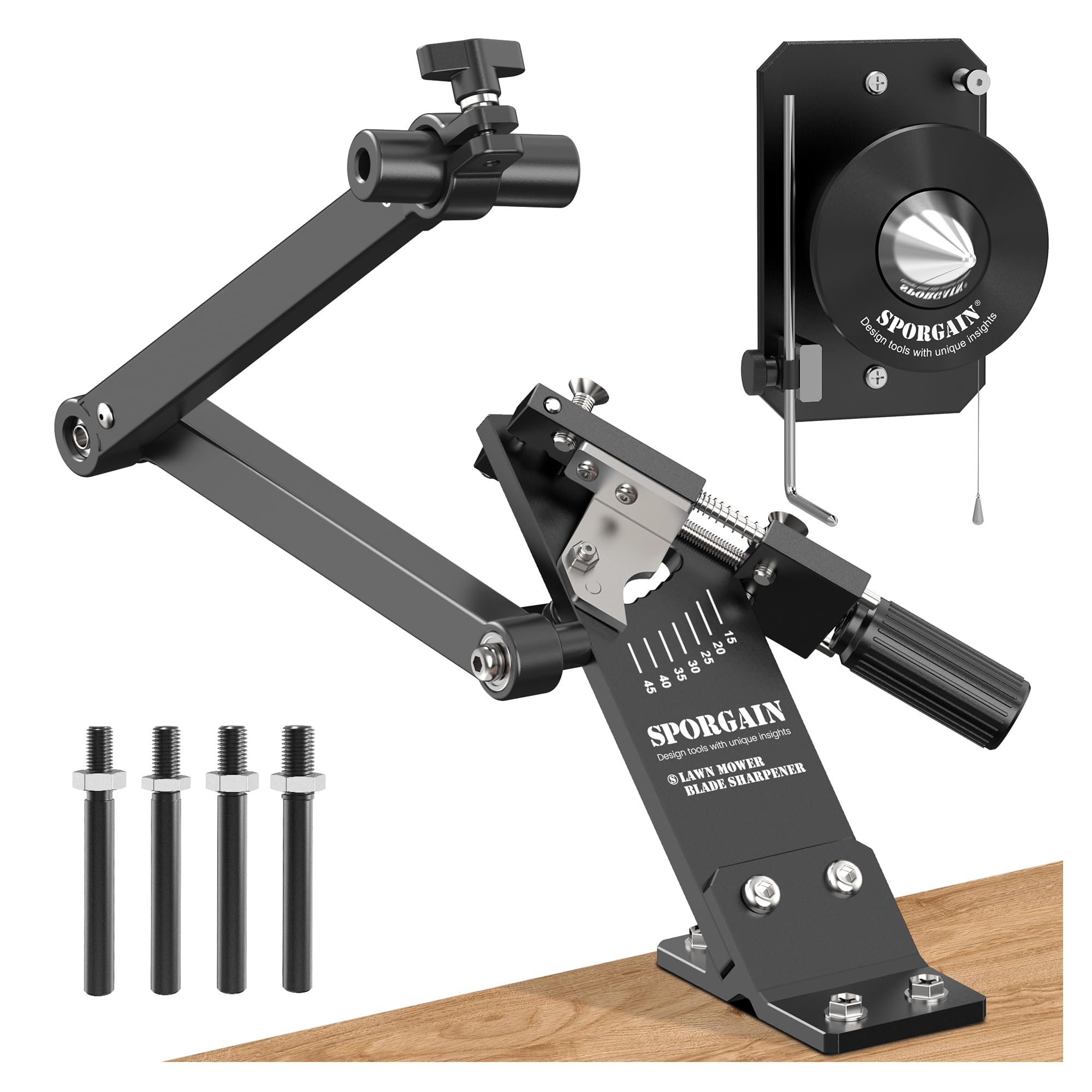
The SporGain combo offers a one-stop solution with a thick-metal sharpening jig and a separate magnetic blade balancer. The jig uses ball bearings in the pivot and a 25 mm diameter handle for secure clamping, with stepless angle adjustment across the 15°–45° range. The balancer employs a hidden magnetic design that holds the blade upright on a precision cone, letting you identify the heavy side after each sharpening pass.
Users who compared it against freehand grinding reported that the jig made the job easier and more consistent, and several noted that the combo paid for itself after a single use. However, a segment of owners found the balancer bearing stiff out of the box — the cone doesn’t spin freely enough to detect very slight imbalances until it is greased or broken in. The sharpener itself drew criticism for limited compatibility with curved high-lift blades; pushing hard on the jig caused flex that produced uneven edge geometry.
For residential straight-blade maintenance, the combo works well and the balancer quickly highlights a quarter-inch of extra metal. Owners planning to sharpen deeply curved or thick commercial blades may need a more rigid jig or a dedicated benchtop grinder. The value proposition is strongest for the homeowner who wants one kit for both tasks and doesn’t push the tool past straight-blade limits.
What works
- Magnetic balancer identifies heavy spots quickly
- Stepless angle adjustment without fixed detents
- Thick metal construction on the jig base
What doesn’t
- Balancer bearing is stiff initially
- Jig flexes under pressure with curved blades
4. Sharp Pebble Cordless Lawn Mower Blade Sharpener
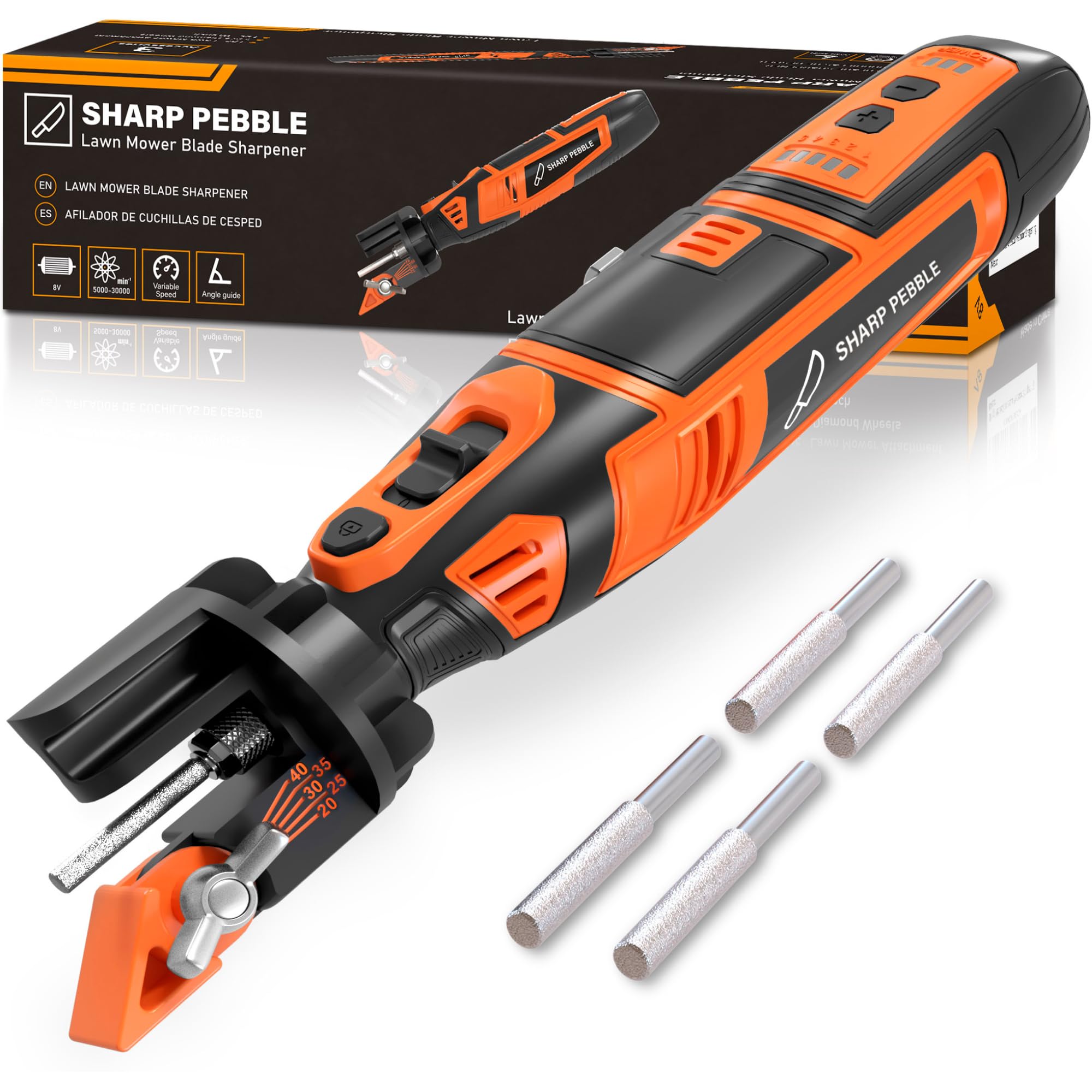
The Sharp Pebble is a cordless rotary tool with a variable-speed range of 5,000 to 30,000 RPM and an attached angle guide adjustable from 20° to 40°. Its main selling point is on-mower sharpening: for standard residential blades with a straight edge, you can slide the guide along the blade without removing it from the deck. The 9V rechargeable battery delivers enough runtime for one to two blades per charge, and the tool weighs only 1.37 pounds.
Owners report that the guide kept the angle consistent and that the resulting cut quality improved noticeably after a single session. The rotary stone is best suited for maintaining an already reasonable edge — not for reshaping a chipped or deeply dulled blade. The manufacturer itself notes this is a sharpener, not a grinder, and recommends addressing chips or deep dents with a grinder first.
For the homeowner who wants a quick touch-up without dragging out a grinder, air compressor, or workbench setup, the Sharp Pebble fills a specific niche. It is not a replacement for a bench grinder or a rigid jig, but it eliminates the disassembly step for most residential blades. Keep a spare blade set on hand for badly damaged edges, and use the Sharp Pebble as a maintenance tool between full sharpenings.
What works
- On-mower sharpening saves disassembly time
- Lightweight and easy to maneuver one-handed
- Angle guide keeps edge geometry consistent
What doesn’t
- Slow material removal — not for chipped blades
- Battery life limits use to one or two blades
5. All American Sharpener Model 5005 Gen 2
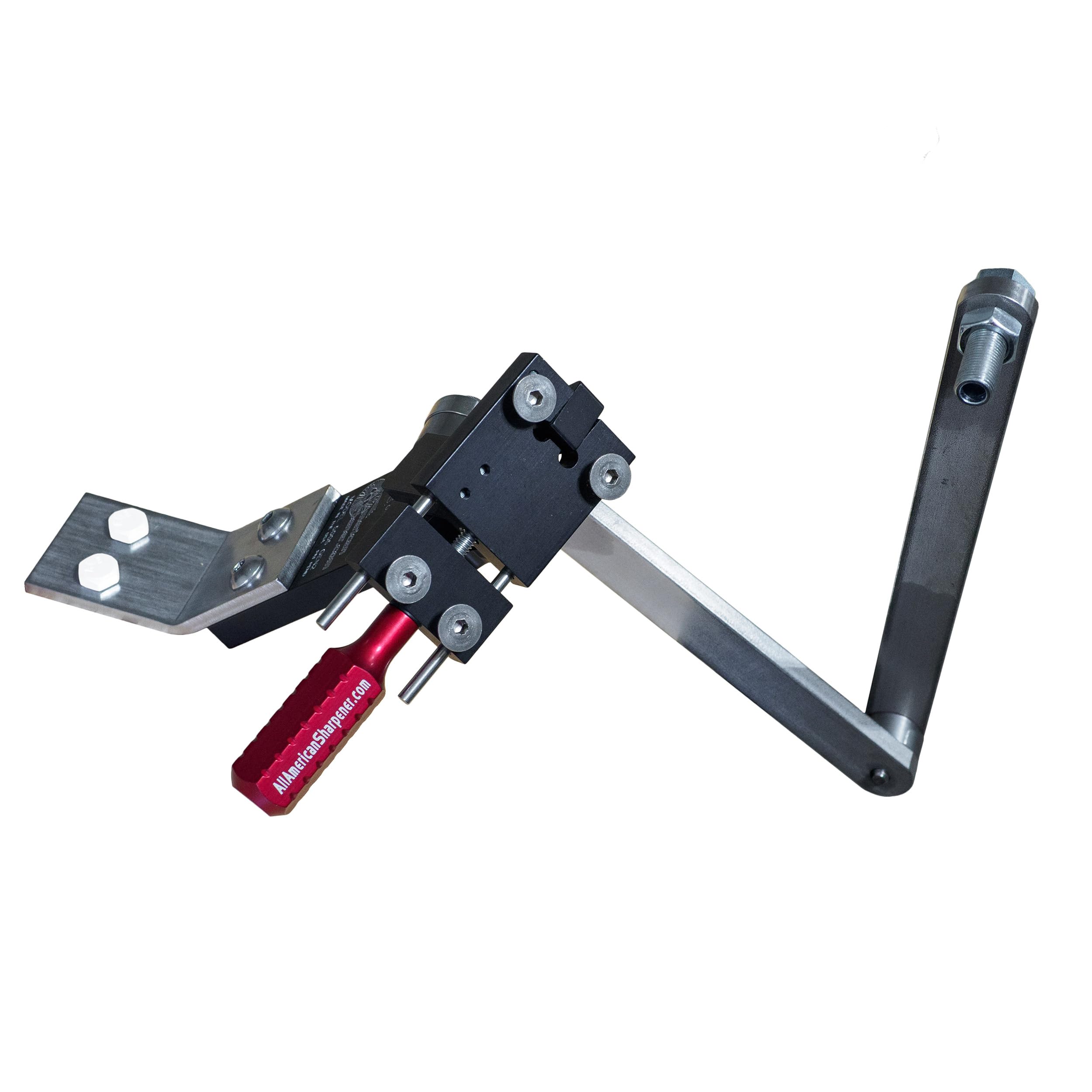
The All American 5005 Gen 2 is built from anodized aluminum and stainless steel, made entirely in the USA by the inventor and backed by a lifetime warranty. It accepts standard straight, mulching, and high-lift blades with an adjustable range of 15°–45° and works with a cordless angle grinder for complete portability. At just 16 ounces, the entire jig weighs less than most blade sets, yet its solid stainless steel arms resist the twisting forces that hollow knockoffs cannot handle.
Owners report that the jig holds a consistent 30° bevel across every edge with no drift. The construction is entirely metal — anodized aluminum paired with stainless steel arms, with no plastic components in the sharpening path. Many buyers cited the USA origin and lifetime warranty as justification for the premium cost, though a vocal minority described the price as excessive for a simple jig that performs the same function as cheaper competitors.
If you value domestic manufacturing, want a tool that will outlast your mower, and sharpen enough blades to amortize the upfront cost, the All American is the most durable option in the category. For occasional residential use where a budget jig delivers similar sharpness, the premium becomes harder to justify. Either way, the accuracy and rigidity are unmistakable the first time you run a grinder across a locked blade.
What works
- Stainless steel arms eliminate flex completely
- Lifetime warranty and USA manufacture
- Ultra-lightweight at 16 ounces for field portability
What doesn’t
- Price is high compared to functionally similar jigs
6. VEVOR 1HP Lawn Mower Blade Sharpener
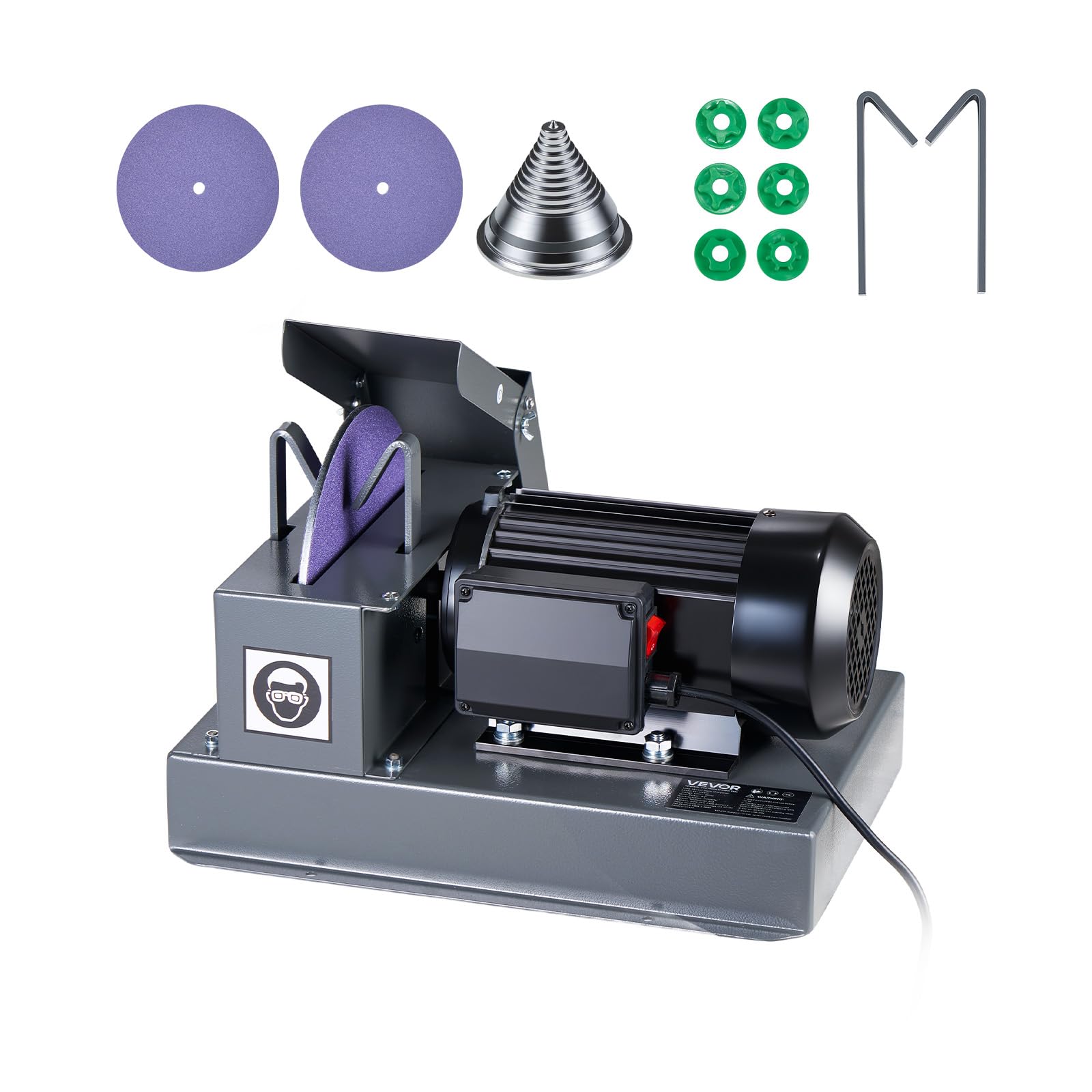
The VEVOR is a benchtop grinding machine powered by a 1 HP motor that turns a 9-inch, 60-grit ceramic wheel at 1725 RPM. It includes two interchangeable fixing brackets — one pre-set at 30° and another at 40° — plus a blade balancer and a grit collector that reduces airborne debris. The steel base and 42-pound weight keep the machine planted during aggressive passes, making it suitable for shops that process multiple decks in a single day.
Owners report that the wheel removes material quickly on straight edges but takes longer on curved profiles. The included sandpaper discs are functional, though several users recommended upgrading to a coarse ceramic wheel for faster stock removal.
For the homesteader managing four or more mowers or the landscaping business that sharpens blades weekly, the VEVOR pays for itself in time saved. The balancer and grit collector are genuine quality-of-life additions that cheaper benchtop units lack. If you only sharpen two blades per season, the footprint and learning curve may outweigh the benefits, but for high-volume work this is the most capable dedicated machine in the lineup.
What works
- 1 HP motor handles thick commercial blades without bogging
- Grit collector keeps the workspace cleaner
- Includes both 30° and 40° fixing brackets plus balancer
What doesn’t
- Curved and high-lift blade profiles take longer to grind than straight edges
- Paper discs wear faster than ceramic for heavy removal
Hardware & Specs Guide
Angle Adjustment Mechanism
Jigs with a thumbscrew or lever-lock system offer continuous (stepless) adjustment from 15° to 45°, which lets you match any blade’s factory bevel. Detent-based systems click into fixed positions and are faster but less precise for non-standard angles. The adjustment range is the most important spec because a mismatch here forces you to remove excess metal to hit the correct edge geometry.
Balancer Type and Sensitivity
Magnetic balancers hold the blade upright on a cone, while cone-only balancers rely on a sharp pivot point. A sensitive balancer rotates freely with just a few grams of imbalance. Stiff bearings or rough pivot surfaces mask light imbalances, leaving vibration that damages spindle bearings over time. Greasing the pivot before first use is a common fix for new balancers that feel tight.
FAQ
Can I sharpen a curved mulching blade with a straight-edge jig?
How often should I sharpen residential mower blades?
Do I need a balancer after every sharpening?
Final Thoughts: The Verdict
For most gardeners, the lawn mower blade sharpener winner is the Adjustable 15°–45° RACTOP because its steel construction, four-holder-bar lock, and wide angle range deliver repeatable bevels at a mid-tier cost. If you want an all-in-one kit with an integrated balancer, grab the Kimgsoak with Blade Balancer. And for high-volume commercial restoration, nothing beats the VEVOR 1HP Benchtop Grinder that chews through thick deck blades in minutes.