
Honeysuckle, especially the aggressive Japanese variety, doesn’t just grow — it strangles. It wraps around trees, forms impenetrable thickets, and outcompetes native plants for light and nutrients. A general-purpose weed killer often bounces off its waxy leaves, leaving you frustrated while the vine thrives. You need a chemistry matched to woody stems and root systems, not just a contact spray for tender annuals.
I’m Rikta — the co-founder and writer behind Lawn Gear Lab. My approach involves cross-referencing active ingredient concentrations, surfactant formulations, and mode-of-action data against hundreds of verified owner experiences to separate claims from real-world knockdown power.
The right product in this fight depends on whether you’re targeting a patch of ground vines or mature bushes climbing into your trees. This guide breaks down the most effective herbicide for honeysuckle based on its specific biology and growth habit.
How To Choose The Best Herbicide For Honeysuckle
Honeysuckle is not a simple broadleaf weed. Its woody stem structure and waxy leaf cuticle require a herbicide that can penetrate bark and translocate to the root system. Before buying, consider the active ingredient, the application method your situation demands, and the concentration value per gallon.
Triclopyr vs. Glyphosate
Triclopyr is the gold standard for woody brush, vines, and honeysuckle. It mimics auxin, causing uncontrolled growth that kills the vascular system. Glyphosate works, but it is slower on mature woody stems and requires a higher concentration. Products with triclopyr as the primary active ingredient, or a triclopyr/2,4-D blend, provide faster visual results and better root kill.
Application Method Matching
If the honeysuckle is climbing into your landscape trees, a foliar spray can kill the tree canopy. In those cases, use a cut-stump or basal bark application (painting a concentrated mixture on the cut stem or lower bark) to target only the vine. For ground-level thickets, a foliar spray with a non-selective herbicide is effective but requires careful drift control.
Concentration and Surfactants
Concentrates offer far better value than ready-to-use sprays, especially when treating large areas or multiple infestations. A built-in surfactant in the formulation improves adhesion to waxy leaves, reducing runoff and increasing absorption. If your chosen product lacks a surfactant, plan to add a non-ionic surfactant at 0.25% of the spray volume.
Quick Comparison
On smaller screens, swipe sideways to see the full table.
| Model | Category | Best For | Key Spec | Amazon |
|---|---|---|---|---|
| ALLIGARE Agri Star Triclopyr 4E | Premium Concentrate | Cut-stump treatment | 61.6% Triclopyr BEE | Amazon |
| Southern Ag Crossbow | Premium Blend | Broad foliar control | Triclopyr + 2,4-D | Amazon |
| Remedy Ultra | Premium | Pasture brush control | Triclopyr concentrate | Amazon |
| Roundup Pro Concentrate | Mid-Range | Large area coverage | 50.2% Glyphosate | Amazon |
| Roundup Poison Ivy Plus | Mid-Range | Confined spot spraying | Triclopyr + Diquat | Amazon |
| Albaugh Gly Star Plus | Budget | Economic glyphosate option | 41% Glyphosate + Surf | Amazon |
| Tenkoz Crossbow | Budget | Fence line clearing | 16.5% Triclopyr | Amazon |
In‑Depth Reviews
1. ALLIGARE Agri Star Triclopyr 4E
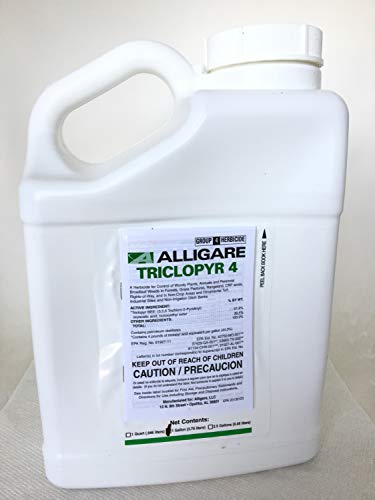
ALLIGARE Agri Star Triclopyr 4E is a generic equivalent to Garlon 4, packing 61.6% triclopyr BEE — the highest concentration in this guide. This level allows you to use it undiluted for cut-stump applications or mix it at a 20-25% ratio with basal oil for hack-and-squirt treatments, making it lethal to established honeysuckle bushes without affecting surrounding soil.
Owners report excellent results on multiflora rose, black locust, and sumac using the cut-stump method: apply the full concentrate to a freshly cut stump within minutes. The ester formulation penetrates bark rapidly and translocates to roots, preventing resprouting. It is not for residential lawns — it is volatile, so avoid foliar spraying near desirable trees or shrubs.
The strong chemical odor requires proper PPE (respirator, gloves, long sleeves). This concentrate treats a massive area relative to other 1-gallon jugs, and users report being satisfied with the economics compared to premixed bottles. If your honeysuckle problem involves large-diameter stems needing cut-stump treatment, this is the chemical you want.
What works
- Highest triclopyr concentration for maximum woody plant penetration.
- Cost-effective for large-scale cut-stump and basal bark applications.
- Proven results on tough brush species without resprouting.
What doesn’t
- Strong ester odor requires a respirator and outdoor mixing.
- Volatile vapor can drift and damage nearby non-target trees.
- Not labeled for residential turf or simple spot spraying.
2. Southern Ag Crossbow Specialty Herbicide

Southern Ag Crossbow combines triclopyr with 2,4-D, creating a broad-spectrum foliar spray that targets both woody stems and broadleaf weeds. This formulation is ideal for treating honeysuckle thickets in open areas — pastures, fence lines, and clearings — where you can blanket the foliage without worrying about overspray on desired plants.
Users note that it produces visible wilting within 48 hours on poison ivy and thick brush. Its soil half-life is about three days, which is short enough to allow replanting in treated areas relatively quickly. The 1-gallon jug makes up to 96 gallons of spray solution, giving you substantial coverage for the cost.
Some owners report that it struggles on wild violets and creeping Charlie in rich soil, but on woody vines like honeysuckle, the triclopyr component drives deep root kill. The odor is strong — mix outdoors — and it is best applied when rain is not expected for at least three days to maximize absorption.
What works
- Fast visual results — wilting in 48 hours on most brush species.
- Short soil half-life minimizes long-term environmental impact.
- High dilution ratio makes this an economical option per acre.
What doesn’t
- Effectiveness varies notably with different soil types and moisture.
- Needs a dry window of three days post-application for best results.
- Strong chemical odor requires careful handling and PPE.
3. Remedy Ultra Specialty Herbicide
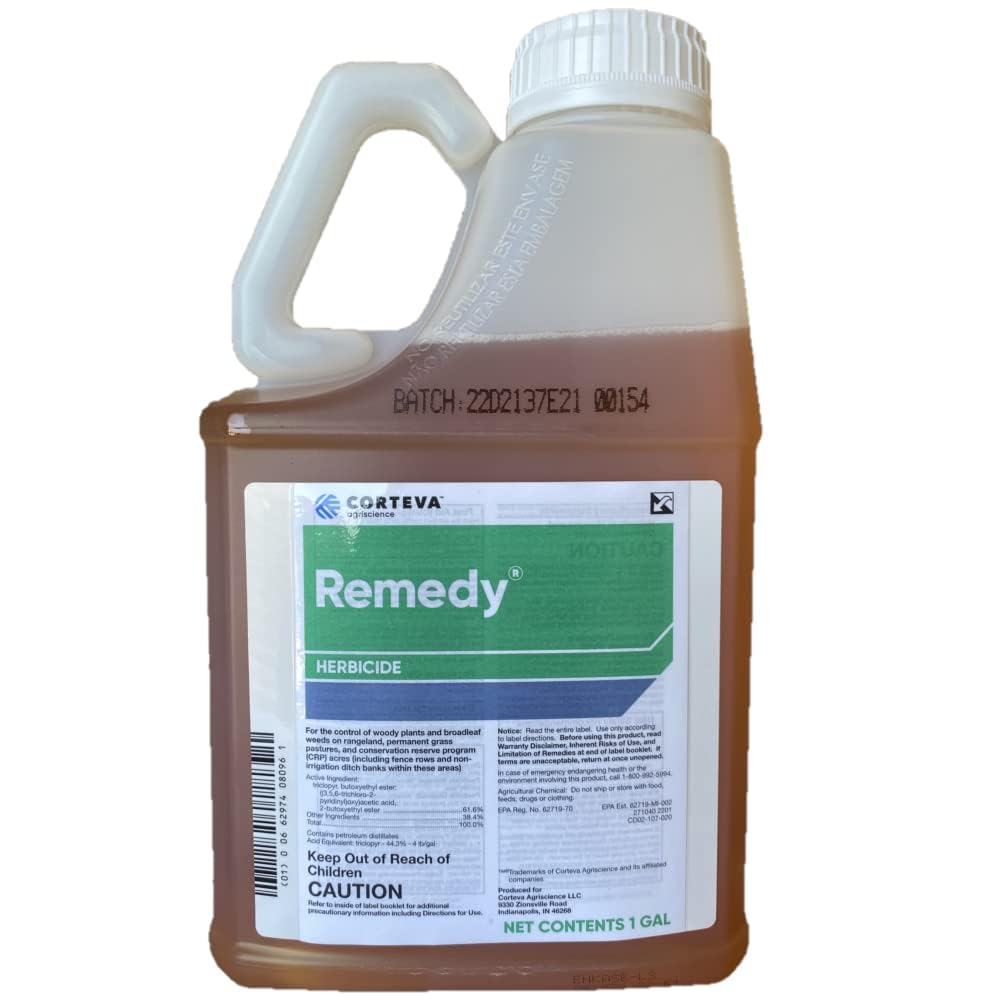
Remedy Ultra from Dow AgroSciences is a dedicated pasture and rangeland herbicide that excels at controlling brush, fence-line invaders, and mid-size trees. Its low-odor formulation is a welcome improvement over older triclopyr products, making it more comfortable to use during long spraying sessions along property boundaries.
Owner feedback highlights its effectiveness on cogon grass, multiflora rose, and honey locust, especially when applied as a basal bark mix with diesel. For honeysuckle, a 20% solution applied to freshly cut stumps stops resprouting, and a 1-2% foliar mix works on smaller bushes. It is selective to grasses, so it won’t kill your pasture if applied correctly.
The main drawback is the price — this is a premium product. It also works slowly on some species, taking up to two weeks to fully kill shrubs. Owners recommend patience and not retreating too early. For large-scale pasture maintenance with honeysuckle encroachment, this balances selectivity and power.
What works
- Low-odor formula makes extended spray sessions more tolerable.
- Selective to grasses — safe for pasture and lawn regeneration.
- Excellent for cut-stump and basal bark applications on dense brush.
What doesn’t
- Premium price per gallon compared to generic triclopyr options.
- Slow visual results — can take up to two weeks for full die-off.
- Weak on grassy weeds, requiring a tank-mix partner for broad control.
4. Roundup Pro Concentrate
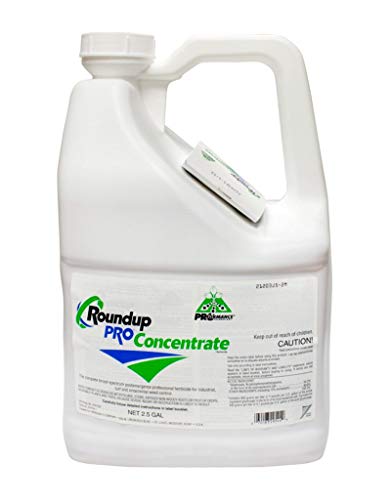
Roundup Pro Concentrate delivers 50.2% glyphosate, making it one of the most concentrated glyphosate formulations available. While triclopyr is generally preferred for woody honeysuckle, this product is useful for treating vines and bushes in open areas where drift onto non-target woody plants is not a concern.
Owners who use this for spring pre-emergent and spot treatment note that it works in 3-4 days on annual weeds but takes about a week to show full results on woody perennials. The super-concentrate nature means a 2.5-gallon jug makes up to 150 gallons of standard spray mix — a massive value for large properties.
Keep in mind that glyphosate is non-selective and kills any green tissue it touches. For honeysuckle climbing up a desirable tree, foliar spraying Roundup Pro on the vine canopy can damage the tree via root grafts. Stick to cut-stump application with this chemical for vines growing into trees, or use a triclopyr product for basal bark painting.
What works
- Extremely high concentration — best value per gallon of spray mix.
- Fast visual effects, especially on annual weeds and tender growth.
- Built-in surfactant reduces the need for additional additives.
What doesn’t
- Not optimal for mature woody stems — slower root kill than triclopyr.
- Non-selective — drift or overspray damages desirable vegetation.
- Can kill host trees if sprayed on climbing honeysuckle canopy.
5. Roundup Poison Ivy Plus Tough Brush Killer₂

This Roundup formulation is purpose-built for tough brush, including poison ivy and woody vines. It combines triclopyr, fluazifop, and diquat dibromide — a three-pronged attack that provides both rapid contact burn (diquat) and systemic transport (triclopyr) through the plant. It is rainproof in 30 minutes, a major advantage in humid climates.
Owners report that it kills poison ivy and invasive weeds around their property, with visible results in a few days. The 32-ounce concentrate treats up to 1,500 square feet, making it suitable for moderate infestations around the home, fences, and cabins. The “hack and squirt” method works well, especially when mixed with cooking oil to improve adhesion on waxy leaves.
The formula is not as cost-effective as large triclopyr concentrates for extensive acreage. It also requires careful timing — allow 1 to 30 days after application before planting in the treated area. For a homeowner dealing with a few patches of climbing honeysuckle, this is a convenient, effective solution.
What works
- Rainproof in 30 minutes — great for unpredictable weather.
- Fast visual results due to diquat contact burn component.
- Effective on poison ivy, wild blackberry, and other tough vines.
What doesn’t
- Relatively small concentrate bottle — low value per square foot.
- Not as potent on large, established honeysuckle bushes.
- Requires waiting period before replanting in treated soil.
6. Albaugh Gly Star Plus Herbicide

Albaugh Gly Star Plus is a professional-grade glyphosate concentrate with 41% active ingredient and a fully loaded surfactant system. It is labeled for commercial use and is restricted from sale to several states, but it delivers the same chemistry as Roundup Ultra at a more accessible price point for large-scale applications.
Users note that it takes about 10-14 days to fully kill vegetation, but the built-in surfactant makes the mixture more effective than buying a bare glyphosate product and adding your own wetting agent. It provides broad-spectrum control of annual weeds, woody brush, and trees, making it a candidate for clearing honeysuckle thickets in non-residential settings.
The big caveat: this is not labeled for residential use, so it is intended for farms, pastures, and commercial operations. If you are a homeowner, verify local regulations. The 2.5-gallon jug is heavy (15 pounds), and the large format is ideal for tank sprayers rather than hand-pump bottles.
What works
- Built-in surfactant eliminates a mixing step for better adhesion.
- Large 2.5-gallon size offers excellent cost per ounce of glyphosate.
- Reliable systemic action on woody brush and perennial weeds.
What doesn’t
- Not labeled for residential use — restricted in several states.
- Slow action — requires patience for full die-off on woody species.
- Large, heavy jug awkward to handle without a dedicated pump.
7. Tenkoz Crossbow Herbicide
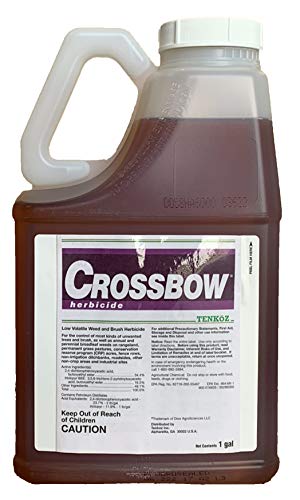
Tenkoz Crossbow is a budget-friendly brush killer that contains 16.5% triclopyr — notably lower than the premium 61.6% concentrates. This is a compromise: it will kill honeysuckle if applied as a foliar spray in warm weather, but it may require multiple applications or a supplementary tank-mix partner for thick, woody stems.
Owners report it kills poison ivy and weeds within a day and keeps them down for months, making it effective for fence rows and clearing light brush. However, one detailed review noted that the triclopyr concentration is relatively low and needed a booster of pure Garlon to handle blackberries and dense woody brush effectively.
For a homeowner with a moderate honeysuckle problem along a fence line, this is the most affordable entry point. Just know that you may need to apply it at a higher rate or follow up with a second spray for complete root kill. The 1-gallon jug covers up to an acre at low rates.
What works
- Lowest price point in this guide for a triclopyr-based product.
- Fast visual knockdown on poison ivy and tender brush species.
- Covers up to an acre per jug, suitable for small to medium properties.
What doesn’t
- Low triclopyr concentration struggles with large woody stems.
- May require tank-mixing with a booster for tough honeysuckle.
- Not as strong or long-lasting as premium triclopyr concentrates.
Hardware & Specs Guide
Active Ingredient Concentration
The most critical spec for honeysuckle control is the percentage of triclopyr (butoxyethyl ester) or glyphosate in the concentrate. Premium formulas like ALLIGARE Triclopyr 4E and Southern Ag Crossbow use high-concentration triclopyr for deep root penetration. Budget options like Tenkoz Crossbow have lower percentages, meaning you need more product per gallon of spray or more applications. Always check the active ingredient percentage before comparing prices.
Application Method Suitability
Foliar sprays (Crossbow, Roundup Poison Ivy Plus) work best for ground-level thickets where drift is not a risk. Cut-stump and basal bark treatments (best done with high-concentration triclopyr like ALLIGARE or Remedy Ultra) are essential when honeysuckle climbs up desirable trees. The ester formulation in these products penetrates bark effectively. Glyphosate-only products are better suited for open-area foliar spraying rather than stem painting.
FAQ
Can I kill honeysuckle without damaging nearby trees?
Will glyphosate alone kill established honeysuckle bushes?
What nozzle setting is best for spraying honeysuckle thickets?
Final Thoughts: The Verdict
For most gardeners, the herbicide for honeysuckle winner is the ALLIGARE Agri Star Triclopyr 4E because its high 61.6% triclopyr concentration gives you maximum flexibility for cut-stump, basal bark, and foliar treatments. If you need a fast-acting foliar spray for thickets, grab the Southern Ag Crossbow. And for a low-odor, pasture-safe option, nothing beats the Remedy Ultra for fence line and rangeland work.