
Mint is a notoriously vigorous grower, but its reputation for being “impossible to kill” leads many indoor gardeners to shove it into any old bag of dirt. The result is usually the same: stunted leaves, yellowing foliage, or a sudden case of root rot that turns your promising plant into a soggy mess. The truth is that mint thrives on a very specific balance of moisture retention, sharp drainage, and aeration—three demands that standard general-purpose potting mixes routinely fail to meet.
I’m Rikta — the co-founder and writer behind Lawn Gear Lab. For this guide, I’ve compared the particle sizes, organic ingredients, pH targets, and water-release characteristics of seven distinct soil products, cross-referencing hundreds of owner reports to isolate which mixes actually support healthy, fast-spreading mint in container environments.
Whether you are starting seeds, transplanting a nursery pot, or refreshing an established clump, finding the right blend is critical. This analysis will help you select the best soil for mint for your specific growing conditions and experience level.
How To Choose The Best Soil For Mint
Mint belongs to the Lamiaceae family and is a shallow-rooted, moisture-loving plant that absolutely despises sitting in wet, compacted media. The ideal mix mimics a forest floor: lightweight, crumbly, and able to hold water droplets against the root zone while letting any excess fall away immediately. Here are the three specifications you need to evaluate before buying.
Moisture Retention vs. Drainage Balance
Mint demands consistent moisture, but its roots suffocate quickly in dense, waterlogged soil. Look for a blend that contains both a water-holding component (sphagnum peat moss or coco coir) and a structural aerator (perlite, pumice, or coarse sand). A mix that feels heavy or clumps into a solid ball when squeezed is too dense for mint and will likely cause root rot within two weeks of potting.
pH Range and Nutrient Profile
Mint grows best in a slightly acidic to neutral pH range of 6.0 to 7.0. Most commercial potting soils are pre-adjusted, but mixes containing high levels of uncomposted bark or raw peat can drift below 5.5, which blocks nutrient uptake and causes leaf tip burn. A mix with added dolomite lime or garden lime helps buffer the pH, while a light initial feeding of worm castings or slow-release fertilizer supports early leaf production without burning tender roots.
Physical Texture and Particle Size
Mint runners need room to spread horizontally just below the soil surface. A mix that is too fine or powdery will compact after the first few waterings, trapping moisture and suffocating the shallow root mat. Chunky ingredients such as pine bark fines, fibrous coir, or perlite chips create the air pockets that mint roots need to breathe. Avoid mixes that list “forest products” or “compost” as the primary ingredient if they do not also include a visible coarse fraction.
Quick Comparison
On smaller screens, swipe sideways to see the full table.
| Model | Category | Best For | Key Spec | Amazon |
|---|---|---|---|---|
| Leaves and Soul Herb Soil | Indoor Herb Mix | Direct mint container use | 2.2 qt bag with perlite + coco coir | Amazon |
| Perfect Plants Indoor Soil | All-Purpose Mix | Deep, wide herb planters | 4 qt pine bark + sand + coco coir | Amazon |
| Grow Queen Aroid Mix | Chunky Organic | High-drainage humidity setups | 2 qt with pumice + lava rock + bark | Amazon |
| Midwest Hearth Premium Mix | Standard Blend | Large volume mint patches | 8 qt with peat + vermiculite + perlite | Amazon |
| Miracle-Gro Indoor Mix | General Purpose | Budget-friendly small pots | 12 qt peat + coir + perlite | Amazon |
| ZESTIGREENS Coco Coir Discs | Soilless Medium | Seed starting and custom mixes | 16 discs, expands to 32 cups | Amazon |
| Gardenera Monstera Mix | Specialty Chunky | Small single-plant containers | 1 qt with bark + biochar + perlite | Amazon |
In‑Depth Reviews
1. Leaves and Soul Professional Indoor Herb Soil Mix

This 2.2-quart mix is purpose-built for culinary herbs including mint, basil, rosemary, and thyme. The formulation combines sphagnum peat moss, coco coir, perlite, and dolomite lime to create a slightly buffered pH that mint roots crave. The texture is light and crumbly right out of the bag; after watering, it holds moisture against the root zone without turning into a dense sludge. Owners consistently report that mint plugs establish quickly and produce full leaves within two weeks of transplant.
The resealable packaging is a practical advantage for herb gardeners who do not need a full cubic foot of soil. At 2.2 quarts, it fills a standard 6-inch pot with some left over for a second container. The inclusion of dolomite lime is a smart touch—it prevents the pH drift that can occur when peat-heavy mixes break down over time. Customer reviews note the soil arrives well-separated during shipping but re-homogenizes easily with a quick hand-mix.
Made in the USA, this blend contains no uncomposted bark fines that might harbor fungus gnat larvae. Experienced indoor herb growers will appreciate that the mix does not require additional amendments for the first 4-6 weeks. The only compromise is the limited bag volume for those managing large patio herb gardens, though the quality per quart justifies the price point.
What works
- pH-buffered with dolomite lime for mint stability
- Consistent crumbly texture with no large bark chunks
- Bug-free, sterile formulation out of the bag
What doesn’t
- Small bag volume limits use to a few containers
- Soil separates during shipping and needs remixing
2. Perfect Plants Indoor Plant Soil 4qt

Perfect Plants delivers a 4-quart mix that uses pine bark fines, coco coir, perlite, sand, and garden lime to create an open structure that mint roots can colonize without resistance. The sand fraction adds weight to the pot, which helps anchor the shallow root mass of mint plants that tend to push upward as they spread. The bag is resealable and heavy-duty, storing well between repotting sessions.
Multiple owner reviews highlight that this soil arrives completely pest-free, a critical factor for indoor gardeners who have battled fungus gnats from cheaper brands. The mix drains rapidly—water poured through a 6-inch pot exits within seconds—yet the coco coir retains sufficient moisture that mint plants do not wilt between daily waterings. The inclusion of garden lime keeps the pH in the 6.0-6.5 range that mint prefers, preventing the leaf yellowing that occurs in acidic peat-only blends.
This is the best option for growers managing multiple mint varieties in a single large planter. The 4-quart size fills a 10-inch container completely, leaving enough volume for a second smaller pot. The lightweight texture makes it easy to work with, and the absence of gnats eliminates the frustration of discovering infested soil during transplanting.
What works
- Pine bark and sand create stable anchoring for runners
- Zero fungus gnat reports from verified buyers
- Ideal moisture balance for clay and plastic pots
What doesn’t
- Higher cost per quart than general-purpose alternatives
- Sand adds weight that may be unwanted for wall planters
3. Grow Queen Craft Aroid Potting Mix
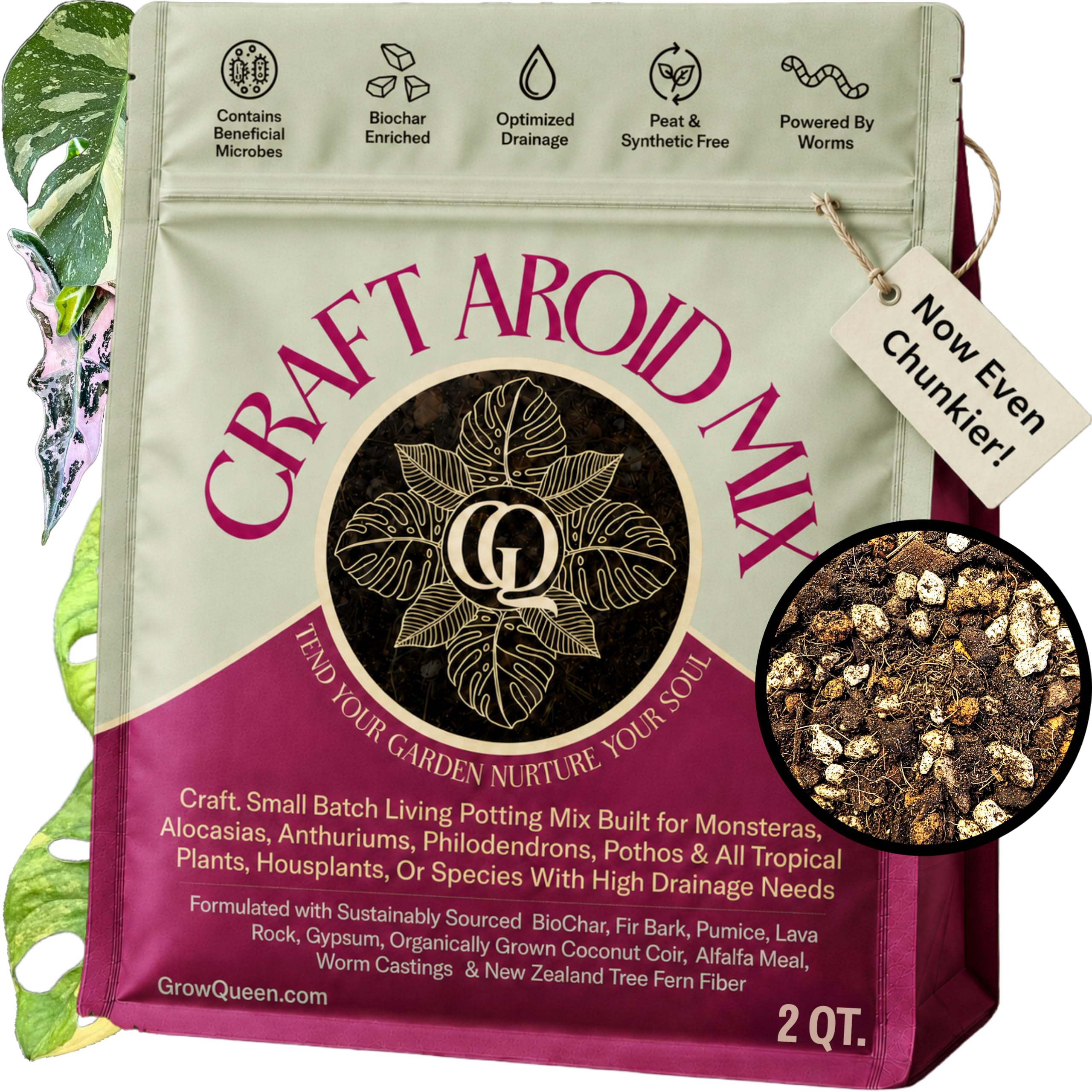
Formulated originally for aroids, this peat-free and perlite-free blend uses Douglas fir bark fines, pumice, lava rock, and New Zealand tree fern fiber to create an exceptionally chunky, fast-draining medium. For mint growers fighting high humidity or chronic overwatering, this mix makes it nearly impossible to drown the roots. The large particle sizes create continuous air channels through the entire pot, keeping the shallow root mat oxygenated even when the surface feels damp.
Certified organic coco coir and worm castings provide a gentle nutrient baseline, while the tree fern fiber buffers the pH down to around 6.0—ideal for mint. Owners report that the mix holds moisture longer than expected given its chunky nature; the pumice acts as a reservoir that slowly releases water back into the root zone. After a month of use, verified buyers note visible new growth without the soggy bottom layer that causes leaf drop in typical all-purpose soils.
The 2-quart bag is relatively small, reflecting the premium nature of the ingredients. This is a specialist choice for the indoor gardener who wants the absolute best possible drainage and is willing to pay for sustainable, ethically sourced inputs. The mix comes pre-moistened and ready to use, saving the step of pre-wetting dry coir.
What works
- Exceptional aeration prevents root rot in any pot
- Sustainable peat-free and perlite-free formulation
- Pre-moistened texture reduces transplant shock
What doesn’t
- Small bag size limits use to one or two small pots
- Chunky texture may feel too loose for inexperienced users
4. Midwest Hearth Premium Potting Soil Mix 8 Dry Quarts

Midwest Hearth offers an 8-quart bag that combines sphagnum peat moss, vermiculite, and perlite into a lightweight, pH-controlled mix. The vermiculite component gives this blend a unique water-holding advantage over straight peat-and-perlite mixes—it holds moisture within its crystalline structure and releases it gradually, which aligns perfectly with mint’s preference for consistently damp (not wet) soil. The texture is fluffy and easy to pour, with no large debris or weed seeds present.
Multiple customer reviews specifically mention successful herb growth, with one owner noting that petunias germinated strongly in this medium, which is a good indicator of its suitability for small-seeded mint starts. The 8-quart bag provides enough volume to fill three 6-inch pots or one large 12-inch planter, making it the most economical option for gardeners who want bulk volume without sacrificing structural quality. The bag is resealable and includes clear labeling of the peat, vermiculite, and perlite percentages.
The main trade-off is the lack of added lime or pH buffers. Growers using municipal water with high alkalinity may need to monitor pH drift over time, especially if they keep mint in the same pot for more than four months. However, for seasonal indoor mint cultivation and propagation projects, this mix delivers dependable results at a low per-quart cost.
What works
- Vermiculite provides sustained moisture release for mint
- Large 8-quart bag offers best per-quart value
- Light, fluffy texture with no weeds or bugs
What doesn’t
- No pH buffer; may drift acidic in long-term containers
- Contains peat, which is less sustainable than coir
5. Miracle-Gro Indoor Potting Mix 12 qt (2-Pack)
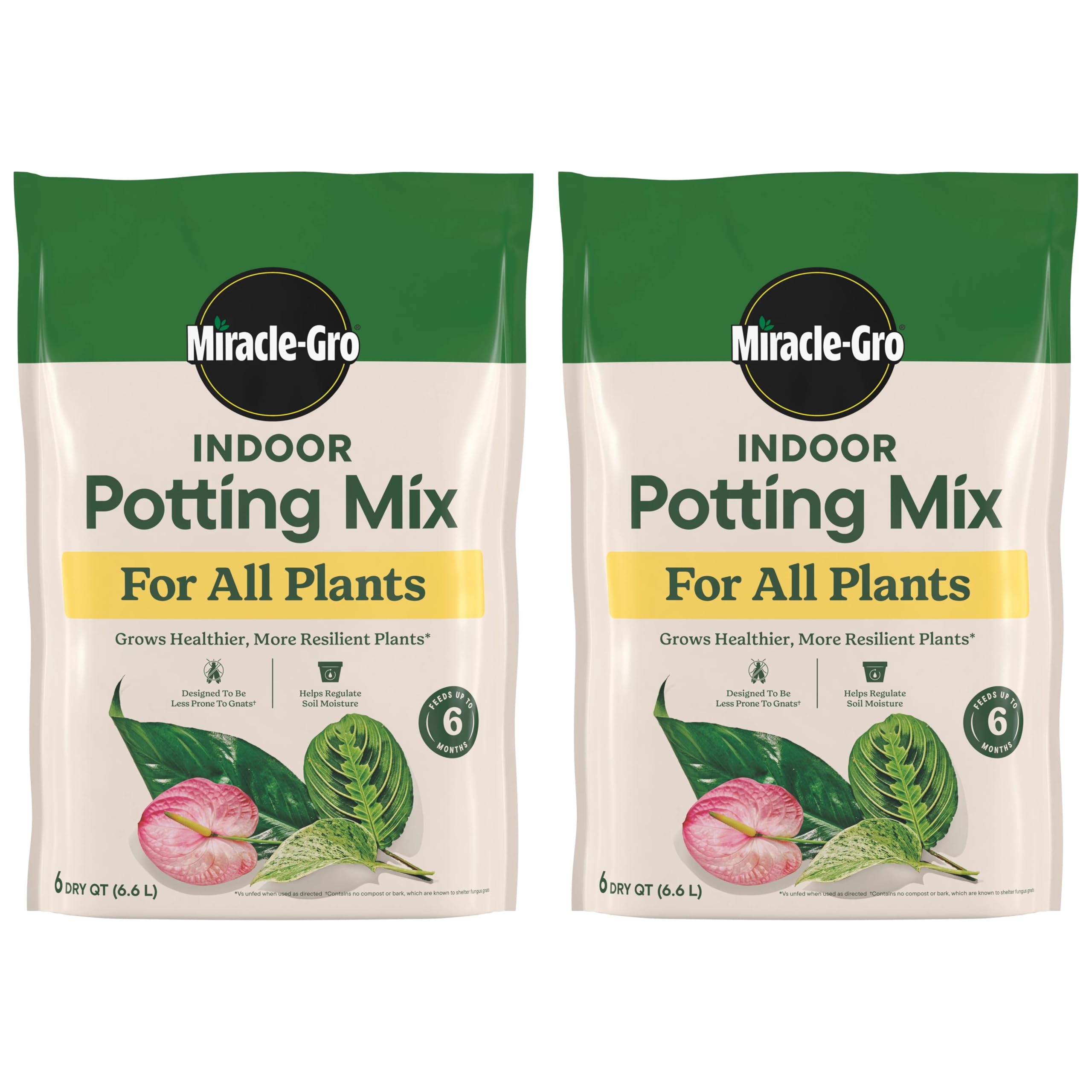
This dual-pack of Miracle-Gro’s indoor formula provides 12 total quarts of a sphagnum peat moss, coco coir, and perlite blend that is already fortified with a 6-month slow-release fertilizer. For the budget-conscious grower who needs a large volume of soil for multiple mint containers or propagation trays, this is the most accessible option. The mix is free of compost and bark, which reduces the risk of fungus gnat infestations that plague many general-purpose outdoor soils used indoors.
Owner feedback is consistently positive regarding the light texture and ease of use. The mix drains adequately for mint when used in pots with proper drainage holes, though growers in deep ceramic planters may need to add extra perlite to prevent a soggy bottom layer. The included fertilizer feed is balanced for foliage growth, which supports mint’s rapid leaf production through the first two months. Some users note the mix can be dusty when dry, so a light pre-moistening before potting is recommended.
The primary limitation is that this is a general-purpose indoor mix, not a mint-specific formulation. The pH is pre-adjusted for a broad range of houseplants, but it lacks the buffering components that prevent drift in long-term containers. For short-term mint cultivation—grow cycles of 8-12 weeks—this is a perfectly functional and affordable choice.
What works
- Built-in 6-month fertilizer supports continuous growth
- Large total volume for multi-pot setups
- Bark-free formulation reduces gnat risk
What doesn’t
- Some bags arrive dusty upon opening
- General-purpose formula lacks mint-specific pH buffering
6. ZESTIGREENS Expanding Coco Coir Soil Discs (16-Pack)

These compressed coco coir wafers are a dehydrated, sterile soilless medium that expands to roughly 2 cups of fiber per disc when hydrated. For the mint grower who wants complete control over their mix, this is the ideal base. The coir has a naturally neutral pH around 6.0, excellent water-holding capacity, and significantly better aeration than peat moss. Because the discs are shrink-wrapped individually, they store indefinitely without mold or contamination.
The 16-pack yields up to 32 cups of hydrated coir, which is roughly equivalent to an 8-quart bag of traditional soil. Adding water triggers a rapid expansion that is engaging for new gardeners, and the resulting medium is soft, fibrous, and easy to blend with perlite, worm castings, or a light organic fertilizer for a customized mint mix. Owners report using this coir in self-watering planters, seed-starting trays, and even aquariums, highlighting its versatility.
The main limitation is that pure coco coir contains essentially no nutrients. Mint planted directly into rehydrated coir will require feeding within the first two weeks. Some users also report a temporary white fungal growth on the surface of discs left in self-watering containers, though this is typically harmless saprophytic mold that resolves with better airflow. For growers who enjoy mixing their own soil, this is a clean, renewable, and lightweight option.
What works
- Sterile, pest-free base with neutral pH for mint
- Long shelf life; discs store indefinitely without degradation
- Excellent water retention without compaction
What doesn’t
- Zero nutrients; must be amended for mint growth
- Expansion process requires planning and container space
7. Gardenera Premium Monstera Potting Soil 1 Quart

Gardenera’s 1-quart mix, designed for monstera, includes organic aged bark, coco coir, perlite, biochar, and worm castings. While formulated for aroids, the chunky, well-draining structure works well for mint planted in small 3- to 4-inch pots where root space is limited. The biochar component provides a unique advantage: it retains nutrients and releases them slowly, reducing the need for frequent fertilization in small volumes of soil.
Owners report that this mix holds moisture without becoming waterlogged, making it suitable for mint grown in humidity domes or terrariums where airflow is reduced. The worm castings offer a gentle nutrient boost that supports initial leaf production without burning sensitive roots. The bag is resealable and compact, making it easy to store for single-plant gardeners.
The 1-quart size is the smallest on this list, and the per-quart cost is higher than any other product. Additionally, the bark fines are larger than what many mint growers prefer; some owners sift the mix through a ¼-inch screen before potting. For the gardener looking for a premium small-batch solution for a single mint plant in a decorative container, this mix works well, but it is not practical for larger herb gardens.
What works
- Biochar improves nutrient retention in small pots
- Excellent drainage for high-humidity environments
- Worm castings provide gentle initial feeding
What doesn’t
- Small bag size limits use to a single small pot
- Bark fines may be too large for some mint growers
Hardware & Specs Guide
Particle Size Distribution
Mint roots are thin, fibrous, and prone to tangling in very fine media. The ideal mint soil should contain a visible fraction of particles between 2 mm and 6 mm. Mixes like the Grow Queen Aroid blend (pumice, lava rock, bark fines) and Perfect Plants (pine bark, sand, perlite) score highest on this metric. Standard blends that list only “peat moss and perlite” often lack the coarse fraction needed to prevent compaction over a 3-month grow cycle.
Water Release Characteristic
Mint tolerates slightly dry soil better than soggy soil, but it grows fastest when the medium releases moisture steadily. Vermiculite-based mixes (Midwest Hearth) absorb water internally and release it slowly, mimicking the effect of a self-watering wick. Coir-based mixes (ZESTIGREENS discs, Leaves and Soul) hold water in the fiber matrix and release it through capillary action. Both approaches work well; pure perlite-based mixes release water too quickly and require more frequent watering.
FAQ
Can I use succulent soil for mint?
How often should I repot mint into fresh soil?
Should I add extra perlite to bagged soil for mint?
Final Thoughts: The Verdict
For most gardeners, the soil for mint winner is the Leaves and Soul Professional Indoor Herb Soil Mix because it arrives perfectly pH-buffered, contains the right balance of coir and perlite, and is free of fungus gnat larvae. If you manage multiple large planters and want more volume per dollar, grab the Midwest Hearth Premium Potting Soil Mix. And for the enthusiast who wants a sustainable, chunky, near-impossible-to-overwater medium, nothing beats the Grow Queen Craft Aroid Mix.