
Balancing a lush, thick lawn with effective broadleaf weed control is the core challenge for any dedicated lawn owner. The wrong product can either green up your grass while leaving weeds untouched, or kill invaders but stress your turf. The solution is a targeted combination formula, but the sheer number of NPK ratios, weed spectrums, and particle sizes makes choosing a product a serious analytical exercise.
I’m Rikta — the co-founder and writer behind Lawn Gear Lab. I spend my time dissecting product labels, cross-referencing active ingredient lists against known weed hardiness, analyzing slow-release nitrogen curves, and reviewing thousands of verified owner experiences to find what really works when applied correctly.
The goal is to give you a data-backed answer to the question: what is the most effective grass feed and weed product for your specific grass type, weed pressure, and lawn size?
How To Choose The Best Grass Feed And Weed
Selecting a combination feed-and-weed product requires analyzing three independent variables: the fertilizer’s nitrogen source and ratio, the herbicide’s active ingredient cocktail and concentration, and the physical form (granules vs. liquid) which dictates application method and timing. Ignoring any one of these three leads to poor results.
Nitrogen Source: Slow-Release vs. Quick-Release
The nitrogen in a feed-and-weed formula drives the greening response. Slow-release nitrogen (often listed as water-insoluble nitrogen or polymer-coated urea) provides color over a 6 to 12 week window without a growth surge that forces frequent mowing. Quick-release nitrogen gives a fast green-up but requires diligent watering and reduces the window for weed control. For a spring application, a product with at least 30% slow-release nitrogen offers the best balance.
Herbicide Active Ingredients: The Weed Spectrum
Not all weed-and-feed products target the same weeds. The three most common broadleaf herbicides are 2,4-D, Dicamba, and Mecoprop (MCPP). A combination of at least two of these three provides broad coverage against dandelion, clover, chickweed, ground ivy, and plantain. Products with a third active ingredient (like Carfentrazone or Quinclorac) handle tougher targets like spurge, oxalis, and nimblewill. Always cross-reference the active ingredient list against your specific weed problems.
Granular vs. Liquid Formulation
Granular feed-and-weed products combine fertilizer prills with herbicide-coated particles that must stick to weed leaves when moist. This requires the grass to be damp at application, and no watering for 48 hours afterward. Liquid concentrates (mixed with water and sprayed) give more precise targeting but require a sprayer and careful calibration to avoid drift. Granular is more convenient for large lawns; liquid is better for spot-treating heavy infestations.
Quick Comparison
On smaller screens, swipe sideways to see the full table.
| Model | Category | Best For | Key Spec | Amazon |
|---|---|---|---|---|
| The Andersons Surge | Professional Grade | Large lawns, 250+ weeds | 40 lb bag, 16-0-9, covers 16,000 sq ft | Amazon |
| GreenView Fairway Formula | Slow-Release | Sustained feeding, 10,000 sq ft | 33 lb bag, 27-0-5, 63% slow N | Amazon |
| Jonathan Green Green-Up | Fine Particle | 250+ broadleaf weeds, 5,000 sq ft | 15 lb bag, 21-0-3, 3-month feed | Amazon |
| PBI/Gordon Trimec | Concentrate | Hard-to-kill weeds, large area | 1 gallon, covers 32,000-64,000 sq ft | Amazon |
| Scotts Turf Builder Weed and Feed | Quick Fix | Dandelion & clover, 5,000 sq ft | 14.3 lb bag, 2X powerful formula | Amazon |
| Gordon’s SpeedZone EW | Fast Acting | 90+ weeds, cool-weather performance | 20 fl oz concentrate, visible results in hours | Amazon |
| Scotts Turf Builder Healthy Plus | Fungicide + Feed | Disease prevention & recovery | 13.7 lb bag, 4,000 sq ft, 27 diseases | Amazon |
In‑Depth Reviews
1. The Andersons Professional Surge Weed and Feed 16-0-9
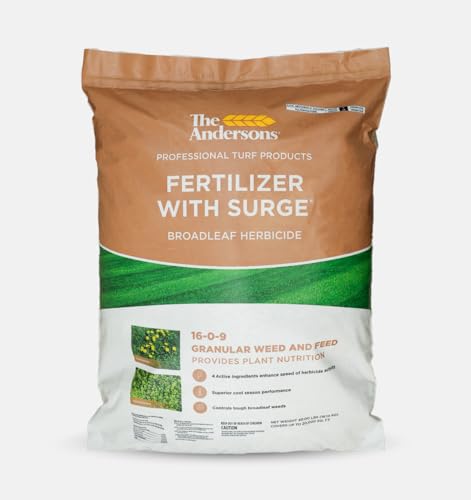
The Andersons Surge delivers professional-grade chemistry in a 16-0-9 formulation that covers a massive 16,000 square feet per 40-pound bag. The four-way herbicide cocktail eliminates over 250 common broadleaf weeds including dandelions, clover, chickweed, and plantain, and the small particle size ensures thorough coverage per square inch. Owners report effective control of creeping Charlie and crabgrass suppression when timing is dialed in correctly.
The 16-0-9 NPK ratio is notably low in nitrogen compared to many consumer products, which means the feeding is gentler but the weed-control chemistry does the heavy lifting. This product performs well in cooler spring and fall temperatures, extending the application window. It is explicitly not for Floratam St. Augustine grass, dichondra, or carpetgrass, so check your grass type before purchase.
Bag condition issues (tears causing spillage) appear in some shipping reviews, but the chemical performance receives consistent praise. A few users note minimal visible difference compared to cheaper brands, but for large properties needing professional-grade weed suppression without a second fertilization pass, the coverage-to-cost ratio is outstanding.
What works
- Professional four-way herbicide targets 250+ weed species
- 16,000 sq ft coverage per bag reduces refill frequency
- Works effectively in cooler spring and fall temperatures
What doesn’t
- Not suitable for Floratam St. Augustine or dichondra lawns
- Bag durability during shipping can be inconsistent
- Higher upfront cost per bag than consumer-grade alternatives
2. GreenView Fairway Formula Lawn Fertilizer 27-0-5

GreenView Fairway Formula is a pure fertilizer with a 27-0-5 NPK ratio and 63% slow-release nitrogen. It contains no herbicide, so it is not a combined weed-and-feed product. Instead, it delivers steady, surge-free nutrition for up to 12 weeks, making it ideal for a spring green-up that carries the lawn through early summer heat. The 33-pound bag covers 10,000 square feet, and the phosphorus-free formula protects waterways.
Owner feedback emphasizes rapid dark green color within days of application, with no clumping issues in standard broadcast spreaders. Users with carpet grass and centipede grass report excellent results. The no-phosphate formulation is a specific advantage for properties near lakes or streams where phosphorus runoff is regulated.
Because this product lacks herbicide, it is best paired with a separate post-emergent weed killer for properties with significant broadleaf pressure. The 27% nitrogen level is high, so application timing and rate must be precise to avoid burning in hot weather.
What works
- 63% slow-release nitrogen feeds consistently for 12 weeks
- Phosphorus-free formula is environmentally responsible
- Covers 10,000 sq ft with no spreader clogging issues
What doesn’t
- Contains no herbicide for weed control
- High nitrogen content demands careful watering to avoid burn
- Best used only in spring or early summer
3. Jonathan Green Green-Up Weed & Feed 21-0-3

Jonathan Green’s Green-Up Weed & Feed uses a fine particle size to maximize contact between the herbicide-coated prills and weed leaf surfaces. The 21-0-3 analysis provides gradual nutrient release for up to three months, and the weed control targets over 250 broadleaf species including tough customers like poison ivy, thistle, and wild onion. The 15-pound bag covers 5,000 square feet, making it a mid-size option for suburban lots.
Reviews are polarized: many owners report the best-looking lawn on their street after application, while others note the weeds are unaffected or that the fertilizer greens up the weeds along with the grass. This inconsistency often traces back to application timing—the product requires actively growing weeds and the correct moisture window. The bag has a reputation for arriving with clumps that are difficult to break up.
The 21% nitrogen content is high for a combined product, so users on warm-season grasses should be careful in hot months. The 5,000 sq ft coverage means two bags are needed for a typical quarter-acre lawn, which pushes the per-treatment cost higher than some alternatives.
What works
- Fine particle design improves herbicide adhesion to weed leaves
- Controls 250+ weed species including thistle and wild onion
- Three-month feeding window supports steady growth
What doesn’t
- Results depend heavily on exact application timing and weather
- Bag frequently arrives with clumped material
- Small bag size requires multiple units for larger lawns
4. PBI/Gordon Trimec Lawn Weed Killer (1 Gallon)

PBI/Gordon Trimec is a concentrated liquid herbicide containing the classic Trimec blend of 2,4-D, Mecoprop, and Dicamba. One gallon covers between 32,000 and 64,000 square feet depending on the mix rate, making it the most cost-effective weed control option per square foot in this lineup. It is formulated specifically for cool-season grasses like Kentucky bluegrass and tall fescue.
Owners consistently call it the best weed killer they have ever used, with visible results on creeping Charlie in as little as 48 hours and tougher weeds like Virginia buttonweed within two weeks. Accurate mixing is critical—some users report needing to double or triple the recommended rate for heavy infestations, and overspray can damage surrounding turf.
This product contains no fertilizer. It is a standalone herbicide concentrate that requires a pump sprayer or hose-end sprayer for application. For properties needing both feeding and weed control, Trimec should be applied separately from a granular feed product, ideally with a 7 to 14 day gap between applications.
What works
- Classic three-way Trimec chemistry kills tough broadleaf weeds
- 1 gallon covers up to 64,000 sq ft at standard mix rates
- Fast visible action on clover, dandelion, and creeping Charlie
What doesn’t
- No fertilizer included; requires separate feeding
- Requires a sprayer and careful mixing to avoid turf damage
- Not labeled for all warm-season grass types
5. Scotts Turf Builder Weed and Feed 3 (5,000 sq ft)
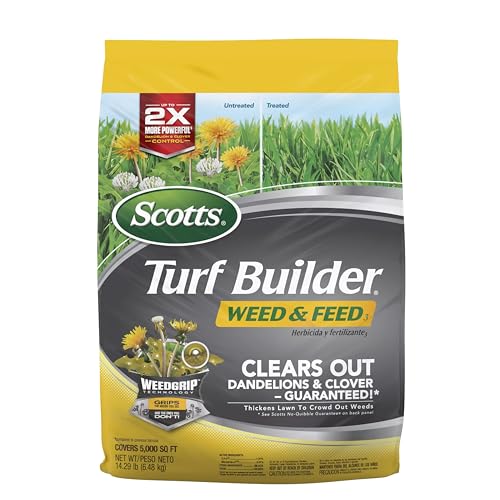
The Scotts Turf Builder Weed and Feed 3 uses Weedgrip Technology designed to adhere herbicide to weed leaf surfaces, including weeds you don’t see above the surface. The formula claims 2X more powerful dandelion and clover control versus previous generations. This is the most widely available granular weed-and-feed at big-box retailers, available in both granular and hose-end sprayer forms.
Owner feedback confirms effective dandelion control and good greening response on Bermuda and other warm-season grasses. The hose-end sprayer version receives particular praise for ease of application and even coverage. However, multiple reviews note the product does not control crabgrass or clover with the same reliability. The 14.3-pound bag covers 5,000 square feet, so larger properties need multiple bags.
Application technique matters significantly: the granular version requires wet weed leaves for granules to stick, and the treated area must not be watered or walked on for 48-72 hours. Failure to follow these instructions leads to burns and reduced weed control. The active ingredients (1.22% 2,4-D, 0.081% Mecoprop) are lower concentration than professional products.
What works
- Weedgrip Technology improves granule adhesion on target weeds
- Easy to find at local retailers and hardware stores
- Hose-end sprayer version simplifies application on moderate lawns
What doesn’t
- Weak on crabgrass and clover control
- Precise watering and timing required to avoid turf burn
- Low herbicide concentration reduces effectiveness on tough weeds
6. Gordon’s SpeedZone EW Lawn Weed Killer

SpeedZone EW is a four-way liquid herbicide containing 2,4-D, Dicamba, Carfentrazone, and Mecoprop for rapid knockdown of 90+ listed weeds including white clover, ground ivy, spurge, goosegrass, and nimblewill. The Carfentrazone component provides visible wilting within hours of application — the fastest visible response of any product in this guide. It is labeled for the most common cool and warm season turf types.
The cool-weather performance is a defining advantage: SpeedZone works effectively when temperatures are in the 50s and 60s, when many other herbicides lose efficacy. It is rainfast in three hours, and the lawn can be reseeded in as little as seven days. Professional lawn care operators regularly recommend this product for its speed and broad spectrum.
The 20-ounce bottle concentrates to a surprisingly small mixing ratio (0.5 to 1 gallon of water per 1,000 sq ft), and the bottle cap is marked for approximate dosing but no measuring cup is included. Over-spray can easily kill surrounding grass, so a calibrated sprayer and steady hand are necessary. Spurge may require a second application after 60 days.
What works
- Visible weed wilting within hours of application
- Works effectively in low temperatures (50s-60s)
- Rainfast in 3 hours, reseed in 7 days
What doesn’t
- No measuring cup supplied; cap markings are small
- Requires precise sprayer calibration to avoid turf damage
- Spurge may need a follow-up treatment within 60 days
7. Scotts Turf Builder Healthy Plus Lawn Food 13.7 lb

Scotts Turf Builder Healthy Plus is a 2-in-1 fungicide and fertilizer formulation targeting 27 diseases including brown patch, leaf spot, powdery mildew, and red thread. The systemic fungicide works from the inside of the plant tissue, meaning it can prevent disease from developing when applied prior to symptom onset during stressful periods. The built-in lawn food helps turf recover from summer stress.
Owners report impressive dual-action results: disease symptoms clear noticeably, and lawn density and green color improve concurrently. One reviewer noted significant reduction in clover infestation while using this product, though it is not labeled specifically as a broadleaf herbicide. The 13.7-pound bag covers 4,000 square feet, which is the smallest coverage range in this guide.
Application timing is critical — this product is designed for preventive use before disease symptoms appear, making it less useful for reactive treatments. Over-application can burn the grass. The bag has a history of arriving torn during shipping, which users have remedied with tape. This is not a traditional weed-and-feed since the weed control is limited to disease suppression rather than broadleaf elimination.
What works
- Systemic fungicide controls 27 types of lawn disease
- Feeds turf to help recover from heat and disease stress
- Safe for all grass types when used as directed
What doesn’t
- Not a broadleaf herbicide; clover control is incidental
- Small 4,000 sq ft bag size requires multiple units for large lawns
- Shipping bags are prone to tearing and spillage
Hardware & Specs Guide
NPK Ratio and Nitrogen Source
The NPK number on the bag (e.g., 27-0-5) tells you the percentage by weight of Nitrogen, Phosphorus, and Potassium. For a grass feed product, the first number is the most important. Slow-release nitrogen is listed as water-insoluble nitrogen (WIN) or polymer-coated urea. A product with at least 30% of its nitrogen in slow-release form provides a consistent green color over 6-12 weeks without a growth surge. Quick-release nitrogen (ammonium sulfate, urea) greens rapidly but requires careful watering to avoid burn.
Herbicide Active Ingredient Concentration
Granular weed-and-feed products list active herbicide ingredients as a percentage of the total bag weight. Professional products typically contain 1-2% of each active by weight. Liquid concentrates list their active ingredients as percentages of the concentrate, which are then diluted at the recommended mix rate. Higher concentration in the bag or bottle does not always mean stronger weed control — the actual dose per 1,000 sq ft is what matters. Always cross-reference the label’s recommended coverage rate against your lawn’s square footage.
FAQ
Can I apply a grass feed and weed product and seed my lawn at the same time?
Why did my grass turn yellow or brown after applying a weed and feed?
Should I use a granular or liquid grass feed and weed product?
Final Thoughts: The Verdict
For most gardeners, the grass feed and weed winner is the The Andersons Professional Surge because it combines professional-grade four-way herbicide with a 16-0-9 fertilizer in a 40-pound bag covering 16,000 square feet. If you want sustained, slow-release feeding without chemical weed control, grab the GreenView Fairway Formula. And for fast-acting liquid knockdown of tough weeds like ground ivy and spurge, nothing beats the Gordon’s SpeedZone EW.