
Boxwood shrubs define the crisp lines of formal gardens and foundation plantings, but their slow growth and tendency to develop yellow, bronzed, or pale leaves frustrate even experienced landscapers. The problem is almost always a mismatch between the plant’s specific nutritional needs — particularly soil pH within the 6.0 to 7.0 range and a steady supply of nitrogen — and the generic shrub food most homeowners grab from the shelf.
I’m Rikta — the co-founder and writer behind Lawn Gear Lab. I’ve spent months analyzing NPK ratios, secondary nutrient profiles, slow-release mechanisms, and hundreds of verified owner experiences to separate the specialized boxwood feeds from the all-purpose fillers in this precise category.
Whether your boxwoods are struggling with nutrient deficiency, transplant shock, or early signs of blight, the right boxwood plant fertilizer can restore deep green color and compact growth within weeks.
How To Choose The Best Boxwood Plant Fertilizer
Boxwood is a shallow-rooted, acid-loving evergreen that responds best to balanced nutrition delivered consistently. Generic “tree and shrub” fertilizers often skimp on the secondary nutrients — magnesium and sulfur — that boxwood needs to maintain its signature dark green color. Understanding three core criteria will simplify your decision.
N-P-K Ratio and Secondary Nutrients
Boxwood performs well with a nitrogen-heavy formula in the 10-to-15 range for foliage growth, balanced by phosphorus and potassium in roughly equal portions (such as 13-3-13 or 16-4-4). The real differentiator is magnesium oxide and sulfur content: these prevent interveinal chlorosis (yellowing between the leaf veins) better than any high-nitrogen lawn food.
Delivery Mechanism: Spikes vs Granules vs Liquid
Slow-release spikes provide steady feeding over 90 days with zero mixing, making them ideal for established hedges where you want to “set and forget”. Granular feeds like TOPBUXUS Turbo Grow disperse faster and are better for correcting acute deficiencies in individual plants. Liquids offer the fastest absorption for stressed or recently transplanted boxwood but require more frequent reapplication.
Disease Protection and Soil pH Management
Boxwood blight and root rot thrive in poorly fed or alkaline soils. Specialized formulas that include sulfur or are formulated for acid-loving plants help maintain the 6.0–7.0 pH sweet spot that suppresses fungal pathogens. The TOPBUXUS Restore & Protect foliar tablets, for example, target blight prevention directly through their micronutrient profile and foliar delivery method.
Quick Comparison
On smaller screens, swipe sideways to see the full table.
| Model | Category | Best For | Key Spec | Amazon |
|---|---|---|---|---|
| TOPBUXUS Boxwood Restore & Protect Mix | Foliar Tablets | Blight recovery & deep green | 8-0-10 NPK + micronutrients | Amazon |
| TOPBUXUS Boxwood Turbo Grow | Granules | Fast root absorption | 13-3-13 + Mg, S, Ca | Amazon |
| TPS Nutrients Boxwood Liquid | Liquid Concentrate | Quick color correction | 32 oz ready-to-use bottle | Amazon |
| Jobe’s 16-4-4 Spikes | Spikes | Set-and-forget hedges | 16-4-4 NPK, 15 spikes | Amazon |
| Old Farmer’s Almanac TruSpikes | Spikes | Unbreakable durability | 13-3-3, 5 inch spikes | Amazon |
| Espoma Holly-Tone | Granules | Organic acid-loving plants | 4-3-4 NPK + 5% sulfur | Amazon |
| Jobe’s 13-3-4 Spikes | Spikes | Affordable maintenance | 13-3-4 NPK, 15 spikes | Amazon |
In‑Depth Reviews
1. TOPBUXUS Boxwood Restore & Protect Mix (Health Mix)
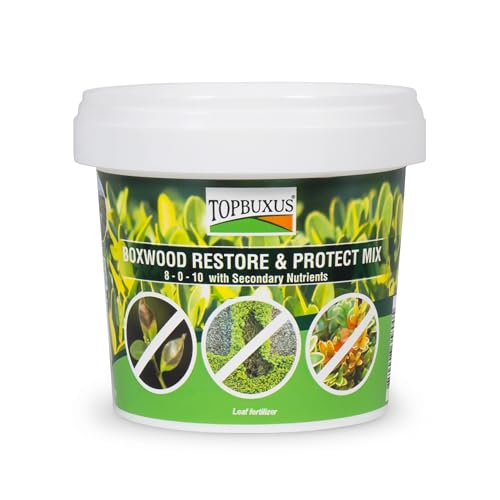
This is the only product on the market designed specifically to address boxwood blight prevention while simultaneously delivering foliar nutrition. Each tablet, when dissolved in one quart of water and applied with a pressure sprayer, covers 100 square feet of boxwood foliage with an 8-0-10 NPK blend plus chelated micronutrients that roots simply cannot absorb from granular applications during early disease stages. The Dutch nursery that developed it — once the world’s largest boxwood grower — backs the formula with decades of field-level efficacy data against Volutella blight and winter bronzing.
Owner reports confirm that a single treatment in late May, after a hard prune, produced fully filled-in, emerald-green shrubs by late July, even on plants previously afflicted by psyllid damage and dieback. The individual foil-wrapping of each tablet preserves shelf stability, and the 10-tablet tub covers up to 1,000 square feet — enough for a substantial hedge or foundation row. One tablet mixed per directions handles roughly a dozen mature boxwood plants in a standard pump sprayer.
The trade-off is the need for a separate sprayer and the patience to wait a full growing season if the boxwood is severely compromised — several users noted that the first year showed modest improvement, but the following spring delivered dramatic recovery. For anyone fighting chlorosis, bronzing, or suspected blight, this foliar approach is the most targeted weapon in the category.
What works
- Formulated specifically for boxwood blight management
- Effervescent tablets store indefinitely and mix instantly
- Owner results show full recovery over one to two seasons
What doesn’t
- Requires a pump sprayer you may not already own
- Results on severely blighted plants can take a full year
2. TOPBUXUS Boxwood Turbo Grow

Where the Restore & Protect Mix treats foliage, Turbo Grow works from the root zone up with an NPK profile — 13-3-13 plus 2.5% magnesium, 9.0% sulfur, and 2.0% calcium — that directly targets the two most common boxwood deficiencies: interveinal yellowing (magnesium shortage) and leaf tip burn (low sulfur). The granules are designed for fast absorption by shallow feeder roots, which means you can see new growth within three to five days on stressed plants, and full recovery from transplant shock in roughly a month.
The one-pound bag covers 100 square feet, making it a high-concentration option best suited for spot-treating individual shrubs or small hedges rather than broad landscape beds. Owners who used it on boxwood that had bronzed from heavy sun or winter wind reported that the majority of their plants greened up noticeably within two weeks. Several reviewers specifically noted that the magnesium content resolved yellowing that generic 10-10-10 fertilizers had failed to touch over multiple seasons.
The container is genuinely compact — roughly 4 by 4 inches — which has surprised many first-time buyers who expected a larger volume. For a hedge of eight to ten mature plants, a single bag provides just enough for one thorough application. If you manage a larger planting, you will need multiple bags, which pushes the per-treatment cost upward relative to spike alternatives.
What works
- Magnesium and sulfur target yellowing that standard blends miss
- Visible greening reported in under a week
- Developed specifically for boxwood, not a generic shrub food
What doesn’t
- Small bag size is expensive for large hedge rows
- No slow-release coating; requires reapplication for sustained feeding
3. TPS Nutrients Boxwood Liquid Plant Food
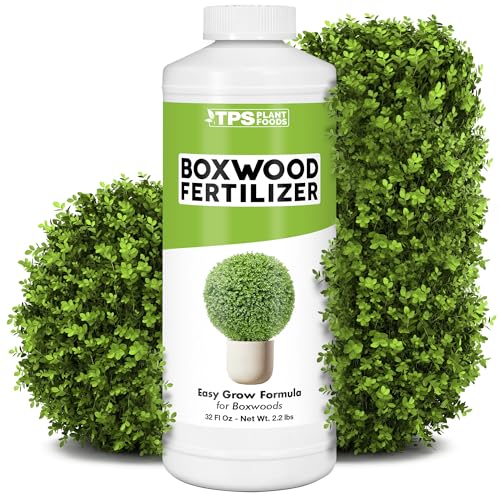
TPS Nutrients took a straightforward approach: formulate a liquid concentrate specifically labeled for boxwood and deliver it in a ready-to-use quart bottle. The selling point is speed — liquid fertilizers bypass the soil microbe breakdown process and enter the root system almost immediately, making this the strongest choice for reviving a boxwood that has suddenly yellowed after a hard winter or during a dry spell. The formula is designed to support dense foliage growth and compact shrub structure without the leggy flush that a generic high-nitrogen lawn food can trigger.
Owner reports consistently describe “boxwood crack” — a revival of dying shrubs within weeks, with foliage turning a lush, deep green that lasted through the season. Multiple buyers noted that their slow-growing boxwood “grabbed faster” compared to previous seasons with granular feeds. The liquid format also makes it easy to mix into a watering can for spot treatment, which is ideal for container-grown boxwood or newly installed foundation plants that need a quick establishment boost.
The main drawback is application frequency: liquid feeds require reapplication every two to four weeks during the growing season, which adds up in both labor and product cost compared to a twice-yearly spike regimen. A 32-ounce bottle covers a modest hedge; for larger plantings you will need to stock multiple bottles, and at this tier’s price point the cost per square foot exceeds granular alternatives.
What works
- Immediate root absorption for rapid color correction
- Easy to apply with watering can or hose-end sprayer
- Integrated micronutrients support dense, compact growth
What doesn’t
- Requires frequent reapplication for sustained results
- Bottle size is modest for large hedge installations
4. Jobe’s 16-4-4 Slow Release Tree & Shrub Spikes

Jobe’s 16-4-4 spike formulation is one of the most established slow-release options for boxwood hedges. The high nitrogen content (16%) promotes lush foliage development, while the 4-4 phosphorus-potassium balance supports root anchoring and disease resistance. Each spike delivers nutrients directly into the active root zone, avoiding the runoff and surface evaporation that plague granular fertilizers on sloped or mulched beds. The spikes come pre-measured, which eliminates the guessing game of “how much per shrub” that often leads to burning or underfeeding.
Long-term owners with 20-year hedge installations consistently report that their Jobe’s-fed boxwood rows are noticeably taller and denser than untreated neighbors’ plantings on the same block. The included plastic driving cap prevents the spike from crumbling during installation, and the 90-day release window means two applications per year (early spring and late fall) provide season-long nutrition. The 15-count box covers roughly 15 medium shrubs, with larger specimens needing two spikes per plant.
Spike density matters — shallow-rooted boxwood can be damaged if spikes are placed too close to the main stem. The instructions recommend driving them at the drip line, which requires moist soil; dry or compacted clay can make installation frustrating even with the cap. Some users also note that the plastic cap can be difficult to remove after pounding, sometimes requiring pliers or a claw hammer.
What works
- Pre-measured spikes eliminate over-fertilization risk
- 90-day slow release matches boxwood’s steady growth habit
- Long-term owner data shows measurable size improvement
What doesn’t
- Requires moist soil for installation without crumbling
- Plastic driving cap can stick and become hard to remove
5. The Old Farmer’s Almanac TruSpikes (13-3-3)

The Old Farmer’s Almanac TruSpike sets itself apart with a patented density that will not break, crush, or crumble under a rubber mallet — a genuine breakthrough over the brittle oval spikes that shatter on contact with rocky or compacted soil. Each 5-inch spike delivers a 13-3-3 formula with 13% nitrogen for foliage vigor, 3% phosphorus for root development, and 3% potassium for general stress tolerance. The slower release rate (up to 3 months per spike) is ideal for boxwood, which prefers steady, low-dose feeding over sudden nitrogen flushes.
Owners handling mature dogwood and boxwood hedges confirm that these spikes can be driven into dry, hard ground without disintegrating, and that the absence of a plastic cap streamlines the process — you simply hammer the spike directly until it is flush with the soil surface. Several users noted that from the same 12-spike box, they saw brighter white blooms and greener foliage on their shrubs within a single growing season, with no signs of fertilizer burn even when placed slightly closer to the trunk than recommended.
The 13-3-3 NPK ratio is slightly lower in phosphorus than some competitors, which may not matter for established boxwood but could be a limiting factor for young plants still building root mass in poor native soil. A minority of buyers reported no visible difference after a full season, which highlights that spikes are less effective than liquids for correcting acute deficiency symptoms.
What works
- Genuinely unbreakable — drives into hard soil without shattering
- No plastic cap needed for installation
- Slow, steady release matches boxwood’s natural growth rhythm
What doesn’t
- Lower phosphorus may not suit newly planted boxwood
- Results can be subtle in already healthy soil
6. Espoma Organic Holly-Tone 4-3-4
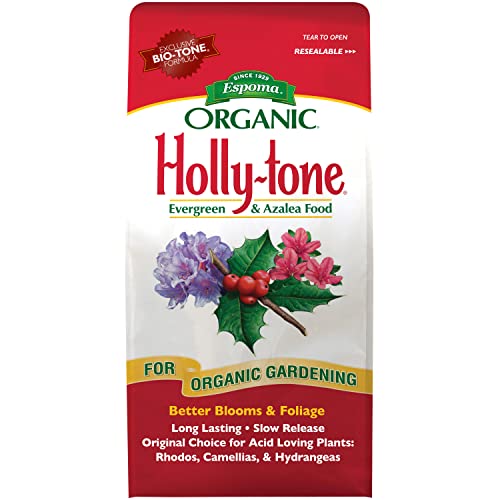
Holly-Tone is the original organic fertilizer for acid-loving plants, and its 4-3-4 analysis with 5% sulfur makes it a strong candidate for boxwood that grows in alkaline soil zones. The sulfur component acts as a soil acidifier, gradually lowering pH toward the 6.0 range that boxwood prefers, while the Bio-tone microbial inoculant accelerates organic matter breakdown so the nutrients are available to shallow roots. The 4-pound bag covers a medium-sized hedge row and is OMRI-listed for organic production.
Long-time users — some spanning decades — report that Holly-Tone keeps their evergreen shrubs consistently green and healthy without the synthetic burn risk associated with high-nitrogen chemical blends. One owner with a 25-year-old holly hedge noted that after switching to Holly-Tone the shrubs greened up “fast and bright” with prolific berry sets. For boxwood specifically, the slow-release organic granules reduce the risk of flushing new growth that gets zapped by a late frost, making it a safe choice for northern climates with unpredictable spring weather.
The 4-3-4 NPK is noticeably lower in nitrogen than the spike options (which range from 13 to 16 percent), so you will need to apply it twice per season (spring and fall) and may see slower initial greening compared to a 16-4-4 spike or liquid concentrate. It also has a distinct organic odor that some find unpleasant, though it dissipates quickly after watering in.
What works
- Certified organic with no synthetic sludges or toxic ingredients
- 5% sulfur actively acidifies soil for pH-sensitive boxwood
- Safe for year-round use without burning tender roots
What doesn’t
- Lower nitrogen content means slower visible results
- Requires twice-annual application for sustained feeding
7. Jobe’s 13-3-4 Evergreen Fertilizer Spikes

This second Jobe’s spike option trades the higher 16-4-4 analysis for a 13-3-4 formulation at a lower entry cost, making it the most budget-conscious way to maintain an established boxwood hedge with minimal effort. The 15 spikes are pre-measured for standard shrub spacing and release nutrients over a 90-day window, requiring just two applications per year. The 13% nitrogen is still sufficient to maintain deep green color in healthy soil, while the 3% phosphorus and 4% potassium support root resilience and winter hardiness.
Owner feedback highlights rapid results on “perky bushes” — boxwood and other evergreens visibly perked up within weeks of application. Buyers with green giant arborvitae and large foundation hedges reported that these spikes produce bigger, more beautiful growth year after year. The slow-release format prevents the surge-and-crash cycle that can happen with water-soluble granular feeds, and the low cost per spike makes it feasible to treat long hedge rows without a significant investment.
The 13-3-4 spikes share the same installation challenge as all spike fertilizers: hard, dry soil makes driving them in difficult without pre-moistening the ground. Several users noted that a hammer claw was necessary to retrieve the plastic cap after driving, and that spikes placed too shallowly can surface during freeze-thaw cycles. For boxwood specifically, the 13% nitrogen may not be enough to correct advanced chlorosis or yellowing caused by nutrient lockout in alkaline soils.
What works
- Very affordable per-spike cost for large installations
- 90-day slow release with no mixing or measuring
- Works reliably on healthy boxwood without burning
What doesn’t
- Insufficient for correcting advanced nutrient deficiencies
- Requires pre-moistening soil for smooth installation
Hardware & Specs Guide
NPK Ratio Explained
The three-number NPK ratio represents the percentage by weight of nitrogen (N), phosphorus (P), and potassium (K). For boxwood, a ratio with 10-16% nitrogen supports leaf density, while phosphorus below 5% and potassium around 3-10% keeps roots healthy without stimulating excessive flower or seed production. Secondary numbers like magnesium (Mg), sulfur (S), and calcium (Ca) are often more important than P and K for preventing the yellowing and bronzing that boxwood is prone to in alkaline or depleted soils.
Slow-Release vs Fast-Acting
Slow-release fertilizers (spikes and coated granules) meter nutrients over 60-90 days, matching boxwood’s steady growth pace and minimizing the risk of leaching. Fast-acting fertilizers (liquid concentrates and uncoated granules like TOPBUXUS Turbo Grow) deliver nutrients within days but must be reapplied every 2-4 weeks. For maintenance, slow-release is less labor-intensive; for correcting a deficiency, fast-acting is more effective.
FAQ
How often should I fertilize boxwood shrubs?
Can I use lawn fertilizer on my boxwood?
Final Thoughts: The Verdict
For most gardeners, the boxwood plant fertilizer winner is the TOPBUXUS Boxwood Restore & Protect Mix because it delivers disease protection and targeted nutrition in a single foliar application — something no generic shrub food can match. If you want instant greening for a struggling plant, grab the TPS Nutrients Boxwood Liquid. And for a low-maintenance hedge with established soil, nothing beats the convenience and durability of The Old Farmer’s Almanac TruSpikes.