
Vegetable plants searching for a targeted phosphorus and potassium boost without excessive foliage growth need a specific nutrient ratio designed to prioritize blossoms and root development. A 5-10-10 blend delivers exactly that: lower nitrogen keeps leafy growth manageable while doubling down on the two elements that drive flowering and fruit bulking in crops like tomatoes, peppers, and root vegetables.
I’m Rikta — the co-founder and writer behind Lawn Gear Lab. I dig into granular and liquid fertilizer formulations, compare NPK ratios, trace micronutrient profiles, and cross-reference hundreds of verified owner reports to separate the formulations that actually move the needle on harvest quality from those that just add nitrogen to the soil.
This guide evaluates the top-rated formulas on the market to help you find the most effective 5-10-10 fertilizer for vegetables that matches your garden size, application preference, and crop-specific needs.
How To Choose The Best 5-10-10 Fertilizer For Vegetables
Selecting the right 5-10-10 blend goes beyond just reading the label. Vegetable gardens demand a specific nutrient release timing, consistent particle size, and often added micronutrients that your soil test results will confirm. The following breakdown covers the critical decision points every gardener should evaluate before buying.
Granular vs. Liquid Formulation
Granular 5-10-10 fertilizers provide a slow-release nutrient supply that feeds plants over 6 to 8 weeks, making them ideal for pre-planting soil incorporation and side-dressing during the growing season. Liquid concentrates, on the other hand, deliver an immediate nutrient boost that roots can absorb within hours — perfect for correcting early-season phosphorus deficiencies or giving transplants a rapid start. For most vegetable gardens, a granular base application combined with a liquid foliar or root drench at flowering stage offers the best of both worlds.
Micronutrient Enrichment
Beyond the primary NPK numbers, effective vegetable fertilizers often include iron, zinc, manganese, copper, and boron. These micronutrients correct hidden soil deficiencies that limit bloom set, fruit fill, and root expansion. A 5-10-10 formula that lists added micronutrients on the label typically delivers more consistent results in raised beds and container gardens where soil volume is limited and nutrient depletion accelerates.
Source and Certification
Check whether the fertilizer uses synthetic mineral salts or naturally mined and derived ingredients. If you maintain an organic vegetable garden, look for an OMRI-listed product or one explicitly stating no urea,no muriate of potash, and no prohibited synthetic coatings. For conventional gardens, a uniform granule size and low-dust formulation ensure even spreading without clogging broadcast spreaders.
Quick Comparison
On smaller screens, swipe sideways to see the full table.
| Model | Category | Best For | Key Spec | Amazon |
|---|---|---|---|---|
| Cz Garden 5-10-10 | Granular | High-yield tomatoes & peppers | 8-lb bag, 2% iron | Amazon |
| Espoma GF51056 | Granular | Transitioning soil to vegetables | 6.75 lbs, 5-10-5 ratio | Amazon |
| TPS Nutrients 5-10-10 | Liquid | Quick correction for blooms | 32 oz concentrate | Amazon |
| TPS Nutrients 10-10-10 | Liquid | All-purpose balanced feeding | 32 oz, with micronutrients | Amazon |
| GardenWise 10-10-10 | Granular | Slow-release continuous feeding | 3 quarts, 8-week feed | Amazon |
| Supply Solutions 10-10-10 | Granular | Lawn & garden soil prep | 5 lbs, micronutrients | Amazon |
| Knox 33lb 10-10-10 | Granular | Large garden coverage | 33 lbs, 5000 sq ft | Amazon |
In‑Depth Reviews
1. Cz Garden Organics 5-10-10 Tomato & Vegetable Fertilizer (8LB)

The Cz Garden 5-10-10 formulation matches the exact ratio that vegetable plants require during flowering and fruit set — low nitrogen prevents excessive foliage at the expense of fruit, while the doubled phosphorus and potassium directly support blossom retention and fruit fill. Verified reports from Pennsylvania growers describe tomatoes reaching 7 feet tall and pepper plants surpassing 4 feet with harvests extending into late October, indicating the nutrient release timing aligns well with long-season crops.
At 8 pounds in a resealable pouch, this bag offers a practical size for a medium vegetable garden — enough to cover roughly 200 to 300 square feet depending on application rate. The inclusion of 2% iron addresses chlorosis risk in high-pH soils and supports chlorophyll production during heavy fruiting loads. The granules are uniformly sized for even hand broadcasting or side-dressing.
The heavy-duty resealable pouch preserves moisture protection and prevents caking between applications. The 5-10-10 analysis is relatively uncommon on Amazon, making this one of the few ready-to-use options at this specific ratio with added iron. Gardeners who want to avoid excess nitrogen while pushing fruit weight will find this blend difficult to beat at this price point per pound.
What works
- Exact 5-10-10 ratio with 2% iron for deep greening.
- Resealable pouch prevents moisture damage.
- Proven yield results on heavy-fruiting crops.
What doesn’t
- Not OMRI-listed; contains synthetic sources.
- Granules may require watering-in to avoid leaf contact.
2. Espoma GF51056 Garden Food Fertilizer 5-10-5 (Two Pack)
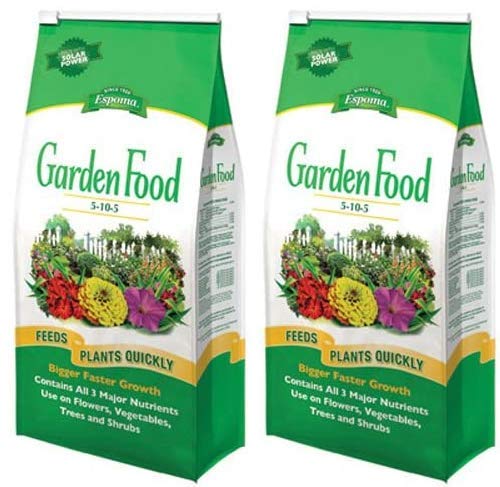
Espoma’s 5-10-5 blend closely mirrors the ideal vegetable ratio, with slightly less potassium than a true 5-10-10 but enough to support strong root anchoring and disease resistance in tomatoes, peppers, and perennials. The two-pack provides 13.5 pounds total, giving extended-season gardeners a full summer supply without reordering. Multiple customers report using this formula after soil tests recommended a low-nitrogen, high-phosphorus approach for converting clay or acidic ground into productive vegetable beds.
Espoma is a trusted brand in the gardening community, and this formulation uses natural organic-based ingredients that are safe around children and pets once watered in. The granules break down gradually in moist soil, releasing nutrients over several weeks. Reviewers consistently note that their vegetable plants produce more blossoms and larger fruit compared to higher-nitrogen all-purpose feeds.
The 5-10-5 ratio works particularly well for flowering ornamentals and root vegetables like carrots and beets, where potassium demands are moderate but phosphorus is critical for below-ground development. Users transitioning from a 10-10-10 regimen report less leggy growth and more compact, productive plants. The two-bag value makes this a strong choice for gardeners who want a proven, gentle formula that reduces the risk of nutrient burn.
What works
- Organic-based ingredients with low burn risk.
- Two-pack offers strong value for large gardens.
- Works well for both vegetables and flowers.
What doesn’t
- 5-10-5 ratio lower in potassium than 5-10-10.
- Cannot be shipped to California.
3. TPS Nutrients 5-10-10 Liquid Fertilizer (32 oz)
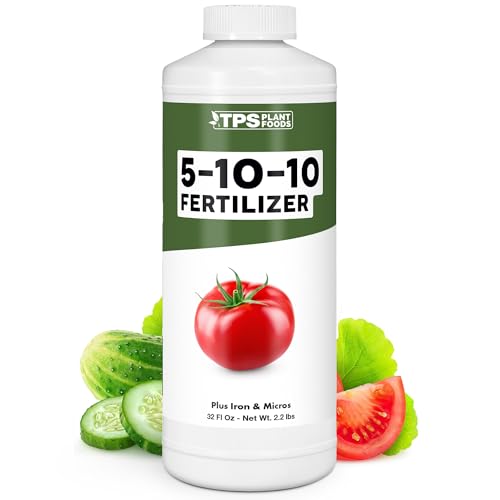
The TPS Nutrients liquid 5-10-10 delivers nutrients in a form that roots can absorb within 24 to 48 hours, making it the fastest-acting option in this lineup for rescuing underperforming plants. One reviewer reported reviving half-dead knockout roses within three weeks and producing vibrant blooms. Cactus growers also praise this formula for its low nitrogen and high phosphorus-potash content, which suits desert plants that burn easily under high-nitrogen feeds.
The 32-ounce bottle is highly concentrated — the label recommends diluting at ratios around 1 to 2 ounces per gallon of water, so a single bottle yields 16 to 32 gallons of ready-to-use solution. That makes this an economical choice for container gardens, raised bed side-dressing, or foliar applications during the flowering stage. A vegetable gardener noted that two applications on bell pepper plants turned a plant with zero buds into one with over 30 buds, showing the phosphorus spike works as advertised.
Because it is a liquid, this 5-10-10 requires more frequent application than granular alternatives — typically every one to two weeks during active growth. The bottle does not include a measuring cup, so you will want a separate graduated syringe or spoon. The synthetic formulation provides rapid results but is not certified for organic production systems.
What works
- Fast absorption — visible results in 1-2 weeks.
- Highly concentrated; 16-32 gallons per bottle.
- Low nitrogen safe for cacti and succulents.
What doesn’t
- Requires weekly or biweekly application.
- No measuring cup included.
4. TPS Nutrients 10-10-10 Liquid Fertilizer with Micronutrients (32 oz)
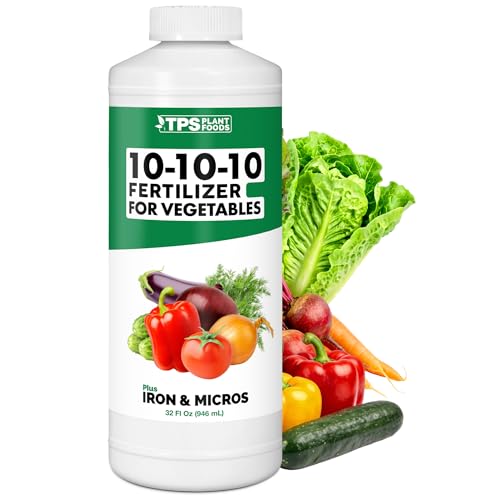
While this TPS formula uses a balanced 10-10-10 NPK rather than the targeted 5-10-10 ratio, it earns a spot because of its added micronutrient package — iron, zinc, and other trace elements that supplement the base NPK and improve overall plant health in vegetable gardens. The manufacturer recommends a mixing ratio of 1:128 or 2:128 ounces per gallon, giving you control over the nitrogen strength. By diluting more heavily during the fruiting stage, you can approximate a lower nitrogen profile while still delivering phosphorus and potassium.
Verified reviews highlight its effectiveness on winter greens — collards, cabbage, and broccoli all produced strong yields when used in cool-season gardens. Indoor basil growers also report rapid recovery and vigorous new growth after transplanting. The liquid formulation works well for both soil drench and foliar feeding, and the inclusion of iron helps prevent yellowing in high-pH or compacted soils.
The packaging has been a weak point — multiple customers report leaking bottles during shipping due to insufficient seal integrity. While the formula itself performs consistently, the delivery experience may require cleanup. Ordering during warmer months or requesting additional padding may reduce this risk. For gardeners who already have a separate phosphorus-potash booster, this all-purpose liquid with micronutrients serves as a reliable base feed.
What works
- Added micronutrients support broad plant health.
- Adjustable dilution allows nitrogen control.
- Effective on winter vegetables and greens.
What doesn’t
- Bottles frequently leak during shipment.
- 10-10-10 ratio not ideal for fruiting vegetables.
5. GardenWise 10-10-10 Slow Release Granular Fertilizer (3 Quarts)
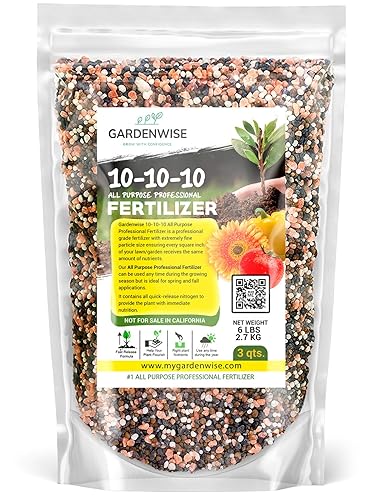
The GardenWise 10-10-10 slow-release granular fertilizer provides a steady nutrient supply for up to eight weeks from a single application, reducing the number of times you need to reapply during the growing season. While the ratio is balanced rather than phosphorus-heavy, the slow-release coating moderates the nitrogen delivery so that it does not all dump at once. This makes it suitable for mixed garden beds where both leafy greens and fruiting vegetables share space.
The 3-quart bag covers a moderate area — roughly 100 to 150 square feet of vegetable garden space depending on soil condition. Gardeners report using it on tomato starters with strong early root response, and on established bushes and hedges with visible feeding stimulation within the first week. The fine granules spread evenly and absorb quickly when watered in, reducing the risk of runoff or concentrated hot spots.
GardenWise positions this as an all-purpose solution for indoor and outdoor plants, including fruit trees, roses, and evergreens. The slow-release mechanism works best when soil temperatures are consistently above 50°F, so early spring applications may show delayed results until the ground warms. Gardeners who want a low-maintenance granular option that does not require mixing will appreciate the straightforward spread-and-water approach.
What works
- Up to 8 weeks of continuous feeding.
- Fine granules spread evenly without clumping.
- Works on vegetables, trees, shrubs, and flowers.
What doesn’t
- 10-10-10 ratio not phosphorus-focused like 5-10-10.
- Slower results in cold spring soil.
6. Supply Solutions 10-10-10 Granular Fertilizer with Micronutrients (5 Pounds)
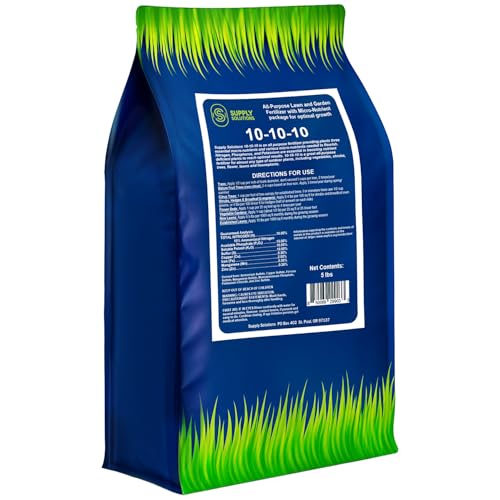
Supply Solutions 10-10-10 goes beyond the basic NPK by including boron, manganese, copper, iron, and zinc — five micronutrients that address hidden soil deficiencies commonly found in raised beds and container gardens. The Nutripaction Technology ensures low-dust, uniform granules that break down gradually and release nutrients directly into the root zone. The 5-pound bag covers up to 1,000 square feet, making it one of the most coverage-efficient options for spreading across a large vegetable plot or lawn border.
Users report strong results on grass regrowth after soil disturbance, such as stump grinding areas reseeded with grass. The balanced 1:1:1 ratio provides even nutrition without over-emphasizing any one element, which works well for soil preparation before planting a diverse vegetable garden. The pH-stabilizing resin helps maintain nutrient availability in soils that tend to drift toward acidity or alkalinity.
One important caveat: the product page and search results sometimes confuse shoppers because the bag says 12-6-6 on the part number listing, but the actual nutrient analysis is confirmed as 10-10-10. A customer noted that it is not water-soluble despite appearing in a soluble search result. For gardeners who want a granular foundation feed with a robust micronutrient package and broad coverage, this is a solid mid-range option.
What works
- Five added micronutrients for deficiency correction.
- Covers 1,000 sq ft — excellent value per bag.
- Low-dust granules spread cleanly.
What doesn’t
- Not water-soluble despite misleading search tags.
- Labeling can cause confusion about NPK ratio.
7. Knox 33lb 10-10-10 Fertilizer
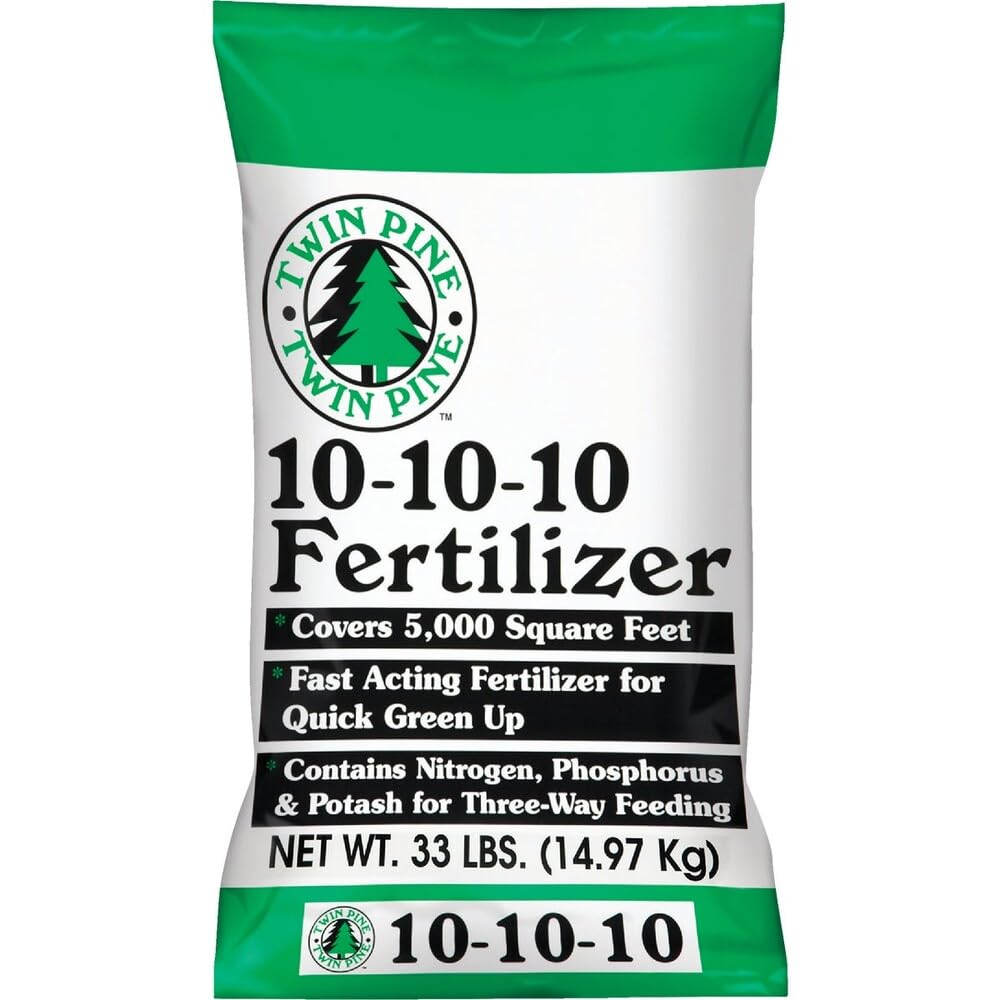
The Knox 33-pound bag of 10-10-10 granular fertilizer is built for scale — covering up to 5,000 square feet with a single purchase. This is the go-to choice for gardeners managing large vegetable plots, multiple raised beds, or properties with substantial lawn and tree areas. The balanced 10-10-10 analysis suits early-season soil preparation where a general nutrient foundation is needed before switching to a bloom-specific formula later.
Verified reviewers report excellent results on tree fertilization, noting that their trees looked their best in years after one spring application. The granules are designed for broadcast spreaders, making it practical to cover large areas quickly without hand-measuring every scoop. Shrub plantings, new lawn seed beds, and established flower borders all benefit from the consistent NPK release pattern.
The primary trade-off is the bag size — 33 pounds is heavy to lift and store, and gardeners with small plots may end up with excess product that needs to be resealed for next season. The ratio is also balanced rather than phosphorus-heavy, so supplementing with a bloom booster during fruiting may still be necessary for heavy-producing vegetables. For value per pound and pure coverage area, however, this bag is unmatched among the options reviewed.
What works
- Massive coverage — 5,000 sq ft per bag.
- Excellent value per pound for large gardens.
- Works for trees, shrubs, lawns, and vegetables.
What doesn’t
- 33-lb bag is heavy and bulky to store.
- 10-10-10 ratio requires phosphorus booster for fruiting.
Hardware & Specs Guide
NPK Ratio and Its Effect on Vegetables
The three numbers on a fertilizer label represent the percentage by weight of nitrogen (N), phosphorus (P), and potassium (K). For a 5-10-10 blend, nitrogen is limited to 5%, which prevents the plant from pouring energy into leaf production at the expense of flowers and fruit. The 10% phosphorus supports strong root establishment, bloom initiation, and fruit set, while the 10% potassium improves water regulation, disease resistance, and overall fruit quality. Vegetables with high fruit loads — tomatoes, peppers, cucumbers, squash — respond particularly well to this lower-nitrogen, higher-P-and-K profile.
Slow-Release Granules vs. Liquid Concentrate
Granular 5-10-10 fertilizers use a coating or organic matrix to break down over weeks, providing a steady nutrient stream with fewer applications. This is ideal for pre-planting incorporation and heavy-feeding crops that need sustained nutrition. Liquid concentrates, by contrast, deliver nutrients in plant-available form immediately upon application. They are best used as a quick corrective measure — for example, when transplants show purpling stems (a phosphorus deficiency signal) or when bloom initiation is delayed. Each form has its place: granular for the base feed, liquid for the targeted boost.
FAQ
Can I use a 5-10-10 fertilizer on all vegetable types?
How often should I apply a granular 5-10-10 fertilizer during the growing season?
What does the addition of iron do in a 5-10-10 vegetable fertilizer?
Final Thoughts: The Verdict
For most gardeners, the 5-10-10 fertilizer for vegetables winner is the Cz Garden 5-10-10 with 2% iron because it delivers the exact phosphorus-potassium ratio that tomatoes, peppers, and root crops need, with added micronutrient insurance. If you want a gentle, organic-based granular option, grab the Espoma 5-10-5 two-pack. And for a fast-acting liquid rescue when plants stall during flowering, nothing beats the TPS Nutrients 5-10-10 concentrate.