
Moss doesn’t just ruin the look of your lawn — it chokes out the grass, traps moisture against your roof shingles, turns wooden decks into slip hazards, and creates a breeding ground for insects. A reactive approach of scraping and pulling only addresses the surface, leaving the spores behind to regrow within weeks. The only reliable fix is a targeted chemical treatment that penetrates the moss’s shallow root system and disrupts its cell structure, and the difference between a good formula and a bad one often comes down to the active ingredient concentration and the delivery method.
I’m Rikta — the co-founder and writer behind Lawn Gear Lab. I spend my days comparing active ingredient percentages, matching moss killers to specific surface types like composite shingles versus St. Augustine turf, and cross-referencing thousands of owner application notes so you don’t have to guess at dilution ratios or coverage gaps.
Whether you need a rainproof spray for a shaded north-facing roof or a granular broadcast for a lawn overtaken by bryophytes, this guide breaks down the most effective chemistry and real-world application data to help you find the best formula to kill moss for your exact property.
How To Choose The Best Formula To Kill Moss
Moss killers fall into two broad categories: contact desiccants that dry out the plant tissue, and systemic agents that travel into the rhizoids. The right choice depends on whether you are treating a thick lawn canopy, a porous concrete driveway, or an asphalt roof where runoff must be controlled. Below are the three critical factors that separate an average purchase from a one-and-done solution.
Active Ingredient: Zinc vs Iron vs Soap
Zinc sulfate monohydrate is the industry standard for roof and hardscape applications because it binds to the moss cuticle without staining painted wood or galvanized metal. Iron-based formulas like iron HEDTA (chelated iron) work rapidly on lawn moss — the moss absorbs the iron, the iron catalyzes oxidation, and the moss turns black and dies within 24 hours. Ammoniated soap (herbicidal soap) is a non-selective contact killer that works by dehydrating plant cells on contact, but it requires thorough coverage because it has zero systemic movement. If you need a formula that can kill moss growing on living tree bark without harming the tree, avoid high-concentration iron products and stick with zinc or soap.
Delivery Format: Granule Broadcast vs Liquid Spray
Granular moss killers are best for flat terrain where you can walk a spreader in straight lines — the granules settle into the moss mat and release their active ingredient as they dissolve in moisture. The drawback is that granules roll off sloped roofs and blow away on windy days, wasting material. Liquid sprays, whether ready-to-use or concentrate, give you control to saturate vertical surfaces and crevices. A hose-end sprayer attachment turns a 32-ounce concentrate into several gallons of finished spray, but you must calibrate the flow rate to avoid overspray onto ornamental plants that are sensitive to iron sulfate.
Coverage Rate and Re-Treatment Window
Manufacturers list coverage in square feet, but that number assumes a single light application at the label rate. Heavy moss mats — anything thicker than half an inch — may require a double dose 14 days later. A 6-pound bag that claims 6,000 square feet of coverage is applying roughly one ounce per 100 square feet, which is a maintenance rate. For knockdown of established moss, you often need to double that rate. Always confirm the concentration of the active ingredient by weight, not just the bag size. Jonathan Green’s 20-pound bag covers only 5,000 square feet because its active ingredient percentage is much higher than budget alternatives.
Quick Comparison
On smaller screens, swipe sideways to see the full table.
| Model | Category | Best For | Key Spec | Amazon |
|---|---|---|---|---|
| Jonathan Green Lawn Moss Control | Granule | Premium lawn knockdown | High active % / 5,000 sq ft | Amazon |
| Sunday Weed Warrior Kit | Spray Concentrate | Organic safe zone | Ammoniated soap / 2 gal spray | Amazon |
| Bonide MossMax Ready-To-Spray | Spray | Fences & trees | 5,000 sq ft / liquid | Amazon |
| Scotts Moss Control Granules | Granule | Green lawn boost | Nutrients + iron / 5,000 sq ft | Amazon |
| Sunday Dandelion Doom | RTU Spray | Spot treatment | Iron HEDTA / 100 sq ft | Amazon |
| Lilly Miller Moss Out! | Granule | Roof & hardscape | Zinc sulfate / 6,000 sq ft | Amazon |
| Bonide MossMax Granules | Granule | Small lawn budget | Fast acting / 1,500 sq ft | Amazon |
In‑Depth Reviews
1. Jonathan Green Lawn Moss Control (20 lbs)

Jonathan Green packs the highest concentration of active moss-killing ingredient per pound in this segment, which is why a 20-pound bag treats 5,000 square feet while budget-friendly 6-pound bags claim the same coverage. The small particle size of the granules improves adherence to low-growing moss mats, and the formula is designed to work within hours — not days. Multiple owner reports confirm that the moss turns black 18–24 hours after a dry application, and the granules do not stimulate excess grass growth the way some iron-only blends do.
The chemistry is zinc-based, making it a strong choice for lawns that also border flower beds, because zinc sulfate is less likely to scorch ornamentals than high-dose iron products. The label explicitly recommends waiting two weeks after application before seeding, which is standard for any granular moss killer that alters soil surface chemistry. Users with heavy infestations — moss thicker than one inch — note that a second application at the 8-pound-per-1,000-square-foot rate was necessary to fully clear the thatch layer.
Where this product stands apart is performance consistency across different grass types: it works on fescue, bluegrass, and perennial ryegrass without the patchy yellowing that plagues some competitive formulations. The only consistent negative feedback involves bag integrity during shipping — the valve-seal design can split, spilling granules into the outer box. Check the bag upon arrival and transfer contents to a sealed bin if you notice any tears.
What works
- Highest active ingredient concentration in its price tier
- Visible moss blackening in under 24 hours
- Safe around ornamentals compared to iron-only killers
What doesn’t
- Bag packaging is prone to splitting during transit
- Requires dry lawn for proper granule adherence
2. Sunday Weed Warrior Concentrate Kit
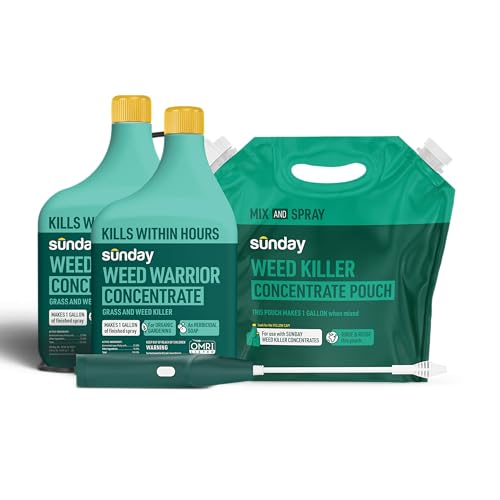
This kit includes two 22-ounce concentrate bottles that mix into two full gallons of spray, plus a battery-powered wand sprayer and reusable mixing pouch — everything you need for a non-toxic approach to moss that also wipes out broadleaf weeds, algae, and lichens. The active ingredient is ammoniated soap (fatty acids) at 22 percent concentration, which kills moss and weeds by dissolving the waxy cuticle and dehydrating the cell structure. It is OMRI Listed for organic gardening, meaning it is certified safe to use around vegetable beds, fruit trees, and ornamental plants, and it is non-staining on concrete, brick, and asphalt.
Owner reports confirm that visible wilting starts in roughly 20 minutes on thin moss growing on driveways and fence lines, with full desiccation occurring within 48 hours. Unlike iron-based moss killers that turn everything black, this soap leaves behind a brown, crispy residue that can be swept or blown away. The formula is non-selective, so care is required around desirable grasses — this is best suited for hardscapes, patios, walkways, and garden bed perimeters rather than broadcast lawn application.
The biggest trade-off is the bag-style sprayer. The included wand provides good reach, but the battery compartment screws are small and the bag’s cap design makes refilling messy. Several users recommend discarding the included bag and mixing the concentrate into a standard pump sprayer for better control. Considering the cost per gallon of finished spray is lower than ready-to-use organic alternatives, the value is strong even if you replace the delivery system.
What works
- OMRI certified for organic gardening and edible plants
- Fast desiccation — visible results in under an hour
- Non-staining formula safe for concrete and asphalt
What doesn’t
- Included bag sprayer has poor ergonomics and messy refill process
- Non-selective — kills grass on contact, not for lawn broadcast
3. Bonide MossMax Ready-To-Spray (32 oz)
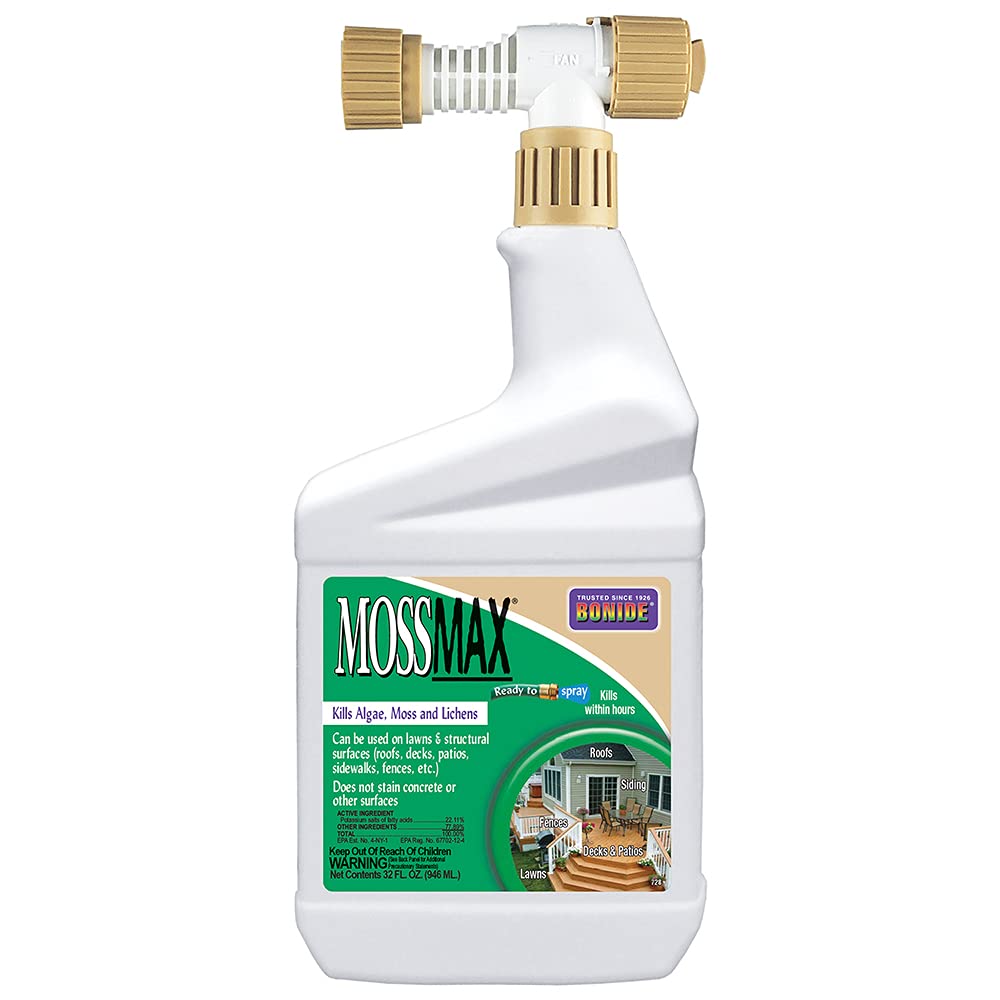
This liquid concentrate connects directly to a garden hose and applies as a fine mist that clings to vertical surfaces — roofs, fences, tree trunks, and wooden deck railings — without pooling or running off before the active ingredient has time to work. The formula kills moss and algae within hours and is labeled safe for use on structural surfaces including unpainted cement, brick, and composite shingles. The label states it does not stain concrete, and owners report that lichen on crepe myrtles and fruit trees died back completely without harming the bark or foliage.
The potassium salt of fatty acids in this spray works via contact desiccation, making it effective on moss growing in shaded, damp areas where granular products cannot reach. Coverage is rated at 5,000 square feet per 32-ounce bottle, which translates to roughly one gallon of finished mix per 200 square feet at the hose-end dilution ratio. Users with heavy lichen growth on slate roofs noted that a second application seven days later was necessary, and that a power washer afterwards made removal fast.
Where this formula falls short is on deep lawn moss mats. The liquid does not penetrate a thick thatch layer as effectively as granular iron products, and some owners reported that moss in dense turf stunted but did not fully die after a single spray. It is best used as a spot treatment for vertical or rough surfaces, not as a full-lawn knockdown solution. For best results, apply on a dry, windless day and let the spray sit for 24 hours before any rain.
What works
- Adheres to vertical surfaces and wooden fences
- Safe on tree bark — does not damage living wood
- Hose-end sprayer covers large areas quickly
What doesn’t
- Less effective on thick, thatched lawn moss
- May require second application for heavy lichen
4. Scotts Moss Control Granules (18.37 lbs)

Scotts Moss Control Granules combine a moss-killing iron compound with lawn nutrients that green up the grass as the moss dies back, making it a two-in-one treatment for homeowners who want to address moss without a separate fertilizing pass. The 18.37-pound bag covers up to 5,000 square feet and is best applied when the lawn is moist and the grass has been mowed short enough to expose the low-growing moss canopy. Users report that the moss turns black within two days and can be raked out easily after it dehydrates.
The key differentiator here is the nitrogen and iron content — the grass takes up the nutrients rapidly, which helps the lawn recover and fill in bare spots that the moss leaves behind. The product is designed for winter or early spring application when moss is actively growing and grass is still semi-dormant, meaning you get the knockdown before the growing season peaks. Owners who use it as a yearly maintenance treatment note that it keeps moss at bay for several weeks, but heavy infestations require a follow-up dose at the higher label rate.
The main criticism from experienced lawn caretakers is that this formulation — gray granules — is less potent than Scotts’ own higher-end iron product (model 31005A, with rust-colored granules). The gray version is better suited for light moss pressure and maintenance, not for eradicating a deep, established mat. Coverage claims also appear optimistic: users spreading at the label rate often needed more than one bag to fully treat a 5,000-square-foot lawn with moderate moss density. For severe moss, start with Jonathan Green and use this for follow-up feeding.
What works
- Dual-action formula kills moss and feeds grass simultaneously
- Visible results in 48 hours — moss turns black and rakes out
- Good for early spring preemptive treatment
What doesn’t
- Less concentrated than higher-tier Scotts iron product
- Coverage estimate is generous — heavy moss needs extra bag
5. Sunday Dandelion Doom (2 Pack, 32 oz)
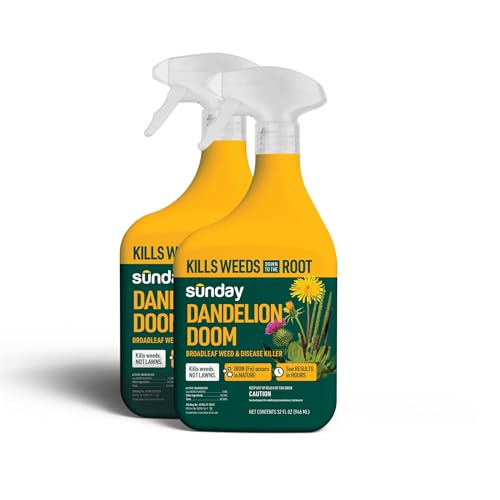
Sunday Dandelion Doom is a ready-to-use, spot-treatment spray powered by chelated iron (FeHEDTA) that targets moss, algae, lichen, and broadleaf weeds simultaneously. The formula is designed to kill down to the root without harming grass — the iron acts as a selective contact herbicide that disrupts photosynthesis in broadleaf plants while leaving monocots like fescue and bluegrass unharmed. Each 32-ounce bottle covers roughly 100 square feet when used as directed, and the adjustable nozzle allows pin-point application around flower beds and sidewalk cracks.
Owner results are polarized but informative: users who applied the spray during active moss growth (temperatures between 50–85°F) report dramatic blackening within 24–48 hours, including moss growing on concrete and brick pathways. The chelation technology makes the iron more bioavailable, so the moss takes it up faster than non-chelated iron granules. However, a small but notable number of buyers received bottles that appeared to be heat-damaged during shipping — the formula arrived as colored water with no moss-killing effect, suggesting that the active ingredient can degrade if exposed to high storage temperatures.
The biggest functional limitation is coverage area. At 100 square feet per bottle, treating a 1,000-square-foot moss patch would require ten bottles, making this an expensive option for anything beyond isolated patches and heavy infestations. It excels as a surgical tool for moss popping up around landscaping features or on walkways, but it is not a cost-effective solution for a full lawn restoration. If you buy this, open and test a small patch within 24 hours of receiving the shipment to confirm potency.
What works
- Selective formula kills moss without harming lawn grass
- Visible moss blackening in under 48 hours on contact
- Adjustable nozzle for precise spot treatment
What doesn’t
- Very small coverage area per bottle (100 sq ft)
- Heat-sensitive formula — degraded product reported by some buyers
6. Lilly Miller Moss Out! For Roofs And Structures (6 lbs)

Lilly Miller Moss Out! uses zinc sulfate monohydrate as its active ingredient, which makes it one of the few moss killers specifically formulated for roof shingles, painted wood, and galvanized gutters without causing corrosion or staining. The micro-granule formula is designed to be sprinkled directly onto moss patches on asphalt shingles, concrete patios, brick walls, and unpainted cement surfaces. The 6-pound bag covers an impressive 6,000 square feet, making it one of the best values for large hardscape areas where you need broad coverage rather than knockdown power.
Owner reports consistently describe it as a slow but reliable option — moss typically shows signs of dehydration within two to three weeks, not hours. This delayed action is normal for zinc-based formulas, which work by blocking enzyme activity in the moss cells rather than burning the tissue on contact. The advantage is that you get a more thorough kill without the unsightly black residue that iron products leave behind on driveways and roofs. The granules are non-staining and the product helps eliminate the damp, musty odor that moss-covered surfaces often produce.
The main drawback is that the micro-granules are light and can blow off the target area if applied on a breezy day, wasting product and potentially landing on nearby plants. The 6-pound bag is also relatively small for the coverage claim — a light dusting at that rate works for thin moss, but thick patches need a heavier hand. Users tackling dense moss on shaded garages and north-facing fences recommend using the entire bag on a 1,000-square-foot area for the first application, then using a second bag for maintenance four weeks later.
What works
- Non-corrosive and non-staining on roofs, gutters, and painted surfaces
- Covers 6,000 square feet per bag — excellent for large hardscapes
- Eliminates damp moss odor effectively
What doesn’t
- Slow acting — can take 2–3 weeks for full results
- Light granules blow away easily in wind
7. Bonide MossMax Granules (6 lbs)

Bonide MossMax Granules in the 6-pound jug is the entry-level granular option that promises fast action — killing moss within hours — for lawns, flower beds, and ornamental shrubs. The label recommends 4 pounds per 1,000 square feet for normal infestations and 8 pounds for heavy moss, which means this 6-pound jug covers roughly 1,500 square feet at the standard rate. The formula uses an iron-based active ingredient that turns moss black quickly, and it is safe to use around established flowers as long as the granules do not pile up on the leaf crowns.
Owner results are split evenly between enthusiastic and disappointed. Users who applied the granules to dry moss and watered them in immediately saw blackening within 24 hours and a clean lawn within a week. Users who spread the granules and left them without sufficient moisture, or who applied them on light moss pressure, reported almost zero visible change. This inconsistency points to a narrow window of effectiveness: the granules require active moisture to dissolve and release the active iron into the moss mat. If your moss is growing in a shaded, damp area that stays wet, this formula works well; if your moss is on a drier slope, you will see patchy results.
Coverage is the biggest practical limitation. At 1,500 square feet per jug, a 5,000-square-foot lawn would require four jugs — which quickly pushes the total cost above the premium 20-pound bag from Jonathan Green. This product is best suited for very small lawns, isolated moss patches, or as a supplemental touch-up between seasons. The fast-acting claim is accurate on wet moss, but the limited coverage area and moisture dependency make it a niche choice for the budget-conscious homeowner with a small, damp yard.
What works
- Fast blackening on wet moss — visible in less than 24 hours
- Safe to use around established ornamental shrubs
- Ready to use directly from the jug — no mixing required
What doesn’t
- Very small coverage area — 1,500 sq ft per 6 lb jug
- Requires active moisture to release the active ingredient
Hardware & Specs Guide
Zinc Sulfate Monohydrate
This is the safest active ingredient for use on roofs, painted wood, and metal gutters because it has a neutral pH and does not cause corrosion. It works by blocking zinc-dependent enzymes in the moss cells, which leads to dehydration over 2–3 weeks. Coverage rates are typically generous per pound, but the kill is slower than iron-based alternatives.
Iron HEDTA (Chelated Iron)
Chelated iron is the fastest-acting moss killer available for lawns and turf. The chelation process keeps the iron soluble and bioavailable, so moss absorbs it within hours and begins to oxidize — turning black by the next day. Iron HEDTA is selective for broadleaf plants, meaning it kills moss without harming grass, but it can stain concrete and hardscapes.
Ammoniated Soap (Fatty Acids)
This is a contact desiccant that kills by dissolving the waxy cuticle on moss and weed cells, causing them to dry out within minutes. It is OMRI Listed for organic gardening and safe around edibles, but it has zero systemic movement — every part of the moss must be coated for the treatment to work. Best for small spot treatments on hardscapes and vertical surfaces.
Granule Particle Size
The physical size of individual granules determines how well they settle into a moss mat. Small-particle formulas like Jonathan Green’s penetrate deeper into the thatch layer, while larger granules tend to sit on top of the moss and may roll off sloped surfaces. For roof applications, micro-granules (Lilly Miller) offer better adhesion than standard broadcast turf granules.
FAQ
How long does it take for a moss killer formula to show visible results?
Can I use a granular moss killer on my roof shingles?
Why did my moss turn black but not die?
Is it safe to plant grass seed right after applying a moss killer?
Will a moss killer formula damage my concrete driveway or brick paver patio?
Final Thoughts: The Verdict
For most gardeners, the best formula to kill moss winner is the Jonathan Green Lawn Moss Control because its high active-ingredient concentration delivers reliable knockdown in under 24 hours without scorching surrounding ornamentals. If you need an organic solution safe around vegetable beds and fruit trees, grab the Sunday Weed Warrior Kit. And for a non-staining, non-corrosive formula that protects your roof and gutters while eliminating moss odor, nothing beats the Lilly Miller Moss Out! Dry Formula.