
Finding an effective lawn insecticide means navigating a maze of active ingredients, application methods, and coverage claims—especially when your turf is under attack from grubs, chinch bugs, ants, or mosquitoes. The wrong choice can waste your time, leave dead patches on your lawn, or fail to stop the infestation at its source. What separates a successful treatment from a frustrating one comes down to matching the product format and active ingredient to the specific pest and your lawn’s size.
I’m Rikta — the co-founder and writer behind Lawn Gear Lab. My approach to this guide involved comparing active ingredient concentrations, analyzing coverage areas against real-world user yard sizes, and cross-referencing owner-reported results for different pest types and lawn conditions to identify which formulations actually deliver the promised control.
Whether you’re battling surface-feeding armyworms or deep-burrowing mole crickets, finding the right insect killer for lawns means understanding how granular vs. liquid formats, residual duration, and target species lists align with your specific infestation pattern and yard dimensions.
How To Choose The Best Insect Killer For Lawns
Selecting the right lawn insecticide requires matching the product’s format, active ingredient, and coverage to the specific pest problem and lawn conditions. Here are the critical considerations.
Granules vs. Liquid Sprays: Matching Format to Pest Behavior
Granular insecticides are ideal for broadcast treatment across large lawns, especially when targeting soil-dwelling pests like grubs, mole crickets, or chinch bugs that live in the thatch and root zone. Granules require watering in after application to activate the active ingredient and drive it down to the pest habitat. Liquid sprays and ready-to-spray hose-end bottles work better for targeting foliage-feeding insects like armyworms, sod webworms, and surface-active pests like ants and ticks. Liquids provide immediate contact kill but may degrade faster under UV exposure and heavy rain.
Residual Duration and Reapplication Frequency
The residual period—how long the active ingredient remains effective after application—is a primary driver of value and convenience. Products offering season-long control (2-4 months per application) reduce labor and cost over the growing season. Products with shorter residuals (1-4 weeks) require more frequent reapplication but may be preferable for targeted spot treatments or when using natural/organic formulations that break down faster. Check the label for specific residual claims for your target pest species.
Active Ingredient Selection for Specific Pest Pressure
Different active ingredients target different pest spectra. Bifenthrin and lambda-cyhalothrin are broad-spectrum pyrethroids effective against ants, ticks, fleas, and many surface-feeding insects. Imidacloprid and chlorantraniliprole provide longer-residual control of soil-dwelling grubs. Spinosad and essential oil-based formulas like castor oil offer natural alternatives that are effective against specific pests like mosquitoes, moles, and voles but may have narrower target ranges. Always verify the product’s target species list matches the pest damaging your lawn.
Coverage Area and Package Economics
Coverage claims vary widely based on concentration and application rate. A 20-pound bag of granular insecticide typically covers 20,000-25,000 square feet, while liquid concentrates may cover 5,000-43,000 square feet per bottle depending on the mixing ratio. Calculate your lawn’s square footage and compare the number of full treatments each package delivers. Larger yards benefit from granular products that can be broadcast efficiently with a spreader, while smaller lawns may be better served by ready-to-spray hose-end bottles that avoid the need for measuring and mixing.
Quick Comparison
On smaller screens, swipe sideways to see the full table.
| Model | Category | Best For | Key Spec | Amazon |
|---|---|---|---|---|
| Talstar PL Granules | Granules | Longest residual control | 2-4 month residual | Amazon |
| Ortho BugClear Granules | Granules | Killing above & below ground | 20,000 sq ft coverage | Amazon |
| Sevin Lawn Granules | Granules | Killing 30+ pest types | 20 lb bag | Amazon |
| BioAdvanced Complete Granules | Granules | Season-long protection | 25,000 sq ft coverage | Amazon |
| Ortho Bug B Gon Spray | Spray | 235 listed insects | 6-month spider protection | Amazon |
| EcoGuard Plus Spray | Spray | Natural mosquito control | 43,560 sq ft coverage | Amazon |
| PetraMax Castor Oil | Oil | Mole & vole repellent | 20,000 sq ft coverage | Amazon |
In‑Depth Reviews
1. Talstar PL Granules Insecticide
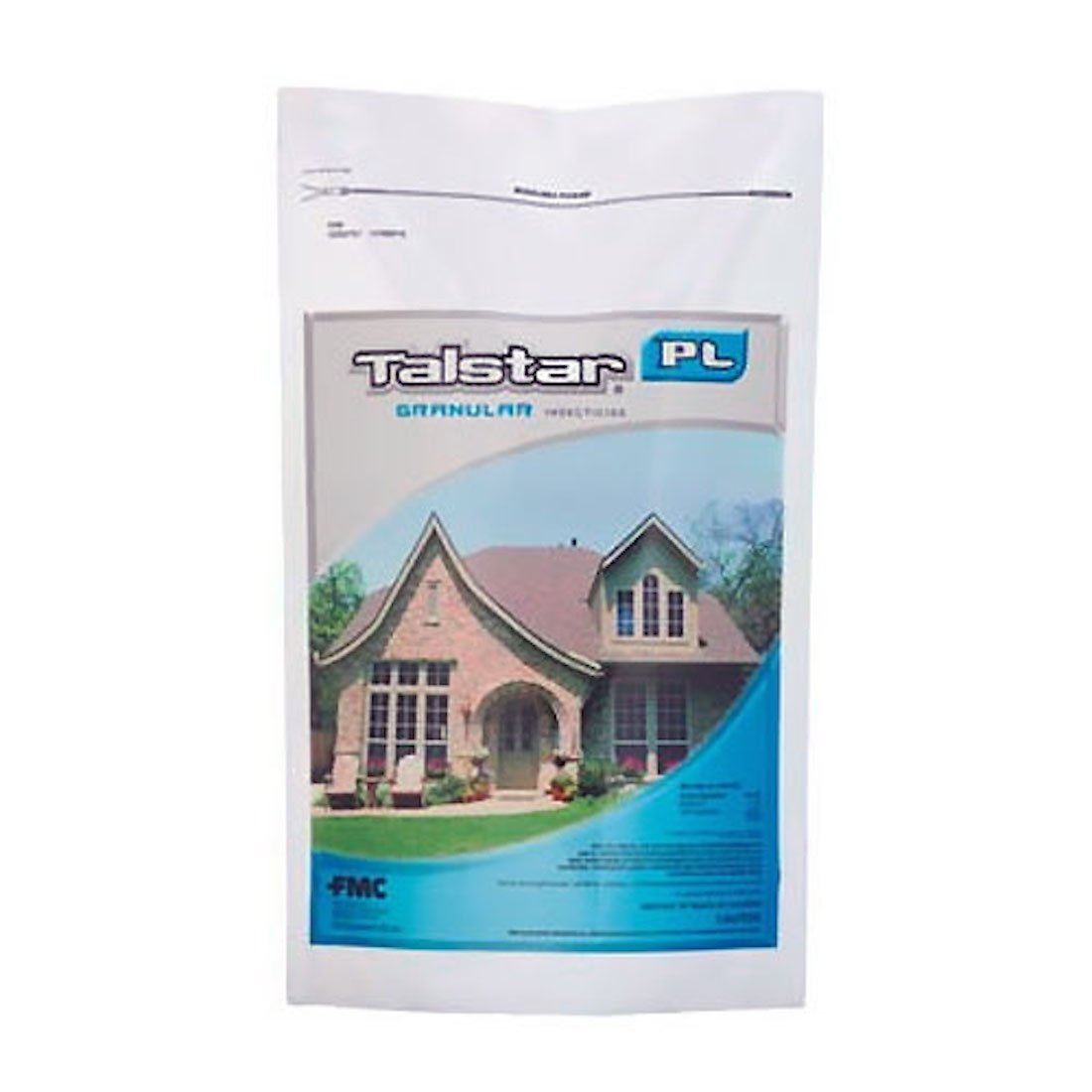
The Talstar PL Granules bring a sand-core granular structure that penetrates mulch and grass without requiring watering in, which sets them apart from other granular products that demand immediate water activation. The residual period stretches to 2-4 months, making this one of the longest-lasting granular options available for outdoor use. The sand-based carrier ensures the granules fall through dense turf and landscape mulch to reach the soil surface where ants, fleas, and other target insects forage.
Owner feedback frequently highlights its effectiveness against persistent ant infestations, with many users reporting visible pest reduction within days of application. The product’s performance on cutter ants receives particular praise, with reports of ant activity eliminated by the following day after treatment. Users with large properties appreciate that a single application can suppress ant populations for the entire season, reducing the need for constant reapplication.
The main limitation noted is that millipedes and certain other non-target arthropods may not be fully controlled, though the product does cause visible die-off in the infestation area. Some users with vacant properties found that achieving full control required patience as the product worked through established pest populations. The 25-pound bag provides ample coverage for larger yards while still remaining manageable for broadcast spreader application.
What works
- No watering-in required for activation; granules penetrate grass and mulch directly
- 2-4 month residual outlasts most granular competitors
- Highly effective against ant species, including cutter ants
What doesn’t
- May not fully control millipedes and some non-target arthropods
- Requires patience for complete elimination in heavily infested properties
2. Ortho BugClear Lawn Insect Killer Granules
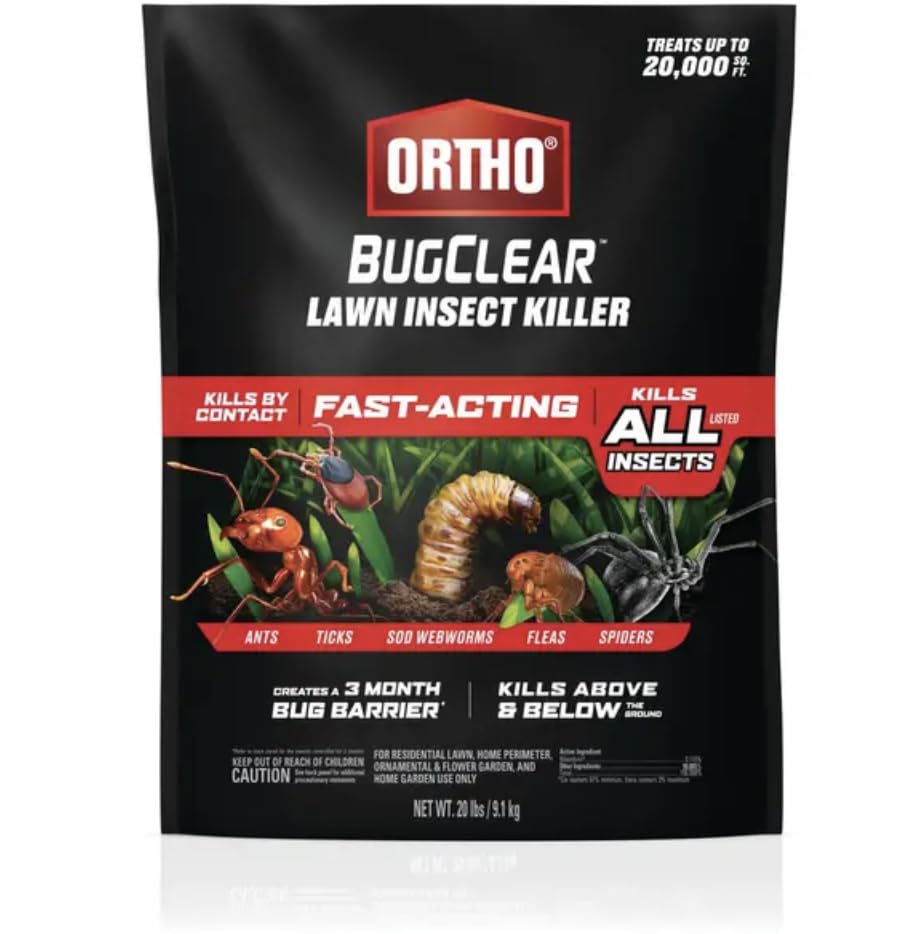
The Ortho BugClear Granules deliver fast-acting control against both above-ground surface pests and below-ground soil insects, with a formulation that kills ants, ticks, armyworms, sod webworms, fleas, and spiders. The product is designed to be applied using a Scotts Drop, SpeedyGreen, or EdgeGuard spreader, followed by watering-in to activate the active ingredient and drive it into the thatch and root zone. Coverage extends to 20,000 square feet per 20-pound bag, making it appropriate for mid-sized to large lawns.
Owner reports consistently emphasize its effectiveness against crane fly larvae and mosquito populations, with many users noting that heavy swarms of gnats and mosquitoes disappeared by the day after application. Several long-term users in humid climates like Florida report successful season-long pest suppression with regular twice-yearly application. The granular format spreads easily without clumping, even in humid conditions, and creates a barrier that discourages insects from migrating into the home.
A recurring concern involves anecdotal reports of reduced flea control over time, with some users suspecting that fleas may be developing resistance or that the formulation has changed. Others point out that the product’s effectiveness depends on thorough watering-in, and that skipping this step significantly reduces results. For crane fly infestations, however, the product receives near-universal praise as one of the most reliable solutions available.
What works
- Fast kill of above-ground pests like mosquitoes, gnats, and crane flies within 24 hours
- Spreads easily through standard broadcast spreaders without clumping
- Creates a home perimeter barrier that discourages indoor insect migration
What doesn’t
- Mixing and watering-in is essential; skipping activation reduces effectiveness
- Some users report reduced flea control with repeated applications over multiple seasons
3. Sevin Lawn Insect Granules

The Sevin Lawn Insect Granules are a long-established broad-spectrum insecticide that kills over 30 listed pests, including ticks, fleas, ants, worms, and several beetle species. The 20-pound bag provides coverage suitable for treating lawns, ornamentals, and the perimeter around home foundations. The active ingredient targets pests through both contact and ingestion, providing dual-mode action that improves control across different insect feeding behaviors. The product is USDA-specified, indicating a baseline quality standard for agricultural and residential use.
User experiences highlight the product’s effectiveness against ant infestations that threaten trees, with one owner reporting that trees previously at risk of being cut down were saved after treatment. Many annual users find the granules easy to spread and appreciate the visible reduction in surface insect activity shortly after application. The product’s reputation for consistent results across multiple seasons leads many owners to use it as a routine preventive treatment.
Some reports indicate variable results, with a minority of users finding the product ineffective for their specific pest pressure. The granules require watering-in to achieve optimal activation, and application timing relative to rainfall significantly influences outcomes. Users with heavy thatch layers may need to adjust the application rate or water more thoroughly to ensure the active ingredient reaches the soil profile where target insects are active.
What works
- Broad-spectrum coverage against 30+ listed pest species
- Dual contact and ingestion mode of action improves control across feeding behaviors
- USDA-specified quality standard for consistent formulation
What doesn’t
- Requires thorough watering-in for activation and optimal results
- Variable effectiveness reported by some users against certain pest populations
4. BioAdvanced Complete Brand Insect Killer Granules
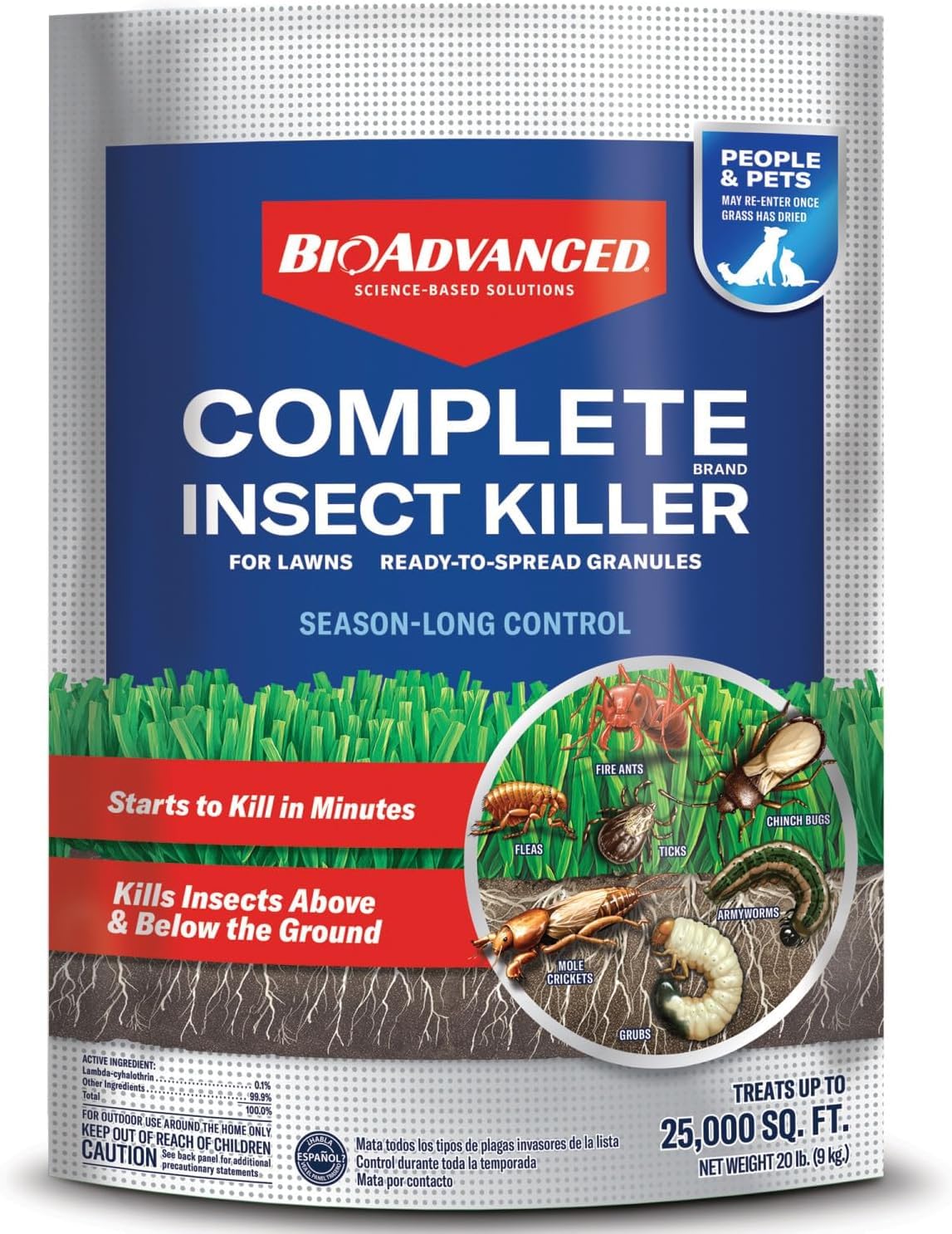
The BioAdvanced Complete Brand Insect Killer Granules are formulated with a bifenthrin-based active ingredient that provides both contact kill and residual control against ants, fleas, ticks, chinch bugs, mole crickets, and grubs. The 20-pound bag treats up to 25,000 square feet, offering the highest coverage-per-pound ratio among the granular products reviewed. The ready-to-spread formulation works with any broadcast or drop spreader, making application straightforward for homeowners with basic lawn equipment.
Owner feedback confirms the product delivers approximately three months of protection in warm climates like South Florida, with users reporting it is safe for St. Augustine grass and other common warm-season turf varieties. Many long-term users consider it their go-to insecticide for routine season-long pest management, applying it twice a year—once in spring and once in late summer. The product’s effectiveness against tick populations in heavy-cover environments like deep forest campsites receives particular mention from users dealing with high pest pressure.
Some users express disappointment that the product does not control stink bugs, which seem to move through treated areas unaffected. Others note that while it eliminates the insect food source for moles, it does not directly repel or eliminate the moles themselves—those persist in hunting surviving insects. The granules also show limited effectiveness against existing flea infestations, with some users finding the product more suitable as a preventive treatment rather than a curative one.
What works
- Highest coverage per bag at 25,000 square feet, ideal for large lawns
- Three-month residual control in warm climates with twice-yearly application schedule
- Safe for use on St. Augustine and other warm-season turf varieties
What doesn’t
- Ineffective against stink bugs, which show no response to the active ingredient
- Does not directly repel or eliminate moles even after removing their food source
5. Ortho Bug B Gon Insect Killer for Lawns and Gardens Ready-to-Spray
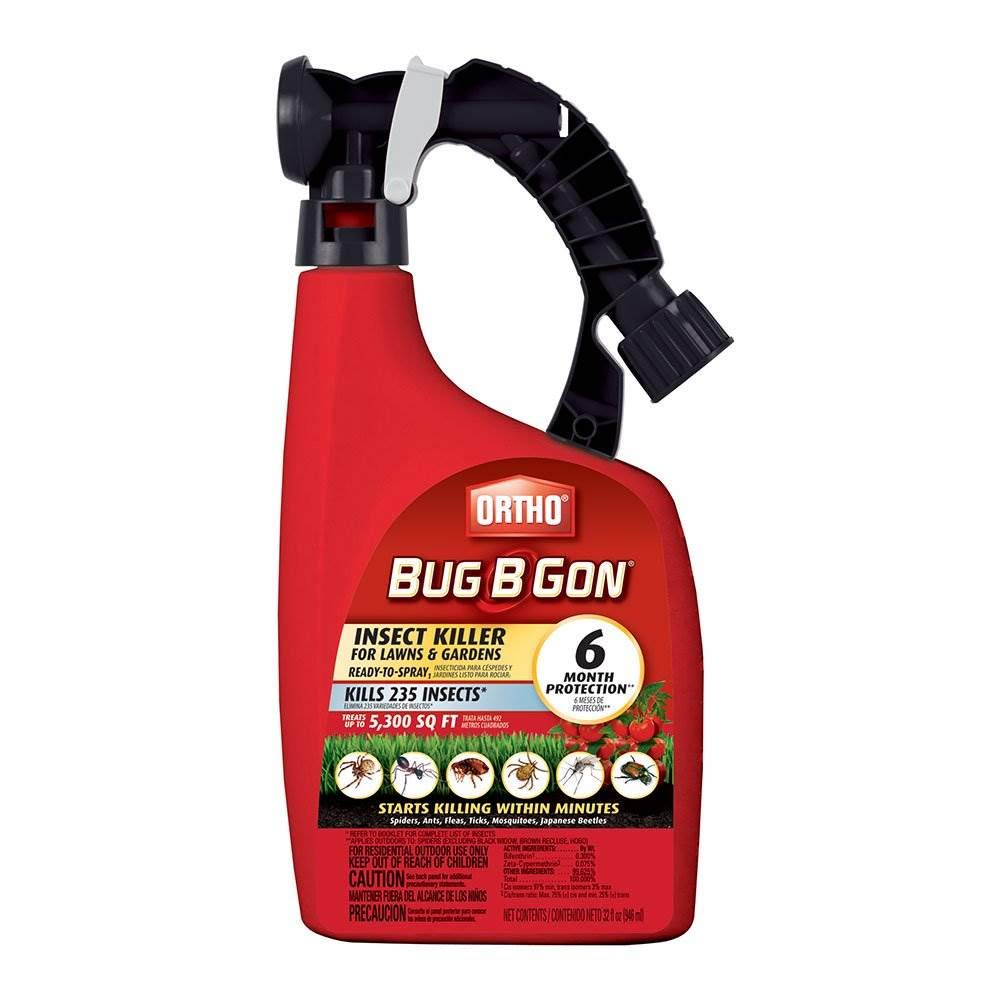
The Ortho Bug B Gon Ready-to-Spray formulation kills an industry-leading 235 listed insects and bugs, including spiders, ants, fleas, ticks, mosquitoes, and Japanese beetles. The ready-to-spray hose-end bottle attaches directly to a garden hose, eliminating the need for measuring, mixing, or cleaning sprayer equipment. The 32-ounce concentrate treats up to 5,300 square feet, with the active ingredient providing up to six months of protection against spiders specifically, though residual duration varies for other target species.
Owner reports from Southern California and other warm regions describe immediate elimination of mosquitoes and flies after spraying backyard areas, with effects lasting for weeks. Long-term users in tick-prone areas report significant reduction in tick populations after a single treatment, with many noting the product is safe for dogs that use the treated lawn. Users in areas with heavy pest pressure find that applying the product twice a year—once in spring and once in late fall—maintains consistent control throughout the growing season.
A critical consideration is the product’s toxicity to beneficial insects, including bees, butterflies, and aquatic species. Multiple owners report that spraying blooming plants kills the flowers and removes pollinators from the area for weeks. The product should not be applied to flowering plants during bloom periods, and users near ponds or water features should exercise caution to avoid runoff. The hose-end sprayer provides even coverage but some users find the stream too narrow for efficient large-area treatment.
What works
- Kills 235 listed insect species, the broadest target spectrum in this guide
- Six-month residual control for spiders with careful seasonal application
- Hose-end sprayer eliminates measuring and mixing steps
What doesn’t
- Highly toxic to bees, butterflies, and aquatic species; requires careful application timing
- Kills blooms on flowering plants when sprayed directly
6. EcoGuard Plus Mosquito Spray for Yard

The EcoGuard Plus Mosquito Spray is formulated from plant-based essential oils, providing a 100% natural and biodegradable alternative to synthetic chemical insecticides. The super-concentrated formula delivers an impressive coverage of up to 43,560 square feet from a single 8-ounce bottle—a full acre of treatment area. The measure-and-pour bottle simplifies mixing, and the product is non-staining, allowing application on all plant material without risk of leaf burn or unsightly residue.
Owners in Alaska and other mosquito-heavy environments report excellent knockdown of mosquitoes and ticks when the product is applied correctly with a hose-end sprayer or fogger. Users with children and pets appreciate the safety profile, noting that the product can be applied without concerns about chemical exposure. The pleasant cedar scent dissipates within two hours, leaving no lingering odor. Customer service from the family-owned manufacturer receives frequent praise for responsiveness and helpfulness.
The primary drawback is the short residual duration relative to synthetic alternatives. Mosquitoes typically disappear within an hour of application but often return the following day, requiring near-daily reapplication for continuous suppression. The product is also relatively expensive per application compared to synthetic insecticides, making ongoing season-long use potentially cost-prohibitive for larger properties. Rain washes the essential oils off plant surfaces, necessitating reapplication after any significant precipitation.
What works
- 100% plant-based essential oil formula with no synthetic chemicals or DEET
- Safe for children, pets, and bees when applied according to directions
- Non-staining formula safe on all plant material
What doesn’t
- Short residual duration; mosquitoes return within 24 hours requiring daily reapplication
- Higher per-application cost compared to synthetic alternatives for ongoing use
7. PetraMax Castor Oil Mole Repellent for Lawns

The PetraMax Castor Oil Mole Repellent is a 100% castor oil-based natural formula designed specifically to deter moles, voles, and gophers by affecting their feeding habits through smell and taste. The 33.8-ounce bottle concentrates to treat over 20,000 square feet when mixed with dish soap and water according to the instructions. The product is pet-safe and biodegradable, making it appropriate for use around pets and children who use the lawn regularly. The formula boasts three times the active ingredients of competing castor oil products, according to the manufacturer.
Users who successfully apply the product report visible reduction in vole and mole activity, with tunnels becoming inactive within days of treatment. The repellent works by making the soil unpalatable, encouraging moles and voles to relocate to untreated areas rather than killing them directly. The American family-owned company’s customer service receives high marks from owners who needed assistance with application equipment or had questions about the mixing process. Some users report that moles simply move to neighboring yard areas rather than leaving the property entirely.
The application process is more involved than granular or spray insecticides, requiring mixing with dish soap and water before each use. The product also needs frequent reapplication—as often as every two weeks during active mole seasons—which increases long-term labor requirements. A minority of users report shipping issues with the bottle arriving damaged due to inadequate packaging, though customer service is responsive with replacements. Some owners found the product ineffective against established mole populations, particularly when tunnels had been active for months.
What works
- 100% natural castor oil formula is pet-safe and biodegradable
- Three times the active ingredient concentration of competing castor oil repellents
- Excellent customer service reputation from family-owned manufacturer
What doesn’t
- Requires complex mixing with dish soap and water before each application
- Moles may simply relocate to neighboring untreated areas rather than leave
Hardware & Specs Guide
Active Ingredient Types
Lawn insecticides use three primary active ingredient categories: pyrethroids (bifenthrin, lambda-cyhalothrin) for broad-spectrum contact kill; neonicotinoids (imidacloprid) for systemic control of soil-dwelling pests; and natural oils (castor oil, essential oils) for repellent-based control. Pyrethroids provide fast knockdown and multi-month residual but are toxic to aquatic life and pollinators. Neonicotinoids offer longer soil persistence against grubs but face regulatory scrutiny. Natural oils degrade rapidly and require frequent reapplication but pose minimal environmental risk.
Granule Size and Spreader Compatibility
Granular insecticides are formulated with different carrier materials that affect spreader performance. Sand-core granules like Talstar PL penetrate grass and mulch without requiring watering-in, while clay-based granules need thorough water activation to release the active ingredient. Broadcast spreaders work best for large-area treatment, while drop spreaders provide more precise application near garden beds and property boundaries. Adjust spreader settings according to the product’s specific flow rate to avoid uneven distribution and potential turf burn from over-concentrated areas.
Residual Duration and Weather Resistance
Residual control periods range from 1-4 weeks for natural oil formulations to 2-6 months for synthetic pyrethroids. Factors that degrade residual activity include UV exposure, heavy rainfall, soil temperature, and microbial activity. Products with longer residuals are more cost-effective for season-long protection but may pose higher risk to non-target organisms during the extended activity period. Watering-in granules or sprays after application improves soil binding and extends residual life, while surface-applied products degrade faster on exposed grass blades.
Coverage Area Calculations
Coverage claims are based on label-specified application rates for specific pest targets. A 20-pound bag claiming 20,000 square feet of coverage at the standard rate will cover less area if applied at the higher rate needed for heavy infestations. Calculate your lawn’s square footage by multiplying length by width, subtracting areas covered by structures and hardscaping. Consider purchasing product to cover at least two full treatments per season, as most lawns require a spring and a late-summer application for year-round pest suppression.
FAQ
Can I use granular insecticide on wet grass?
How soon after applying insect killer can I let my dog on the lawn?
Will rain wash away my insect killer application?
Final Thoughts: The Verdict
For most gardeners, the insect killer for lawns winner is the Talstar PL Granules because its sand-core formulation penetrates without watering-in and delivers the longest 2-4 month residual control against ants and fleas. If you want broad-spectrum coverage against 30+ pest species, grab the Sevin Lawn Insect Granules. And for a natural, pet-safe solution targeting mosquitoes without synthetic chemicals, nothing beats the EcoGuard Plus Mosquito Spray.