
Few things are more frustrating than watching perfectly healthy grass or a prized flower bed suddenly wilt and die, only to discover a network of shallow surface tunnels running through your lawn. Voles are relentless reproducers that leave behind ugly runways and feast on root systems, bulbs, and stems, often causing damage far greater than their small size suggests. Finding a bait that actually gets them to take a lethal dose, rather than just push dirt around the yard, is the real challenge.
I’m Rikta — the co-founder and writer behind Lawn Gear Lab. I’ve spent countless hours cross-referencing active ingredient profiles, application methods, and palatability claims from dozens of vole bait products, and I’ve analyzed hundreds of verified owner reports to separate the formulations that truly eliminate colonies from those that just get ignored.
This guide breaks down the most effective formulations, active ingredients, and deployment strategies to help you regain your lawn. Here is everything you need to find the best vole bait and finally put an end to the damage.
How To Choose The Best Vole Bait
Voles are not dumb — they can develop bait shyness with certain active ingredients, and they often ignore the same food twice if it made them sick the first time. Choosing the right bait comes down to matching the active ingredient to your infestation level, the environment, and the vole’s feeding behavior.
Active Ingredient: Anticoagulant vs. Acute Toxicant
The two main chemical categories you’ll see are first-generation anticoagulants (diphacinone, warfarin) and acute toxicants (zinc phosphide, strychnine). Anticoagulants work over the course of days — voles must feed multiple times before the lethal dose builds up, but they do not associate the bait with illness, so they keep eating. Acute toxicants kill faster, often within 24 hours, but can trigger bait shyness if the vole feels sick before the lethal dose is absorbed. For heavy infestations, a first-generation anticoagulant like diphacinone often yields higher total colony elimination because every vole in the tunnel keeps feeding.
Bait Form and Palatability Drivers
Voles prefer certain bait shapes and flavors. Granules can disappear into the soil or be ignored. Paraffinized bait blocks hold up better in damp tunnels but must be scored or broken so voles can bite off pieces. Fish-flavored baits consistently show higher acceptance in consumer reports compared to grain-only or peanut-flavored options, likely because the strong scent overrides the taste of the chemical carrier. Weather-resistant formulations are critical for outdoor underground placement because moisture ruins the palatability of untreated grain or meal-based baits within days.
Application Strategy: Bait Stations vs. Direct Burrow Placement
Direct burrow placement — poking bait into an active tunnel opening — puts the poison right in the vole’s living area, which speeds up consumption. But you must confirm the tunnel is active by trampling it down and checking 24 hours later for reopened holes. Bait stations (tamper-resistant boxes) are safer around pets and children and protect the bait from rain, but they rely on voles leaving their tunnel system to find the station, which is not their natural behavior. For maximum vole uptake, place bait inside the tunnel itself using a probe or dedicated bait dispenser, not on top of the ground.
Quick Comparison
On smaller screens, swipe sideways to see the full table.
| Model | Category | Best For | Key Spec | Amazon |
|---|---|---|---|---|
| Neogen Ramik Mini Bait Bars | Bait Bars | Targeted vole elimination | 0.005% Diphacinone | Amazon |
| Tomcat All Weather Bait Chunx | Bait Blocks | Large property coverage | 0.005% Diphacinone | Amazon |
| Neogen Ramik Green Pellets (20 lb) | Pellets | Broadcast application | 0.005% Diphacinone | Amazon |
| Victor Rodent Killer M925 Fish Bait Balls | Bait Balls | Multispecies rodent control | 0.005% Diphacinone | Amazon |
| Victor Outdoor Mole & Gopher Poison Peanuts | Pellets | Quick knockdown in tunnels | Zinc Phosphide | Amazon |
| Monterey Go-DIE Gopher Bait | Powder | Strychnine-sensitive infestations | Strychnine Alkaloid | Amazon |
| Revenge Moletox Mole & Gopher Killer | Granules | Budget-sensitive first treatment | Zinc Phosphide | Amazon |
In‑Depth Reviews
1. Neogen Ramik Fish Flavored Rodenticide Mini Bait Bars (4 lb)

This mid-range option hits the sweet spot for vole control because the food-quality fish-flavored grain mix drives consumption rates that make first-generation anticoagulant baits work. The 0.005% diphacinone formulation requires multiple feedings over four to five days, but voles do not develop bait shyness, so every animal in the tunnel system keeps coming back to the bars. The mini bar format — roughly half-inch size — fits perfectly inside bait stations and even into the entrance of a vole tunnel, whereas larger blocks often get pushed out by dirt or ignored.
Weather resistance is genuinely strong here. The extrusion process holds the bait together without wax, so these bars remain palatable even in damp soil conditions where granular baits turn to mush within a day. User reports consistently note that rodents carry the mini bars away into deeper tunnels, which spreads the poison to the entire colony rather than only to the voles that happen to eat on the surface. The 4-pound pouch lasts through a moderate infestation and reseals reasonably well if you store the remainder properly inside a rodent-proof container.
That said, some users mention that the fish scent can attract raccoons or opossums if the bait is placed above ground without a secured station. This is not a flaw in the bait itself — it just reinforces that tunnel placement or a tamper-resistant bait station is non-negotiable for this product. Also, the diphacinone formula works slowly compared to acute toxicants, so do not expect visible results before day four.
What works
- Fish flavor drives high palatability across multiple vole feeding sessions
- Mini bar format fits inside tunnels and standard bait stations easily
- Weather-resistant extrusion prevents spoilage in damp underground placements
What doesn’t
- Fish scent may attract raccoons if bait is not secured inside a station or tunnel
- Death can take 4-5 days, requiring patience compared to faster acute baits
2. Tomcat All Weather Bait Chunx, 4 Lb
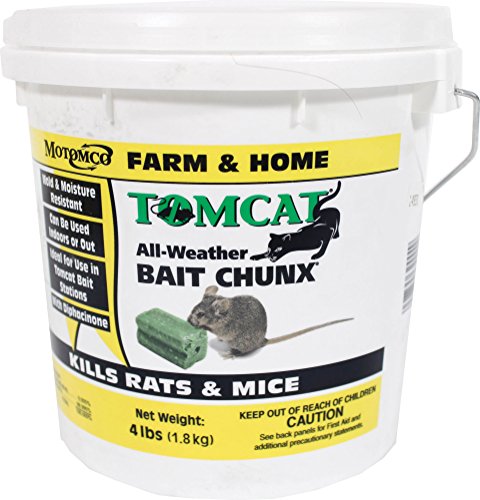
Tomcat Bait Chunx is one of the most widely deployed rodenticides on the market, and its reputation holds up for vole control when used correctly. The chunky molded blocks contain 0.005% diphacinone in a paraffin-based binder that resists moisture exceptionally well, making it suitable for agricultural or rural properties where bait may sit in a tunnel for weeks. The 4-pound bucket provides enough coverage for large properties, and the chunky format encourages voles to gnaw repeatedly rather than nibble and move on.
The mildew and moisture resistance is superior to most granular alternatives because the paraffin formulation does not soften or dissolve in wet tunnels. This gives voles a longer window to discover and consume the bait, which is critical when dealing with a low-density vole population that does not encounter the bait on the first night. Multiple user reports confirm that this bait stopped vole damage after glue traps and spring traps had failed entirely, suggesting that the palatability profile outperforms mechanical methods in heavy grass conditions.
On the downside, the slow action of diphacinone means you may not see any change in tunnel activity for two to three weeks. Some users noted that the blocks are somewhat hard, and voles may take longer to work through them compared to softer pellet baits. Additionally, the label restricts this product to agricultural or rural use, so homeowners with small suburban lawns should verify local regulations before purchasing.
What works
- Paraffin binder keeps bait palatable through rain and soil moisture
- Large 4-pound bucket provides ample supply for multi-acre properties
- Slow-acting formula prevents bait shyness across the colony
What doesn’t
- Blocks can be too hard for small voles, slowing initial consumption
- Label restricts use to agricultural or rural settings, not small suburban lawns
3. Neogen Ramik Green Fish Flavored Rodenticide Pellets, 20-Pound bucket

If you are battling a large vole population across multiple acres, the 20-pound bucket of Ramik Green pellets delivers the volume and the bait durability needed to make progress without running out mid-treatment. The hot-extruded pellets carry the same 0.005% diphacinone found in the mini bars, but in a loose pellet form that can be broadcast by hand or placed directly into tunnel systems with a spoon or probe. The fish-flavored grain mix keeps voles feeding over multiple nights, and the weather resistance holds up well in damp conditions because the extrusion process creates a dense pellet that does not crumble like standard meal baits.
User reports from owners of large rural properties and wildlife managers indicate that this product works well for voles, mice, and rats when placed inside PVC T-bait stations or directly into runways. The bulk size reduces per-ounce cost significantly compared to smaller retail packages, making it a practical choice for ongoing seasonal maintenance. The first-generation anticoagulant profile means low secondary poisoning risk for predators if voles die above ground, though the manufacturer still recommends removing and disposing of carcasses whenever possible.
The biggest drawback is the storage requirement — once opened, this 20-pound bucket needs a tightly sealed container to keep the fish scent from attracting unwanted attention from raccoons or neighborhood dogs. The pellets also require strategic placement rather than scattering; broadcasting on the surface is ineffective because voles feed primarily within their tunnel system rather than on open ground.
What works
- Bulk 20-pound size offers the best per-ounce cost for large properties
- Hot-extruded pellets resist moisture better than loose grain baits
- Fish flavor maintains palatability over repeated feeding sessions
What doesn’t
- Fish scent strongly attracts dogs, requiring secure storage and placement
- Pellets must be placed inside tunnels, not broadcast on the surface
4. Victor Rodent Killer M925 Fish-Flavored Bait Balls, 4 lb

Victor’s M925 bait balls provide a balanced approach to vole control at a price that undercuts most premium block baits. The 0.005% diphacinone formulation is identical to the ingredient used in far more expensive brands, and the fish flavoring drives acceptance even when voles have access to other food sources in the yard. The 4-pound bag contains loose bait balls that you can break apart into smaller pieces to place inside multiple tunnel openings, which speeds up coverage compared to placing whole blocks.
Owner reports are split between spectacular results — rats and mice gone within a week after other methods failed — and complaints that the bait takes longer than expected to eliminate the target species. The key distinction appears to be placement: users who placed bait balls directly inside active vole tunnels or inside bait stations reported fast results, while those who sprinkled the balls on the surface saw little to no effect. The weather-resistant coating keeps the balls intact through rain and sprinkler irrigation, which is critical for maintaining palatability over multiple nights.
Where this product falls short is in packaging reliability. Several users reported that the bags arrived with damaged seals or that the bait had been partially consumed by rodents during shipping due to inadequate outer packaging. This is a quality control issue with the supply chain rather than the formulation itself, but it is worth inspecting the bag on arrival and transferring the bait to a sealed bucket immediately.
What works
- Fish-flavored bait balls show high acceptance across mouse, rat, and vole species
- Weather-resistant coating maintains palatability through rain and wet soil
- 4-pound bag provides extensive coverage for multi-point placement
What doesn’t
- Bags may arrive with damaged seals due to poor outer packaging
- Results vary significantly if bait is not placed directly into active tunnels
5. Victor Outdoor Mole & Gopher Poison Peanuts 4-Pack
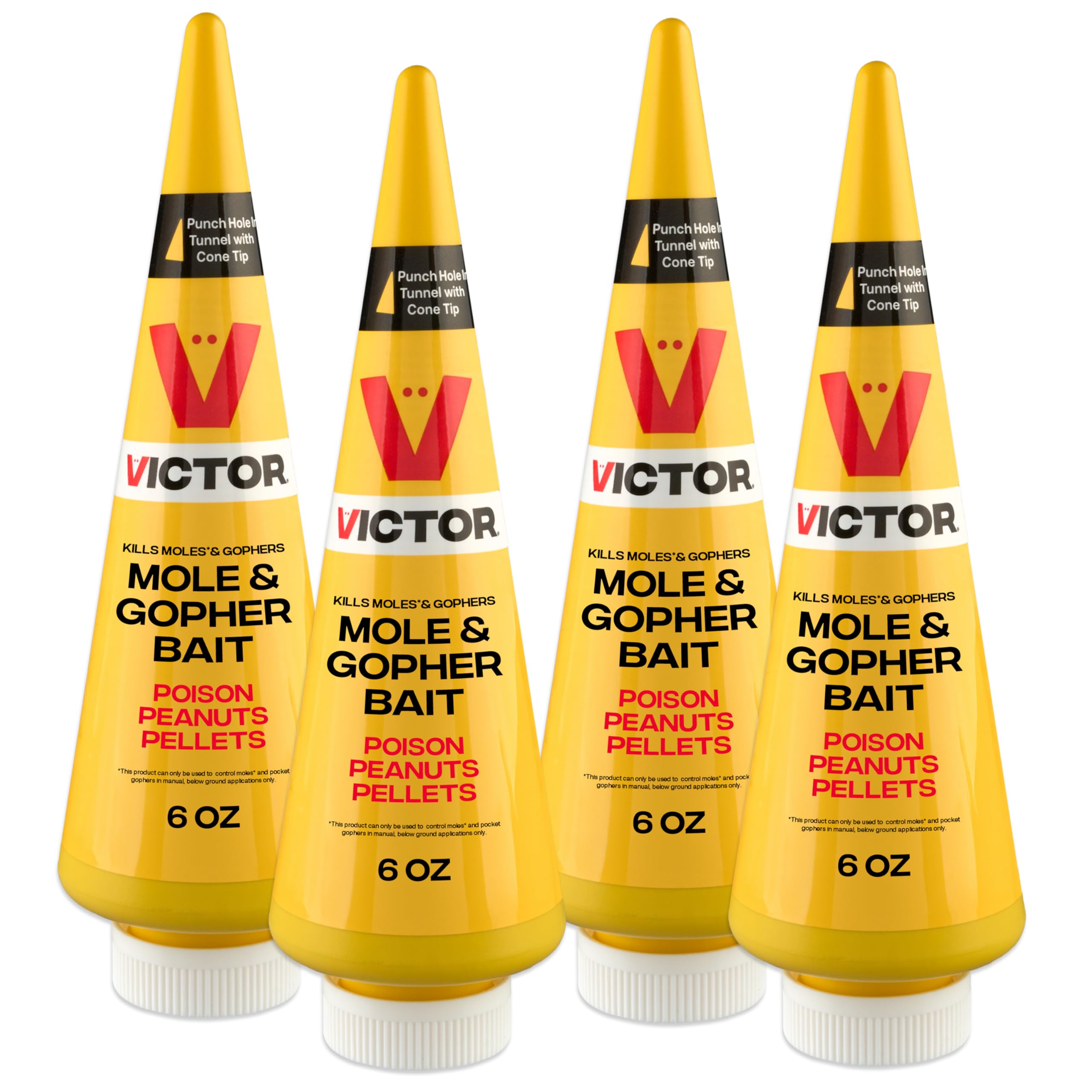
Victor’s poison peanuts use zinc phosphide — a fast-acting acute toxicant that kills burrowing rodents within 24 hours of ingestion, making it a good choice for those who need visible results quickly. The 4-pack format provides four 6-ounce containers, each with a cone-tip applicator that lets you punch a hole into an active tunnel and squeeze a dose of pellets directly into the burrow. This delivery method puts the bait exactly where voles live and eliminates guesswork about placement.
The peanut-flavored bait matrix is designed to be highly attractive but carries a risk of bait shyness if voles eat a sublethal dose. Some users in arid climates reported that pocket gophers in Arizona ignored the bait entirely, suggesting that regional food availability can override the flavor profile. However, for voles in lawns and gardens, the zinc phosphide formulation generally delivers a fast knockdown, and the 6-ounce containers are small enough to carry around the yard easily during treatment rounds.
The main concern with zinc phosphide is that it reacts with moisture in the stomach to produce phosphine gas, which means the bait must stay dry before ingestion. If the tunnel is wet or the pellets get damp before the vole consumes them, the active ingredient can degrade and become less effective. This product should only be used in dry soil conditions, and you should not apply it during or immediately after rain.
What works
- Zinc phosphide kills voles within 24 hours when conditions are right
- Cone-tip dispenser enables precise placement into active tunnel openings
- 4-pack provides enough bait for multiple treatment rounds across the yard
What doesn’t
- Moisture degrades zinc phosphide, making it ineffective in wet tunnels
- Acute effect can cause bait shyness if voles consume a sublethal dose
6. Monterey Go-DIE Gopher Bait

Monterey Go-DIE uses strychnine alkaloid as its active ingredient, which places it in the acute toxicant category alongside zinc phosphide but with a different action profile. Strychnine kills by blocking nerve signals, causing convulsions and respiratory failure within hours after a lethal dose is consumed. This bait is formulated specifically for pocket gophers and is labeled for non-crop areas only — pastures, rangelands, and other undeveloped land where secondary exposure risk to pets and livestock is low.
The biggest advantage of Go-DIE is that strychnine does not cause bait shyness in voles or gophers the way some other acute toxicants can. Users on large properties in Southern California reported reducing a population of over 80 gophers to just 15 active holes after a single application, which shows the knockdown potential when bait is placed correctly into the burrow system. The powder formulation must be applied using a specialized probe or spoon that delivers the bait deep into the tunnel, not on the surface.
This is not a suburban lawn product. The strychnine formulation is extremely toxic to dogs and cats, and the container has no child-resistant features beyond the standard screw cap. Multiple reviews report that the second-purchase containers arrived with broken seals or were less than half full, suggesting that quality control during shipping is inconsistent. If you have pets or children on your property, this bait requires a secure, locked bait station.
What works
- Strychnine kills quickly and does not induce bait shyness in voles
- Reduced gopher activity dramatically after single application on large properties
- Powder formulation is effective when placed deep inside active tunnels
What doesn’t
- Extremely toxic to pets; not suitable for suburban yards without locked stations
- Shipping quality control issues with containers arriving damaged or underfilled
7. Revenge Moletox Mole & Gopher Killer Granules, 1 lb

Revenge Moletox is a budget-friendly entry point for vole baiting, and the zinc-based active ingredient delivers a fast knockdown when voles consume a full dose. The 1-pound container is small enough to test whether this bait works on your local vole population before committing to a larger investment, and the ready-to-use granules require no mixing or measuring. A single teaspoon placed into an active burrow or tunnel opening is the recommended dose, which means one container treats multiple burrows.
Owner feedback is polarized. Some users reported that voles were dead within 24 hours, which validates the acute toxicant profile when the bait is consumed in sufficient quantity. Others reported that the entire container was consumed without any noticeable reduction in tunnel activity, which could indicate that the voles in those cases either did not eat the bait or consumed a sublethal amount. The floral perfume scent used to attract rodents can be overpowering when the container is first opened, and users recommend wearing a mask and gloves during application.
The most consistent complaint revolves around packaging quality. Several users reported that the bottle arrived without a safety seal under the cap, and that the granules had spilled inside the shipping box. This is a recurring quality control issue that makes it difficult to recommend this product for anyone who needs confidence that the bait has not been contaminated or exposed to moisture before arrival. If you do purchase it, inspect and transfer the granules to a sealed container immediately.
What works
- Zinc-based formula can kill voles within 24 hours when consumed fully
- Small bottle allows low-cost testing before larger bait investments
- No mixing required — ready to use straight from the container
What doesn’t
- Frequent packaging quality issues with missing safety seals or spillage
- Effectiveness varies greatly depending on local vole population feeding habits
Hardware & Specs Guide
Active Ingredient: Diphacinone (0.005%)
First-generation anticoagulant that disrupts vitamin K recycling, causing internal bleeding and death within 4-7 days. This is the most common active in mid-range and premium vole baits because it requires multiple feedings but does not trigger bait shyness. Voles continue eating the bait over several nights, ensuring the entire colony is exposed rather than only the individuals that find the bait on the first night. Diphacinone poses low secondary poisoning risk to predators because the lethal dose is not met in a single feeding from a poisoned carcass.
Active Ingredient: Zinc Phosphide
Acute toxicant that reacts with stomach acid to release phosphine gas, killing voles within 24 hours. This is the fastest-acting option available, but it carries a significant risk of bait shyness because voles that consume a sublethal dose associate the illness with the bait and avoid it afterwards. Zinc phosphide is moisture-sensitive and degrades rapidly in wet tunnels. Best reserved for short-duration, high-intensity knockdown treatments on small properties where you can monitor bait consumption daily and switch to a different active if needed.
FAQ
How do I tell if my vole tunnels are active before placing bait?
Can I use rat bait blocks designed for mice and rats on voles?
How long should I leave bait in the tunnel system before checking results?
Final Thoughts: The Verdict
For most gardeners, the best vole bait winner is the Neogen Ramik Fish Flavored Mini Bait Bars because the fish flavor drives consistent consumption over the multiple feedings required for a first-generation anticoagulant to eliminate the entire colony. If you want faster visible results and have dry soil conditions, grab the Victor Poison Peanuts. And for high-volume coverage across several acres, nothing beats the Neogen Ramik Green Pellets (20 lb) for cost efficiency and weather-resistant durability.