
That yellowing leaf, the powdery white coating, or the sudden black spot on your prize tomato can turn a thriving garden into a source of frustration overnight. Copper fungicides are the go-to defense for a wide range of plant diseases, but the wrong formulation or application method can mean the difference between a saved harvest and a complete loss. This guide cuts through the marketing to identify the formulations that actually work on fruit trees, ornamentals, and vegetables.
I’m Rikta — the co-founder and writer behind Lawn Gear Lab. I’ve spent countless hours analyzing active ingredient concentrations, customer failure reports, and application data for dozens of copper-based treatments to build this practical, spec-focused guide.
The single most important factor in disease control is choosing the right active ingredient and concentration for your specific plants, which is why this guide to the best copper fungicide focuses on real-world performance across different garden scenarios.
How To Choose The Best Copper Fungicide
Not all copper fungicides are created equal. The active ingredient, concentration, and formulation type determine whether a product will save your plants or simply stain your foliage. Here are the critical factors to evaluate before you buy.
Active Ingredient: Copper Octanoate vs. Copper Sulfate
Copper octanoate (copper soap) is generally safer for delicate foliage and less likely to cause phytotoxicity (leaf burn) when applied correctly. It’s the standard for liquid concentrates used on vegetables and ornamentals. Copper sulfate, often found in dry or powdered formulations, is more aggressive and effective on tough diseases like fire blight and peach leaf curl, but requires precise mixing to avoid damaging plants. Match the aggressiveness of the copper to the toughness of the disease and the sensitivity of the plant.
Concentration and Dilution Ratio
The label’s mixing rate is non-negotiable. A concentrated product with a higher copper content (e.g., 8% vs. 1%) will cover more area per ounce. However, a higher concentration also increases the risk of leaf burn if you deviate from the recommended dilution. Look for products that offer clear, specific ounce-per-gallon instructions for the exact plants you are treating, rather than a generic one-size-fits-all rate.
Formulation: Ready-to-Use vs. Concentrate
Ready-to-use (RTU) sprays in a trigger bottle are ideal for small gardens, container plants, or quick spot treatments on a few vegetables. They offer zero-mixing convenience but are significantly more expensive per application. Concentrates require measuring and mixing with water in a pump sprayer, but they provide far better value and allow you to control the strength. For a large orchard or a serious vegetable garden, a concentrate is the only economically sensible choice.
Quick Comparison
On smaller screens, swipe sideways to see the full table.
| Model | Category | Best For | Key Spec | Amazon |
|---|---|---|---|---|
| Bonide 811 Copper 4E (2 Pack) | Concentrate | Orchard owners & fire blight | Copper sulfate, 473ml | Amazon |
| Monterey Complete Disease Control | Concentrate | Fruiting vegetables & root drench | Copper octanoate, 16 oz | Amazon |
| Bonide Captain Jack’s RTU (Pack of 2) | Ready-to-Use | Quick spot treatment & small gardens | Copper octanoate, 32 oz | Amazon |
| Ferti-lome Copper Fungicide | Concentrate | Tree & rose disease prevention | Copper octanoate, 16 oz | Amazon |
| Southern Ag Liquid Copper 32oz | Concentrate | Large area coverage & moss control | Copper octanoate, 32 oz | Amazon |
| Bonide Captain Jack’s Concentrate | Concentrate | General vegetable & mildew defense | Copper octanoate, 16 oz | Amazon |
| Southern Ag Liquid Copper 16oz | Concentrate | Entry-level & small plot control | Copper octanoate, 16 oz | Amazon |
In‑Depth Reviews
1. Bonide 811 Copper 4E Fungicide 16oz (2 Pack)

This two-pack from Bonide delivers a concentrated copper sulfate formulation that is the heavy artillery for serious disease outbreaks. With a stellar 4.7-star rating from nearly 200 reviews, it is the highest-rated product on this list, specifically praised for tackling aggressive pathogens like fire blight on pear trees and Volutella fungus on pachysandra. The 473ml bottle is a proper concentrate, designed for mixing in a pump sprayer for maximum coverage on orchards and large landscapes.
Users consistently highlight its effectiveness where other fungicides fail, especially on bacterial issues like fire blight that require the stronger copper sulfate molecule. The formula is noted for being odor-free and for providing long-lasting protection, requiring less frequent reapplication than some milder copper soaps. It is also explicitly labeled as safe for beneficial insects, a critical feature for integrated pest management.
The main trade-off is the cost; this is a premium investment for the home orchardist. Additionally, because it is a potent copper sulfate formula, precise mixing is not optional—over-application can easily cause phytotoxicity. The bottle label can be a bit challenging to read for mixing instructions, so consult the manufacturer’s full label online before use. This is for the gardener who needs professional-grade disease control and understands the responsibility that comes with it.
What works
- Exceptional effectiveness against fire blight and aggressive fungi
- Excellent long-term residual protection
- Odor-free and safe for beneficial insects
What doesn’t
- Higher risk of leaf burn if mixing ratio is incorrect
- Premium price point for the two-pack
2. Monterey Complete Disease Control with Measuring Spoon

Monterey’s offering stands out because it goes beyond a simple foliar spray. This copper octanoate concentrate is designed to be effective both as a leaf spray and as a root drench, meaning it can colonize root hairs to provide systemic protection from the ground up. The inclusion of a measuring spoon in the bundle directly solves the single biggest complaint about copper fungicides—dosing errors—making this a thoughtful choice for gardeners who want precision without hassle.
With a strong 4.5-star average and consistent praise from tomato growers in humid climates, this product has proven itself against the relentless pressures of blight and leaf spot. The ability to use it as a soil drench is a unique advantage for plants like tomatoes that are susceptible to soil-borne pathogens. Users report that it acts as “tomato insurance,” significantly slowing the progression of diseases during cool, wet summers.
While it is highly effective, some users note that it does not entirely eliminate severe, established infections; it is best used as a preventative or at the very first sign of disease. The safety warnings on the label—though standard for copper products—can be alarming for new users. Nonetheless, for its versatility, value, and user-focused packaging, this concentrate is the most balanced choice for the dedicated vegetable gardener.
What works
- Unique dual-action as a foliar spray and root drench
- Comes with a measuring spoon for accurate dosing
- Highly effective against tomato blight and leaf spot
What doesn’t
- May only slow, not cure, advanced infections
- Safety warnings on label can be off-putting
3. Bonide Captain Jack’s Copper Fungicide, 32 oz RTU (Pack of 2)

For the gardener who needs immediate, no-mix defense, the Bonide Captain Jack’s Ready-to-Use spray in this two-pack is the ultimate convenience play. Each 32-ounce trigger bottle is filled with a diluted copper octanoate solution that is ready to spray straight out of the box. This is a fantastic choice for container gardening on a patio, for spot-treating a few diseased leaves on a rose bush, or for gardeners who are intimidated by measuring and mixing concentrates.
Users report that the speed of this spray is its strongest asset; it visibly knocks down powdery mildew after a single application, though consistency is required to fully eradicate it. The sprayer nozzle provides a good, even mist that covers foliage without excessive runoff. Because it is a milder, ready-to-use formulation, the risk of leaf burn is dramatically lower than with a concentrate, making it suitable for sensitive ornamentals and seedlings.
The major downside of any RTU product is the cost per gallon and the limited coverage area. Each bottle will cover a small number of plants, and larger gardens will find it economically inefficient. Also, a few users reported minor leaking from the sprayer when trying to reach awkward angles under leaves. But for the small-space gardener prioritizing ease and safety over bulk value, this pack is hard to beat.
What works
- Zero mixing required; grab and spray
- Very low risk of burning delicate foliage
- Effective knockdown of powdery mildew on contact
What doesn’t
- Poor cost-per-gallon value for large gardens
- Trigger sprayer can leak when angled
4. Fertilome (16132) Copper Fungicide Concentrate, 16 oz
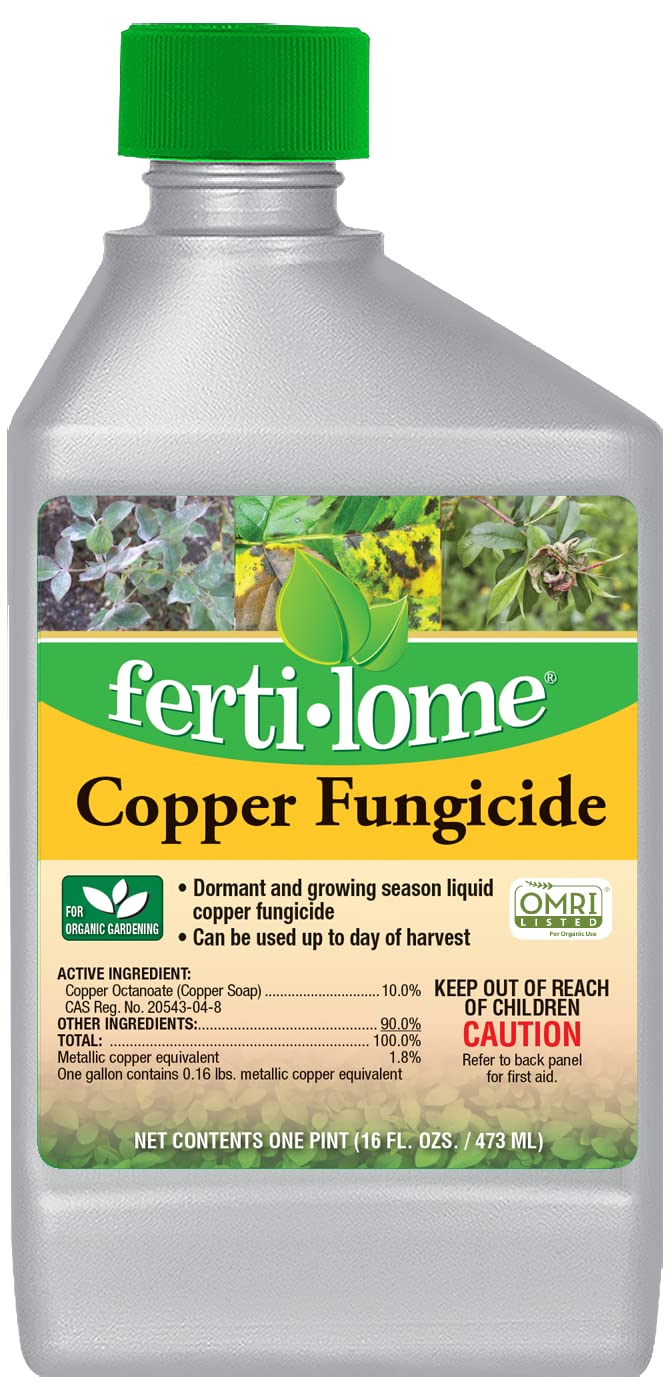
Ferti-lome’s concentrate is specifically formulated with the fruit tree and rose grower in mind, boasting a disease list that includes cedar apple rust, peach leaf curl, and needle blight. Its OMRI listing assures organic certification compliance, and user reports confirm it can revive trees that appear to be on their last legs—one user reported bringing nearly dead peach trees back to productive health after just three applications. The 16-ounce concentrate will mix into a significant volume of finished spray, making it a good value for the homeowner with a small orchard or several large shrubs.
The versatility of this formula is a key strength; it is marketed as both a preventative and a treatment for active disease. Application is straightforward with a standard pump sprayer, and the product is noted for being gentle on pollinators like bees when used according to the label. The manufacturer recommends treating as a preventative before disease is visible, which is the best practice for copper fungicides.
The most common complaint is the quality of the spray bottle’s nozzle, which some users find fails before the bottle is empty. This is a minor but frustrating design flaw that may require you to transfer the liquid to a better sprayer. Also, while effective, it is not as potent against aggressive bacterial infections like fire blight compared to dedicated copper sulfate formulations.
What works
- Excellent for reviving disease-stricken fruit trees
- OMRI listed for organic gardening
- Targets a wide range of tree-specific diseases
What doesn’t
- Included spray nozzle is prone to failure
- Less effective on severe bacterial infections
5. Southern Ag Liquid Copper Fungicide, 32oz

The Southern Ag 32-ounce quart is the volume champion for the budget-conscious gardener with a large property. This copper octanoate concentrate provides double the liquid of standard 16-ounce bottles for a modest price increase, making it the most economical choice for covering extensive vegetable beds or treating multiple trees. Customer reviews highlight its effectiveness against needlecast fungus on pines and as a general-purpose spray for the unique humidity-driven fungal problems of the Southern states and Florida.
The formula is explicitly labeled for control of moss and algae in addition to plant diseases, expanding its utility to pathways and patios. Users have found it to be a “miracle” for pine trees suffering from needle loss, with reports of regrowth after consistent application. When used as a dormant spray, it is also effective at killing insect eggs in bark when applied in late October and early spring.
The biggest functional issue is the bottle’s design. The opening and lack of a measuring cap make it incredibly difficult to dispense the concentrate without spilling; users strongly recommend having a graduated measuring cup ready. It also stains surfaces very easily, so care must be taken around concrete or painted structures. The faint “catpiss” smell during mixing, noted by one user, is a minor annoyance of copper octanoate.
What works
- Excellent value for the volume of concentrate
- Effective on pine needlecast and moss
- Good for dormant season insect control
What doesn’t
- Poor bottle design makes dosing messy
- Stains concrete and painted surfaces easily
6. Bonide Captain Jack Copper Fungicide 16 oz Concentrate

Captain Jack’s is a household name in the fungicide world, and this 16-ounce concentrate is a reliable, no-nonsense solution for the average home gardener. Approved for organic gardening and effective against the most common garden scourges—powdery mildew, black spot, and blight—this is a direct, effective product. With thousands of reviews and a strong 4.5-star average, it has the widest track record of user validation on this list.
Users specifically praise its performance on tomatoes in humid climates, noting that when applied at the first sign of trouble, it prevents fungi from ever establishing a stronghold. It mixes easily with water and applies evenly through a standard sprayer. The label is clear and detailed, providing specific mixing rates for different diseases and plants, which takes the guesswork out of the equation.
The primary drawback for some users is the risk of leaf burn if you apply it too aggressively or in hot, direct sunlight. It’s not a product you want to overuse. The concentrate also lacks a measuring cap or integrated dosing system, so you will need a separate measuring tool. While it is effective, it does not have the dual-action root drench capability or the bundled tools of the Monterey option, placing it as a solid, standard choice rather than an exceptional one.
What works
- Extensive user reviews confirming real-world effectiveness
- Approved for organic produce up to day of harvest
- Clear, detailed mixing instructions on the label
What doesn’t
- Can cause leaf burn if over-applied or used in full sun
- No measuring cap included
7. Southern Ag Liquid Copper Fungicide, 16oz

Southern Ag’s 16-ounce entry-level concentrate is the perfect starting point for the new gardener. With a very accessible price point and a 4.5-star rating from over 4,700 reviews, it is the most-reviewed product in this guide. This is a testament to its sheer popularity and consistent basic performance. It is effective against the core problems: leaf spot, powdery mildew, and general blight on vegetables, ornamentals, and fruit trees.
Gardeners report that it effectively stops leaf deterioration and promotes healthy new growth, even in challenging environments like crowded gardens with poor airflow. It mixes easily and does not stain leaves as badly as some other formulations. For a budget option, it punches well above its weight, saving crops like gourds from total powdery mildew loss in tight quarters. The bottle is sturdy and stores well between uses.
The primary limitation is that it is the smallest bottle of concentrate on the list, so larger gardens will need to buy multiple units to get through a season of preventative spraying. Additionally, while it works well for general fungal issues, it may lack the potency needed for tough bacterial diseases like fire blight or for deep-seated infections on woody plants. It is a fantastic “starter” fungicide, but serious gardeners may outgrow its capacity.
What works
- Proven effectiveness with thousands of positive reviews
- Very low cost to get started
- Easy to mix and gentle on most foliage
What doesn’t
- Small bottle size runs out quickly for large gardens
- Less effective on aggressive bacterial diseases
Hardware & Specs Guide
Copper Octanoate vs. Copper Sulfate
Copper octanoate is a “copper soap” that is more plant-friendly and less likely to cause phytotoxicity, making it the standard for liquid concentrates on vegetables and ornamentals. Copper sulfate is a mineral salt that is more potent and aggressive, often used for dormant applications and tough bacterial infections like fire blight. The choice depends on the target disease and the plant’s sensitivity.
Formulation Types: RTU and Concentrate
Ready-to-use (RTU) formulations are pre-mixed and sold in trigger sprayers, offering maximum convenience for small jobs. Concentrates require mixing with water and are sold in small bottles; they provide far better value per gallon of finished spray and allow for dosage adjustment. For any garden over 50 square feet, a concentrate is the only economically viable choice.
Preventative vs. Curative Application
Copper fungicides are primarily protectants. They work best when applied before a disease takes hold, forming a protective barrier on the leaf surface. While they can slow active infections, they are not systemic and cannot cure heavily diseased tissue. For best results, begin spraying at the first sign of disease or as a preventative during weather conditions favorable to fungal growth.
OMRI Listing and Organic Use
The Organic Materials Review Institute (OMRI) listing indicates that a product is approved for use in certified organic production. Many copper fungicides are OMRI listed because copper is a naturally occurring mineral. However, even organic-approved products must be used strictly according to label instructions, as overuse can lead to copper buildup in the soil, which is harmful to microbial life.
FAQ
Can I use copper fungicide on my vegetable garden up to the day of harvest?
Why did my copper fungicide turn my plant leaves blue or cause them to burn?
Is copper fungicide safe for pollinators like bees and ladybugs?
Final Thoughts: The Verdict
For most gardeners, the best copper fungicide winner is the Monterey Complete Disease Control because its unique root-drench capability, the inclusion of a measuring spoon, and versatile disease control make it the most effective and user-friendly concentrate. If you want a convenient, no-mix solution for small gardens, grab the Bonide Captain Jack’s RTU 2-Pack. And for tackling aggressive bacterial diseases like fire blight in an orchard, nothing beats the potency of the Bonide 811 Copper 4E (2 Pack).