
A pond filter is the single most important piece of equipment you will buy for your water garden, koi pond, or backyard ecosystem. Without proper filtration, the water turns green with algae, fish waste accumulates, and ammonia builds up, creating a toxic environment. A well-chosen filter eliminates particulate debris, houses beneficial bacteria for biological filtration, and often includes a UV clarifier to zap free-floating algae, keeping the water crystal clear and your fish healthy.
I’m Rikta — the co-founder and writer behind Lawn Gear Lab. I’ve spent countless hours analyzing pump flow rates, UV wattage, media types (sponges, bio-balls, ceramic rings), and thousands of owner reviews to identify which pond filter systems truly deliver on their claims and which fall short after a season of use.
Whether you have a small goldfish pond or a large koi habitat, the right equipment makes all the difference — and this guide to the best pond filter breaks down the top models by performance, capacity, and ease of maintenance so you can buy with confidence.
How To Choose The Best Pond Filter
Selecting the right filtration system depends on pond size, fish load, and your tolerance for cleaning frequency. Prioritize three-stage filtration (mechanical, biological, UV) and a flow rate that turns over your entire pond volume at least once per hour. A 500-gallon pond needs at least a 500 GPH pump-filter combo, though heavier fish loads demand 1.5x that rate.
Filtration Type: All-in-One vs. Modular
All-in-one units combine the pump, filter media, and often a UV clarifier inside a single housing. These are easier to install but harder to isolate when one component fails. Modular systems let you pair a separate pump with an external pressurized or gravity-fed filter, giving you more control over flow rates and replacement costs. For most small to medium ponds, an integrated submersible unit offers the simplest path to clear water.
Media Quality & Surface Area
The filter media determines how much surface area is available for beneficial bacteria (biofilm) to break down ammonia and nitrites. High-quality bio-balls, ceramic rings, and layered sponges outperform open-cell foam pads alone. Multi-stage designs that pass water through coarse foam, then fine foam, then bio-balls trap debris progressively and maintain biological stability longer between cleanings.
UV Clarifier Wattage & Lamp Life
A UV clarifier kills single-celled algae as water passes through the light chamber. For ponds under 1000 gallons, a 9W to 13W UV lamp is standard. Ensure the quartz sleeve is removable and replaceable — many budget units do not sell replacement sleeves separately, rendering the UV function useless after the lamp burns out (typically 8000 hours). Pressurized filters with UV chambers keep the lamp submerged and cool for maximum efficiency.
Quick Comparison
On smaller screens, swipe sideways to see the full table.
| Model | Category | Best For | Key Spec | Amazon |
|---|---|---|---|---|
| VIVOHOME Bio Pressure (2630 GPH) | Pressurized | Large koi ponds, heavy fish load | 2630 GPH flow, 13W UV | Amazon |
| HAPPYGRILL Pond Filter | Pressurized | Koi ponds, high-volume waterfalls | 2642 GPH flow, 13W UV | Amazon |
| VIVOHOME Pressurized (1840 GPH) | Pressurized | Medium ponds, backwash cleaning | 1840 GPH flow, 13W UV | Amazon |
| TetraPond Biofilter PF-1 | Gravity-fed | Reliable, long-term outdoor use | 1200 gal max, Bio Rings | Amazon |
| Jebao All-in-One | Submersible | Small ponds, fountain features | 530 GPH pump, 13W UV | Amazon |
| Aquascape 95110 | Submersible pre-filter | Pre-filter for existing pump | 13 x 11 x 5 inch sponge | Amazon |
| POPOSOAP Pond Filter Kit | All-in-one | Small ponds, tight budget | 660 GPH pump, 40W | Amazon |
In‑Depth Reviews
1. VIVOHOME Bio Pressure Pond Filter (2630 GPH)

This VIVOHOME pressurized filter is the top-tier workhorse for serious koi keepers. It handles up to 2600-gallon ornamental ponds or 1300-gallon fish ponds with a massive 2630 GPH flow rate. The multi-stage media uses two blue 20 PPI sponges for coarse debris, two yellow 25 PPI sponges for fine particles, and bio-balls for robust biological filtration — a combination that outpaces single-foam competitors. The 13W UV lamp (8000-hour life) sits inside a quartz sleeve that is user-replaceable, and the UL-certified 5-meter cord gives flexibility on larger ponds.
Owners report that the backwash function works as designed: switch the handle to CLEAN mode, push the button, and the internal cleaning rod flushes waste out through the drain port without opening the canister. The red float indicator rises when the sponges are clogged, eliminating guesswork. Several long-term users note that the blue flush knob is somewhat stiff and the locking lugs require careful turning — do not force them. One reviewer on their third unit confirms that replacement parts are consistent across generations, making swaps seamless.
The ABS housing is weather-resistant and the IP44 rating protects against splashback. The included adapters (¾”, 1″, 1¼”, 1½”) cover nearly any pump hose size. A few customers report that the UV bulb can fail after winter if water seeps into the chamber — drying the quartz sleeve before reassembly prevents this. Overall, this is the most complete pressurized filter in the lineup for large ponds demanding high flow and UV sterilization.
What works
- Multi-stage sponges plus bio-balls for thorough mechanical and biological filtration.
- Backwash cleaning without disassembly saves time and mess.
- UL-certified with a long 5M power cord for flexible placement.
What doesn’t
- Blue flush knob is stiff and hard to turn on some units.
- UV bulb can fail if moisture enters the quartz chamber during winter idle.
2. HAPPYGRILL Pond Filter (2642 GPH)

The HAPPYGRILL pressurized filter matches the VIVOHOME on raw flow (2642 GPH) but adds a cleaner sponge-cleaning indicator light — a yellow LED that illuminates when the foam needs rinsing. This is genuinely useful for owners who forget maintenance schedules. It handles koi ponds up to 1321 gallons or ornamental ponds up to 2642 gallons. The internal UV-C lamp is rated for 8000 hours, and the quartz sleeve is user-serviceable. Four hose adapters (¾”, 1″, 1¼”, 1½”) ensure compatibility with most pump brands.
Owner feedback highlights the thick, durable ABS/PP construction that resists UV degradation. The backwash valve is intuitive: switch to CLEAN mode, press the button, and waste exits through the drain port. Several users report that adding a permanent hose to the cleaning outlet simplifies disposal into a garden bed. One experienced pond keeper notes that the plastic washers on the hose connections are easy to lose during maintenance — keep them in a bag. A few customers have experienced leaks around the O-ring, which can be resolved by applying silicone lubricant during assembly.
The internal baffle and foam assembly must be photographed before disassembly for correct re-installation; reversing the order reduces filtration efficiency. The unit is best paired with a pump rated at or slightly above its flow capacity to avoid air pockets. For owners with larger ponds (3000+ gallons), some have purchased two units in parallel — a testament to its reliability. The cleaning indicator light is a standout differentiator that makes the HAPPYGRILL a smart choice for mixed-use koi and water garden setups.
What works
- Sponge cleaning indicator light removes guesswork from maintenance schedules.
- Thick, weather-resistant ABS housing stands up to full sun and temperature swings.
- Four hose adapter sizes included for wide pump compatibility.
What doesn’t
- Plastic washers on hose fittings are small and easy to misplace.
- O-ring leaks possible without proper silicone lubrication during assembly.
3. VIVOHOME Pressurized Biological Pond Filter (1840 GPH)
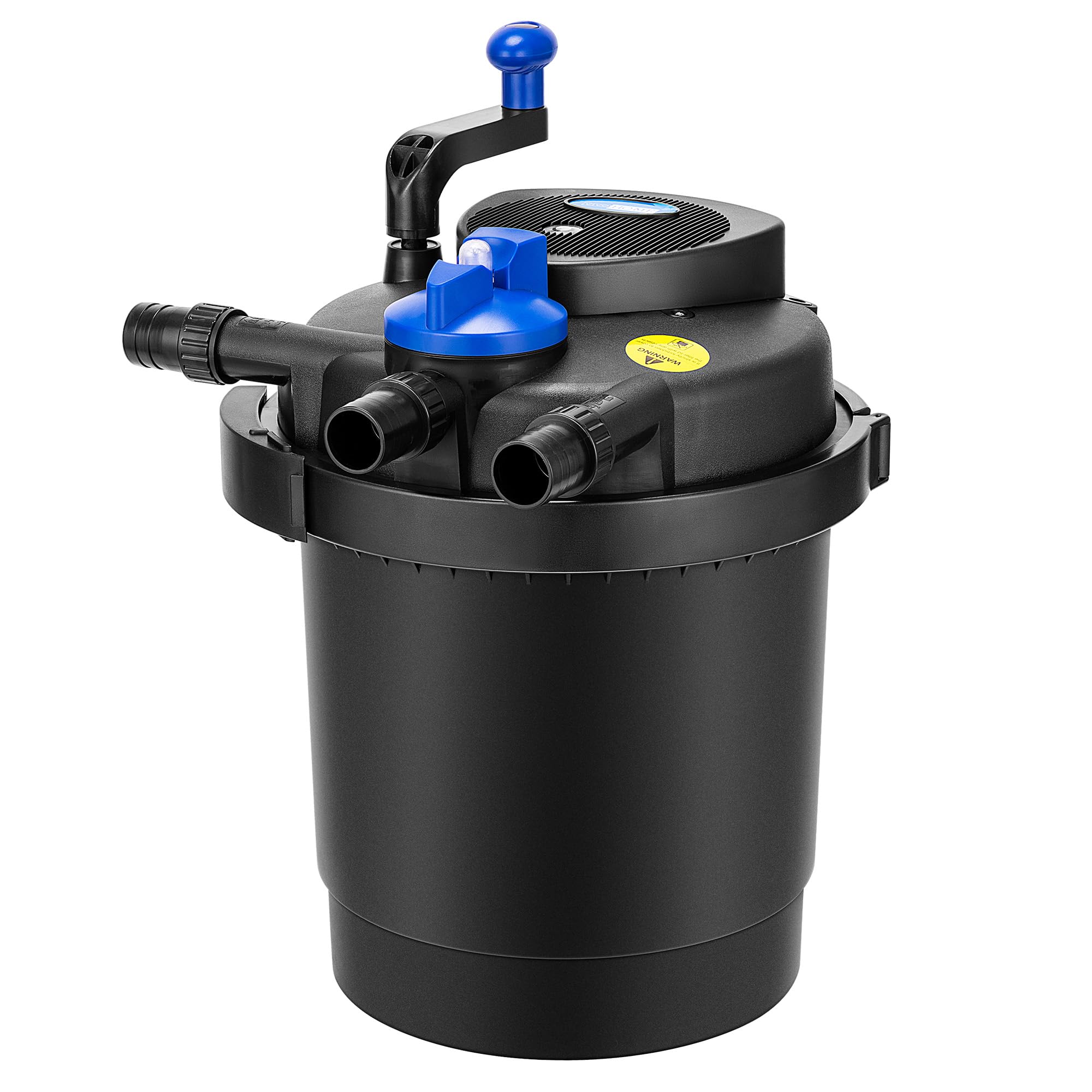
This VIVOHOME pressurized filter sits one tier below the 2630 GPH model but punches well above its weight for ponds up to 2100 gallons (ornamental) or 1000 gallons (koi). The filtration stack uses two blue 20 PPI and two yellow 25 PPI sponges plus bio-balls, identical in design to the larger sibling. The 13W UV clarifier is the same unit, and the backwash mechanism — switch to CLEAN, rotate the handle, and flush — is identical. For medium-sized ponds, this filter offers nearly the same feature set at a lower entry point.
Real-world owner experiences are overwhelmingly positive. One user cleared a dark green pond in 36 hours, and another saw results in 96 hours on a 700-gallon koi pond. The backflush water makes excellent garden fertilizer, a nice bonus for plant lovers. A few owners advise using 1.25-inch tubing instead of the included 1-inch adapters to reduce backpressure and improve flow stability. The red float indicator rises reliably when the sponges are saturated, providing a clear visual cue.
However, there are some durability concerns. A handful of customers report that the UV light chamber can leak water, causing the circuit breaker to trip — this appears to be a manufacturing defect on some early production units. Vivohome’s customer service has been responsive in replacing defective units under warranty, but the hassle is real. The backflush action is less effective on heavy sludge; some owners still disassemble the housing for a deep clean every few months. Despite these issues, this filter remains a strong value in the pressurized category.
What works
- Clears heavily algae-laden water in 36–96 hours in real owner tests.
- Backwash valve enables quick cleaning without opening the housing.
- Multiple hose adapter sizes included for flexible installation.
What doesn’t
- UV chamber seal can leak, tripping the circuit breaker on some units.
- Backflush struggles with thick sludge; periodic hand cleaning still needed.
4. TetraPond Biofilter PF-1

The TetraPond Biofilter PF-1 is a gravity-fed external filter that has been a staple in the pond industry for decades. Unlike pressurized units, this filter sits above the water line and relies on gravity to return cleaned water to the pond. It handles water gardens up to 1200 gallons or koi ponds up to 500 gallons. The Bio Ring media provides massive surface area for aerobic bacteria, and the mechanical pre-filter sponges catch suspended debris. The included fountain attachment adds aeration and visual appeal.
Owner loyalty to this model is remarkable — one reviewer used the same green version for 30 years before buying the new black model. Proper installation is critical: the unit must be placed higher than the water level to avoid leaks. Pumps over 550 GPH can overwhelm the inlet, causing water to back up. The included 0.75-inch and 1-inch fittings are interchangeable, and stainless steel clamps (not included) are recommended to prevent hose blow-off. Once dialed in, users report overnight water clarity improvement.
A few downsides: replacement blue pads last indefinitely, but the gray pads deteriorate over time and must be replaced as a set. The gravity-flow design means flow rate depends entirely on pump output and head height — and if the pump stops, the filter drains partially, requiring repriming. The bio-balls are oversized for the housing cavity, leaving some dead space. Still, for a reliable gravity system with proven longevity, the TetraPond PF-1 remains a solid choice for low-maintenance ponds.
What works
- Proven 20+ year lifespan with minimal maintenance on proper installations.
- Bio Ring media offers excellent surface area for biological filtration.
- Fountain attachment included for aeration and decoration.
What doesn’t
- Must be mounted above water line — gravity flow can stop if placement is wrong.
- Replacement gray filter pads are sold as a set and deteriorate faster than the blue ones.
5. Jebao All-in-One Pond Filter System

The Jebao UFP-2000 is a submersible all-in-one filter that combines a 530 GPH pump, a 13W UV sterilizer, and four fountain nozzles inside a single unit. It is designed to sit fully submerged, making it invisible in the pond — a major advantage for smaller landscapes where external boxes are eyesores. The internal filtration path passes water through a large coarse foam first, then through three Bio media baskets filled with bio-balls and a mesh bag of ceramic stones. The adjustment valve lets you balance flow between the fountain head and a secondary water feature outlet.
Owner feedback is mixed but skews positive for the price point. Several users report that this unit cleared green, pea-soup water in 4–5 days, and many note that it is far more effective than chemicals or barley straw they had tried previously. The UV lamp effectively kills free-floating algae but does not stop algae growth on pond walls — that requires an algicide or manual scrubbing. The unit floats slightly in the water; owners recommend placing a rock on top to keep it fully submerged.
The biggest reliability concern is lifespan: many customers report the pump or UV bulb failing after 1–2 years of continuous use. Replacement parts (especially the quartz sleeve) are hard to find, and the UV lamp is not user-serviceable on all versions. The large foam filter collects debris quickly and requires squeezing out every few weeks. For small ponds (under 300 gallons) where budget and simplicity are priorities, the Jebao works well, but it is not a long-term investment for a high-bio-load koi pond.
What works
- Fully submersible design hides the filter completely from view.
- Four fountain nozzles provide flexible water display patterns.
- Clears green water in under a week per multiple owner reports.
What doesn’t
- Pump and UV bulb typically fail after 1–2 years of continuous use.
- Does not prevent algae on pond sides; UV only kills free-floating algae.
6. Aquascape 95110 Submersible Pond Water Filter

The Aquascape 95110 is not a standalone filter — it is a pre-filter cage that attaches to the intake of a submersible pump. It provides both mechanical and biological filtration by housing a large coarse sponge that traps debris while allowing beneficial bacteria to colonize. At 13 inches by 11 inches by 5 inches, it is compact enough to fit under a rock ledge or inside a skimmer box. The removable cage unsnaps easily for rinsing the sponge, and the multi-hose fitting accommodates most pump inlet sizes.
This is the ideal solution for pond owners who already have a submersible pump and simply want to reduce clogging frequency and improve water clarity. Owners of turtle ponds, small goldfish ponds (150–270 gallons), and indoor koi tanks report that cleaning drops from weekly to every 1–2 months. The coarse sponge allows good flow while catching leaves, string algae, and fish waste before they reach the pump impeller. Several users noted improved water clarity within 24–48 hours of installing this pre-filter on turbid ponds.
The main drawback is the cost of replacement sponges — the official Aquascape replacement sponge costs more than half the price of the entire unit. Many owners bypass this by using generic pond sponge sheets cut to size. The clips that secure the cage are stiff and can be difficult to open without a screwdriver. Also, the filter does not include any UV clarification, so if your pond suffers from green water algae, you will still need a UV sterilizer in the circuit. For mechanical pre-filtration, however, this is a reliable, low-profile workhorse.
What works
- Massively reduces pump clogging — cleaning intervals stretch to 1–2 months.
- Easy clip-on installation — no tools required for daily maintenance.
- Works with any submersible pump via multi-hose fitting.
What doesn’t
- Official replacement sponges cost over half the price of the entire unit.
- Clips are very stiff — many owners resort to using a screwdriver to open them.
7. POPOSOAP Pond Filter with Pump Fountain Kit

The POPOSOAP PF-S104 is a budget-oriented all-in-one filter kit that includes a 660 GPH submersible pump, a filter box with dual sponge and bio-media layers, and a fountain kit with three spray nozzles. It is designed for small ponds up to 1180 gallons and runs on 40W of power. The integrated diverter valve lets you run both a fountain and a waterfall simultaneously, and the three additional inlets allow expansion to secondary features.
Owner reviews are enthusiastic for the price. One user with a 300-gallon pond reported that the filter cleared heavy algae in 24 hours — a dramatic improvement. Another uses it for a 100-gallon pond with zero issues across two seasons. The filter pads and bio-ceramic rings are replaceable, and the easy-access clips on the lid make cleaning straightforward. The included 1-year warranty and satisfaction guarantee provide peace of mind for a low-cost investment.
The main complaint comes from turtle pond owners: the coarse filter clogs quickly with turtle waste, requiring cleaning every few days. The pump’s maximum lift height of 8.2 feet is adequate for waterfall features but will struggle with longer hose runs to a separate waterfall. The unit is made of plastic and feels less robust than higher-priced competitors. For small goldfish ponds or water gardens under 500 gallons, however, the POPOSOAP offers an excellent entry point without sacrificing basic filtration performance.
What works
- Clears green water in 24 hours on small ponds per real owner reports.
- Diverter valve lets fountain and waterfall run simultaneously.
- Includes filter pads, bio-ceramic rings, and three fountain nozzles in one box.
What doesn’t
- Clogs quickly in turtle ponds — requires frequent cleaning for high-waste setups.
- Plastic construction feels less durable than pressurized or gravity-fed alternatives.
Hardware & Specs Guide
Flow Rate (GPH)
Flow rate measured in gallons per hour determines how many times your pond water passes through the filter each hour. For healthy ponds, aim for a turnover rate of 1x to 1.5x the pond volume per hour. A 500-gallon pond needs at least 500 GPH; a 1000-gallon koi pond with heavy feeding benefits from 1500 GPH. Pressurized filters handle higher flow rates without bypass, while gravity-fed units are limited by pump head height and inlet size.
UV Clarifier Wattage
UV clarifiers use a germicidal lamp to kill free-floating algae cells. The standard wattage for ponds under 1000 gallons is 9W–13W. The UV lamp must be housed inside a quartz sleeve that protects the bulb from water contact and allows replacement when the lamp burns out (typically 8000 hours). Pressurized filters submerge the UV chamber for maximum efficiency; gravity units often expose the lamp to air, reducing effectiveness.
Media Type & Surface Area
Filter media provides the physical and biological filtration. Mechanical filtration uses sponges or pads to trap solid debris. Biological filtration relies on porous media (bio-balls, ceramic rings, lava rock) that provides surface area for beneficial bacteria to colonize. Higher surface area per volume (measured in m² per m³) supports a larger bacterial colony, which breaks down ammonia and nitrites more efficiently. Multi-stage filters that combine coarse foam, fine foam, and bio media outperform single-type setups.
Backwash vs. Manual Cleaning
Pressurized filters with a backwash valve let you reverse the water flow to flush accumulated debris out through a drain port — no disassembly required. This is a major time saver for maintenance. Gravity-fed units require opening the housing and manually rinsing or replacing sponge pads. Submersible all-in-one units must be lifted out of the pond for cleaning. The backwash feature is worth the premium if you value 10-minute cleanings over 30-minute disassembly sessions.
FAQ
Do I need a UV clarifier on my pond filter if I only have goldfish?
How often should I clean a pressurized pond filter with backwash?
Can I use a pond filter designed for 2000 gallons on a 300-gallon pond?
Final Thoughts: The Verdict
For most gardeners, the pond filter winner is the VIVOHOME Bio Pressure Pond Filter (2630 GPH) because it combines high flow, multi-stage media, a reliable backwash system, and a 13W UV clarifier in a durable package that handles both ornamental and koi ponds up to 2600 gallons. If you want the easiest cleaning with a visual sponge indicator, grab the HAPPYGRILL Pond Filter (2642 GPH). And for a small pond setup on a tight budget, nothing beats the value of the POPOSOAP Pond Filter Kit (660 GPH) — it clears green water fast and includes everything you need to start.