
Choosing the wrong outdoor plant food can lead to weak stems, pale leaves, and disappointing yields. Most gardeners underestimate how critical the balance of nitrogen, phosphorus, and potassium is for the specific plants they are growing—vegetables demand a different formula than flowering ornamentals or shrubs. Without a precise NPK ratio tailored to your garden’s needs, you risk either underfeeding your plants or burning their roots with too much salt.
I’m Rikta — the co-founder and writer behind Lawn Gear Lab. I spend my time analyzing soil-science data, comparing NPK formulations, studying organic certification standards, and cross-referencing thousands of verified owner reports to separate effective outdoor plant food from overhyped bags of filler.
This guide breaks down the top contenders by their formulation type, release speed, and organic credentials so you can confidently choose the best outdoor plant food for your specific garden goals. I cover how to match a product to your soil type and plant variety, how to interpret NPK numbers, and which ingredients actually make a difference in growth and bloom quality.
How To Choose The Best Outdoor Plant Food
Outdoor plant food is not one-size-fits-all. The first thing to verify is the NPK ratio printed on every label: the three numbers stand for the percentages of nitrogen (N), phosphorus (P), and potassium (K). A high first number (like 20-20-20) pushes leafy green growth, while a higher middle number (like 5-10-5) supports flowering and fruiting. You also need to decide between synthetic water-soluble formulas that deliver nutrients fast but require frequent reapplication, and organic slow-release granules that feed the soil microbiome over weeks. Below are the key categories that matter most when shopping.
NPK Ratio: Match It to Your Garden’s Goal
Leafy greens and lawns thrive on a higher nitrogen ratio, typically something in the 4-1-1 or 5-1-1 range. Flowering perennials, tomatoes, and peppers benefit from a more balanced or bloom-focused ratio like 4-6-2 or 5-3-3. Universal all-purpose formulas around 4-4-4 work well for mixed beds but may need a supplement during heavy fruiting.
Release Speed: Soluble Powder vs Slow-Release Granules
Water-soluble powders provide an immediate nutrient spike—ideal for correcting a deficiency fast—but require mixing every one to two weeks. Granular organic options release nutrients gradually as soil microbes break them down, which reduces the risk of root burn and means fewer applications over the season. The choice depends on how much time you want to spend feeding versus how consistent you want the nutrient delivery to be.
Organic vs Synthetic: Soil Health vs Rapid Correction
Organic plant foods certified by OMRI (Organic Materials Review Institute) improve long-term soil structure by feeding beneficial bacteria and fungi. They are gentler on roots and safer for edible crops. Synthetic formulas deliver higher salt concentrations that can build up and alter soil pH over time if not managed properly. If you are growing vegetables or want to build a resilient soil ecosystem, organic granular formulas are the safer bet.
Quick Comparison
On smaller screens, swipe sideways to see the full table.
| Model | Category | Best For | Key Spec | Amazon |
|---|---|---|---|---|
| Espoma Organic Plant-Tone | Granular Organic | Flowers and vegetables | 5-3-3 NPK with calcium | Amazon |
| Down To Earth All Purpose Mix | Granular Organic | Tomatoes and peppers | 4-6-2 NPK formula | Amazon |
| Alaska Fish Fertilizer | Liquid Organic | Vegetative leaf growth | 5-1-1 NPK liquid concentrate | Amazon |
| FoxFarm Happy Frog | Granular Organic | Mixed ornamentals and vegetables | 6-4-5 NPK with soil microbes | Amazon |
| Jobe’s Organics All Purpose | Granular Organic | Large beds and shrubs | 4-4-4 NPK, 16 lb bag | Amazon |
| Peter’s Professional 20-20-20 | Water Soluble | General fast feeding | 20-20-20 NPK with micronutrients | Amazon |
| Miracle-Gro Liquafeed Refills | Liquid Concentrate | Hose-end quick feeding | 1:533 dilution ratio | Amazon |
In‑Depth Reviews
1. Espoma Organic Plant-Tone 5-3-3

The Espoma Plant-Tone uses a 5-3-3 NPK ratio that provides enough nitrogen for steady foliage growth while supporting flower and fruit development without pushing excessive leaf mass. The inclusion of calcium at 5 percent helps prevent blossom-end rot in tomatoes and peppers, a common frustration for vegetable gardeners. This is a granular organic formula that must be worked into the top inch of soil and then watered to activate the Bio-Tone microbes.
User reports highlight visible greening and improved bloom counts within two weeks of application, especially on perennials and established shrubs. The two-pack configuration offers 8 pounds total, which is enough to cover a 200-square-foot garden bed for a full season if applied monthly. Many owners mention the product is easy to spread evenly by hand or with a small garden rake.
The main drawbacks are the strong organic smell—similar to chicken manure—which can be offensive during application, and the fact that it requires soil moisture to activate, making it less effective during drought unless you irrigate. Some users noted the granules can clump if stored in humid conditions after opening.
What works
- Balanced NPK with added calcium prevents blossom-end rot
- Long-lasting organic formulation feeds for weeks after one application
What doesn’t
- Strong manure-like odor during and after application
- Granules can clump if not stored in a dry environment
2. Down To Earth All Purpose Tomato & Vegetable Mix 4-6-2

This Down To Earth blend stands out because of its 4-6-2 NPK ratio, which puts phosphorus higher than nitrogen to encourage robust flowering and fruit setting in tomatoes, peppers, and melons. The five-pound box contains a mix of fish bone meal, blood meal, feather meal, rock phosphate, langbeinite, greensand, humates, and kelp meal—providing a rare diversity of organic nutrient sources. All ingredients are OMRI listed for organic production, so you can use it in certified organic beds without worry.
Gardeners report that pale, struggling tomato plants visibly rebounded within two weeks of working this granular food into the soil. The formula is gentle enough not to burn transplants, even when applied at the full rate. The 5-pound bag covers roughly 50 square feet at the recommended rate, making it a good choice for raised beds of moderate size.
The smell is distinctly fishy and barnyard-like for the first 24 to 48 hours, which can be unpleasant if you garden near a patio or open window. The granular texture also makes it harder to apply evenly to dense established beds without disturbing roots.
What works
- High phosphorus ratio specifically targets flowering and fruiting crops
- Features a wide spectrum of organic ingredients for soil microbe health
What doesn’t
- Strong initial odor can linger near garden areas
- Granular form is tricky to spread evenly in tight plant spacing
3. Alaska Fish Fertilizer 5-1-1
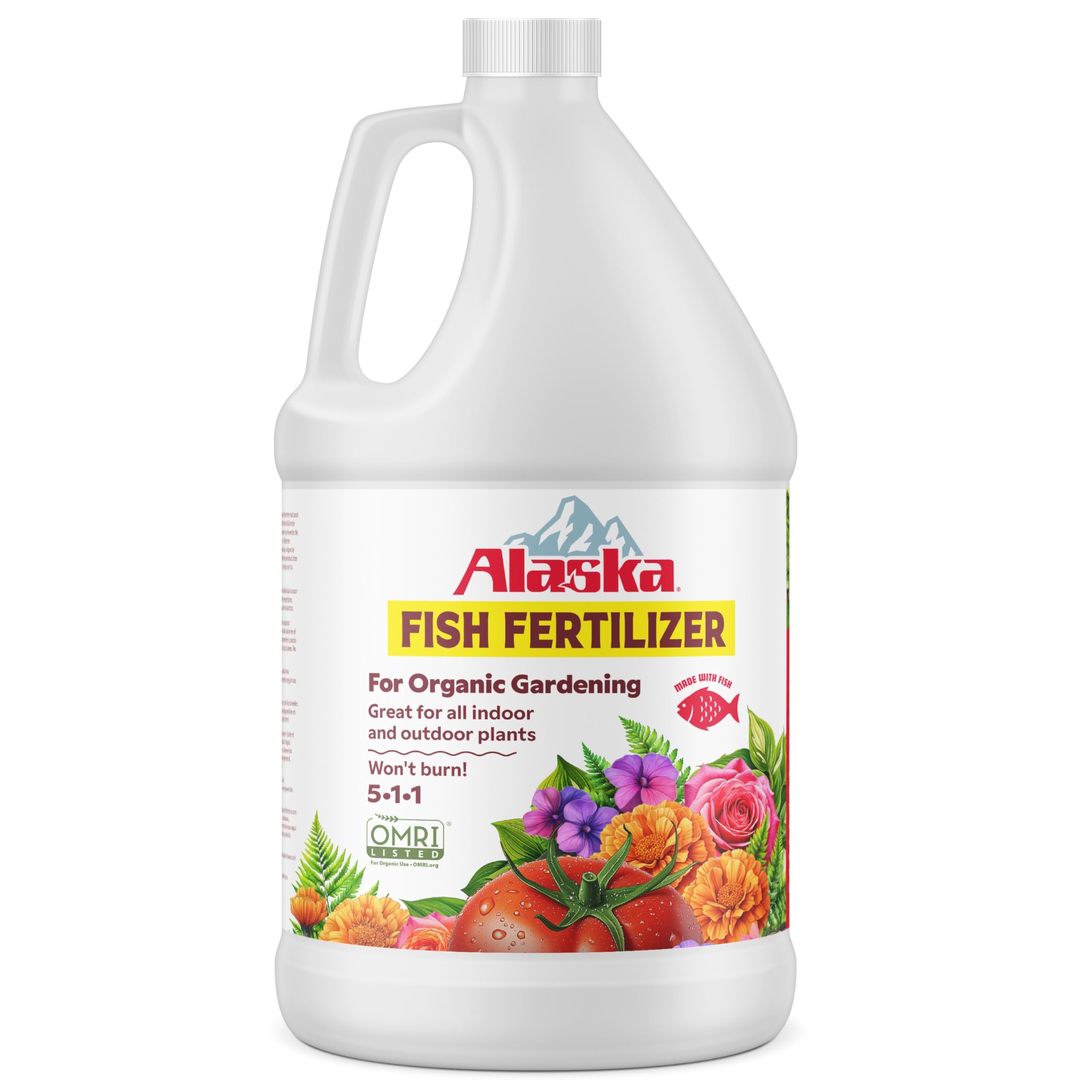
The Alaska Fish Fertilizer is a nitrogen-heavy liquid concentrate (5-1-1) that excels at pushing dark green vegetative growth in leafy greens, lawns, and early-season transplants. It is made from cold-processed fish emulsion that preserves natural micronutrients and beneficial amino acids that synthetics lack. Each 115-fluid-ounce jug covers up to 1,000 square feet when diluted at the recommended rate, making this a high-value option for large gardens.
The OMRI listing gives organic growers confidence that the product meets certified production standards, and the liquid form allows for quick soil absorption through both root drenching and foliar feeding.
The primary issue is the potent fish odor. While the deodorized formula dissipates within a day outdoors, the smell can linger for hours if applied near a house or greenhouse. Also, the low phosphorus and potassium levels mean you will need a separate bloom booster formula if you are growing heavy-fruiting crops like tomatoes or squash.
What works
- High nitrogen content rapidly greens up leafy vegetables and lawns
- Cold-processed liquid retains natural micronutrients and amino acids
What doesn’t
- Potent fish smell even in the deodorized formula
- Low phosphorus and potassium require additional feeding for blooms
4. FoxFarm Happy Frog All Purpose Fertilizer 6-4-5

The FoxFarm Happy Frog fertilizer uses a 6-4-5 NPK ratio that leans slightly nitrogen-heavy but still provides balanced support for both foliage and flowers. What separates this product from standard organic blends is the inclusion of active beneficial soil microbes and mycorrhizal fungi, which colonize root zones to improve nutrient and water uptake. The OMRI listing confirms organic compliance, and the 4-pound bag is surprisingly concentrated—users report using half a bag per year for a medium-sized garden.
Owners consistently mention that yellowing tomato and zucchini plants turned dark green within a week of application and produced the healthiest yields they have ever grown. The slow-release granular form is forgiving for beginners because it is difficult to over-apply without burning roots, and it feeds steadily for a full month before needing reapplication. Monstera and other ornamental houseplant growers also praise the formula for its gentle effect on tropical foliage.
The biggest criticism is the smell, which multiple users describe as very pungent—similar to fresh manure. Indoor application requires good ventilation or the odor can fill a room. A few users also noted that if sprinkled too thickly on the surface, a white mold can form within days before the granules break down fully.
What works
- Added beneficial microbes and mycorrhizae enhance root performance
- Concentrated 4 lb bag goes a long way per season
What doesn’t
- Very strong manure-like odor that is hard to ignore indoors
- Surface mold can develop if granules are over-applied without mixing in
5. Jobe’s Organics Granular All Purpose Fertilizer 4-4-4

Jobe’s Organics All Purpose Fertilizer delivers a perfectly even 4-4-4 NPK ratio in a bulky 16-pound bag that provides outstanding coverage for large garden beds, shrub borders, and even small-scale lawn feeding. The balanced formulation makes it safe for a wide range of plants—vegetables, herbs, flowers, trees, and shrubs—without needing to calculate different rates for each bed. The OMRI listing verifies that it meets USDA organic standards, and the granular form is friable enough to spread with a hand-crank lawn spreader.
Experienced gardeners report turning their squash, cucumber, and pepper beds into massive producers by steeping one cup of granules in a gallon of dechlorinated water for 24 hours to create a homemade compost tea. Others simply sprinkle granules near the drip line and water it in, noting rapid budding and more colorful blooms within two weeks. The resealable bag helps keep the remaining product dry for the next application.
The 16-pound bag is more than many small-space gardeners will use in a single season, and the granules are dense enough that a full bag is heavy to carry. Some users also find the smell—described as pungent but milder than raw manure—lingers for a day or two after spreading. It is also important to store the bag in a rodent-proof container because the organic ingredients can attract vermin.
What works
- Large 16 lb bag provides excellent value for extensive gardens
- Perfectly balanced 4-4-4 ratio works for almost any plant type
What doesn’t
- Large bag is heavy and can be excessive for small gardens
- Organic smell can attract pests if not stored properly
6. Peter’s Professional 20-20-20 Water Soluble Fertilizer

Peter’s Professional 20-20-20 is a high-concentration water-soluble powder that delivers an immediate, balanced dose of all three primary macronutrients in equal proportion. The 2-pound bag contains enough powder to make 32 gallons of liquid feed at the standard rate of half a tablespoon per gallon, making it a highly efficient option for gardeners who need quick results on a tight budget. The formula includes chelated micronutrients that prevent deficiency spotting commonly seen in potted and container plants.
Users with a wide range of plants—from African violets to outdoor cannabis—report consistent, rapid greening and increased bud production when used on a weekly schedule during the growing season. The powder dissolves completely in water without leaving residue, and the lack of organic solids means this product has no smell during or after application. Many reviewers note that this product outperforms the leading synthetic brands available at big-box stores, especially when used on vegetables and annuals.
The biggest downside is that this is a synthetic salt-based fertilizer that can burn roots if over-applied, especially in hot weather. It also lacks the soil-building organic matter that feeds beneficial microbes, so it is better suited as a supplement to compost rather than a sole feeding strategy. The bag is also small relative to the coverage area for large gardens, which means you may need to buy multiple units for a full season of weekly feedings.
What works
- High concentration makes a large volume of liquid fertilizer from a small bag
- Completely odorless and dissolves fully with no sediment
What doesn’t
- Salt-based formula can burn roots if mixed too strong or applied in heat
- Does not contain organic matter to improve soil structure or microbial life
7. Miracle-Gro Liquafeed Refills All Purpose Fertilizer (4 Pack)

The Miracle-Gro Liquafeed Refills are designed specifically for use with the separate Liquafeed garden feeder, handling the dilution automatically as water passes through the bottle. Each 1.25-pound refill cartridge treats a substantial area, and the 4-pack provides a full season of feeding for an average-sized lawn and garden combination. The all-purpose formula delivers a balanced nutrient profile that works on flowers, vegetables, shrubs, and lawns without any mixing or measuring.
Owners appreciate the convenience of being able to feed large areas without mixing buckets or handling powders, simply by attaching the cartridge to a hose and spraying. Users note a clear improvement in flower quantity and vegetable yield compared to unfertilized beds, and the price per refill is often lower than buying the same bottles individually at garden centers. The instant feeding approach also makes it easy to spot-treat weak or yellow patches in a lawn during the growing season.
The main limitation is that the feeder wand is required and sold separately, so you must own or buy the hardware to use these refills. The synthetic liquid concentrate also has a relatively high salt index, which can build up in container soils over time if used exclusively without periodic leaching. Additionally, the refill cartridges cannot be resealed once opened, so you must use the entire cartridge within a few weeks to maintain consistent strength.
What works
- Automatic dilution via hose feeder eliminates measuring and mixing
- 4-pack provides convenient season-long feeding for large areas
What doesn’t
- Requires the separate Liquafeed garden feeder hardware
- Open cartridge must be used quickly before nutrient strength degrades
Hardware & Specs Guide
NPK Ratio Interpretation
The three hyphenated numbers on any plant food label represent the percentage by weight of nitrogen, phosphorus, and potassium. A 5-3-3 formula contains 5 percent nitrogen, 3 percent phosphorus, and 3 percent potassium. Nitrogen drives leaf and stem growth, phosphorus supports root development and flowering, and potassium strengthens overall plant immunity and water regulation. Choose a higher first number for lawns and leafy greens; a higher middle number for tomatoes and fruiting crops; a balanced equal ratio for general maintenance.
Release Method Comparison
Water-soluble powders and liquid concentrates deliver nutrients immediately but require reapplication every 1 to 2 weeks during the active growing season. Granular organic fertilizers release nutrients over 4 to 8 weeks as soil microbes break them down, providing a steadier supply that reduces the risk of nutrient overdose. Synthetic slow-release coated granules can last 3 to 4 months with a single application, but they do not feed the soil biology. When choosing a release method, weigh your feeding schedule tolerance against your garden’s soil health goals.
FAQ
What is the difference between OMRI Listed and organic on the label?
Can I use indoor plant food on my outdoor vegetable garden?
How often should I apply granular outdoor plant food during the growing season?
Final Thoughts: The Verdict
For most gardeners, the best outdoor plant food winner is the Espoma Organic Plant-Tone because its 5-3-3 NPK ratio with added calcium covers the broadest range of flowers, vegetables, and shrubs while feeding the soil with organic matter. If you want a targeted bloom booster for heavy-fruiting crops like tomatoes and peppers, grab the Down To Earth 4-6-2. And for quick, large-scale vegetative feeding through a hose-end system, nothing beats the convenience of the Miracle-Gro Liquafeed Refills.