
Inside a greenhouse, trapped heat and stagnant humidity are the fastest way to stunt growth, invite mold, and stress your plants. The right fan pushes stale air out, pulls fresh air in, and keeps the internal climate stable through every temperature swing of the day.
I’m Rikta — the co-founder and writer behind Lawn Gear Lab. I specialize in analyzing greenhouse ventilation systems, comparing CFM ratings, motor efficiency, and real-world installation requirements to help you buy with confidence.
Whether you’re a weekend grower or a serious hobbyist, understanding the specs that actually matter is the difference between a cooked crop and a thriving one. This guide breaks down the top contenders for any fan for greenhouse setup you’re planning.
How To Choose The Best Fan For Greenhouse
Selecting the right ventilation fan for your greenhouse starts with sizing and airflow. The most common mistake beginners make is buying a fan that either moves too little air to cool the space or consumes too much energy for the benefit it provides. Focus on the CFM rating, mounting type, and the motor’s ability to handle constant moisture.
CFM and Space Sizing
CFM (Cubic Feet per Minute) tells you how much air the fan pushes every minute. A rough rule is that your fan should be able to exchange the total air volume of your greenhouse in one to two minutes. Measure your greenhouse length x width x average height to find cubic feet; divide by 60 to get the minimum CFM you need.
Shutter vs. High-Velocity Fans
Shutter exhaust fans are built into a wall opening and use automatic louvers to block backdrafts, pests, and weather when off — ideal for permanent, sealed installations. High-velocity floor or wall fans are better for circulating air inside without venting direct heat outside, good for smaller setups or supplemental circulation.
Motor and Material Durability
Greenhouse fans run in high-humidity, temperature-fluctuating environments. Look for sealed ball-bearing motors, rust-resistant aluminum blades, and powder-coated or galvanized steel frames. These materials resist corrosion and keep the fan running reliably season after season.
Quick Comparison
On smaller screens, swipe sideways to see the full table.
| Model | Category | Best For | Key Spec | Amazon |
|---|---|---|---|---|
| iLIVING 20″ Shutter Exhaust | Shutter Fan | Large greenhouse climate control | 3368 CFM / 5000 sq. ft. coverage | Amazon |
| AC Infinity AIRLIFT S10 | Shutter Fan | Precise temp/humidity automation | 631 CFM / 10-speed EC motor | Amazon |
| AC Infinity AIRTITAN T3 | Inline Fan | WiFi control in small grow areas | 120 CFM / 6″ inline with app | Amazon |
| hykolity 20″ Floor Fan | Floor/Wall Fan | High-velocity air movement | 4650 CFM / 3-speed metal | Amazon |
| BILT HARD 18″ Wall Mount | Wall Mount Fan | Barn/shop with limited floor space | 4300 CFM / 180° tilt | Amazon |
| KEN BROWN 12″ Shutter | Shutter Fan | Plug-and-play small greenhouse | 1450 CFM / pre-installed cord | Amazon |
| VEVOR 10″ Shutter | Shutter Fan | Budget-friendly exhaust install | 820 CFM / 1650 RPM motor | Amazon |
In‑Depth Reviews
1. iLIVING 20″ Wall Mounted Shutter Exhaust Fan

The iLIVING 20-inch shutter fan is a serious piece of ventilation hardware for medium to large greenhouses. With a rated 3368 CFM and coverage up to 5000 square feet, it exchanges the air in a sizable growing space in under two minutes. The Thermospeed controller lets you set a temperature range from 32°F to 130°F, so the fan activates and ramps automatically when the greenhouse heats up.
Build quality is industrial — a galvanized steel frame and aluminum shutters resist rust well, and the permanently lubricated motor is UL certified for safety. Noise levels are rated under 69 dB, which is reasonable for a fan of this capacity. The variable speed control gives you fine adjustment instead of just high/medium/low.
Real owners report a temperature drop of more than 10°F in heavily sun-loaded greenhouses, and the gravity shutters close cleanly to block debris and pests. The fan arrives fully assembled, which simplifies installation. Some users note a slight shutter rattle at the highest speeds, but it does not affect performance.
What works
- Very high CFM rating suitable for large greenhouses
- Built-in thermostat automates ventilation
- Corrosion-resistant metal construction
What doesn’t
- Shutters may rattle slightly at full speed
- Requires a wall opening for flush mounting
2. AC Infinity AIRLIFT S10 Shutter Exhaust Fan

The AC Infinity AIRLIFT S10 uses an energy-efficient EC motor paired with a 10-speed PWM controller, giving you granular airflow control from a whisper-quiet breeze up to 631 CFM. That makes it an excellent choice for a greenhouse where you need precise conditions — not just max power. The IP44-rated housing keeps moisture and dust out of the motor and electronics.
Build quality is a step above typical shutter fans. The all-metal housing feels solid, the dual ball bearings support smooth rotation, and the aluminum shutters open and close cleanly. The included speed controller also reads temperature and humidity, so you can set the fan to ramp proportionally as conditions change inside the greenhouse.
Users frequently mention how quiet the fan runs at the lower speeds — ideal for a greenhouse near living areas. The app integration available with the optional controller upgrade adds remote monitoring and automation. Some experienced growers pair this with other AC Infinity gear for a fully automated ventilation network.
What works
- EC motor is extremely energy-efficient
- 10-speed control offers exceptional airflow tuning
- IP44 moisture and dust resistance
What doesn’t
- Lower max CFM than budget shutter fans
- Premium price point
3. AC Infinity AIRTITAN T3 Inline Exhaust Fan

The AC Infinity AIRTITAN T3 is a different animal — a 6-inch inline exhaust fan designed for ducted ventilation setups. It moves 120 CFM, which is modest compared to wall-mounted shutter fans, but it connects to WiFi so you can monitor temperature and humidity from your phone. The dynamic programming supports timers, cycles, and minimum speed settings for precise automation.
The heavy-duty anodized aluminum frame carries an IP55 rating, making it highly resistant to dust and water jets — suitable for the damp conditions inside a greenhouse. The EC motor is quiet and efficient, and the fan can be mounted inline with ductwork to pull hot, humid air directly out of the growing area without requiring a large wall cutout.
Owners highlight the reliability of the controller once the programming clicks, though the user interface has a learning curve. The T3 is best for small greenhouses, propagation tents, or hydroponic setups where floor and wall space are tight and ducting is already planned.
What works
- WiFi app control for remote monitoring
- IP55 dust and water resistance
- Very quiet operation at low speeds
What doesn’t
- Lower CFM limits it to small spaces
- Controller programming is not intuitive
4. hykolity 20″ High Velocity Floor Fan
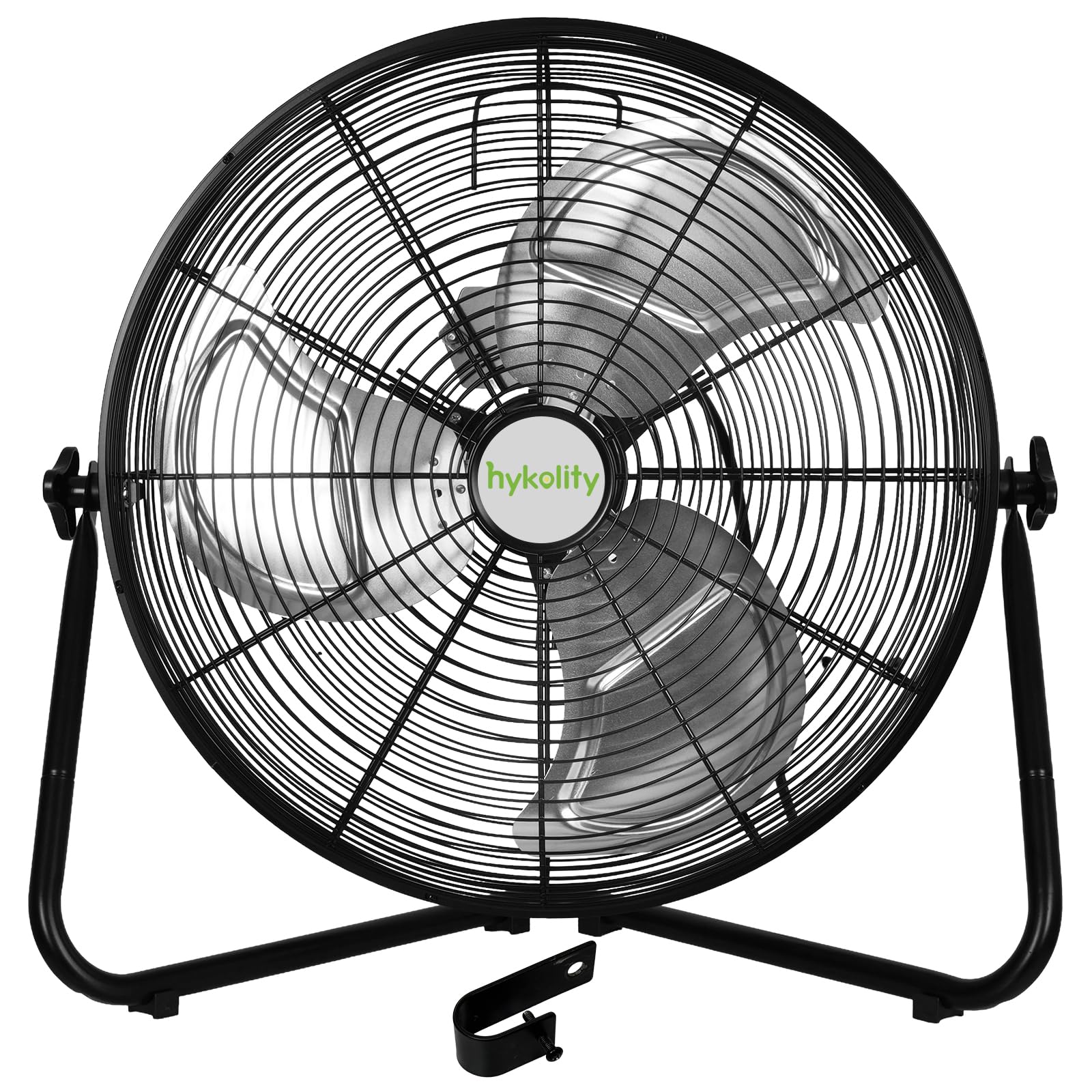
The hykolity 20-inch high-velocity floor fan delivers a massive 4650 CFM at top speed, making it one of the highest-flow options here. It is not a shutter exhaust fan — it uses a 3-speed motor with an aluminum blade and a tiltable head that rotates 360 degrees. The included wall-mounting bracket lets you install it overhead to save floor space in a greenhouse.
The all-metal construction and black powder-coated finish hold up well in dusty, humid greenhouse environments. The small grid spacing on the grille keeps fingers and paws safe, and the unit is UL certified. Three CFM settings (4650 / 3750 / 2980) give you flexibility between hurricane-force circulation and a gentler breeze for seedlings.
Owner reviews consistently praise the raw power and value, especially for larger hobby greenhouses where circulating air inside the structure prevents hot spots. The noise level is high on the top speed, but that is expected from a fan moving this much air. The floor stand with rubber feet keeps it stable on uneven surfaces.
What works
- Extremely high CFM for circulation
- Can be used as floor or wall-mounted
- Sturdy all-metal build with rubber feet
What doesn’t
- Not a sealed exhaust fan — no backdraft shutter
- Loud on the highest speed setting
5. BILT HARD 18″ Industrial Wall Mount Fan

The BILT HARD 18-inch wall mount fan is designed for spaces where floor area is at a premium. It pushes up to 4300 CFM with a 3-speed PSC motor, and the 180-degree adjustable tilt head directs airflow wherever you need it — across benches, toward a door, or along a row of plants. The 2-foot pull chain makes speed switching convenient once it is mounted high.
The fully enclosed ball-bearing motor is protected from dust and debris by the powder-coated steel housing. Aluminum fan blades keep weight low and resist corrosion better than stamped steel. The installation hardware supports both wall and ceiling mounting, and the OSHA-compliant grille meets safety requirements for commercial environments.
User feedback highlights the quiet operation relative to the air volume moved, and the longevity of the motor over multiple seasons. It is a circulation fan, not a sealed exhaust, so it works best paired with a separate intake or exhaust vent to remove hot air rather than just move it around.
What works
- High CFM output in a compact wall mount
- 180-degree adjustment for targeted airflow
- Quiet operation for its class
What doesn’t
- Not rated for outdoor or wet locations
- Pull chain may be short for very high ceilings
6. KEN BROWN 12″ Shutter Exhaust Fan

KEN BROWN’s 12-inch shutter exhaust fan is built for growers who want a simple, no-wire installation. It comes with a 5.4-foot pre-installed power cord and plug — mount the fan in a wall opening, plug it in, and the automatic aluminum shutters open when the fan runs and close when it stops. At 1450 CFM, it handles greenhouses up to roughly 1000 cubic feet efficiently.
The high-grade aluminum shutters and blades resist corrosion from constant humidity and temperature swings. The fan runs at 1650 RPM on 120V and pulls just 0.6 amps, keeping energy costs low. The compact dimensions (15 x 15 inches) fit standard wall cutouts without framing modifications.
Several owners report this fan solved attic and greenhouse overheating problems within minutes of installation. It is not the most powerful on the list, but the plug-and-play convenience and quiet operation make it a strong mid-range option. Some users noted the louvers were slightly sticky on initial use but freed up after a few cycles.
What works
- True plug-and-play — no wiring required
- Corrosion-resistant aluminum construction
- Quiet operation at lower speeds
What doesn’t
- No thermostat or speed control included
- Lower CFM limits it to smaller greenhouses
7. VEVOR 10″ Shutter Exhaust Fan

The VEVOR 10-inch shutter exhaust fan is an entry-level solution that still delivers real utility. With an 820 CFM airflow at 1650 RPM, it can ventilate a small greenhouse, shed, or chicken coop effectively. The galvanized steel frame combined with an aluminum alloy fan blade and shutter provides good rust resistance for the price point.
This is a basic model — it does not include a speed control switch, plug, or thermostat. The fan itself is FCC listed, and the fully enclosed motor has thermal protection and permanent lubrication. You will need to purchase a separate plug and wire it if you want to use a standard outlet, or connect it directly to a switched circuit.
Users who pair this fan with a separate thermostat controller report significant temperature drops — one owner documented a drop from 115°F to 100°F inside a greenhouse on a 90°F day. The primary appeal is the value: you get the core function of a shutter exhaust fan at a fraction of the cost of premium models, as long as you are comfortable with the extra wiring step.
What works
- Very affordable shutter exhaust option
- Rust-resistant aluminum and galvanized steel
- Reliable 1650 RPM motor
What doesn’t
- No plug or speed control included
- Requires separate wiring before use
Hardware & Specs Guide
CFM and Coverage Area
CFM measures how many cubic feet of air the fan moves each minute. For a greenhouse, the goal is a complete air exchange every one to two minutes. A 10x10x8 greenhouse (800 cubic feet) needs at least 400 CFM. Large shutter fans like the iLIVING 20″ move over 3000 CFM and can cover entire commercial structures.
Motor Types: AC vs. EC
AC motors are traditional, reliable, and cheaper, but they run at fixed speeds and consume more electricity per CFM. EC motors (electronically commutated) are more efficient, offer variable speed control through PWM, and run cooler. The AC Infinity AIRLIFT S10 uses an EC motor with 10-speed control, ideal for energy-conscious setups.
Shutter vs. Circulation Fans
Shutter fans mount through a wall and exhaust air directly outside, with gravity louvers closing when off to prevent backdrafts. Circulation fans (floor or wall mount) move air inside the greenhouse without exhausting it. A proper ventilation strategy often combines an intake vent with a shutter exhaust fan to create active, directional airflow.
Material and Weather Resistance
Greenhouse fans must handle high humidity, condensation, and temperature extremes. Aluminum blades and shutters resist rust far better than bare steel. Look for powder-coated steel frames, galvanized frames, or anodized aluminum housings. IP ratings (e.g., IP44, IP55) indicate the level of dust and moisture protection the electronics have.
FAQ
Should I choose a shutter fan or a circulation fan for a greenhouse?
How do I calculate the correct CFM for my greenhouse size?
Can I use a regular household fan in a greenhouse instead of a dedicated fan?
Do I need a thermostat to control my greenhouse fan?
Final Thoughts: The Verdict
For most gardeners, the fan for greenhouse winner is the iLIVING 20″ Shutter Exhaust Fan because it combines high CFM, a built-in thermostat, and durable metal construction at a strong mid-range price. If you want automated precision with EC motor efficiency and app control, grab the AC Infinity AIRLIFT S10. And for a compact, WiFi-equipped inline exhaust in a small grow space, nothing beats the AC Infinity AIRTITAN T3.