
Pine trees send a clear signal when they’re hungry: needles lose their deep green vibrancy, new growth stunts, and the canopy thins out from the inside. Unlike quick-feed lawn fertilizers that push fast top growth, pines thrive on a slow-release meal that builds deep root systems and supports the mycorrhizal partnerships they depend on. Feeding a pine the wrong NPK ratio—especially one with too much nitrogen or an alkaline base—can scorch sensitive root hairs or lock out the micronutrients acid-soil lovers require. The right fertilizer delivers a steady nutrient stream over weeks, not days, without overwhelming the tree’s natural cycle.
I’m Rikta — the co-founder and writer behind Lawn Gear Lab. I spend my days analyzing commercial NPK ratios, parsing soil amendment chemistry, and cross-referencing hundreds of verified owner reports to identify which formulations actually move the needle on needle density, branch internode length, and root mass development in conifers.
Whether you are planting a new sapling or trying to revive a mature spruce, choosing the right feed comes down to understanding release mechanisms, target soil pH, and the specific nitrogen source. This guide breaks down the top seven options to help you find the best fertilizer for pine trees that matches your tree’s age, soil condition, and your preferred application method.
How To Choose The Best Fertilizer For Pine Trees
Pine trees are heavy feeders on a very specific set of nutrients, but they are sensitive to over-application. The goal is to mimic the slow decomposition of organic matter on a forest floor. Focus on three key factors: the nitrogen source and ratio, the sulfur content for acidification, and the physical form that best suits your planting setup.
NPK Balance and Nitrogen Source
A ratio near 4-3-4 or 6-2-1 works well for most established pines. The first number (nitrogen) should come from a slow-release organic source like feather meal or cottonseed meal, not from urea or ammonium nitrate, which can cause a rapid green-up followed by root burn. The potassium and phosphorus numbers should be lower to avoid pushing premature flowering or fruit set in conifers that should focus energy on needle and root growth.
Sulfur Content and Soil pH
Pines demand acidic soil in the range of 5.0 to 6.5. If your soil pH creeps above 6.5, iron and manganese become unavailable and the needles turn yellow even when nitrogen is plentiful. Look for a fertilizer that includes 5% to 8% sulfur (elemental or from sulfate) to gradually lower pH around the root zone. Without sufficient sulfur, the best NPK ratio in the world will still leave your pine chlorotic.
Application Method: Spikes vs. Granules vs. Soluble
For established trees with a wide drip line, granular fertilizers spread evenly under the canopy and watered in offer the best distribution. Pre-measured spikes are convenient for young trees or areas with dense undergrowth where spreading is difficult, but they concentrate nutrients in a narrow column of soil. Water-soluble powders provide the fastest uptake for a tree in acute distress, but they require repeat applications every 7-14 days.
Quick Comparison
On smaller screens, swipe sideways to see the full table.
| Model | Category | Best For | Key Spec | Amazon |
|---|---|---|---|---|
| Espoma Evergreen-Tone | Premium Granules | General pine & spruce health | 4-3-4 NPK with 5% sulfur | Amazon |
| Espoma Holly-Tone | Premium Granules | Acid-loving pines & ornamentals | 4-3-4 NPK with 5% sulfur | Amazon |
| Jobe’s Tree Spikes (16-4-4) | Spikes | All trees & deciduous shrubs | 16-4-4 time-release | Amazon |
| Jobe’s Evergreen Spikes | Spikes | Evergreens & green giants | 13-3-4 slow-release | Amazon |
| FoxFarm Happy Frog | Organic Granules | Acid-loving container plants | Low pH with mycorrhizae | Amazon |
| Down To Earth Cottonseed Meal | Organic Granules | Blueberries & acid-soil feeding | 6-2-1 slow-release | Amazon |
| Miracle-Gro Water Soluble | Soluble Powder | Quick green-up for acid-lovers | Water soluble for acid plants | Amazon |
In‑Depth Reviews
1. Espoma Organic Evergreen-Tone 4-3-4

Espoma’s Evergreen-Tone is built around a 4-3-4 analysis with 5% sulfur sourced from elemental sulfate, which directly addresses the two biggest needs of pines: steady nitrogen delivery without a burn spike and ongoing soil acidification. The Bio-tone microbial consortium helps break down the organic matter into plant-available nutrients, which is particularly valuable on compacted suburban lots where natural soil biology is depleted. The 18-pound bag covers a substantial drip line area for multiple mature trees without needing to remix or reapply for 8 to 10 weeks.
Owner reports consistently mention noticeable needle greening within two weeks of spring application, with denser growth habits visible by mid-summer. The barnyard smell from the chicken manure base is a sign of active microbial ingredients, not spoilage. The granules flow well through a broadcast spreader and do not clump when stored in dry conditions. Reapplication in late fall supports root development going into dormancy.
One trade-off is the higher cost per pound compared to basic synthetic feeds, but the lack of salt-index burn and the extended feeding window make it more economical per season. The sulfur content means you should test your soil pH annually to avoid over-acidifying if you are already in the 4.5-5.0 range.
What works
- Proven 4-3-4 ratio with added sulfur for long-term soil pH management
- Bio-tone microbes improve nutrient cycling in poor soil
- Granules spread easily and do not require mixing
What doesn’t
- Strong organic smell that lingers for a few days after application
- Premium cost per pound relative to conventional granular feeds
2. Espoma Organic Holly-Tone 4-3-4

Holly-Tone is the original acid-lover’s fertilizer and shares the same 4-3-4 analysis with 5% sulfur as Evergreen-Tone, but it is marketed primarily for flowering acid-lovers like azaleas and hydrangeas. The difference is subtle: Holly-Tone includes slightly more organic feather meal versus fish meal, which shifts the amino acid profile but still delivers the same reliable slow-release nitrogen for pines. The 36-pound bag is the largest option on this list, making it the most cost-effective choice for a property with multiple large pines, spruce, or fir.
Long-term users report that their magnolias, pines, and blueberry bushes all show improved leaf color and vigor after switching to Holly-Tone from synthetic blends. The Bio-tone formula here is identical to Evergreen-Tone, so you get the same microbial boost for root development. The granules have a consistent particle size that does not produce dust when poured, and they dissolve at a steady rate over several months.
The main disadvantage is that some pine-specific growers feel the formula is too generalized for conifers that do not flower, so they prefer Evergreen-Tone for its slightly lower potassium-to-phosphorus balance. Also, the heavy bag size can be cumbersome if you only have a single tree to feed.
What works
- Large 36-pound bag delivers the best per-feeding value in the premium tier
- Same proven 4-3-4 NPK and 5% sulfur for effective acidification
- Versatile enough for pines, ornamentals, and berries on the same property
What doesn’t
- Formulated for flowering acid-lovers, not exclusively for conifers
- Heavy bag is less convenient for small-scale users
3. Jobe’s Tree Fertilizer Spikes 16-4-4

Jobe’s 16-4-4 spikes deliver a very high nitrogen punch relative to the other products on this list. The 16-4-4 ratio is more aggressive than what pines typically need, but the time-release coating moderates the release rate so the nitrogen does not hit the roots all at once. The spike format is ideal for young pines where you want to target the root ball precisely without broadcasting granules across the lawn. Each spike feeds for about 8 weeks, and the package contains 30 units, enough for several small to medium trees.
Users report improved branch density and needle color in previously stressed pines after just one seasonal application. The no-mix, no-measure convenience is a genuine advantage for anyone who finds granular spreading tedious, especially on slopes or in mulched beds. The spikes are effective on deciduous trees as well, so one box can handle your entire landscape.
The high nitrogen content can still cause marginal leaf burn if over-applied or if the soil is already rich in organic matter. For mature pines, one spike per inch of trunk diameter is the rule, and that is easy to exceed. Also, the 16-4-4 ratio does not provide the sulfur needed to maintain low pH, so you may need a separate soil acidifier if your pH is above 6.5.
What works
- Pre-measured spikes eliminate measuring and spreading guesswork
- Time-release coating prevents root burn despite high NPK numbers
- Long 8-week feeding window works well for single-application seasons
What doesn’t
- 16-4-4 ratio is higher in nitrogen than ideal for mature pines
- No sulfur content, so it does not help with soil acidification
4. Jobe’s Evergreen Fertilizer Spikes 13-3-4

Jobe’s Evergreen-specific spikes use a 13-3-4 formulation that is much closer to the ideal ratio for conifers than the 16-4-4 version. The lower nitrogen content reduces the risk of burning feeder roots, and the slow-release mechanism extends the feeding period up to 90 days per spike. The 15-pack is entry-level pricing for anyone testing spikes for the first time, and the smaller format works well for solitary specimen pines or a row of green giants along a property line.
Multiple verified reviews mention that green giant arborvitae and white pines showed rapid lateral growth and darker green color after the first season. The spikes do not crumble during insertion—a common complaint with budget spike brands—and the plastic cap can be reused many times to drive the spike straight. Owners also note that pre-moistening the soil before insertion dramatically reduces the effort required.
The primary limitation is the 15-spike count: for a property with many large trees, you will run through a pack quickly. The spikes do not include any sulfur or acidifying agents, so they work best on already-acidic soil. Some users find the spikes difficult to drive into clay soil without a pilot hole.
What works
- 13-3-4 ratio is well-suited for evergreen species like pine and spruce
- Sturdy spike construction does not break apart during installation
- Affordable entry point for first-time spike users
What doesn’t
- Low unit count per pack for larger landscaping needs
- No sulfur or acidifying components for high-pH soil correction
5. FoxFarm Happy Frog Acid Loving Fertilizer

FoxFarm’s Happy Frog line is built around soil biology. The 4-pound bag contains a proprietary blend of beneficial mycorrhizal fungi and soil microbes that colonize the rhizosphere and improve phosphorus and water uptake—especially valuable in sandy or heavily leached soils where nutrients flush out before roots can grab them. The NPK is not printed prominently on the label, but the analysis is roughly 3-4-3, designed to support general flowering and fruiting in acid-loving plants, which translates to gentle maintenance feeding for container-grown pines.
Growers of potted Japanese black pines and dwarf mugo pines report visible bud break and deeper green needle tone within 10 days of application. The powder texture mixes easily into the top inch of container soil and does not form a crust. The OMRI listing confirms it meets organic production standards, which matters for anyone sourcing all inputs organically.
The small bag size and relatively low nitrogen output mean this is not a practical choice for feeding a large in-ground pine. It works best as a maintenance amendment for potted pines or for mixing into planting holes. Some users find the application rate of 1/16 cup per gallon of soil too fiddly for broad coverage.
What works
- Contains mycorrhizal fungi that enhance root nutrient exchange
- Gentle formula safe for sensitive container-grown conifers
- OMRI Listed for organic gardening compliance
What doesn’t
- Small 4-pound bag unsuitable for large in-ground trees
- Lower nitrogen output requires more frequent reapplications
6. Down To Earth Organic Cottonseed Meal 6-2-1
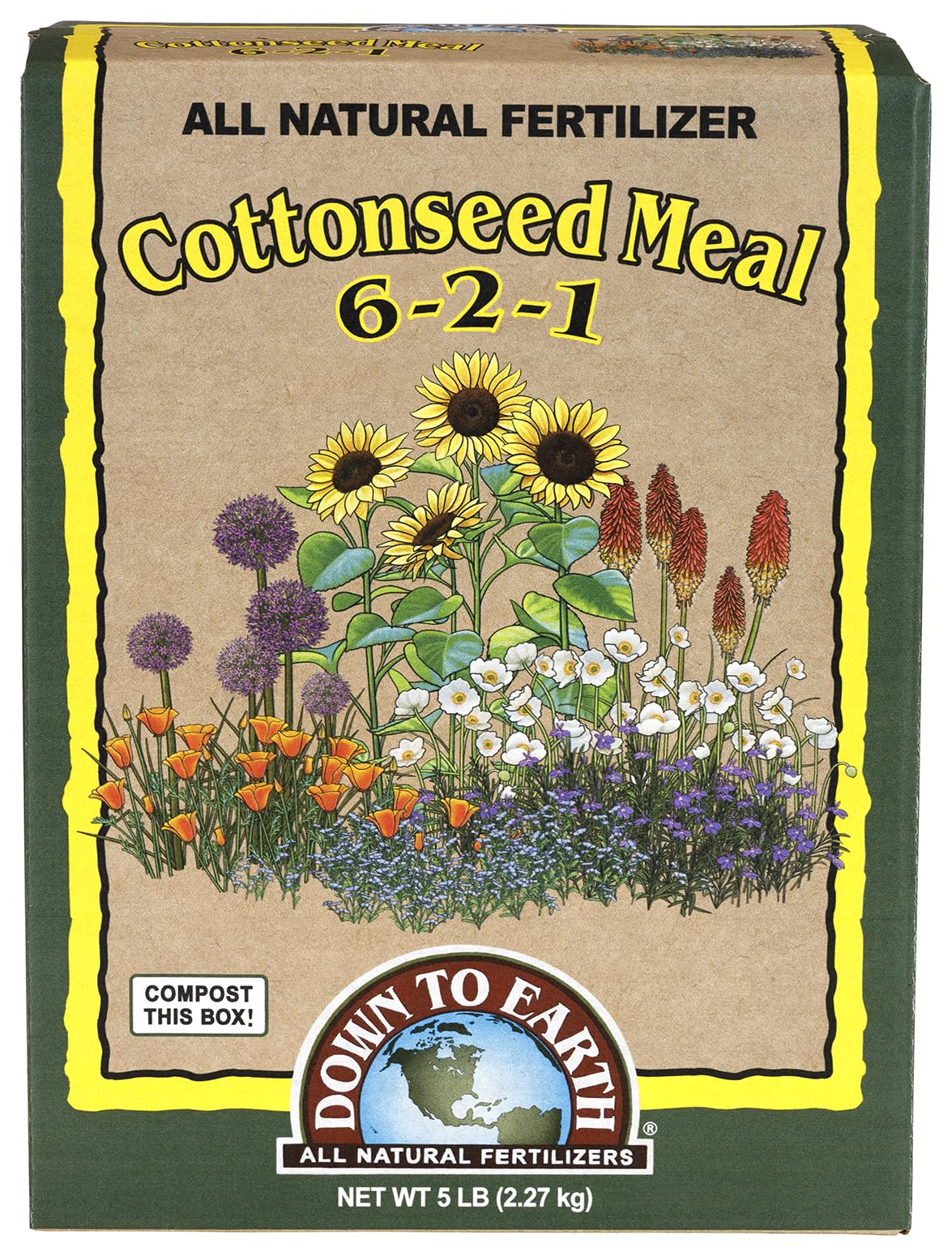
Cottonseed meal is a classic organic amendment long used by specialty blueberry and rhododendron growers, but its 6-2-1 NPK profile and acidic reaction in the soil make it a solid choice for pines planted in neutral or slightly alkaline ground. Down To Earth packages it as a fine granule that breaks down over several months, releasing nitrogen at a pace that matches natural root exudate cycles. The low potassium number means the tree will not waste energy on flower or fruit formation, keeping the focus on needle and branch development.
Regular users report that their blueberry bushes and white pines both benefit from a spring and fall top-dress. The meal does not burn roots even at slightly higher application rates, which gives beginners some margin for error. It also improves soil aggregate stability over time as the organic matter decomposes.
The main drawback is that cottonseed meal is naturally low in phosphorus, which may not provide enough support for newly transplanted pines that need strong root initiation. Also, the fine granular texture can clump if stored in a humid environment or if applied to wet soil without immediate watering-in.
What works
- Naturally acidic formulation helps lower soil pH around the root zone
- Very low burn risk even with generous applications
- Improves soil organic matter content over repeated use
What doesn’t
- Low phosphorus content reduces early transplant root support
- Fine granules may clump if stored in damp conditions
7. Miracle-Gro Water Soluble Azalea, Camellia, Rhododendron Plant Food

Miracle-Gro’s acid-loving plant food is a water-soluble powder with an NPK ratio designed to deliver an immediate green-up to acid-dependent plants. For pines that have turned yellow due to iron chlorosis or a sudden nitrogen deficit, this product can restore color within a week. The formula includes chelated micronutrients that remain available even in alkaline soils, which gives it an edge over organic-only options when the clock is ticking on a declining tree.
Users report fast visible results on rhododendrons and holly, and the same rapid action applies to potted pines or newly planted saplings that need a quick establishment boost. The powder dissolves fully in water and can be applied with a watering can or hose-end sprayer, making it the most versatile delivery method on the list. The 5-pound bag makes many gallons of solution for a low per-application cost.
The downside is the formulation is built for flowering ornamentals, not exclusively for conifers, so the phosphorus and potassium proportions are higher than pines need. Frequent use can lead to a buildup of phosphorus in the soil, which can interfere with mycorrhizal activity. The resealable bag closure is notoriously weak, and moisture infiltration can spoil unused powder.
What works
- Water-soluble formula delivers visible needle greening within days
- Chelated micronutrients bypass pH lockout in alkaline soils
- Large bag volume at entry-level pricing per application
What doesn’t
- Higher P and K ratio than ideal for non-flowering conifers
- Bag reseal closure fails quickly, risking moisture damage to powder
Hardware & Specs Guide
NPK Ratio Explained
The three numbers on a fertilizer bag represent the percentage by weight of nitrogen (N), phosphorus (P), and potassium (K). For pine trees, a lower first number between 4 and 8 is ideal because pines do not need massive leaf production—they need steady stem and root growth. The middle number should be low (under 5) because phosphorus encourages flowering and fruiting, which is counterproductive for a conifer. Potassium should stay under 5 to avoid forcing soft new growth that winter cold will kill.
Sulfur and Soil pH
Pines evolved in soils with a pH of 5.0 to 6.5. Above 6.5, iron, manganese, and zinc become chemically locked in the soil and unavailable to the roots even if they are present. A fertilizer containing 5% or more elemental sulfur or sulfate helps gradually shift the pH downward over successive applications. Products like Espoma’s Evergreen-Tone and Holly-Tone include 5% sulfur specifically for this purpose.
FAQ
Can I use a standard lawn fertilizer on my pine trees?
How do I apply granular fertilizer to an established pine tree?
What does it mean when pine needles turn yellow even after feeding?
Final Thoughts: The Verdict
For most gardeners, the fertilizer for pine trees winner is the Espoma Organic Evergreen-Tone because its 4-3-4 NPK with 5% sulfur matches the exact nutritional and pH needs of conifers in a single product. If you prefer no-mess spikes for a young specimen tree, grab the Jobe’s Evergreen Spikes. And for an emergency green-up on a chlorotic tree, nothing beats the speed of the Miracle-Gro Water Soluble Acid-Loving Plant Food.