
Kneeling in the dirt, wrestling with a taproot, and then feeling that sharp twinge in your lower back is a ritual no gardener should tolerate. Long-handled weeding tools solve this by transferring the leverage from your spine to a steel shaft, letting you extract deep-rooted thistles and dandelions while standing fully upright. The difference isn’t just comfort — it’s whether you actually finish the bed or quit halfway.
I’m Rikta — the co-founder and writer behind Lawn Gear Lab. After comparing the claw geometries, handle lengths, ejection mechanisms, and foot-pedal durability across seven top models, this guide tells you which one earns a permanent spot in your shed.
From the original bamboo-handled claw to a heavy-duty 60-inch rake-hoe hybrid, we tested the build materials and root-grip designs to bring you the definitive analysis of the best long-handled weeding tools for a pain-free yard.
How To Choose The Best Long-Handled Weeding Tools
Not every long-handled weeder works on every soil type or weed species. The right choice depends on three core factors: head design, handle length and material, and the ejection system. Ignore these and you’ll end up with a tool that either snaps, misses the root, or forces you to bend anyway.
Claw Count & Tooth Design
The most effective weeding heads use four serrated claws that converge around the taproot when you tilt the handle. A 4-claw configuration outsizes 2-prong or flat-blade alternatives because it envelops the root from more angles, reducing the chance of a broken-off stem. For hard, compacted clay, look for claws with inward-facing serrations — they bite into the root rather than sliding around it.
Handle Length & Material
A handle between 39 and 60 inches keeps your spine vertical during use. Bamboo handles are lightweight (under 2.5 pounds) and absorb vibration, but they can develop cracks in dry climates. Aluminum handles stay corrosion-free and lighter than steel, while full-steel shafts add durability but shift the balance point forward, making the tool feel heavier at the head. The ideal handle material matches the soil resistance you face most often.
Ejection Mechanism
Once the weed is captured, you need to clear the claws before the next pull. Hand-lever ejection lets you release the weed by pulling a trigger or sliding a collar — keep hands clean but require decent grip strength. Foot-pedal ejection uses your body weight to push the weed out, leaving both hands free but adding a moving part that can wear. The best systems combine both options, so you can choose based on how much debris is stuck.
Quick Comparison
On smaller screens, swipe sideways to see the full table.
| Model | Category | Best For | Key Spec | Amazon |
|---|---|---|---|---|
| Fiskars 4-Claw | Premium | Precision root extraction | 4 serrated claws | Amazon |
| Grampa’s Weeder | Premium | Classic bamboo design | 45″ bamboo handle | Amazon |
| SOMOLUX 52″ | Mid-range | Long-reach standing work | 52″ handle length | Amazon |
| RexWeed Dual Eject | Mid-range | Mess-free weed removal | Dual eject modes | Amazon |
| Allsetool 4-Claw | Mid-range | Budget-friendly stand-up | 2 ejection methods | Amazon |
| NICOFPHY 2-in-1 | Budget | Versatile weeding & hoeing | Adjustable 15″-57″ | Amazon |
| ATFVERDEX 60″ | Budget | Large-area clearing | 7 tines + hoe blade | Amazon |
In‑Depth Reviews
1. Fiskars Stand-Up Weed Puller Tool, 4 Serrated Stainless Steel Claws, 39″

The Fiskars 4-Claw weeder represents the gold standard for precision root extraction. Its four serrated stainless steel claws converge around the taproot with a level of grip that three-claw designs simply cannot match, and the integrated viewing window lets you center the head exactly over the weed before you step down. The aluminum handle keeps the overall weight at a manageable 2.5 pounds, and the offset grip reduces wrist fatigue during repeated pulls.
Where this tool truly separates itself is the lever-action eject mechanism. A simple squeeze releases the weed without requiring you to bend, tap the head against the ground, or use your hands. The claws are designed to penetrate soft to moderately firm soil best, so watering the area 30–60 minutes before use is recommended for hard clay. Many users report filling a 30-gallon can in under 20 minutes on dandelions and thistles.
Two minor drawbacks: the plastic lever base can crack under extreme sideways force if you try to yank a deeply rooted weed in a single motion, and the 39-inch handle is shorter than some competing models, so taller users may feel a slight forward lean. Fiskars backs the tool with a lifetime warranty, and replacement parts are easy to source. For the gardener who wants surgical weed removal with minimal effort, this is the pick.
What works
- Serrated claws grip taproots firmly for one-pass removal.
- Viewing window helps center the head accurately before stepping.
- Offset handle reduces wrist strain on repetitive pulls.
What doesn’t
- Plastic eject lever can crack under high lateral force.
- Shorter 39-inch handle may not suit very tall users.
2. Grampa’s Weeder – The Original Stand Up Weed Puller Tool, 45″ Bamboo Handle

Grampa’s Weeder has been in continuous production since 1913, and the design remains largely unchanged because the mechanics work. The 45-inch handle is made from genuine bamboo — a natural material that dampens vibration and feels warm in the hand — while the 4-claw alloy steel head delivers the same converging bite that defines the category. The head is not serrated, relying instead on the sharp taper of each claw to penetrate and grip.
This tool prefers softer soil and performs best when the ground is damp from rain or recent watering. On dandelions and thistles with thick central taproots, the four claws close around the root completely, and a slow, steady upward pull extracts the entire weed. The lack of an eject mechanism means you will occasionally need to tap the head against a hard surface or manually remove stubborn weeds from the claws, but the simplicity also means there are no plastic levers or sliding collars to break.
On hard clay or rocky ground, the claws may struggle to penetrate the full depth of the taproot, and thin-stemmed weeds like clover can slip through the gaps. The bamboo handle is strong but can develop hairline cracks over time if left in direct sun or stored in very dry conditions. Grampa’s offers a lifetime guarantee, and the tool’s American-made heritage appeals to those who value longevity over gimmicks. For traditionalists who appreciate a no-plastic, back-saving tool, this is the timeless choice.
What works
- Bamboo handle absorbs shock and feels comfortable during extended use.
- Simple four-claw mechanism with no plastic parts to wear out.
- Proven century-old design with a lifetime guarantee.
What doesn’t
- No ejection system — must tap or pull weeds out by hand.
- Less effective on hard clay, dry soil, or thin-stemmed weeds.
3. SOMOLUX 52″ Stand-up Weed Puller, Heavy-Duty Stainless Steel Claw

The SOMOLUX stand-up weeder distinguishes itself with a 52-inch handle — the second longest in this lineup — which keeps your back fully vertical even if you are over six feet tall. The head uses four 3-inch stainless steel claws with serrated inner edges that grip the root as you tilt the handle sideways toward the built-in lever. The lever closes the claws around the weed, and a simple squeeze releases the debris after extraction.
Assembly takes about two minutes, and the aluminum shaft resists rust while keeping the total weight low enough for easy maneuvering. The foot pedal is reinforced metal rather than plastic, so you can stomp down firmly without worrying about cracking. In practice, the tool handles dandelions and crabgrass with high reliability in moist soil, and the serrated teeth reduce the chance of the root slipping out during the lift phase.
A recurring note from long-term users is that the threaded connection between the handle and the head works loose after prolonged use. Some have applied thread-locking compound or drilled a small set-screw to solve the problem permanently. The tool also tends to clog in wet, sticky clay because the claws are spaced closely together. For tall gardeners who want maximum stand-up reach and a sturdy metal foot pedal, the SOMOLUX delivers strong value with a fixable looseness issue.
What works
- Long 52-inch handle suits tall gardeners and eliminates bending.
- Serrated claws grip taproots firmly during extraction.
- Metal foot pedal withstands heavy stomping without cracking.
What doesn’t
- Threaded handle joint loosens over time without thread-locker.
- Claws can clog in wet, sticky clay soil.
4. RexWeed Stand Up Weed Puller Tool, 4-Claw with Dual-Eject, 43.7″ Bamboo Handle
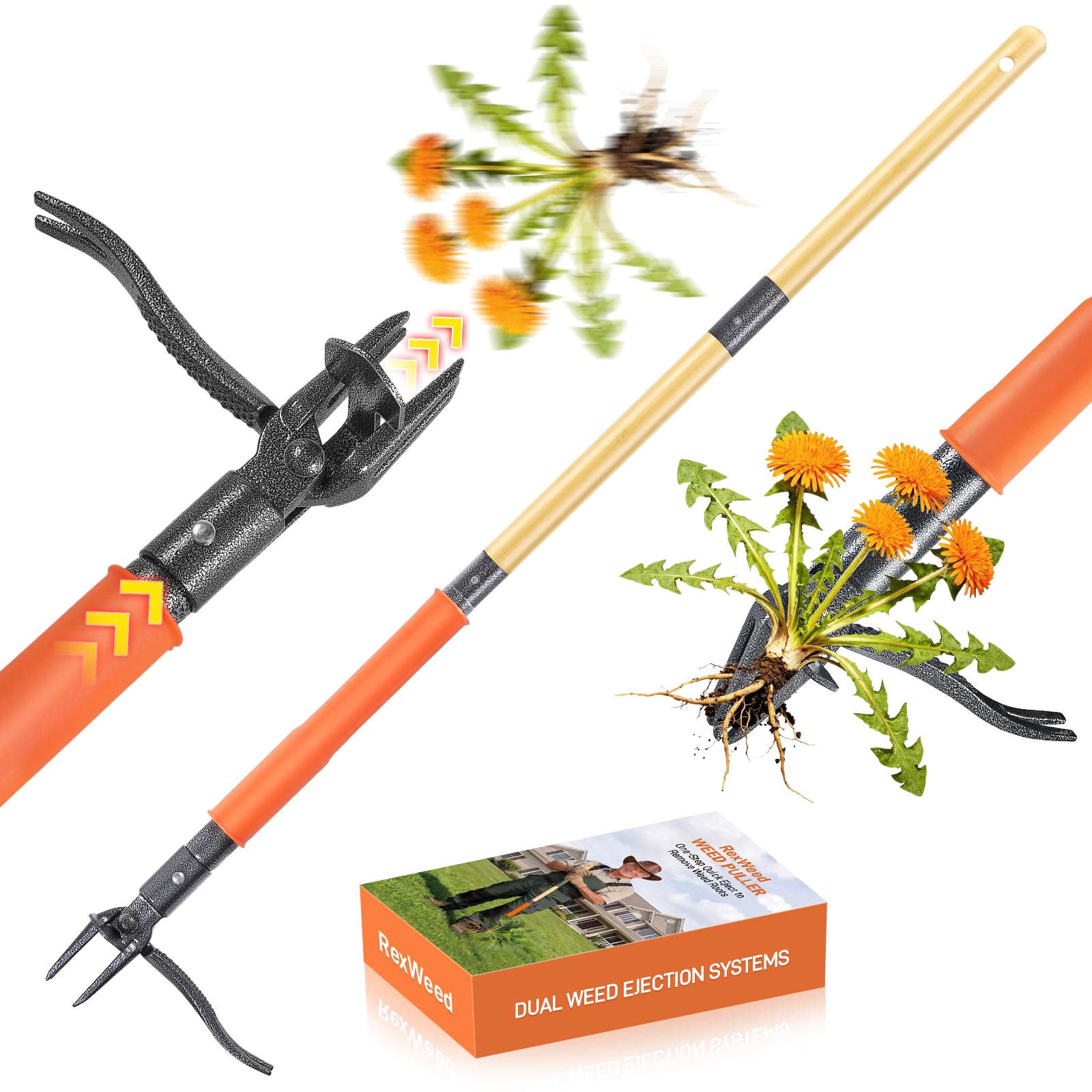
The RexWeed puller focuses on the mess factor with two independent ejection methods: a hand lever that slides the weed off the claws and a foot pedal that pushes it out from below. Having both options means you can choose the cleanest release for each situation — the hand lever keeps you from bending, while the foot pedal is faster when your hands are muddy. The 43.7-inch bamboo handle is smooth, lightweight, and connected via a threaded joint that users report stays tighter than multi-section poles.
The four hardened steel claws are tapered to 3 inches deep and grip the taproot from multiple sides. On damp ground after rain, the tool extracts dandelions, thistles, and crabgrass in a single motion, leaving a clean hole with minimal soil disturbance. The foot pedal is made from all steel with an anti-slip texture, so it does not flex or crack under heavy stomping. The natural bamboo handle also resists the cold-to-the-touch feel of aluminum in early spring mornings.
Some users note that the claws are slightly narrower than those on premium models, which means they can struggle with very wide or multi-stemmed weeds. The dual-eject mechanism adds moving parts that may require occasional lubrication to stay smooth. RexWeed includes a 1-year free replacement warranty for quality defects. For gardeners who prioritize clean, hands-free weed release and appreciate the warmth of a wood handle, this tool balances features and affordability well.
What works
- Dual eject modes (hand lever and foot pedal) keep hands clean.
- Bamboo handle is lightweight and comfortable in cool weather.
- Steel foot pedal withstands repeated heavy stomping.
What doesn’t
- Narrower claws may struggle with wide or multi-stemmed weeds.
- Dual-eject mechanism needs occasional lubrication to stay smooth.
5. Allsetool Weed Puller Tool with 2 Weed Eject Feature, 43.7″ Bamboo Handle & Metal Foot Pedal
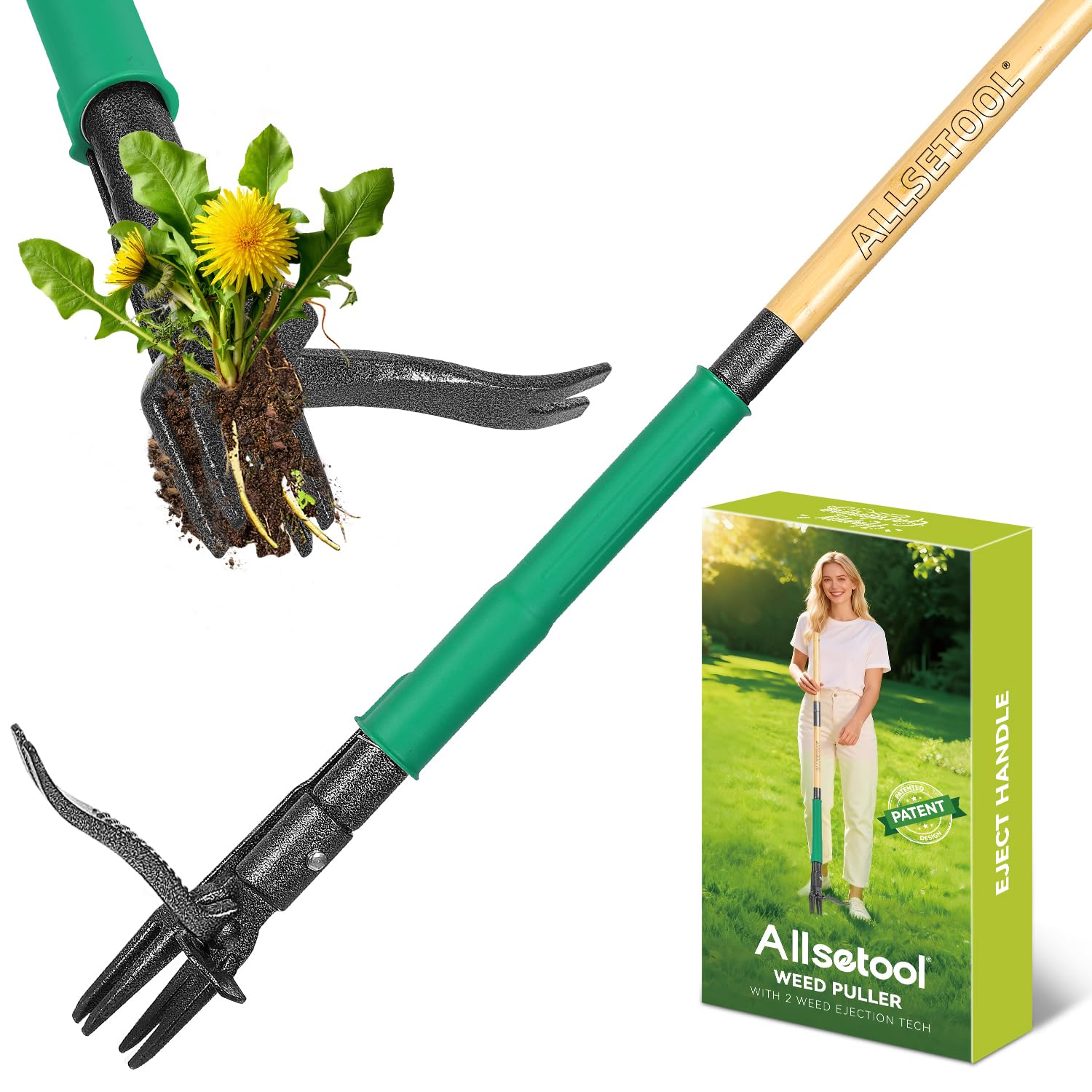
Allsetool delivers the core stand-up weeding experience at a price point that undercuts most competitors while still including two ejection methods. The 43.7-inch bamboo handle keeps your back straight, and the four metal claws penetrate soft to moderately firm soil effectively. The foot pedal is heavy-duty metal with a textured surface, so you can apply your full weight without cracking a plastic housing. The hand-lever eject slides the weed off for hand-free disposal, while the foot-pedal eject offers a backup option.
In use, the tool performs best on dandelions and thistles with a single central taproot. The claws are sharp enough to bite into damp ground, and the leverage from the long handle makes pulling effortless. Users consistently describe the weeding process as satisfying and addictive, with many reporting that they start looking for weeds to pull just for the gratification. The tool ships in a colorful box with clear instructions, making it a practical gift for older gardeners who struggle with bending.
The main trade-off at this tier is build consistency. Some users report that the release mechanism occasionally fails to push the weed out completely, requiring a manual nudge or a second pedal stomp. The bamboo handle is solid, but the threaded connector can loosen with heavy use. For the gardener who wants dual-eject functionality and a bamboo handle without spending premium money, the Allsetool is the smart entry point.
What works
- Two ejection methods for clean, no-touch weed disposal.
- Bamboo handle is comfortable and reduces vibration.
- Metal foot pedal is durable and non-slip.
What doesn’t
- Release mechanism can occasionally fail to fully eject the weed.
- Bamboo handle connector may loosen with heavy use.
6. ATFVERDEX 60″ Wooden Handle 2-in-1 Uprooting Tool, 7-Tine Garden Hoe & Weed Remover
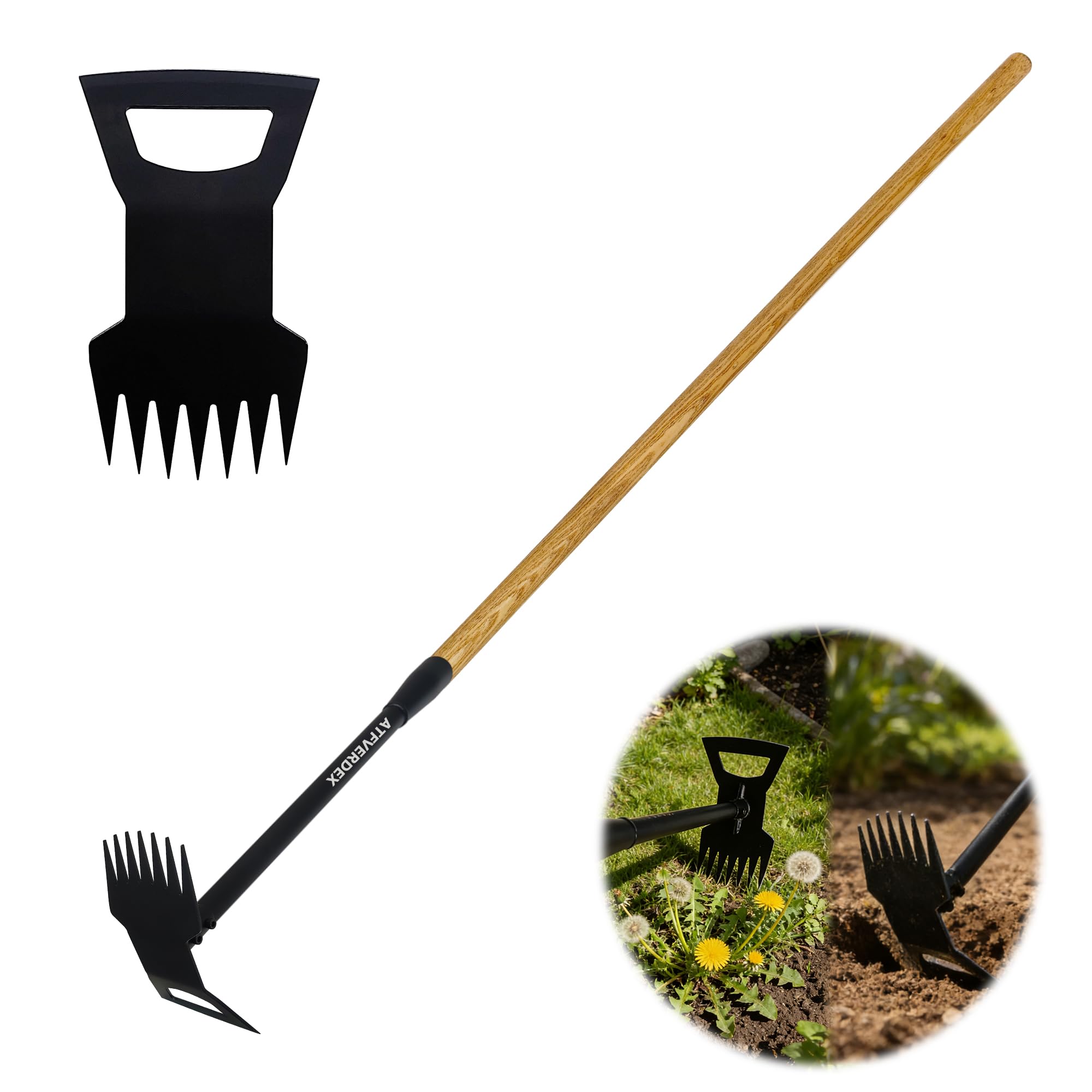
The ATFVERDEX takes a radically different approach from the claw-style pullers above. Instead of a gripping mechanism, it uses seven sharp steel tines on one side and a wide cast-iron hoe blade on the other — essentially a rake-hoe hybrid on a 60-inch wooden handle. The tines are 1.77 inches long and penetrate deep into crevices to uproot weeds, while the arched hoe blade is 4.7 inches wide for clearing large areas, leveling soil, or cutting through surface roots.
This tool shines in scenarios where you are tackling dense patches of weeds rather than isolated taproots. The seven tines pull multiple small weeds in a single pass, and the long handle lets you work standing fully upright over large garden beds or along fence lines. The head is forged from manganese steel, with multiple welds at the T-joint for strength. The wooden handle is thicker than bamboo options, providing a substantial grip for heavy pulling and levering.
The downside is that this tool does not function as a precise root extractor — it is better at scratching, raking, and chopping than at grabbing a single dandelion taproot. The hardware that connects the metal head to the wooden handle has been described as underbuilt by some users, though a simple lag-screw upgrade solves the issue. If your primary weeding task involves clearing large areas of crabgrass or leveling beds, the ATFVERDEX is a powerful, budget-friendly workhorse.
What works
- Seven tines cover more ground per pass than a 4-claw weeder.
- Wide hoe blade handles soil leveling and large-area clearing.
- 60-inch handle provides maximum stand-up reach.
What doesn’t
- Not designed for precise taproot extraction — better for mass clearing.
- Handle-to-head connector may require a stronger bolt upgrade.
7. NICOFPHY Weed Puller Tool with Long Handle Pro, 2-in-1 Garden Weeding Rake & Hoe, 57″ Adjustable
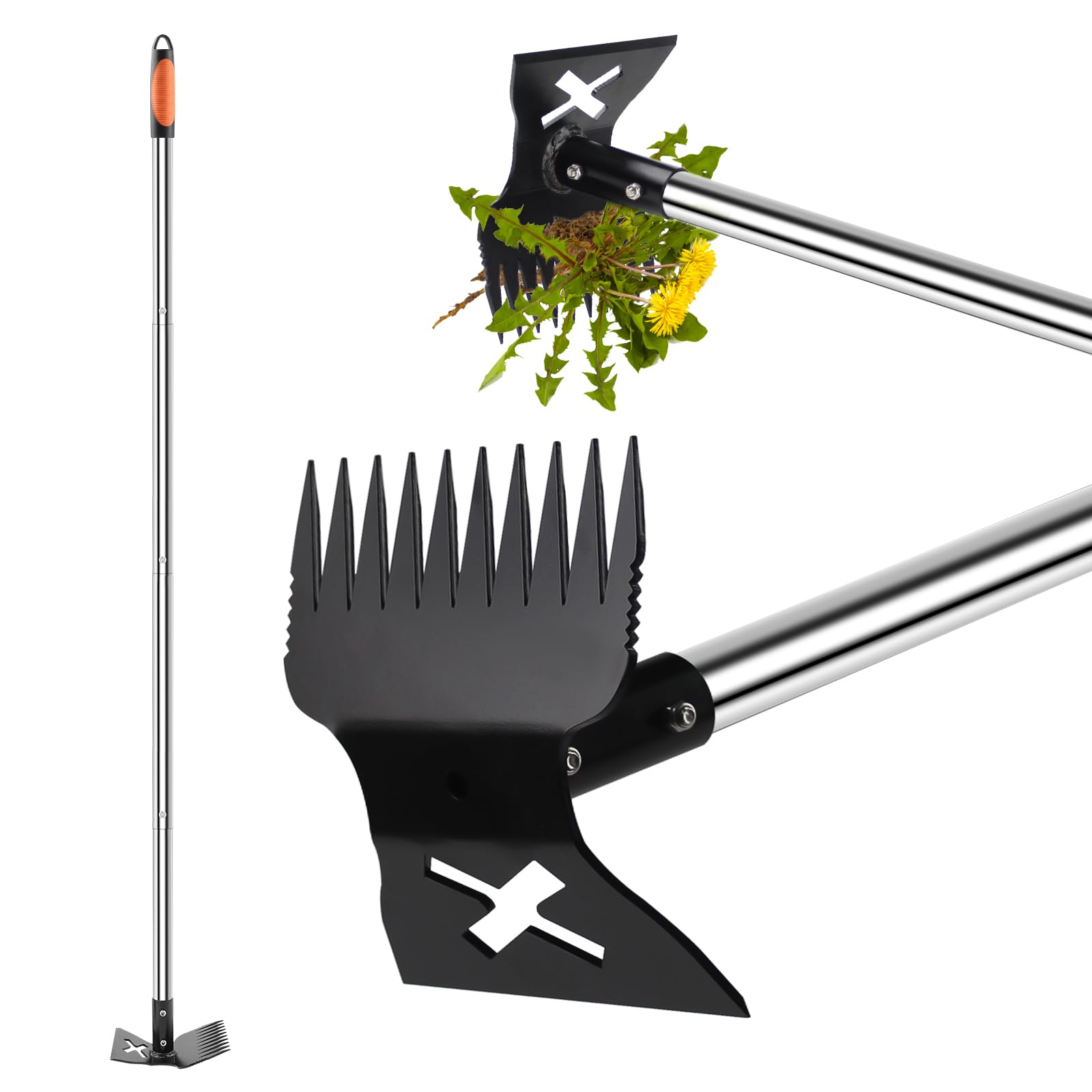
The NICOFPHY 2-in-1 weeder uses a one-piece cast steel head with ten sharp tines on one edge and a flat hoe blade on the other, giving you two tools in a single head. The standout feature is the modular handle system — four stainless steel poles let you configure the length from 15 inches up to 57 inches in 14-inch increments. This adjustability makes the tool suitable for users of different heights and for tasks that require either a short grip (close-up detail work) or a long reach (stand-up weeding).
The male-female screw fastening system is a deliberate improvement over the threaded-shaft connectors that commonly loosen. Bolts and nuts clamp the sections together firmly, and the head is welded to prevent separation. At just 2 pounds when fully assembled, the tool is easy to swing and maneuver, though the lightweight steel poles create a head-heavy balance that some users find slightly off-kilter. The ten tines are excellent for raking out small weeds in sidewalk cracks and flower beds, while the flat edge handles light hoeing duty.
The head is not designed for deep taproot extraction — the tines scrape and scratch rather than grip and pull. It works best on loose, friable soil and for preventing weed establishment rather than removing established dandelions with thick roots. The adjustability and dual-purpose design make it a great all-around tool for small gardens and patio maintenance, but serious weed warriors will want a dedicated 4-claw puller for persistent invaders.
What works
- Adjustable handle length from 15 to 57 inches fits any user height.
- Ten tines are effective for raking small weeds from cracks and beds.
- Secure bolt-and-nut fastening eliminates handle loosening.
What doesn’t
- Head-heavy balance can feel awkward during extended use.
- Tine design is best for surface weeds, not deep taproots.
Hardware & Specs Guide
Claw Count & Geometry
The number of claws directly determines how well a weeder envelops the taproot. Four-claw heads offer the best balance of grip and soil penetration because they close around the root from four directions, reducing the chance of slippage. Three-claw or dual-prong heads leave larger gaps, which allows thin roots to escape. Serrated inner edges further increase friction, making them essential for dry or fibrous soil conditions where smooth claws would slide off the root.
Handle Material & Balance Point
Bamboo handles are the lightest option (typically under 2.5 pounds) and absorb vibration, but they can be prone to cracking in low-humidity environments. Aluminum handles offer rust resistance and a balanced weight distribution, making them the most versatile material for all-season use. Wooden handles provide a traditional feel and excellent durability but add weight, shifting the balance toward the head. The balance point matters because a head-heavy tool fatigues your wrists faster during repetitive pulls.
FAQ
How deep do the claws need to penetrate to remove the taproot?
Will a bamboo handle last as long as an aluminum handle?
Final Thoughts: The Verdict
For most gardeners, the best long-handled weeding tools winner is the Fiskars 4-Claw Stand-Up Weeder because its serrated claws and viewing window deliver the most reliable taproot extraction with minimal effort. If you want a classic, no-plastic wood-handle design, grab the Grampa’s Weeder. And for clearing large patches of weeds with a rake-hoe hybrid that extends to 60 inches, nothing beats the ATFVERDEX 2-in-1.