
The difference between a raised bed that rewards you with weeks of salads and one that fizzles out after a single harvest comes down to what you fill it with. Piling in cheap topsoil or random compost creates drainage nightmares and nutrient deserts, forcing roots to fight for every sip of water and every mineral. A purpose-engineered blend of organic matter, aeration agents, and slow-release nutrients transforms a wooden frame into a self-sustaining ecosystem where vegetables thrive with minimal intervention.
I’m Rikta — the co-founder and writer behind Lawn Gear Lab. My process for this guide involved cross-referencing ingredient lists against published horticultural data, weighing bulk density claims against real-world drainage performance, and synthesizing hundreds of verified owner reports to identify which formulations actually deliver on their promise of raised bed productivity.
Finding the right mix means navigating between moisture retention and drainage, organic certification and nutrient density, and bag size against bed volume. After hours of isolating the highest-performing formulations, here is the definitive breakdown of the best soil for raised veg beds.
How To Choose The Best Soil For Raised Veg Beds
Raised bed soil is a distinct category from both bagged potting mix and native topsoil. Its ideal formulation balances three conflicting demands: water retention without waterlogging, aeration without drying out too fast, and a nutrient profile that sustains heavy-feeding vegetables for an entire growing season. Understanding the functional role of each major ingredient helps you spot the difference between a premium blend and a bag of glorified filler.
Ingredient Hierarchy — What Matters Most
The backbone of any raised bed mix is its organic matter content — typically sphagnum peat moss, compost, or coconut coir. Compost provides immediate microbial activity and a broad spectrum of micronutrients, while peat moss or coir handles moisture management. Look for formulations that list compost (or a blend of composted forest products) as a primary ingredient rather than just peat moss, because peat alone contributes negligible fertility. Premium blends also incorporate worm castings, kelp meal, or alfalfa meal for slow-release nitrogen that prevents the mid-season slump.
Aeration and Drainage Mechanics
Dense, slumped soil suffocates root systems and invites fungal disease. Quality raised bed mixes use perlite, pumice, or coarse sand to create pore spaces that allow oxygen to reach the root zone and excess water to drain freely. The volume of perlite visible in the bag — typically 10–20 percent of the total volume — is a quick visual cue. A mix that looks uniformly dark and compact with no visible aeration particles will likely turn into a brick after a few watering cycles. For clay-heavy native soil beneath the bed, products containing biochar or greensand can further improve long-term soil structure.
Organic Certification and pH Stability
For vegetable beds, organic certification (OMRI-listed or equivalent) removes any guesswork about synthetic pesticides, fungicides, or chemical fertilizer residues that could disrupt the soil food web. Beyond certification, look for added dolomite lime or oyster shell flour, which buffer the natural acidity of peat moss and keep the pH in the 6.0–7.0 range preferred by most garden vegetables. A pH-stable soil reduces the risk of blossom-end rot in tomatoes and peppers and ensures that micronutrients remain bioavailable throughout the harvest window.
Quick Comparison
On smaller screens, swipe sideways to see the full table.
| Model | Category | Best For | Key Spec | Amazon |
|---|---|---|---|---|
| Coast of Maine Castine Blend | Premium Organic | Maximum yield in raised beds | 2 cu ft — includes biochar + mycorrhizae | Amazon |
| FoxFarm Raised Bed Mix | All-Purpose Organic | Ready-to-use beds without mixing | 1.5 cu ft — oyster shell + worm castings | Amazon |
| Espoma Organic Raised Bed Mix | Specialty Raised Bed | Seed starting & gentle nutrient release | 1.5 cu ft — contains Myco-Tone mycorrhizae | Amazon |
| Coast of Maine Bar Harbor Blend | Multi-Purpose Potting | Containers & small raised beds | 16 QT (two-pack) — lobster/crab shell meal | Amazon |
| Espoma Organic Veg & Flower | In-Ground Amendment | Amending native soil in beds | 1 cu ft (two-pack) — worm castings | Amazon |
| Espoma Organic Potting Mix | Container Mix | Indoor/outdoor containers & herbs | 2 cu ft — Myco-Tone + kelp meal | Amazon |
| Michigan Peat All Purpose | Budget Value | Large volume fills on a budget | 50 lbs — includes slow-release fertilizer | Amazon |
In‑Depth Reviews
1. Coast of Maine Castine Blend Raised Bed Soil
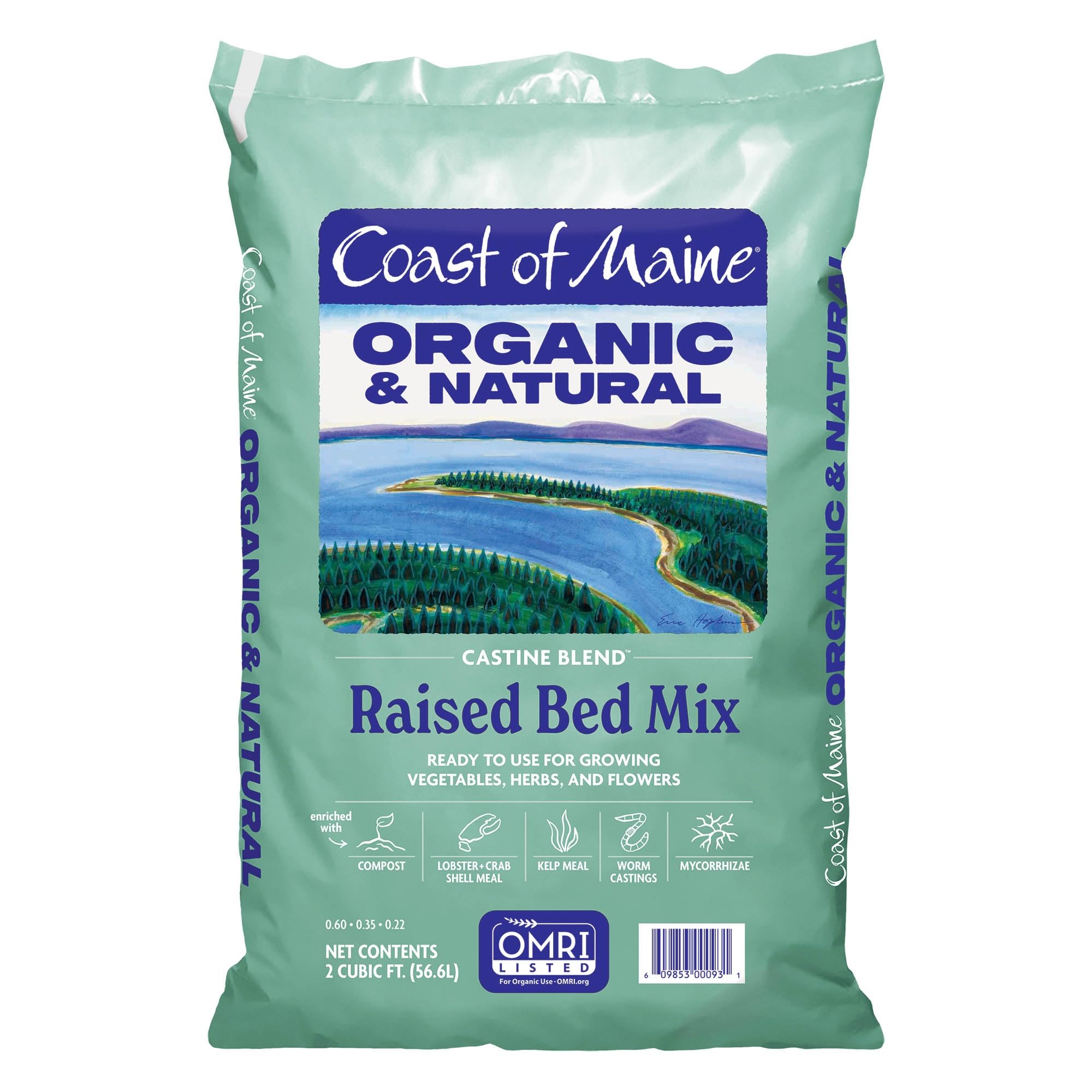
The Castine Blend occupies the top tier for good reason: it is the only product in this lineup that combines biochar, mycorrhizae, worm castings, greensand, kelp meal, and lobster-crab shell meal into a single 2-cubic-foot bag. Biochar acts as a permanent carbon sponge that improves cation exchange capacity, holding onto nutrients that would otherwise leach out during heavy rain. Mycorrhizae form a symbiotic network around root systems, extending the root zone’s reach for phosphorus and trace minerals — a measurable advantage for tomatoes, peppers, and squash.
Owners consistently describe the texture as “light, fluffy soil” that loosens existing clay beneath raised beds and remains aerated after multiple seasons of watering. Multiple users report three-year repeat purchases on the same beds, indicating the blend’s structure does not collapse into a dense mat after one season — a common failure point for cheaper mixes. The inclusion of greensand slowly releases potassium and iron over the entire growing cycle, reducing the need for mid-season liquid feedings.
The price premium is real at nearly per bag, but the value equation shifts when you account for the 2-cubic-foot volume and the fact that this is essentially a complete soil amendment that can be used straight from the bag without custom blending. For gardeners with multiple large beds who want to minimize season-to-season soil replacement, Castine Blend’s long-term structural integrity makes it the most cost-effective premium option on the market.
What works
- Biochar and mycorrhizae create a self-sustaining root ecosystem that improves year after year.
- Light, fluffy texture does not compact or slump after repeated watering.
- Rich, dark, organic composition with zero twigs, bark chunks, or insect larvae reported.
What doesn’t
- Premium price point may strain a budget when filling multiple 4×8 beds.
- Only available in 2-cubic-foot bags; no larger bulk size for serious volume.
2. FoxFarm Raised Bed Planting Mix
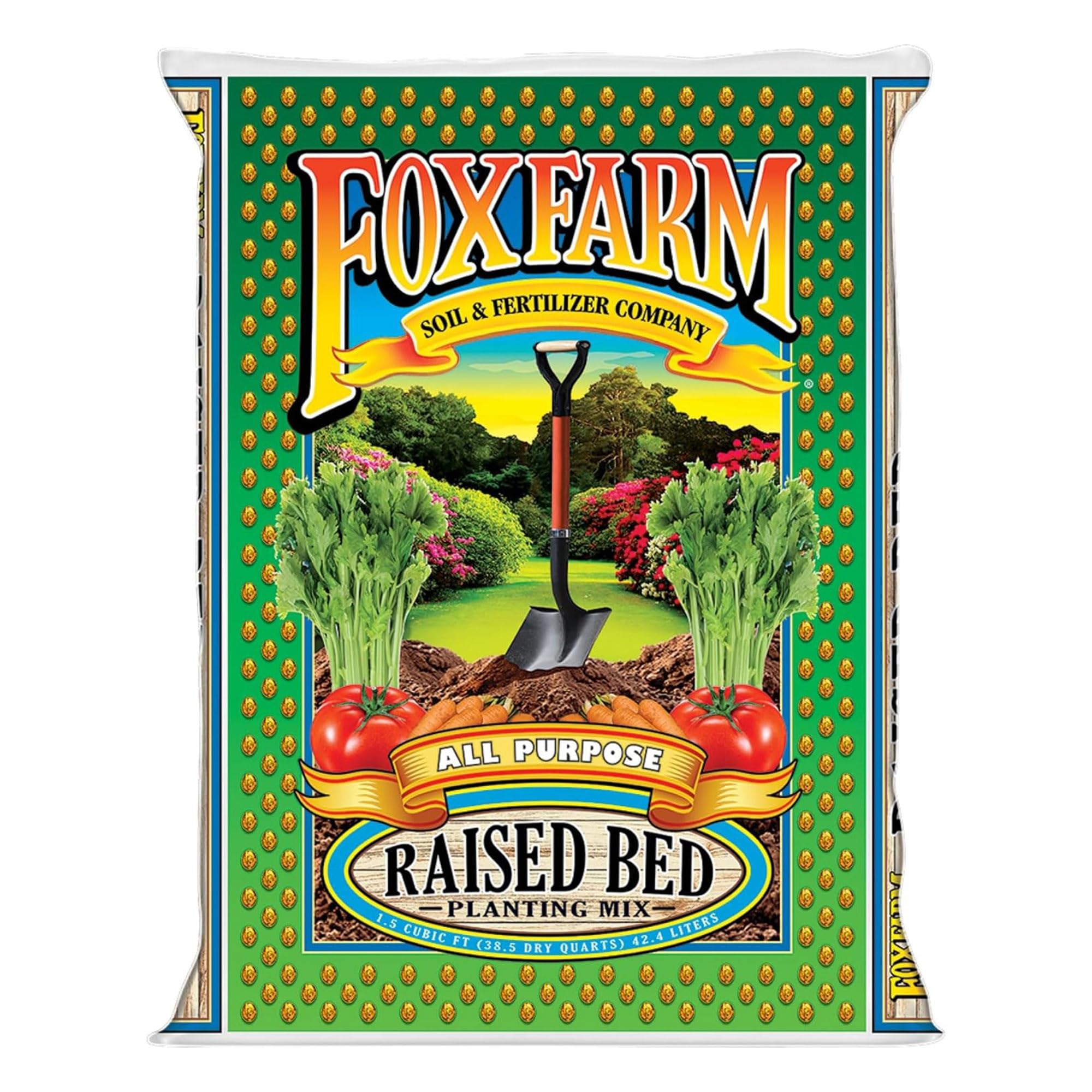
FoxFarm brings the same reputation that made their potting soils a cult favorite among cannabis growers into the raised bed category, but this blend is formulated specifically for vegetables, herbs, and fruits. The ingredient list is anchored by aged forest products (50–60 percent), sphagnum peat moss, worm castings, oyster shell, and dolomite lime — a deliberately balanced pH buffer that keeps the soil in the 6.2–6.8 sweet spot where leafy greens and fruiting crops absorb nitrogen and calcium most efficiently. The oyster shell provides a slow-release calcium source that directly reduces blossom-end rot incidence in tomatoes and peppers.
User feedback is almost universally positive, with reviewers calling it “the best garden soil on the market” and noting that it works equally well in raised beds and large containers. The moisture-retaining capacity is specifically calibrated for raised bed environments where the sides of the bed accelerate drying compared to in-ground planting. Multiple owners report that a single 1.5-cubic-foot bag is sufficient for a 4×2-foot bed when mixed with existing soil, making it a practical choice for intermediate beds that have some native soil already in place.
For growers who pay retail, the cost per cubic foot is higher than the Espoma Raised Bed Mix, but the ingredient quality (worm castings and oyster shell rather than generic compost) justifies the difference for gardeners who prioritize soil biology over pure volume.
What works
- Oyster shell and dolomite lime provide dual calcium/ph pH stabilization for heavy feeders.
- Ready-to-use formula requires zero mixing or additional amendments.
- Aged forest products ensure no raw wood or bark chunks that steal nitrogen during decomposition.
What doesn’t
- Amazon price can be 50 percent higher than local garden center pricing in some regions.
- Moisture retention may be too high for beds without drainage holes or in rainy climates.
3. Espoma Organic Raised Bed Mix

Espoma’s Raised Bed Mix is a dedicated formulation — not a re-badged potting soil — that includes a proprietary mycorrhizal blend called Myco-Tone, featuring both endo- and ectomycorrhizal species. This dual-action approach colonizes the root zones of a broader spectrum of vegetables than single-strain products. The base is a blend of earthworm castings, alfalfa meal, kelp meal, and feather meal, creating a nitrogen curve that releases gradually over the first 6–8 weeks and then tapers off as the mycorrhizal network becomes self-sustaining. This makes it ideal for seed starting in raised beds, where young seedlings are sensitive to nutrient burn from synthetic fertilizers.
Verified owner reports from Florida and California confirm that the mix “retains moisture well in subtropical conditions” and supports germination of watermelon, cantaloupe, kale, peppers, cucumbers, and celery directly from seed without additional soil amendments. The absence of manure eliminates the odor problems that plague many compost-heavy blends, and multiple users note the bag arrives “perfectly sealed, no mold or dry spots.” The 1.5-cubic-foot bag is the most common size across all reviewed products, but Espoma’s higher particle uniformity means you get more usable volume per bag compared to mixes that contain large wood chunks or uncomposted bark.
The minor trade-off is that this is a pure raised bed mix — it is less suited for standalone containers or hanging baskets where a lighter, perlite-dominated potting mix would drain faster. Some users also find the price-per-bag slightly above the category average, though the nutrient density and mycorrhizal content offset the cost for small to medium beds.
What works
- Myco-Tone dual mycorrhizae improve root colonization across diverse vegetable families.
- Clean, manure-free formula with no odor — ideal for urban and balcony gardens.
- Evenly blended compost sustains seedlings without fertilizer burn.
What doesn’t
- Not optimized for containers — drains slower than standard potting mixes.
- Price per cubic foot is higher than in-ground amendment blends.
4. Coast of Maine Bar Harbor Blend Potting Soil
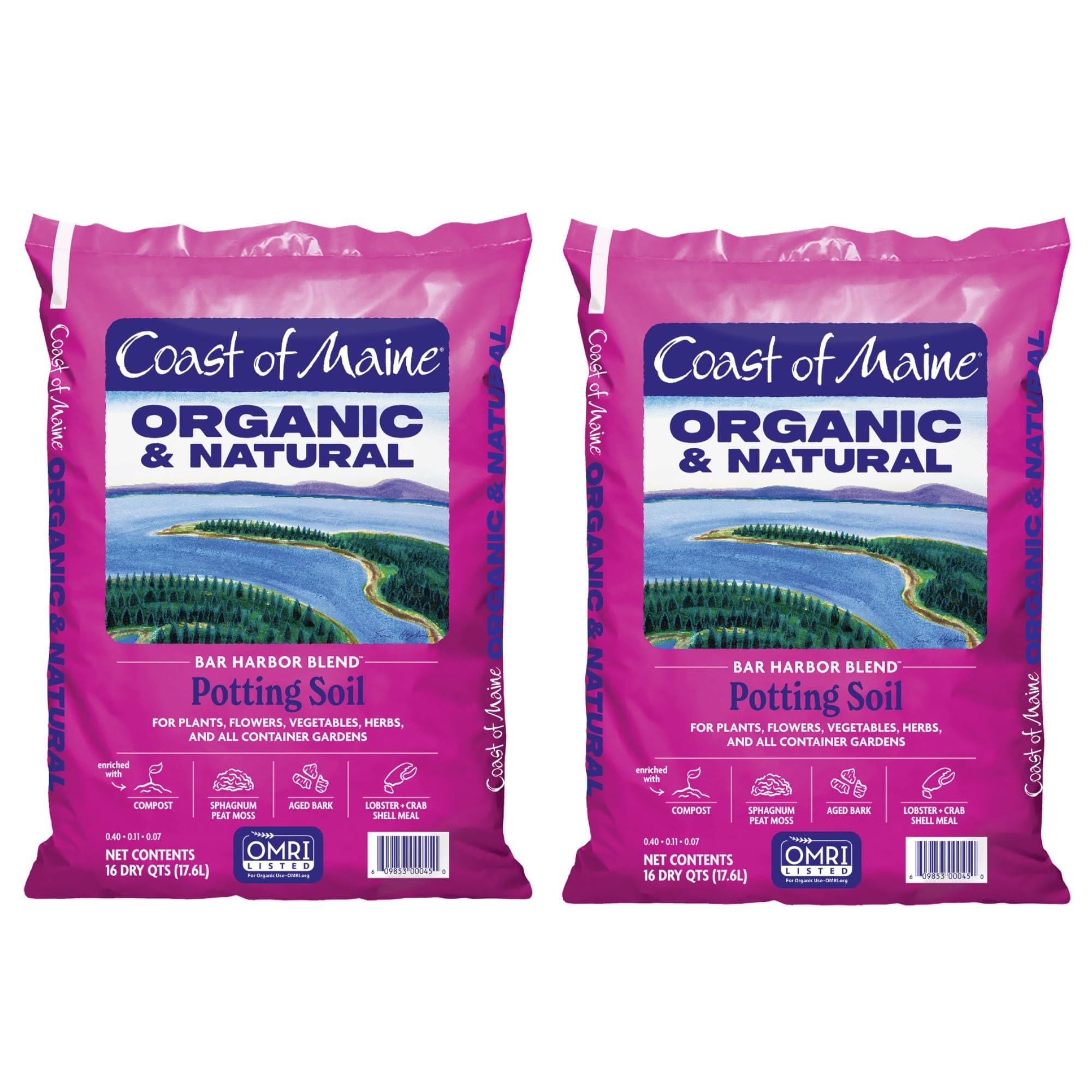
Coast of Maine’s Bar Harbor Blend brings the seafood industry byproduct synergy that the brand is known for: lobster and crab shell meal supply chitin, a natural compound that stimulates soil bacteria populations that suppress fungal pathogens and root-feeding nematodes. Combined with sphagnum peat moss, compost, perlite, and kelp meal, this is a potting soil that doubles as a soil health input. The 16-quart two-pack format is smaller than the bulk raised bed mixes, but the nutrient density is high enough that a few inches of this blend tilled into the top layer of a raised bed effectively recharges the soil for a second season without a full replacement.
Users report exceptional results with potatoes, tomatoes, and peas in container gardens, noting that the darker color indicates a higher compost-to-peat ratio than cheaper blends. The perlite content is visibly generous, creating a structure that “feels super nice” and does not harden into a crust after drying. Multiple verified reviews mention that this soil produced better growth than a well-known national brand they had used for years. The absence of “sticks and wood chunks” is a recurring positive theme.
The primary limitation is the bag size — at 16 quarts per bag, two bags total only 32 quarts, which is roughly 1.1 cubic feet. Filling a 4×4-foot raised bed to an 8-inch depth requires approximately 10.7 cubic feet, so this product is best used as a top-dressing or a high-performance amendment rather than the sole fill material for large beds.
What works
- Lobster and crab shell meal provide natural chitin that supports disease-suppressive soil bacteria.
- High perlite volume ensures excellent drainage and aeration for root crops.
- Darker color indicates higher compost content for immediate nutrient availability.
What doesn’t
- Two-pack still yields only ~32 quarts — insufficient as a primary bed fill for large raised beds.
- Best suited as a top dressing or amendment rather than a standalone bulk fill.
5. Espoma Organic Vegetable & Flower Garden Soil

Unlike the raised-bed-specific Espoma mix in position three, this Vegetable & Flower Garden Soil is designed as an in-ground amendment — meant to be mixed 50/50 with your existing native soil when planting or transplanting. The 1-cubic-foot two-pack format yields 2 cubic feet total, which is enough to amend approximately 16 square feet of bed area when blended at the recommended ratio. The ingredient profile centers on worm castings as the primary biological catalyst, with a base of rice hulls and peat moss for texture and moisture retention.
Long-term users report consistent success since 2022, with tomatoes, beans, corn, garlic, and flowers all showing “excellent growth” when this product is mixed into native garden soil. Reviewers specifically note that mushrooms appearing in the bed are a sign of healthy fungal activity rather than contamination. The soft, easy-to-work consistency makes it more pleasant to handle than dense clay-like soils, and the lack of peanut hulls is a specific advantage for households with nut allergies.
The main drawback is its intended design — this is not a complete raised bed fill. Using it straight without mixing with denser native soil can result in a mixture that dries out faster and lacks the structural weight that supports tall plants like indeterminate tomatoes. Additionally, some users reported finding “a lot of pieces of wood” in the bag, which suggests batch-to-batch consistency could be tighter.
What works
- Worm castings provide broad-spectrum micronutrients and beneficial microbial life.
- Soft, workable texture makes planting and transplanting easy on the hands.
- Two-pack format offers flexibility to amend multiple small beds or individual planting holes.
What doesn’t
- Requires mixing with native soil — not a standalone raised bed fill.
- Some bags contain noticeable wood chunks that need screening.
6. Espoma Organic Potting Mix (AP2)

Espoma’s AP2 Organic Potting Mix is the most versatile product in this lineup — technically a potting soil but functionally close to a raised bed blend thanks to its high organic matter and Myco-Tone mycorrhizae inclusion. The formula combines sphagnum peat moss, humus, perlite, worm castings, alfalfa meal, kelp meal, and feather meal. The 2-cubic-foot bag is the largest single-bag format among the reviewed products, making it the most volume-efficient option for filling large containers or small raised beds in a single purchase.
User feedback highlights the loamy, chunky texture that “doesn’t get dense or crusty” after multiple watering cycles — a common complaint with cheap potting mixes that turn into hydrophobic bricks. The perlite content is high enough to support container drainage, and multiple owners report using it as a base for custom blends by adding extra bark, perlite, or sand for specific plant requirements. The absence of large stick pieces or wood debris is a consistent advantage over competitor products in the same price band.
However, this is still a potting mix first — its water retention profile is calibrated for containers with drainage holes, not for ground-level raised beds where evaporation is slower. In deep raised beds, the mix can stay too wet at the bottom unless amended with additional perlite or pumice. Gardeners who want a single-bag solution for a small raised bed (up to 2×4 feet) will find this product convenient, but those with larger beds should look at the dedicated raised bed mixes.
What works
- Largest single-bag volume (2 cu ft) among reviewed products — best for solo container fills.
- Loamy, chunky texture resists crusting and compaction over multiple seasons.
- Versatile base for custom blending with additional drainage amendments.
What doesn’t
- Potting mix drainage profile may retain too much moisture in deep raised beds.
- Higher price per bag than bulk-oriented raised bed soils.
7. Michigan Peat General All Purpose Premium Potting Soil

Michigan Peat’s 50-pound all-purpose bag is the budget anchor of this list — a no-frills blend of reed sedge peat, perlite, and sand with a slow-release fertilizer charge built in. At this price point, the primary selling point is raw volume: a single 50-pound bag covers roughly 1.5 cubic feet of space, making it the cheapest per-unit-volume option for filling the bottom layers of deep raised beds where pure composition matters less than drainage mass and root anchorage.
User reviews are predictably mixed for a commodity product. Positive notes include “perfect consistency for potting,” “good quality,” and fast delivery with “dirt arriving moist” — confirming that the physical handling and shipping are reliable. The mixture includes sand, which adds weight and structural stability that lighter peat-heavy blends lack. This is beneficial for taller raised beds where a lighter mix would shift during heavy rain or wind.
The most frequently cited downside is the presence of fungus gnats emerging from the bag, which multiple reviewers flagged as a recurring issue. Fungus gnats are common in peat-based soils that have been stored in moist conditions, and while they are harmless to mature plants, they become a nuisance in indoor or patio settings. Gardeners using this product in outdoor raised beds are unlikely to notice the gnats, but indoor container growers should budget for a hydrogen peroxide drench or diatomaceous earth top-dressing after opening.
What works
- Lowest cost per pound — ideal for filling the base layer of deep raised beds.
- Sand content adds weight and structural stability to tall bed frames.
- Slow-release fertilizer provides baseline nutrition for the first 4–6 weeks.
What doesn’t
- Multiple reports of fungus gnats emerging from the bag after opening.
- Lower organic matter and micronutrient density compared to premium blends.
Hardware & Specs Guide
Biochar and Cation Exchange Capacity
Biochar is a stable form of carbon produced by heating organic material in a low-oxygen environment. When mixed into raised bed soil, it creates microscopic pore spaces that act as nutrient reservoirs — holding onto positively charged ions (calcium, magnesium, potassium) that would otherwise wash out during irrigation. The Coast of Maine Castine Blend is the only product in this guide that includes biochar, which gives it a measurable advantage in long-term fertility retention compared to standard compost-based mixes.
Mycorrhizae and Root Symbiosis
Mycorrhizal fungi form a mutualistic relationship with plant roots, extending the effective root surface area by up to 100x in exchange for carbohydrates. Endomycorrhizae penetrate root cells and are most effective with vegetables, while ectomycorrhizae wrap around root tips and benefit trees and shrubs. Espoma’s Myco-Tone includes both types, making it the most broad-spectrum mycorrhizal product in this review. For maximum effect, avoid applying high-phosphorus fertilizers at planting, as they inhibit mycorrhizal colonization.
FAQ
Can I use standard potting soil instead of raised bed soil for my vegetable beds?
How much raised bed soil do I need to fill a 4×8 foot bed?
Why does my bagged garden soil contain visible wood chunks and bark pieces?
Final Thoughts: The Verdict
For most gardeners, the soil for raised veg beds winner is the Coast of Maine Castine Blend because its biochar and mycorrhizae create a self-improving soil ecosystem that delivers measurable yield increases season after season. If you want a ready-to-use mix that works straight from the bag without any custom blending, grab the FoxFarm Raised Bed Mix. And for seed starting in small beds where gentle, mycorrhizal-rich soil gives seedlings the best start, nothing beats the Espoma Organic Raised Bed Mix.