
St. Augustine grass has a notorious appetite; it craves a specific diet of nutrients or it punishes you with a sickly yellow hue and thinning turf that invites weeds. Finding a fertilizer that delivers the right balance of nitrogen, iron, and potassium without burning this sensitive warm-season grass is the single biggest challenge for homeowners in the South.
I’m Rikta — the co-founder and writer behind Lawn Gear Lab. I’ve spent hundreds of hours cross-referencing NPK ratios, analyzing iron percentages, and sifting through real owner feedback to isolate which products actually work for the finicky St. Augustine rhizome system without triggering a flush of disease.
This guide cuts through the marketing fog to deliver the definitive shortlist of lawn fertilizer for st. augustine grass, ranked by nutrient precision, greening speed, and long-season safety.
How To Choose The Best Lawn Fertilizer For St Augustine Grass
St. Augustine grass has a lower nitrogen tolerance than hybrid Bermuda and is highly susceptible to iron chlorosis in alkaline soils. Selecting the wrong analysis can trigger excessive thatch, gray leaf spot, or a flush of growth that invites chinch bugs. Here is what to look for.
N-P-K Ratio Targeting
Aim for a ratio where nitrogen (N) is the dominant macronutrient, but not so high that it forces rapid, soft growth. For established St. Augustine, ratios like 15-0-15, 24-0-6, or 7-0-20 work well. Phosphorus (the middle number) is rarely needed unless a soil test indicates a deficiency; excess P can harm mycorrhizal fungi and contribute to runoff issues.
Slow-Release vs. Quick-Release Nitrogen
Slow-release nitrogen (polymer-coated sulfur-coated urea or Bio-Nite) provides a steady feed over 6-8 weeks and dramatically reduces the risk of burning St. Augustine’s stolons. Quick-release ammonium nitrate can green up fast, but it forces a growth surge that requires more frequent mowing and increases thatch accumulation. For St. Augustine, slow-release is the safer default, especially in summer heat.
Iron and Potassium Content
St. Augustine growing in high-pH soil often shows interveinal chlorosis (yellowing between green veins) because the grass cannot uptake iron. A fertilizer with 2-6% chelated iron resolves this without lowering soil pH. Potassium (K) is equally important; it strengthens cell walls and improves drought and disease resistance — crucial for St. Augustine which is prone to take-all root rot and large patch fungus.
Quick Comparison
On smaller screens, swipe sideways to see the full table.
| Model | Category | Best For | Key Spec | Amazon |
|---|---|---|---|---|
| Yard Mastery 24-0-6 Flagship | Premium Granular | All-season feeding & deep green | 24-0-6, 3% Iron, 15,000 sq ft | Amazon |
| PetraMax Neighbor’s Envy | Premium Liquid | Fast green-up & convenience | 7-in-1, 19% N, 2.5% Iron, 16,000 sq ft | Amazon |
| SeedRanch St. Augustine 24-2-11 | St. Augustine Specific | Specialized St. Augustine blend | 24-2-11, 6% Iron, 12,000 sq ft | Amazon |
| Yard Mastery 7-0-20 Stress Blend | Mid-Range Granular | Summer stress & heat relief | 7-0-20, 3% Iron, 6,000 sq ft | Amazon |
| Petra 28-0-0 Liquid Nitrogen | Premium Liquid N | Nitrogen boost & rapid green | 28-0-0, 70/30 quick/slow, 25,600 sq ft | Amazon |
| The Andersons DGL 25-0-0 | Professional Nitrogen | Quick green & early spring kick | 25-0-0, Quick-Release, 5,000 sq ft | Amazon |
| Gardenwise 13-13-13 | Budget All-Purpose | General feeding & beginner use | 13-13-13, 8-week slow-release, 10 qt | Amazon |
In‑Depth Reviews
1. Yard Mastery 24-0-6 Flagship Granular Fertilizer

The Yard Mastery Flagship is my top overall pick for St. Augustine because its 24-0-6 ratio delivers the high nitrogen St. Augustine needs for dense growth, but does so almost entirely through slow-release sources. The 24% nitrogen is coated slow-release, which prevents the rapid stolon elongation that forces you onto a twice-a-week mowing schedule and reduces the risk of thatch buildup. The addition of 3% iron ensures that the deep green color comes from within the leaf, not just from surface staining.
At 45 pounds covering 15,000 square feet, the cost per square foot is competitive for a premium granular. Real-world owner reports highlight how this formula thickened Bermuda and St. Augustine lawns alike, with some users noting it choked out weeds better than three years of professional yard service. The Bio-Nite additive helps hold nitrogen in the root zone longer, which is especially useful on sandy coastal soils where nitrogen leaches quickly.
On the downside, the 6% potassium is on the lower side for St. Augustine in high-stress summer conditions. You may need a supplemental potassium source like 0-0-50 during peak heat if you live in the deep South or Gulf Coast. Also, the bag is heavy, and the fine granule size can be tricky to calibrate: set your spreader lower than you think, or you risk burning stripes.
What works
- Dominant slow-release nitrogen prevents burning and reduces mowing frequency
- 3% iron delivers a deep, internal green without staining sidewalks
- Large 15,000 sq ft bag offers excellent per-acre value
What doesn’t
- Potassium content is modest for peak summer stress relief
- Fine granules require careful spreader calibration to avoid uneven distribution
2. SeedRanch St. Augustine 24-2-11 Fertilizer
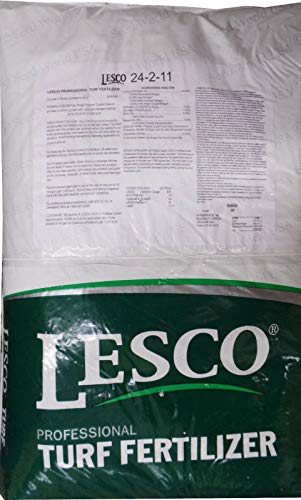
The SeedRanch/Lesco blend is one of the very few granular fertilizers marketed specifically for St. Augustine, and the NPK analysis — 24-2-11 with a remarkable 6% iron — makes it the strongest anti-chlorosis weapon on the list. If your St. Augustine is suffering from the classic yellow-green look on caliche or high-pH clay, this fertilizer will restore a dense, dark-green canopy faster than any balanced product. The 6% chelated iron is the highest concentration in this roundup, and it targets the exact micronutrient deficiency that plagues St. Augustine in alkaline soils.
The 50-pound bag covers 12,000 square feet, which is a slightly denser application rate than the Yard Mastery Flagship, meaning you get a heavier dose of nutrients per square foot. Owner reports from California and Texas confirm that St. Augustine responds with vigorous, dark green growth after application, even when applied just before heavy rain. The inclusion of 2% phosphorus is minor enough that it won’t upset a balanced soil, but it provides a small rooting boost for newly laid sod or plugs.
However, the nitrogen is likely partially quick-release, which may trigger a growth flush that demands more frequent mowing. The price per bag is high relative to general-purpose fertilizers, and it can be difficult to find in stock during peak season. Additionally, the lack of clear slow-release labeling means you should water it in immediately and avoid applying during extended heat waves above 90°F.
What works
- 6% iron content is the highest available for severe chlorosis correction
- Specifically formulated for St. Augustine’s nutrient demands
- Includes a small phosphorus boost for rooting new sod or plugs
What doesn’t
- Partially quick-release nitrogen may force a growth surge
- Premium price point and periodic stock shortages
3. Yard Mastery 7-0-20 Stress Blend Granular Fertilizer

The Yard Mastery Stress Blend flips the traditional high-N formula on its head with a 7-0-20 analysis that prioritizes potassium over nitrogen. This is the ideal fertilizer for St. Augustine during deep summer — when soil temperatures exceed 85°F — because potassium strengthens cell walls and improves the grass’s ability to manage heat and drought stress. The 20% potash combined with 3% iron makes this a targeted rescue product for St. Augustine lawns that are thinning out or showing signs of large patch fungus pressure.
The Bio-Nite additive is particularly useful here: it helps hold the modest nitrogen in the soil longer, so the grass gets steady access to the 7% nitrogen without triggering a growth flush. The 18-pound bag covers 6,000 square feet, which is a dense enough application to see results within two weeks. Florida users report that this product is a “must-have” for bringing lawns out of dormancy and maintaining color through winter months without forcing excessive blade growth that invites frost damage.
The biggest trade-off is that this is a seasonal specialty product — you would not use it as your primary spring fertilizer because the nitrogen content is too low to support the growth surge after winter dormancy. It works best as a second or third application in the warmest months when your lawn is already dense but needs stress protection. Also, the 6,000 sq ft bag size means larger lawns will need multiple bags.
What works
- 20% potash provides superior heat and drought stress protection for St. Augustine
- Bio-Nite technology holds modest nitrogen in the root zone longer
- 3% iron corrects yellowing without stimulating excessive top growth
What doesn’t
- Low nitrogen content makes it unsuitable as a primary spring fertilizer
- Small bag coverage requires multiple bags for larger properties
4. PetraMax Neighbor’s Envy Liquid Fertilizer
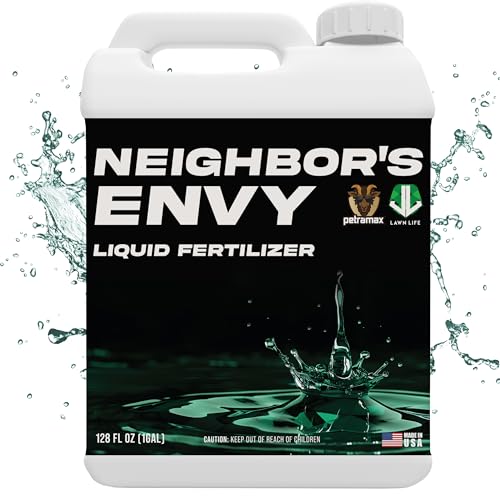
Neighbor’s Envy is a liquid formula that bundles seven actives — nitrogen, iron, humic acid, sea kelp, potassium, sulfur, and a wetting agent — into a single gallon that covers up to 16,000 square feet. For St. Augustine owners who prefer spraying over pushing a spreader, this product eliminates the need for multiple bottles of micronutrient supplements. The liquid form means the nutrients hit the leaf surface and root zone immediately, and owners report visible darkening within 1-3 days of application.
The 19% nitrogen and 2.5% iron provide a rapid green-up that is useful for correcting nitrogen deficiency symptoms quickly, while the humic acid and sea kelp work as biostimulants to improve root biomass and the grass’s response to heat stress. The sulfur content is a hidden benefit for St. Augustine on alkaline soils, as sulfur helps lower localized pH around the root zone, making iron more available. Owner reports from the South describe this product as creating the “darkest grass in the neighborhood” when used consistently.
The biggest limitation is that liquid fertilizers require more frequent reapplication — every 2-4 weeks — compared to granular slow-release products which last 30-45 days. For large lawns over 8,000 sq ft, the cost per season is noticeably higher than granular options. Over-application can cause leaf tip burn, and the darkening effect comes partly from cosmetic staining, so it is best used as a complement to a granular program rather than a standalone solution.
What works
- Visible greening in 1-3 days due to liquid delivery and iron content
- Convenient 7-in-1 blend eliminates need for separate humic, kelp, and sulfur products
- Sulfur component helps acidify root zone in high-pH soils for better iron uptake
What doesn’t
- Requires reapplication every 2-4 weeks; higher seasonal cost for large lawns
- Cosmetic staining contributes to “green” effect; not purely nutritional
5. Petra 28-0-0 Liquid Nitrogen Fertilizer

The Petra 28-0-0 is a pure liquid nitrogen supplement designed for rapid color correction and growth stimulation. Its unique 70/30 split — 70% quick-release ammonium for an immediate green-up within 48 hours and 30% slow-release polymer-coated urea for sustained feeding — makes it the most versatile nitrogen-only option for St. Augustine. Use it as a booster between granular applications, especially in early spring when the lawn is waking up and needs a surge of nitrogen to fill in bare patches.
A single gallon mixed at the maintenance rate (5 oz per gallon of water) covers 25,600 square feet, making the per-treatment cost extremely low for large lawns. For nitrogen-deficient St. Augustine showing overall yellowing, the curative rate (10 oz per gallon) still covers 12,800 square feet and delivers a measurable color shift within a week. Owner reviews report that skeptical first-time users become repeat buyers after seeing the contrast between treated and untreated sections of their lawn.
The limitation here is the absence of potassium, iron, and phosphorus. Using this as your sole St. Augustine fertilizer would eventually lead to potassium deficiency, weak root structure, and iron chlorosis. It is designed as a tool, not a complete program. Over-application with the quick-release fraction can burn leaf tips, especially in high heat, so it should be applied in the early morning and watered in lightly. Also, the 1-gallon bottle requires a sprayer — it is not a hose-end ready product unless you own a PetraTools sprayer.
What works
- Dual-release nitrogen provides both immediate green-up and sustained feeding
- Excellent coverage per gallon — up to 25,600 sq ft at maintenance rate
- Low per-treatment cost for a premium liquid product
What doesn’t
- Contains zero potassium or iron; must be used within a broader program
- Quick-release fraction can burn St. Augustine if applied during heat above 85°F
6. The Andersons Professional DGL 25-0-0 Fertilizer
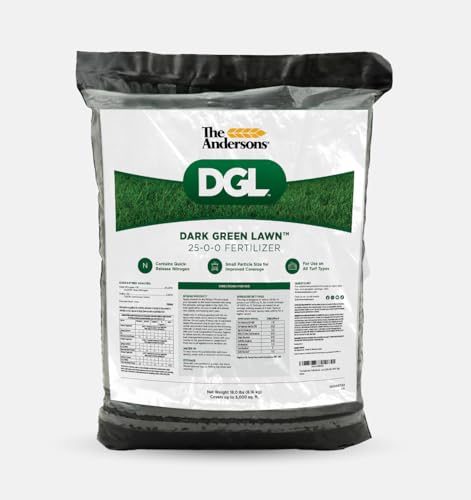
The Andersons DGL is a professional-grade, 100% quick-release nitrogen fertilizer designed for turf managers who need precise control over timing. The formulation is 25-0-0 with no iron and no slow-release coating, meaning it hits the grass immediately and delivers results in 3-4 days. For St. Augustine, this is a risky tool best reserved for early spring when soil temperatures are still below 70°F and the lawn needs a wake-up call after dormancy.
What makes this product unique is the particle engineering: the Dark Green Lawn (DGL) granules are extremely fine and uniform, which allows for exceptionally even distribution through a rotary spreader. The coverage is dialed in at 5,000 square feet per 18-pound bag — a dense rate that ensures every stolon gets a dose. Owner reports from the Mid-Atlantic confirm that a dormant lawn turned “vibrant dark green” within 8 days after application, which is remarkable speed for a granular fertilizer.
The same feature that makes it fast is also its danger for St. Augustine: pure quick-release nitrogen at 25-0-0 can cause rapid growth, increased thatch accumulation, and severe leaf burn if applied above 75°F. The absence of potassium leaves the grass vulnerable to heat stress during the growth surge. You should never use this in the summer on St. Augustine, and it will require frequent mowing (twice a week) during the active growth phase. Also, the fine particles can stain concrete if not swept immediately.
What works
- Visible greening in 3-4 days — fastest-acting granular option for early spring
- Extremely uniform particle size allows for professional-level spreader accuracy
- Ideal single product for dormant wake-up on St. Augustine in early spring
What doesn’t
- Pure quick-release nitrogen is dangerous on St. Augustine above 75°F
- No potassium or iron, making it unsuitable as a standalone or summer product
- Fine particles stain concrete and sidewalks on contact
7. Gardenwise 13-13-13 Slow Release Granular Fertilizer
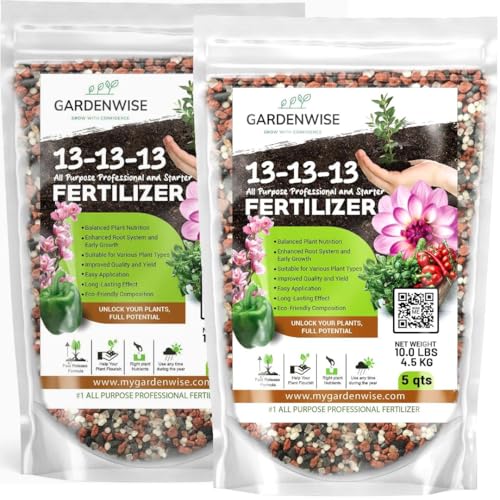
The Gardenwise 13-13-13 is a balanced, all-purpose slow-release granular that is the most affordable entry point in this guide. The equal 13-13-13 ratio makes it a generalist — it provides nitrogen for growth, phosphorus for rooting, and potassium for overall health — but it lacks the high nitrogen and iron content that St. Augustine truly craves. On established St. Augustine lawns in decent soil, this will maintain a baseline green without burning, thanks to the slow-release coating that feeds for up to 8 weeks.
The fine granule size ensures good soil contact, and owner reviews report that lawns, shrubs, and gardens all respond positively. For homeowners who are also feeding flower beds and vegetable patches with the same bag, this versatility saves money and storage space. The 10-quart bag (about 20 pounds) is enough for a small to medium lawn, and the slow-release mechanism means you only need to apply 3-4 times per growing season.
The major downside for St. Augustine is the phosphorus content. The 13% P is unnecessary for most established St. Augustine soils and can contribute to mycorrhizal suppression and nutrient runoff. Additionally, the total nitrogen at 13% is too low to deliver the dense, emerald-green appearance that St. Augustine owners expect. This is a budget backup option for a lawn that already looks decent — not a product for fixing a yellow, struggling St. Augustine lawn. It is also a risky choice on sandy Florida soils where phosphorus binds quickly and nitrogen leaches before the slow-release coating dissolves.
What works
- Slow-release coating provides consistent feeding for up to 8 weeks
- Versatile all-purpose formula feeds lawn, shrubs, and garden beds from one bag
- Budget-friendly entry price for small lawns and general maintenance
What doesn’t
- Phosphorus is unnecessary for most established St. Augustine and may harm soil biology
- 13% nitrogen is too low for deep greening or correcting chlorosis
- Not suitable for fixing nitrogen-deficient or stressed St. Augustine lawns
Hardware & Specs Guide
N-P-K Ratio Interpretation
The three numbers represent nitrogen (N), phosphorus (P), and potassium (K) by weight percentage. For St. Augustine, N should be the highest number but applied via slow-release sources. P (the middle number) should ideally be 0 unless a soil test reveals deficiency. High P contributes to runoff and can suppress beneficial mycorrhizae in the root zone. K (the last number) should be at least half of the N value for disease resistance; 20% K is ideal for peak summer heat.
Iron Content and Form
Iron is listed as a percentage on the guaranteed analysis. Chelated iron (EDTA or DTPA) stays available to the plant longer in high-pH soils than non-chelated forms. For St. Augustine, 2-6% iron is the therapeutic range. Iron does not stimulate leaf growth the way nitrogen does, so it corrects yellowing without increasing thatch. Look for “chelated iron” on the label if you have alkaline or caliche soil.
Nitrogen Release Technology
Quick-release (ammonium nitrate or urea) feeds immediately but forces rapid growth and can burn. Slow-release options include sulfur-coated urea (SCU), polymer-coated urea (PCU), and nitrogen stabilizers like Bio-Nite or Nutrisphere. For St. Augustine, at least 50% of the nitrogen should be slow-release to prevent soft, disease-prone growth. Labels will indicate “slow-release nitrogen” or list a percentage as “WIN” (water insoluble nitrogen).
Coverage Calculations
Coverage is listed on the bag (e.g., 5,000 sq ft, 15,000 sq ft). This tells you how many square feet one bag covers at the labeled N application rate. For St. Augustine, the standard application rate is 1 lb of actual nitrogen per 1,000 sq ft per feeding. To calculate actual N per 1,000 sq ft, divide the N percentage by 100, multiply by bag weight, then divide by coverage per 1,000 sq ft. Precision avoids over-fertilization and the disease pressure that follows.
FAQ
How often should I fertilize St. Augustine grass?
Why does my St. Augustine grass look yellow even after fertilizing?
Can I use a 13-13-13 fertilizer on St. Augustine grass?
What is the best time of day to apply liquid fertilizer to St. Augustine?
How do I prevent lawn fertilizer from burning my St. Augustine?
Final Thoughts: The Verdict
For most homeowners, the lawn fertilizer for st. augustine grass winner is the Yard Mastery 24-0-6 Flagship because it combines high slow-release nitrogen with 3% iron and covers 15,000 sq ft per bag — delivering deep green color without forcing growth that you have to mow twice a week. If you need a quick green-up intervention, grab the PetraMax Neighbor’s Envy liquid formula for its visible results in 1-3 days. And for peak summer stress protection, nothing beats the Yard Mastery 7-0-20 Stress Blend, which uses high potash to keep your St. Augustine alive through the toughest heat waves.