
Standing in a yard ankle-deep in wet autumn leaves with a dying battery or a tangled extension cord is the exact moment most homeowners realize they picked the wrong tool. The gap between a frustrating chore and a quick, satisfying cleanup comes down to matching the right airflow, battery platform, and weight to your actual property size and debris type.
I’m Rikta — the co-founder and writer behind Lawn Gear Lab. I’ve spent dozens of hours cross-referencing CFM ratings, motor RPMs, battery capacities, and real-world owner feedback to separate the yard blowers that deliver on their spec sheets from those that don’t.
Whether you need to clear a small driveway or manage a half-acre lot, this guide to the best yard blowers will help you find a model that matches your workload without wasting money on power you don’t need or a battery that dies mid-task.
How To Choose The Best Yard Blowers
Selecting the right blower isn’t about picking the highest number on the box. You need to match the machine to your debris type, yard size, and tolerance for noise and weight. Here are the three specs that matter most.
Airflow Volume (CFM) vs. Airspeed (MPH)
CFM (cubic feet per minute) measures how much air the blower moves. High CFM is what you need for sweeping large piles of loose leaves across a lawn. MPH (miles per hour) measures how fast that air exits the nozzle. High MPH is better for dislodging wet, caked-on leaves or blasting debris out of tight corners. For most general yard work, prioritize models with at least 400 CFM. If you regularly deal with wet leaves, look for 160+ MPH combined with that 400+ CFM.
Battery Voltage and Amp-Hour Capacity
Higher voltage (40V vs. 20V) generally signals more raw power potential, but the real runtime indicator is the amp-hour (Ah) rating on the battery. A 2.0Ah battery on high speed might last 8–12 minutes, while a 7.5Ah pack can run for 30–40 minutes at full throttle. Two smaller batteries in the kit let you swap and keep working, but if you have a large property, a single high-capacity pack or a 40V platform is the better long-term investment.
Weight and Ergonomics for Extended Use
A handheld blower weighing 5–6 pounds feels manageable for a 10-minute driveway cleanup. If you’re clearing a full acre or using the vacuum/mulch function with a collection bag, that weight can double. Models with a shoulder strap, padded grip, and trigger-lock cruise control reduce fatigue significantly. A corded blower eliminates battery weight but adds the restriction of a 100-foot extension cord, so consider your property layout before going that route.
Quick Comparison
On smaller screens, swipe sideways to see the full table.
| Model | Category | Best For | Key Spec | Amazon |
|---|---|---|---|---|
| Husqvarna 350iB | Cordless | Whole-property power | 800 CFM / 200 MPH | Amazon |
| Sihuird SL9501 | Cordless | Extended runtime | 765 CFM / 290 MPH | Amazon |
| WORX Trivac WG509 | Corded | Mulching & vacuuming | 350 CFM / 210 MPH | Amazon |
| Laapee BF868 | Cordless | Versatile speed control | 650 CFM / 180 MPH | Amazon |
| RYAHT DD8179 | Cordless | Quick patio cleanup | 3.4 lbs weight | Amazon |
| SUNCHERS RC3009 | Cordless | Budget twin-battery kit | 650 CFM / 280 MPH | Amazon |
| BLACK+DECKER LB700 | Corded | Lightweight corded work | 180 CFM / 180 MPH | Amazon |
In‑Depth Reviews
1. Husqvarna 350iB

The Husqvarna 350iB sits at the top of the handheld cordless class with an 800 CFM airflow and a 200 MPH top speed that matches or exceeds many gas-powered competitors. Its 40V brushless motor delivers that output with notably low noise levels — around 65 decibels — making it suitable for early-morning or neighborhood-sensitive cleanup. The 7.5Ah battery provides enough runtime for most residential lots on standard mode, though using the Power Boost mode for wet or heavy debris will drain the pack faster.
The cruise control feature locks in a consistent speed so you don’t have to hold the trigger continuously, reducing hand fatigue during longer sessions. The included debris scraper at the nozzle edge is a practical touch for loosening sticky, compacted leaves from pavement. At roughly 10 pounds with the battery, it’s heavier than budget cordless models, but the weight is well-balanced and the harness-style shoulder strap distributes the load effectively.
Owners consistently report that the 350iB replaces their gas blower entirely, citing the instant start and zero-emissions operation as major advantages. The 40V battery platform is shared across Husqvarna’s handheld tool line, so if you already own other Husqvarna tools, this blower integrates seamlessly. The primary drawback is the price of extra batteries — a second 7.5Ah pack is expensive, so plan your charging cycle between tasks.
What works
- Near gas-level power at 800 CFM / 200 MPH
- Very quiet for its output class
- Cruise control lock reduces trigger fatigue
What doesn’t
- High initial investment for the kit
- Extra batteries are expensive
2. Sihuird SL9501
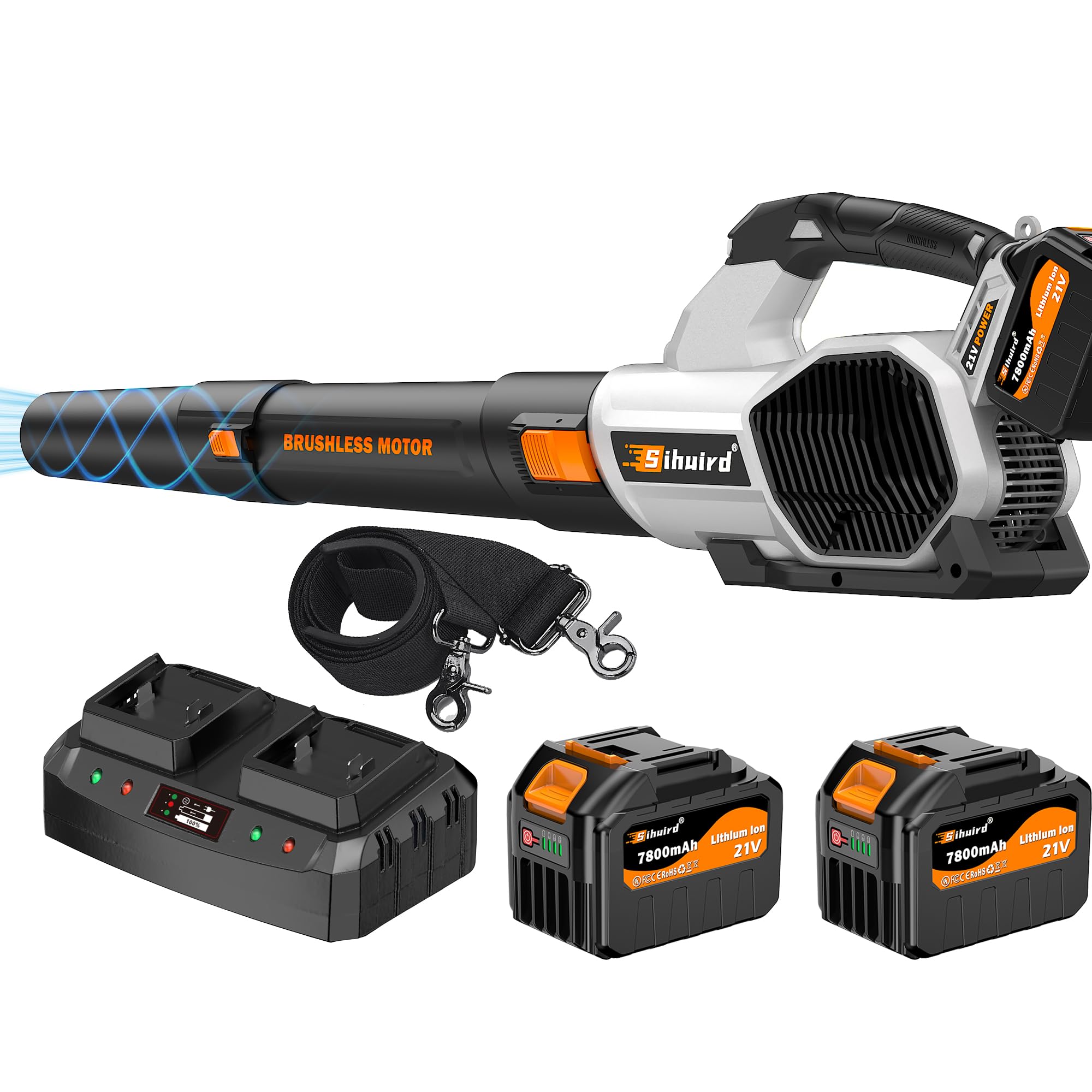
The Sihuird SL9501 tackles the biggest complaint about budget cordless blowers — insufficient runtime — by including two massive 7.8Ah batteries in the kit. On low speed, owners report combined runtimes approaching three hours, and even at maximum output with the Turbo mode engaged, the twin-pack system can sustain over 60 minutes of heavy blowing. The brushless motor and axial fan design push up to 765 CFM and 290 MPH, figures that rival premium models at a fraction of the price.
Three preset speed levels plus a momentary Turbo mode give you granular control: low for dusting off a workbench or car interior, medium for dry leaves on pavement, and high-plus-turbo for wet debris or compacted piles. The 15-second auto-lock on Turbo is a thoughtful feature that avoids holding the button while you blast a stubborn patch. An LED light on the nozzle makes twilight or garage-area cleanup practical, and the shoulder strap is well-padded for longer sessions.
The dual rapid charger fully replenishes both 7.8Ah packs in about 2.5 hours, which is fast given the capacity. A few owners note that the claimed 56-decibel noise level feels optimistic — it’s still quiet enough for suburban use but not silent. The 3-year tool warranty and 2-year battery warranty add confidence for a brand that is still building its reputation in this space.
What works
- Exceptional runtime with twin 7.8Ah packs
- Turbo mode with 15-second auto-lock
- Brushless motor delivers high CFM/MPH
What doesn’t
- Noise level slightly higher than advertised
- Batteries add weight to the handle
3. WORX Trivac WG509

The WORX Trivac WG509 stands apart from every other blower on this list because it vacuums and mulches leaves in addition to blowing them. The 12-amp corded motor produces 350 CFM and 210 MPH — modest figures for blowing alone, but the real value is the 18:1 mulching ratio that reduces 18 bags of leaves into one. The metal impeller inside the vacuum housing can handle twigs and dry leaves without cracking, though wet piles will clog the system quickly.
Switching between blower, vacuum, and mulcher requires a tool-free tube rotation and bag attachment, which owners find intuitive after a few uses. The collection bag has a quick-release zipper at the bottom for dumping directly into a compost bin or yard waste bag. On the downside, the fully assembled unit weighs 9.3 pounds, and with the bag filling up, the overall load becomes significant — the shoulder strap is essential for any job exceeding 20 minutes.
Noise is a factor here; the 12-amp motor is loud enough that hearing protection is strongly recommended. The blowing-only performance is adequate for hard surfaces but not powerful enough to move heavy wet leaves across a lawn — you’ll use this primarily as a vacuum. For homeowners who want to reduce leaf volume for composting or curbside collection, the Trivac is a dedicated niche tool that outperforms general-purpose blowers.
What works
- 18:1 mulching ratio dramatically reduces bag count
- Tool-free switching between blow/vac/mulch
- Metal impeller resists damage from twigs
What doesn’t
- Heavy and loud during vacuum operation
- Blower performance alone is underwhelming
4. Laapee BF868
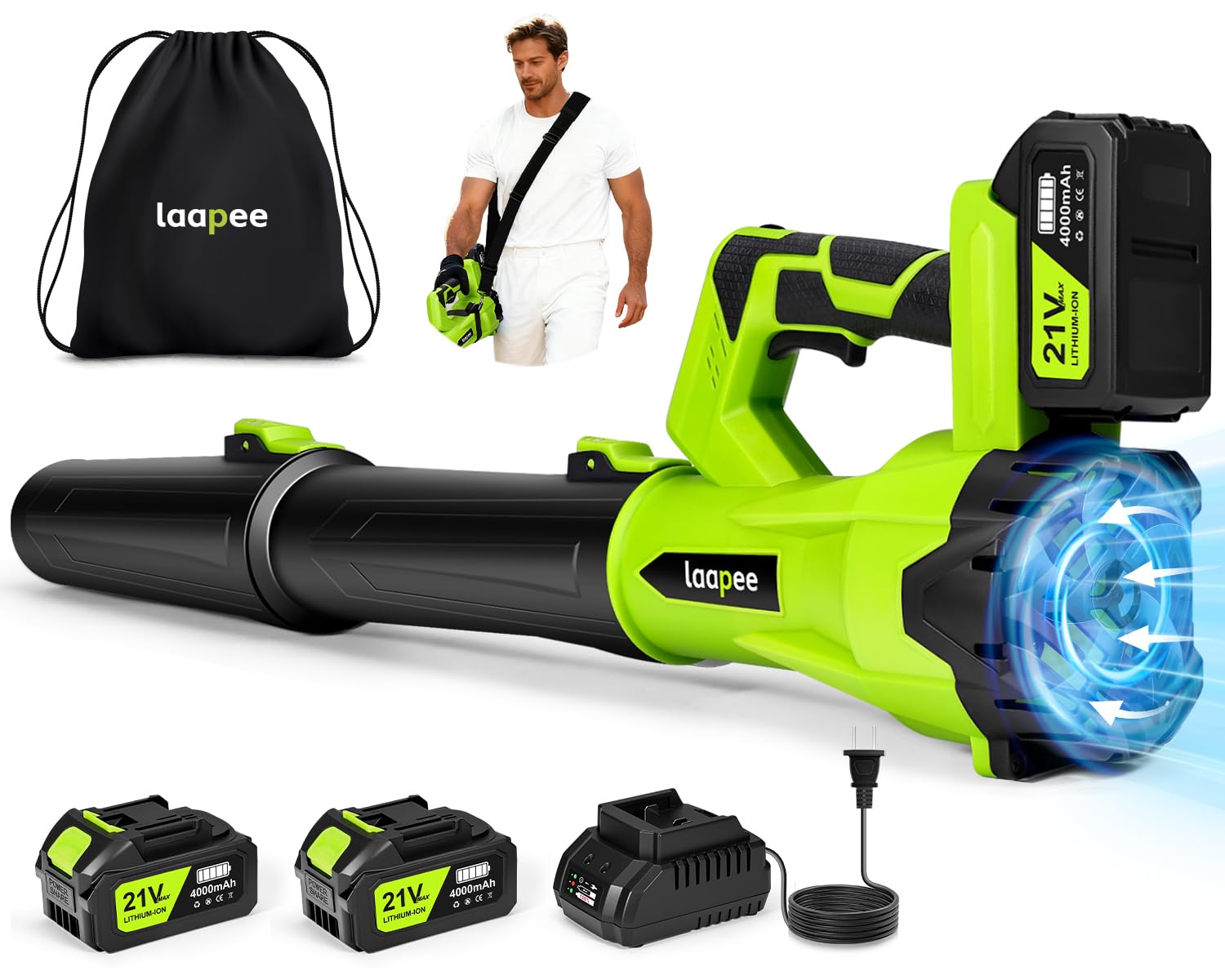
The Laapee BF868 distinguishes itself with a six-speed adjustable motor that lets you dial in exactly the airflow you need — from 80 MPH for dusting off a patio table up to 180 MPH for clearing a wet pile of leaves. The brushless motor produces up to 650 CFM, placing it in the upper tier of mid-range cordless blowers. The twin 4.0Ah batteries provide enough runtime for a typical suburban yard, though running at speed 6 cuts that to about 7–10 minutes per pack.
The included shoulder strap and dual-nozzle system (a standard tube plus an extended nozzle) improve reach and reduce arm fatigue during longer jobs. The fast charger replenishes each 4.0Ah battery in about an hour, so you can cycle through the two packs without significant downtime. Assembly is straightforward — attach the tube, insert a battery, and pull the trigger — making this a good option for someone buying their first cordless blower.
Owner feedback highlights the strong value proposition: you get brushless power, a high CFM rating, and two decent-capacity batteries at a mid-range price point. The primary compromise is build quality — the plastic housing feels less rugged than premium brands, and the battery latch is somewhat tight when removing packs. For light to medium yard work on properties up to a quarter acre, this kit delivers everything you need without overspending.
What works
- Six speed settings cover dust to wet leaves
- Brushless motor with 650 CFM output
- Fast 1-hour charger included
What doesn’t
- Battery latch can be stiff to operate
- Housing feels less premium than top brands
5. RYAHT DD8179
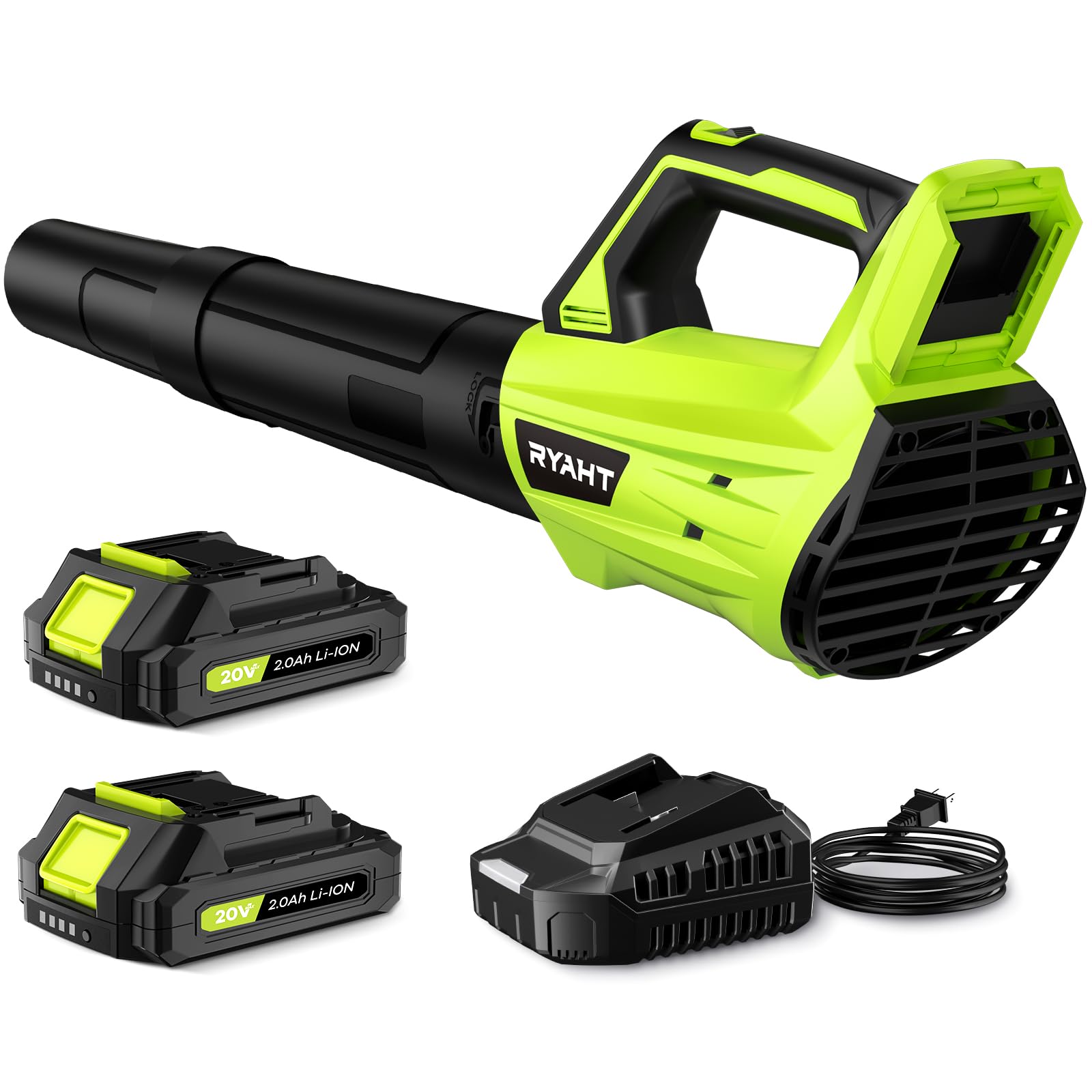
At just 3.4 pounds, the RYAHT DD8179 is the lightest model in this guide, making it ideal for users who need a blower for quick, frequent tasks rather than marathon leaf-clearing sessions. The 20V brushless motor offers two speed settings: low for dust and dry debris on hard surfaces, high for loose leaves and grass clippings. The two included 2.0Ah batteries provide roughly 20–30 minutes of combined runtime at high speed, which is sufficient for a typical driveway, patio, or small lawn.
The dual-tube design with an extension nozzle gives you flexibility for tight spaces under furniture or between bushes. The rubber-coated non-slip handle is comfortable for smaller hands and supports one-handed operation without fatigue. Assembly is tool-free — attach the desired nozzle, slide in a charged battery, and you’re running within 30 seconds. The compact size also means it stores easily in a garage cabinet or on a wall hook.
Customer reviews consistently praise the lightweight portability and cordless convenience for pool decks, balconies, and car drying. The trade-off is that the 20V platform produces less raw power than 40V or 60V systems — you won’t move heavy wet leaves or deep pine straw effectively. If your property requires serious blowing force, this model will frustrate you. For targeted cleanup and users who prioritize handling ease over maximum power, it’s a solid choice.
What works
- Extremely lightweight at 3.4 lbs
- Easy one-hand operation
- Compact storage footprint
What doesn’t
- Limited power for wet or heavy debris
- 2.0Ah batteries drain fast on high speed
6. SUNCHERS RC3009

The SUNCHERS RC3009 delivers a compelling spec-on-paper proposition for its price tier: a claimed 650 CFM and 280 MPH from an 18,000 RPM motor, plus two 3.0Ah batteries and a charger. The dual-speed switch lets you toggle between a low setting for fine dust and a high setting for loose leaves. The lightweight 5.5-pound build and rubber-coated handle make it easy to maneuver for most users.
Real-world owner feedback, however, reveals a gap between the advertised numbers and actual performance. Multiple verified buyers report that the effective wind speed is closer to 100–120 MPH rather than the stated 280 MPH, and the “dual hose” is simply a two-piece tube rather than two different nozzle shapes. The unit handles dry leaves on pavement well but struggles with wet debris, pine needles, or compacted piles — making it best suited as a light-duty maintenance tool.
The twin 3.0Ah batteries provide decent runtime — owners report 30+ minutes combined on high speed — and the fast charger replenishes them reasonably quickly. Customer service responsiveness is a positive, with several reviews noting prompt replacement when units failed. If you keep expectations within the “light to medium dry cleanup” zone, the RC3009 offers good value, but it does not replace a higher-end gas or premium cordless blower for heavy work.
What works
- Aggressive price for a twin-battery kit
- Lightweight and easy to maneuver
- Responsive customer service
What doesn’t
- Real-world airflow much lower than advertised
- Ineffective on wet leaves and pine needles
7. BLACK+DECKER LB700

The BLACK+DECKER LB700 is a straightforward, no-battery-required corded blower that appeals to homeowners who want to avoid battery degradation and charging downtime. The 7-amp motor outputs 180 CFM and 180 MPH — modest numbers that translate to reliable performance on dry leaves, grass clippings, and dust on hard surfaces. At 4.4 pounds, it’s light enough for one-handed operation without fatigue, and the built-in cord retention bracket prevents accidental unplugging during use.
Unlike most cordless models, the LB700 offers a single speed — pull the trigger and it runs at full power until you release it or unplug the extension cord. This simplicity is a strength for users who just want to blow a driveway without fiddling with speed settings or battery levels. The blow tube locks in place with a simple twist, and the compact body stores easily in a small space. Note that the unit does not include an extension cord, so factor that into your total cost if you don’t already own a suitable outdoor-rated 14-gauge cord.
Owner reviews highlight the surprising power-to-weight ratio, with many stating it easily handles wet leaves and heavy debris that they expected would require a more expensive unit. The only consistent complaint is the limited reach of a corded tool — you’re tethered to an outlet, making it impractical for large yards far from power sources. For properties under a quarter acre with accessible outlets, the LB700 is a durable, low-maintenance workhorse that outperforms its entry-level price tag.
What works
- Very lightweight for corded power
- No battery charging or degradation
- Consistent full-power output
What doesn’t
- Requires outdoor extension cord (not included)
- Limited by cord length and outlet availability
Hardware & Specs Guide
Air Flow (CFM) vs. Air Speed (MPH)
CFM measures volume — how much air gets moved per minute. High CFM clears wide areas fast. MPH measures velocity — how hard that air hits the debris. High MPH dislodges stuck or wet material. A good yard blower balances both. For dry leaves on open lawn, prioritize 400+ CFM. For wet leaves or compacted debris, look for 160+ MPH combined with that CFM. Models above 600 CFM with 180+ MPH are the sweet spot for most residential work.
Battery Voltage and Amp-Hours (Ah)
Voltage (20V, 40V, 60V) drives motor power potential. Higher voltage generally produces higher CFM/MPH, but the battery’s Ah rating determines how long that power lasts. A 2.0Ah pack on high speed might run 8–12 minutes; a 7.5Ah pack can exceed 30 minutes. Twin-battery kits with smaller packs let you swap and extend runtime, but high-capacity single packs offer uninterrupted work. Check whether the battery platform is shared with other tools in the brand’s lineup before committing.
Brushless vs. Brushed Motors
Brushless motors use electronic controllers instead of physical brushes to transfer power, resulting in less friction, more efficient energy use, and longer motor life. Most premium and mid-range cordless blowers now use brushless motors. Brushed motors are older technology — they’re cheaper but produce more heat, consume battery faster, and wear out sooner. For any cordless blower you plan to keep for more than a season, a brushless motor is worth the price premium.
Weight and Ergonomics
Handheld blowers range from 3.4 pounds (ultra-light 20V models) to over 10 pounds (corded vacuum combos with full bags). Weight distribution matters as much as total weight — a well-balanced 9-pound blower with a shoulder strap can feel less fatiguing than an unbalanced 6-pound blower. Cruise control or trigger-lock features let you maintain speed without constant finger pressure. For extended use, prioritize models under 8 pounds or those with a quality harness system.
FAQ
Is a higher CFM or higher MPH more important for moving wet leaves?
How long should a cordless leaf blower battery last on a single charge?
What gauge extension cord do I need for a corded electric blower?
Can I use a leaf blower to clear light snow from a driveway or walkway?
Final Thoughts: The Verdict
For most homeowners who want gas-level power without the noise and maintenance, the best yard blowers winner is the Husqvarna 350iB because its 800 CFM output and quiet brushless motor handle everything from dry leaves to wet debris on properties up to an acre. If you prioritize maximum runtime without spending Husqvarna money, grab the Sihuird SL9501 for its twin 7.8Ah batteries and Turbo mode. And for those who need a leaf vacuum and mulcher as much as a blower, nothing beats the WORX Trivac WG509 for reducing your bag count by an order of magnitude.